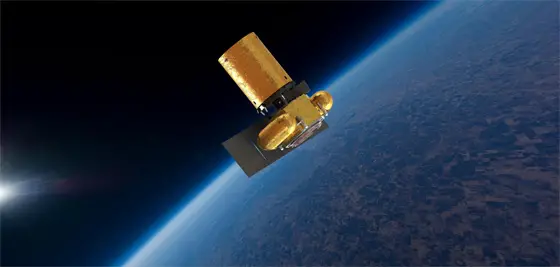
Planetary Resources Inc. announces agreement with Virgin Galactic for payload services 12th July 2012 Planetary Resources - the world's first asteroid mining company - has announced an agreement with Virgin Galactic, enabling multiple launch opportunities for its spacecraft, including the Arkyd-100 low-Earth orbit (LEO) space telescopes. Continuous, low-cost launch services for spacecraft to LEO will help in accelerating Planetary Resources' vision to extract valuable resources from Near-Earth Asteroids (NEAs), ranging from water to precious metals. "While the Arkyd spacecraft line itself radically reduces the traditional cost of exploring the NEAs, the less expensive the cost to launch an Arkyd spacecraft to LEO, the more spacecraft the company will launch. The more spacecraft that the company launches, the faster it will create a future where access to asteroid resources results in a vast network of propellant depots throughout space and a future where once precious and rare materials are abundant for all. This will enable humanity’s prosperity to continue for centuries to come," said Eric Anderson, Co-Founder & Co-Chairman of Planetary Resources, Inc. Of the nearly 10,000 known NEAs, more than 1,500 are energetically as easy to reach as the Moon. In the next few years, constellations of Arkyd-100 Series space telescopes (pictured below) will help fulfill the company's early objective of identifying the most energetically-optimal and resource-valuable NEAs. These will be added to the detailed list of the company’s prospecting targets and pursued for potential resource extraction.
"We are excited to announce this agreement with Virgin Galactic. LauncherOne has the potential to provide reliable and continuous launch service capability for small payloads. I expect Planetary Resources will launch several constellations of Arkyd-100 Series spacecraft in the coming years aboard LauncherOne," said Mr. Anderson. George Whitesides, President and CEO of Virgin Galactic, said: "We are developing the LauncherOne to deliver small satellites to LEO in a reliable fashion, with the capability to fly dozens of times per year. LauncherOne leverages our work in the area of commercial human spaceflight, and will provide reliable, regular launch opportunities to enable Planetary Resources to explore and develop valuable resources from asteroids." Chris Lewicki, Chief Engineer of Planetary Resources, noted that "As Planetary Resources works to expand humanity’s resource base, we also plan to increase scientific and commercial access to the Earth and deep space by developing capable and cost-efficient spacecraft. Interest in using our Arkyd-100 Series for commercial purposes – in addition to finding asteroids – has been very strong."
Comments »
|