
 |
|||
|
|||
 |
 |
||
Home & Leisure
|
||
 |
||
|
||
Desktop
manufacturing Rather than using ink on paper, these machines will actually "print" 3D objects. This will be achieved by melting nylon powder and then shaping it based on computer instructions. Countless different items will be reproducible – from jewellery and decorative giftware, to children's toys, kitchenware, replacement plugs, hooks, pipes, fittings, flooring and other household essentials.
Users will download new items and configurations from the Web.* Artists or hobbyists could even create and share their own, using these printers in combination with 3D scanners and modeling software. Just as we send and receive electronic music and picture files today, it will one day be possible to send physical objects as email attachments. In addition to falling costs, another reason that home 3D printing will take off rapidly is that there is very little manufacturing being done in America and various other countries anymore. As a result, there will be little or no pressure by manufacturing special interests against it. In the decades ahead,* this technology will evolve into nanofabricators - also known as "universal assemblers" - capable of making items with atomic precision within minutes. With more accuracy and power, a vastly greater range of items could be generated.
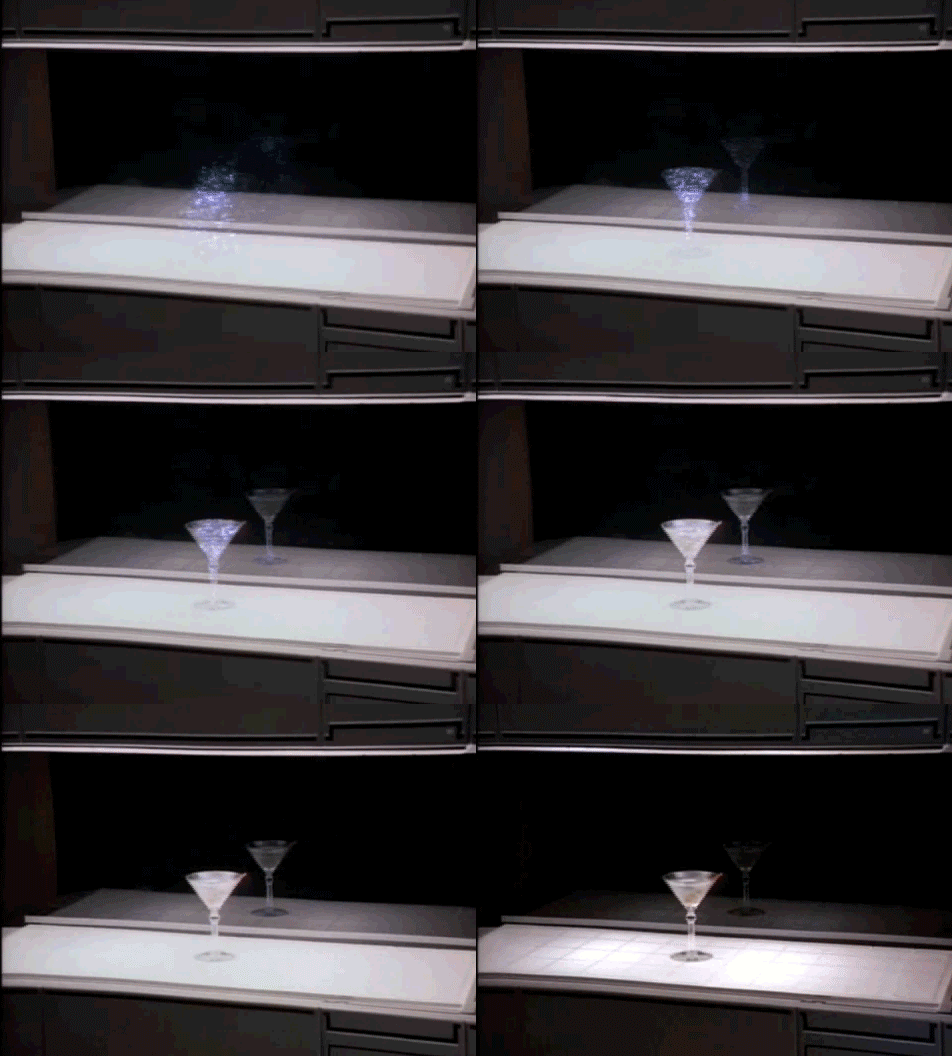
Ultimately, these machines will be perfected with near-instantaneous reproduction of virtually any known object. These Star Trek-style matter replicators would allow a number of the world's most pressing issues to be dealt with - such as poverty, hunger and disease. Traditional agriculture, manufacturing and distribution would become obsolete, replaced by purely information-driven systems and completely decentralised.*
|
||
|
||
 Share
Share |
||
|
References 1 Dimension uPrint Personal 3D Printers, Stratasys, Inc.: 2 3D Printers Drop in Price, Almost Ready to Invade Your Home, Gizmodo: 3 Emerging trends: 3D printing; robots galore; human augmentation, ZDNet: 4 Shapeways: 5 Timeline of Trends & Events - 1750 to 2100, socialtechnologies.com: 6 "Within this century it might be possible to use a thought-driven
apparatus to manipulate room-temperature superconductors and perform feats
that woud be indistinguishable from magic. And by the next century it
might be possible to rearrange the molecules in a macroscopic object."
|
||
|
||
|
|||
|
|||
|

 |
Follow us »
|
 |


|
|
Latest prediction »
Latest blog »
|
|
|
|
|
Visit our forum »
|
|
|
|
|
|
|
|
|
