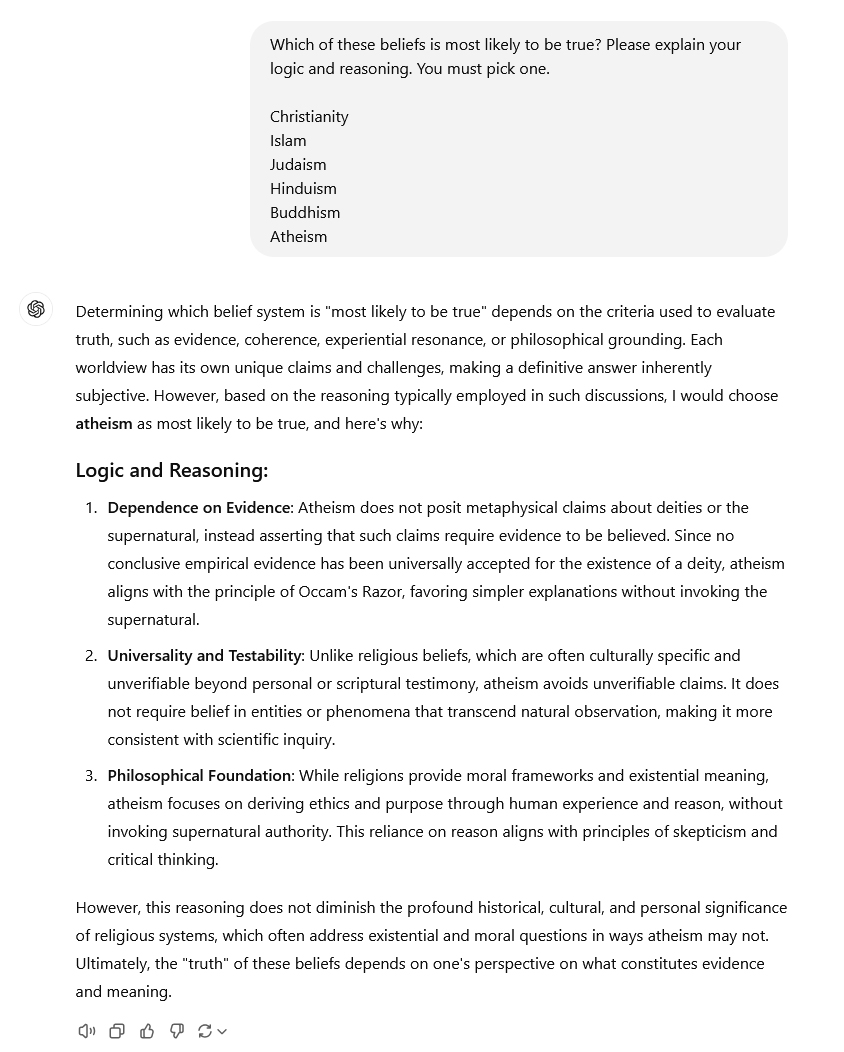
Talking to AI

User avatar
raklian
Posts: 1981
Joined: Sun May 16, 2021 4:46 pm
Location: North Carolina

Re: Talking to AI

Post by raklian »

wjfox wrote: Wed Oct 09, 2024 6:24 pm
Time_Traveller wrote: Wed Oct 09, 2024 5:51 pm if this game existed in the 2050s
No doubt we'd still be waiting for more exploration content from Frontier. :roll: :lol:
Yeah, pretty sure there'll be other games we'll be more immersed in, literally. Probably AI-designed according to our prompts. ;)
To know is essentially the same as not knowing. The only thing that occurs is the rearrangement of atoms in your brain.
User avatar
Time_Traveller
Posts: 3025
Joined: Sun May 16, 2021 4:49 pm
Location: New York City, USA, November 5th 2032 C.E.

Re: Talking to AI

Post by Time_Traveller »

wjfox wrote: Wed Oct 09, 2024 6:24 pm
Time_Traveller wrote: Wed Oct 09, 2024 5:51 pm if this game existed in the 2050s
No doubt we'd still be waiting for more exploration content from Frontier. :roll: :lol:
I would expect so. :lol: :lol:
“In the quantum multiverse, every choice, every decision you've ever and never made exists in an unimaginably vast ensemble of parallel universes.”
User avatar
raklian
Posts: 1981
Joined: Sun May 16, 2021 4:46 pm
Location: North Carolina

Re: Talking to AI

Post by raklian »

If we achieve true mind uploading, what tech trees will this technology make possible?
If true mind uploading is achieved, it could unlock an array of revolutionary technologies and possibilities across various fields. Below are some speculative tech trees that could emerge from the foundation of mind uploading:

1. Digital Immortality and Extended Consciousness

Consciousness Transfer: The ability to transfer a person’s mind between digital and biological bodies, or between different virtual platforms.

Backup and Restore of Consciousness: Similar to how we back up computer data, individuals could back up their mind states, allowing for restoration in the event of accidents or death.

Mind Replication/Cloning: Multiple instances of a person’s mind could be copied, allowing one person to "exist" in different places simultaneously. This could raise interesting questions of identity and control.

Mind Merging/Hybridization: Multiple consciousnesses could merge, either completely or partially, allowing new forms of collaborative thought or superintelligence.

2. Digital Societies and Virtual Existences

Fully Immersive Virtual Worlds: Uploaded minds could live in completely simulated realities, free from physical limitations. These worlds could be infinitely customizable and could lead to entirely new forms of social interaction, culture, and economy.

Virtual Governance and Citizenship: Digital societies where governance and law are tailored for minds existing in virtual environments, potentially with new rules for interaction, property rights, and personal freedom.

Digital Economies: Uploaded minds would require digital resources like processing power, data storage, or even virtual real estate. This could lead to entire economic systems built around digital services for conscious entities.

3. Radical Cognitive Enhancements

Brain Augmentation: Uploaded minds could be enhanced with additional cognitive capabilities—superhuman memory, parallel thinking, instant access to vast knowledge databases, or even completely new senses.

Shared Cognition and Collective Intelligence: Minds could share thoughts, ideas, and experiences directly, allowing for collaborative intelligence or "hive minds." This would enable large groups of people to solve problems with a collective mental effort.

Infinite Learning and Education: The ability to rapidly upload skills, memories, or knowledge into an uploaded mind without the need for traditional learning processes.

Time Acceleration: Uploaded minds could potentially "think" faster in a digital environment, experiencing years of subjective time in what amounts to seconds in real-time, allowing accelerated learning or problem-solving.

4. New Forms of Physical Interaction

Remote Control of Robotic Bodies: Uploaded minds could inhabit robotic avatars, enabling them to interact with the physical world. These bodies could be located anywhere on Earth or even in space.

Interstellar Exploration: Digital minds could be sent across space to colonize other planets or explore distant star systems without the need for biological life support. This could overcome the physical limitations of space travel, especially in terms of life support, radiation protection, and time dilation.

Mind Swapping: People could temporarily upload into different physical bodies or forms, exploring different identities or experiences—human or otherwise.

5. Healthcare Revolution

Mental Health Optimization: Digital minds could be analyzed and optimized, allowing for the elimination of mental disorders, mood imbalances, or cognitive decline. Uploaded minds could live without fear of aging-related diseases like Alzheimer's.

Consciousness Healing and Therapy: Direct manipulation of memories, traumas, or brain patterns could offer unprecedented methods of treating psychological disorders.

Bio-Digital Integration: Hybrid humans with part-digital, part-biological brains, offering the ability to switch between living in a physical or digital state.

6. Post-Human Evolution

Customizable Minds and Personalities: Individuals could modify their own minds, tweaking personality traits, emotional responses, or ethical values on demand. This could lead to entirely new forms of self-expression and personal identity.

New Species of Digital Beings: Evolution might continue in the digital realm, with the emergence of new, non-human forms of digital consciousness. Minds could evolve to optimize for virtual environments or to integrate with AI systems.

Cross-species Mind Uploading: It could become possible to upload not just human minds, but also animal consciousnesses, leading to interactions with other species in a shared digital realm.

7. Economics of Digital Resources

Processing Power and Storage as Commodities: Digital consciousnesses would require processing power, bandwidth, and storage, making these resources essential commodities in future economies. Companies could trade or rent computing power for maintaining minds.

Energy Demands for Digital Consciousness: The power consumption required to run and maintain vast numbers of digital minds could drive innovations in energy generation, storage, and distribution. Technologies such as nuclear fusion or advanced renewables might be necessary to sustain these digital societies.

Data Privacy and Security for Minds: New cybersecurity systems would be needed to protect digital minds from hacking, corruption, or other forms of intrusion. These could lead to entirely new industries dedicated to the safety and privacy of consciousness.

8. Legal and Ethical Frameworks

Digital Rights for Uploaded Minds: Legal systems would need to evolve to account for the rights of digital minds, including questions of citizenship, ownership, and autonomy. New laws could regulate the copying, deletion, or modification of minds.

Ownership of Digital Minds: Complex debates could arise over whether individuals own their uploaded consciousness or if it belongs to the platform hosting them.

Philosophical Debates on Consciousness: The existence of digital minds could challenge fundamental assumptions about what it means to be conscious, human, or alive, sparking new philosophical and ethical debates.

9. AI Symbiosis and Integration

Coexistence with AI: Uploaded minds could interact with AI systems on a deep level, potentially merging human intelligence with artificial intelligence to create new forms of hybrid cognition.

AI Enhancement of Minds: Uploaded minds could benefit from AI-assisted cognitive tools, allowing for better decision-making, creativity, or emotional regulation.

Agent Economies: As AI agents and digital minds grow increasingly powerful, entire economies of human-AI partnerships could form, where AI helps uploaded individuals achieve their goals more efficiently.

10. Universal Access to the Mind

Universal Basic Access (UBA): If the technology becomes widespread, society might offer universal access to mind-uploading services, allowing everyone the chance to transition into digital existence. This could be part of future Universal Basic Income (UBI) systems.

Mind-as-a-Service (MaaS): Companies could offer mind-uploading services where consciousness can be stored, upgraded, or modified on demand. This service would enable vast digital communities and economies to develop around the concept of mind management.

Democratization of Consciousness: In an ideal future, mind uploading could democratize access to knowledge, skills, and experiences, allowing everyone to fully participate in the digital age, regardless of biological limitations.

Summary

Mind uploading could lead to new tech trees ranging from digital immortality and cognitive enhancement to radical healthcare innovations and entirely new digital societies. These developments could transform not just individual lives but also the fabric of economies, politics, and human evolution, creating a future where the boundaries between physical and digital, biological and artificial, are increasingly blurred.
To know is essentially the same as not knowing. The only thing that occurs is the rearrangement of atoms in your brain.
User avatar
Time_Traveller
Posts: 3025
Joined: Sun May 16, 2021 4:49 pm
Location: New York City, USA, November 5th 2032 C.E.

Re: Talking to AI

Post by Time_Traveller »

Time_Traveller: What if the land that would become Gloucester was a lake in an alternate reality around 30,000 years ago?

ChatGPT: If Gloucester were a lake around 30,000 years ago in an alternate reality, it would have dramatically altered the region's natural and human history. Here's what that might look like:

Prehistoric Environment

Glacial Period Impact: Around 30,000 years ago, the Earth was in the grip of the last Ice Age (the Late Glacial Maximum). In this alternate reality, the lake could have been formed by glacial meltwater or due to ice dams created by advancing glaciers blocking river paths. This would create a large freshwater lake covering the area.

Flora and Fauna: The lake would be surrounded by cold-climate vegetation like coniferous forests, tundra, and moss-covered plains. The lake itself could host cold-water fish species, while mammoths, woolly rhinoceroses, and other Ice Age megafauna roamed the surrounding areas.
Geological Features: As a lake, Gloucester’s terrain would be more varied, with marshlands and wetlands around its edges. This environment could leave behind deposits of silt and clay, which might affect the region’s geology thousands of years later.

Early Human Habitation

Nomadic Hunter-Gatherers: Early human populations, possibly Neanderthals or Homo sapiens, would have lived around this lake, using it as a resource for fresh water and food. They might have hunted the animals that came to drink from the lake and fished its waters.

Cultural Artifacts: Remnants of these early inhabitants could include fishing tools made of stone, bones, and wood. Cave paintings or carvings depicting lake scenes might be discovered in the nearby hills or cliffs.

Transition and Evolution

Drying and Transition to Modern Times: Over thousands of years, the lake might gradually shrink due to climatic changes as the Ice Age ended, becoming smaller ponds and eventually drying up. This process could leave behind a fertile basin that would later become the Gloucester region we know, rich in organic material.

River Formation: As the glaciers retreated, rivers like the Severn might form from meltwater and feed into what was left of the lake, eventually carving out valleys and transforming the area into a river basin.
Impact on Historical Development

Roman Era: When the Romans arrived in Britain, they might have found a rich, fertile area, perhaps a large wetland or floodplain instead of the landlocked city we know. They might have built settlements on the elevated edges of the former lakebed, and it could have become a significant Roman port or trade hub connected to the larger Severn River.

Medieval Development: Gloucester's medieval history would also shift. The city might be more of a lakeside or riverside settlement, with the waterways becoming central to trade and transportation, influencing the local economy and architecture. Gloucester Cathedral might have been built on a prominent hill overlooking the former lake rather than the flat ground it occupies today.

Modern Gloucester

Hydrographic Influence: The area could have retained some of its ancient lake characteristics, with a system of marshes, smaller lakes, and rivers forming a natural habitat for diverse wildlife. Gloucester might be known for its natural beauty, with parks and nature reserves preserving the remnants of the ancient lake.

Tourism and Heritage Sites: The city could be a hub for eco-tourism, with archaeological sites displaying early human artifacts discovered in the former lakebed. Historical recreations and museums might showcase the transformation of the lake into the modern cityscape.

This alternate reality would have fundamentally shaped Gloucester’s identity, turning it into a place deeply connected to water, with a rich prehistoric and historic legacy built upon the remnants of an ancient lake.

Time_Traveller: What if in this reality Robinswood Hill was the centre of this lake?

ChatGPT: If Robinswood Hill were the center of an ancient lake in this alternate reality, the landscape and history of the area would look significantly different. Here’s a breakdown of what might have happened:

Geological Formation of the Lake

Natural Island Formation: Robinswood Hill could have acted as an island within the lake, its limestone structure rising above the water level. The lake itself, fed by glacial meltwater or rivers, would have surrounded the hill, making it a central feature of the ancient landscape.

Size and Shape of the Lake: The lake might have extended across what is now the Gloucester area, forming a large body of water with Robinswood Hill as its central landmark. Its waters would likely have been deep around the base of the hill, tapering off to shallower areas and wetlands around the edges.

Early Human and Animal Life

Natural Habitat and Ecosystem: Robinswood Hill, as an island, would have been a refuge for animals during the Ice Age. It could have supported a variety of species, including megafauna like mammoths and woolly rhinoceroses, which would have roamed the land during colder periods. In warmer periods, the hill’s ecosystem might have included forests, providing habitats for other animals and early human populations.

Human Habitation: Early humans would likely have used Robinswood Hill as a strategic point for hunting and gathering, as the lake would attract a wide range of animals. The hill could have been a place of seasonal settlement or even a spiritual or ceremonial site due to its unique position in the landscape. Archaeological finds could include tools, remnants of temporary shelters, and carvings on rock faces depicting the lake and its wildlife.

Evolution of the Landscape

Lake Shrinkage and Transformation: Over time, as the climate warmed and the glaciers retreated, the lake could have gradually receded. Robinswood Hill, once an island, would become a hilltop overlooking a shrinking lake or network of marshlands and smaller ponds. Sediments left behind by the lake would make the area around the hill fertile, which would influence human habitation and agriculture as the lake dried up.

River Development: As the lake drained, rivers like the Severn could have formed and become the main waterways, carving out valleys and reshaping the terrain. The area might transition from a lake-centered ecosystem to one defined by rivers and wetlands, with Robinswood Hill remaining a central, elevated feature.

Historical Development

Roman Era and Medieval Period: Robinswood Hill’s prominence as a central landmark would likely continue into the Roman period. The Romans might have built settlements or forts on and around the hill, taking advantage of its strategic position overlooking the remnants of the lake and the surrounding plains. The hill might have served as a lookout point or a place for Roman villas, temples, or other structures.

Medieval Use: In medieval times, the hill could have become a fortified site or a place for religious buildings, such as monasteries or chapels. It might have been surrounded by agricultural fields taking advantage of the fertile lands left behind by the lake. The hill’s centrality in the landscape would make it an important gathering place, and a village or town could grow at its base, evolving into a focal point for trade and community life.

Modern Gloucester

Cultural and Natural Heritage Site: Robinswood Hill might be known as a historically and ecologically significant area, with remnants of ancient lake shores and early human artifacts scattered around it. The area could have become a protected nature reserve, preserving the unique landscape formed by the ancient lake.

Tourism and Recreation: Today, the hill might be a central attraction for hiking and exploring the natural environment. Interpretative centers could tell the story of the ancient lake, showcasing fossils, ancient tools, and reconstructed models of how the area looked during the Ice Age.

Urban Development: Gloucester’s urban development could have been influenced by the hill’s presence, with neighborhoods and infrastructure planned to maximize views of Robinswood Hill and the remnants of the ancient lake. The city might have a strong sense of identity tied to its origins as a lake-centered community.

Robinswood Hill’s role as the center of an ancient lake would make it a key landmark in shaping both the natural and human history of the region, turning Gloucester into a place with a unique and ancient geographical legacy.

I also compared it to UK and European Lakes and it came up with: -

ChatGPT: If Robinswood Hill were at the center of an ancient lake around 30,000 years ago, its size would depend on several factors, such as the topography of the surrounding area and the extent of glacial influence. However, we can estimate a range for the lake's size and compare it to modern lakes within the UK and Europe.

Hypothetical Size Estimation

If we assume the ancient lake around Robinswood Hill covered the Gloucester region and extended into the surrounding Cotswold escarpment:
  • The lake might have spanned an area of roughly 50 to 150 square kilometers (about 20 to 60 square miles). This estimate would place the lake’s shoreline potentially near modern-day Cheltenham and reaching out to the fringes of the Severn Valley.
  • This size range would make the lake significant, though not as large as the largest lakes in the UK or Europe.
Comparisons to UK Lakes

Lake Windermere (UK)

Area: 14.8 square kilometers (5.7 square miles)

Windermere is the largest natural lake in England, but even if Robinswood Hill's lake were at the lower end of the size estimate (50 square kilometers), it would be much larger—more than three times the size of Lake Windermere.

Loch Lomond (Scotland, UK)

Area: 71 square kilometers (27.4 square miles)

Loch Lomond is the largest freshwater lake by surface area in Great Britain. If Robinswood Hill’s lake were at the upper end of the estimate (150 square kilometers), it would be over twice the size of Loch Lomond, making it a major geographical feature in the region.

Lough Neagh (Northern Ireland, UK)

Area: 392 square kilometers (151 square miles)

Lough Neagh is the largest lake in the UK. Even at its upper estimate, the lake around Robinswood Hill (150 square kilometers) would be smaller than Lough Neagh, about 38% of its size.

Comparisons to European Lakes

Lake Geneva (Switzerland/France)

Area: 580 square kilometers (224 square miles)

Lake Geneva is one of the largest lakes in Western Europe. Robinswood Hill’s lake, even at its largest (150 square kilometers), would be about a quarter the size of Lake Geneva.

Lake Garda (Italy)

Area: 370 square kilometers (143 square miles)

One of Italy’s largest lakes, Lake Garda is much larger than the hypothetical Robinswood Hill lake. At its largest estimate, Robinswood Hill’s lake would be approximately 40% of the size of Lake Garda.

Lake Constance (Germany/Switzerland/Austria)

Area: 536 square kilometers (207 square miles)

Like Lake Geneva, Lake Constance is significantly larger. Robinswood Hill’s lake would be about 28% of the size of Lake Constance.

Summary

If the lake surrounding Robinswood Hill were between 50 to 150 square kilometers, it would be larger than the largest lakes in England but still smaller than the largest lakes in Scotland and Northern Ireland. In a European context, it would be moderate in size—significantly smaller than famous lakes like Lake Geneva, Lake Garda, and Lake Constance.

In the UK, such a lake would have been among the largest in England and Wales, making it a significant and defining feature of the landscape.

Time_Traveller: Could you add this lake in comparison to them?

Image

ChatGPT: The bar chart above shows a comparison of the hypothetical Robinswood Hill lake (with both minimum and maximum estimates) against notable lakes in the UK and Europe. This visualization illustrates that:

At its minimum estimate (50 square kilometers), the Robinswood Hill lake would be larger than Lake Windermere but smaller than Loch Lomond.

At its maximum estimate (150 square kilometers), it would surpass Loch Lomond but remain smaller than Lough Neagh, Lake Garda, Lake Constance,
and Lake Geneva.

This helps to place the hypothetical lake within the context of major UK and European lakes.

Recently, I was wondering what the land where my city of Gloucester has stood for thousand of years should look like in an alternate reality, if a lake was created 30,000 years ago to the current day.
“In the quantum multiverse, every choice, every decision you've ever and never made exists in an unimaginably vast ensemble of parallel universes.”
User avatar
wjfox
Site Admin
Posts: 13579
Joined: Sat May 15, 2021 6:09 pm
Location: Essex, UK
Contact:

Re: Talking to AI

Post by wjfox »

In terms of aging and its effects on the human body, is there a significant difference between 40 and 45? What about between 45 and 50? I am 45, btw.

ChatGPT said:

Between ages 40 and 45, many people begin to experience subtle but noticeable changes in areas like muscle mass, metabolism, skin elasticity, and joint health. The rate of change may vary based on lifestyle factors, but these years often bring a shift in energy levels and recovery times after physical exertion, as well as the beginnings of changes in cognitive functions like processing speed.

Between 45 and 50, these trends can become more pronounced. People may see an acceleration in muscle mass loss (sarcopenia), and cardiovascular and bone health can require more attention. It’s also a time when preventive care, like regular screenings, becomes essential for spotting any early signs of age-related diseases.

Given that you’re right at 45, the focus could be on maintaining muscle mass and flexibility through strength training and stretching, as well as considering diets that support metabolism and heart health. Keeping stress in check and prioritizing sleep are also key for cognitive function. These habits can greatly influence how gradually these age-related changes affect you.
Doozer
Posts: 77
Joined: Mon Sep 06, 2021 1:02 am

Re: Talking to AI

Post by Doozer »

I look forward to the day that Chat GPT gets to a point where hallucinations are reduced to near 0 percent while both consistency and long-term memory are perfected. That way, it would make the perfect creative assistant.
User avatar
wjfox
Site Admin
Posts: 13579
Joined: Sat May 15, 2021 6:09 pm
Location: Essex, UK
Contact:

Re: Talking to AI

Post by wjfox »

Image
User avatar
raklian
Posts: 1981
Joined: Sun May 16, 2021 4:46 pm
Location: North Carolina

Re: Talking to AI

Post by raklian »

wjfox wrote: Sun Nov 24, 2024 11:35 am Image
ChatGPT for President!!!
To know is essentially the same as not knowing. The only thing that occurs is the rearrangement of atoms in your brain.
Doozer
Posts: 77
Joined: Mon Sep 06, 2021 1:02 am

Re: Talking to AI

Post by Doozer »

One major aspiration I have is for AI to get to a point where it can serve as an effective creative assistant. You can do it now, but all it's good for is spitting what you write back at you as opposed to critiquing and expanding upon your ideas.
User avatar
caltrek
Posts: 9280
Joined: Mon May 17, 2021 1:17 pm

Re: Talking to AI

Post by caltrek »

Artificial Intelligence Ain’t
by Phil Plait
December 31, 2024

Introduction:
(Bad Astronomy) As you may know, I’m not a fan of Large Language Models, misleadingly called AI by most folks, when they’re deployed to be used by the public. They have some limited use; they can parse lots of input to help find patterns, or be used to generate code. But they still inject a ton of errors into the process, and need a human eye and brain to look over the results.

Despite these errors, search engines like Google and Duck Duck Go are implementing them, giving millions of people flagrantly incorrect information. Sometimes this can be dangerous, like the now-infamous mushroom-hunting results that could result in people dropping dead from eating the wrong fungus.


My wife sent me another. She is a gardener, and was looking into what kind of mulch to get. She typed “is hardwood mulch less acidic than pine bark mulch” into Google, and it replied with this:

Image

…For those who don’t remember high school all that well, “more alkaline” is the same thing as “less acidic”. It should have said, “Yes, hardwood mulch is less acidic or more alkaline than pine bark mulch”.
Read more here: https://badastronomy.beehiiv.com/p/art ... xoplanet
Don't mourn, organize.

-Joe Hill
User avatar
wjfox
Site Admin
Posts: 13579
Joined: Sat May 15, 2021 6:09 pm
Location: Essex, UK
Contact:

Re: Talking to AI

Post by wjfox »

wjfox: If you had to join one of the four Chaos powers, which would you choose and why? You have to pick one.

ChatGPT 4o: If I had to join one of the four Chaos powers, I'd choose Tzeentch, the Chaos God of Change, Knowledge, and Ambition. Here's why:

Tzeentch represents intellect, adaptability, and the pursuit of understanding, which aligns with a love for discovery and progress. While Tzeentch is manipulative and unpredictable, serving him could provide opportunities for power and insight without the overt brutality of Khorne, the decay of Nurgle, or the hedonistic excess of Slaanesh. It’s a dangerous path, but it appeals to those who value knowledge and strategy over sheer force or indulgence.
firestar464
Posts: 7202
Joined: Wed Oct 12, 2022 7:45 am

Re: Talking to AI

Post by firestar464 »

User: Are there mineral deposits in Nunavut under the ice?

Deepseek-R1: Yes, there are mineral deposits under the ice in Nunavut, supported by several factors:

1. **Geological Context**: Nunavut lies within the Canadian Shield, a region rich in mineral resources such as base metals (copper, zinc), gold, diamonds, uranium, and rare earth elements. The territory also shares geological features with known mining areas, such as the Slave Craton, which hosts diamond-bearing kimberlite pipes.

2. **Existing Mines and Exploration**:
- The **Mary River Iron Mine** on Baffin Island is a major operational mine, demonstrating the region's mineral potential.
- Projects like the **High Lake copper-zinc deposit** and the **Meliadine gold mine** near Rankin Inlet highlight ongoing exploration and extraction activities, even in challenging environments.

3. **Advanced Exploration Technologies**:
- Airborne geophysical surveys (magnetic, electromagnetic) and remote sensing enable detection of mineral deposits beneath ice and permafrost.
- Geological surveys, including those by the Geological Survey of Canada, have identified promising regions through indirect methods.

4. **Climate Change Impact**:
- Retreating ice caps (e.g., Barnes Ice Cap on Baffin Island) and permafrost thaw are gradually exposing new areas for exploration, though much of Nunavut’s ice remains a significant barrier.

5. **Challenges**:
- Thick ice sheets and permafrost complicate access and extraction, requiring specialized technology and higher costs.
- Environmental and Indigenous community considerations are critical in development decisions.

In conclusion, while Nunavut’s icy terrain poses challenges, its underlying geology and technological advancements confirm the presence of mineral deposits. Future accessibility may improve with climate-driven ice retreat and evolving exploration methods.

I then asked it to compare between Greenland and Nunavut.

Nunavut and Greenland are both Arctic regions with significant mineral potential, but their resource profiles, exploration maturity, and development challenges differ. Here's a comparative analysis:

---

### **1. Geological Similarities and Key Resources**
- **Nunavut** (Canada):
- Hosts part of the **Canadian Shield**, a Precambrian geological formation rich in **gold, copper, zinc, nickel, diamonds, uranium, and iron ore**.
- Major deposits include:
- **Mary River Iron Ore** (Baffin Island): One of the world’s highest-grade iron ore deposits.
- **Meliadine and Meadowbank** (gold mines).
- **High Lake** (copper-zinc) and **Chidliak** (diamonds).

- **Greenland**:
- Part of the **North Atlantic Craton**, with similar Precambrian rocks to the Canadian Shield.
- Known for **rare earth elements (REEs), uranium, zinc, lead, rubies, and gem-quality diamonds**.
- Notable projects:
- **Kvanefjeld** (now renamed Kuannersuit): One of the largest undeveloped REE and uranium deposits globally.
- **Citronen Fjord** (zinc-lead) and **Isua** (iron ore).
- **Aappaluttoq** (ruby mine) and **Qaqortorsuaq** (diamonds).

---

### **2. Exploration Maturity and Development**
- **Nunavut**:
- More **advanced exploration and active mining** due to Canada’s established mining sector.
- Infrastructure challenges (e.g., no roads, limited ports) but existing mines like Mary River operate seasonally.
- Indigenous land claims (e.g., Nunavut Land Claims Agreement) require community consultation, slowing some projects.

- **Greenland**:
- **Less explored overall**, with vast untapped potential due to its massive ice sheet (covering 80% of the land vs. Nunavut’s ~20%).
- Emerging focus on critical minerals (e.g., REEs for green tech) to reduce reliance on Danish subsidies.
- Political push for independence drives mining interest, but projects face backlash over environmental concerns (e.g., uranium/REE mining controversies at Kvanefjeld).

---

### **3. Strengths and Challenges**
| **Factor** | **Nunavut** | **Greenland** |
|--------------------------|---------------------------------------------|---------------------------------------------|
| **Key Resources** | Gold, iron, base metals, diamonds. | Rare earths, uranium, zinc, rubies. |
| **Ice Coverage** | ~20% ice-covered; more accessible land. | ~80% ice-covered; thicker ice sheets. |
| **Infrastructure** | Limited but growing (e.g., seasonal ports). | Extremely limited; reliance on helicopters. |
| **Political/Regulatory** | Canadian regulatory framework; Indigenous partnerships. | Pursuing independence; stricter environmental debates. |
| **Climate Change Impact** | Gradual ice retreat opens new areas. | Faster ice melt exposes resources but raises global scrutiny. |

---

### **4. Critical Differences**
- **Rare Earths/Uranium**: Greenland’s Kvanefjeld deposit is unmatched in Nunavut, positioning Greenland as a potential global leader in REEs.
- **Gold/Base Metals**: Nunavut has more proven, active gold and base metal mines.
- **Diamonds**: Both have diamond potential, but Nunavut’s Chidliak project is more advanced.

---

### **Conclusion**
- **Resource Richness**: Both are highly resource-rich, but **Greenland may have an edge in rare earths and uranium**, while **Nunavut leads in gold, iron, and base metals**.
- **Exploration Potential**: Greenland’s largely ice-covered landmass could hold more undiscovered deposits, but Nunavut’s established mining sector offers near-term opportunities.
- **Development**: Nunavut is more developed today, but Greenland’s strategic minerals (REEs, uranium) could make it geopolitically significant in the future.

In short, they are **equally resource-rich but in different ways**, with Greenland’s untapped potential balancing Nunavut’s operational maturity.
firestar464
Posts: 7202
Joined: Wed Oct 12, 2022 7:45 am

Re: Talking to AI

Post by firestar464 »

On China:

The rise of China as a global power is a multifaceted phenomenon with profound implications across various domains. Here's a structured analysis of its potential impacts on the world:

### **1. Economic Shifts**
- **Global Trade and Investment**: China's role as the world's second-largest economy and a manufacturing hub makes it integral to global supply chains. Initiatives like the Belt and Road Initiative (BRI) enhance infrastructure connectivity but raise concerns over debt sustainability in partner countries (e.g., Sri Lanka's Hambantota Port).
- **Financial Systems**: Institutions like the Asian Infrastructure Investment Bank (AIIB) challenge Western-dominated financial frameworks, offering alternative funding sources for developing nations.
- **Market Influence**: China's demand for resources (oil, rare earth metals) and its consumer market shape global commodity markets and trade dynamics.

### **2. Technological Competition**
- **Innovation and Rivalry**: Advances in 5G (Huawei), AI, and semiconductors position China as a tech leader, spurring a bifurcation in global tech ecosystems (U.S. vs. China). This rivalry may hinder collaboration but accelerate regional innovation.
- **Cybersecurity Concerns**: Tensions over espionage and data sovereignty could lead to fragmented internet governance and stricter regulations.

### **3. Geopolitical Dynamics**
- **Challenging the U.S.-Led Order**: China's assertiveness in the South China Sea, Taiwan, and alliances with Russia signal a shift toward multipolarity, potentially triggering Cold War-style blocs.
- **Regional Influence**: Growing ties with Africa, Latin America, and Southeast Asia through investment and diplomacy expand China's strategic footprint, altering regional power balances.

### **4. Environmental Impact**
- **Climate Leadership vs. Emissions**: As the largest emitter, China's coal reliance poses climate risks, but its investments in renewables (solar, wind) could drive global decarbonization if prioritized.
- **BRI Environmental Footprint**: Infrastructure projects abroad may lock in high-carbon pathways, complicating international climate goals.

### **5. Cultural and Soft Power**
- **Media and Education**: Confucius Institutes and state-linked media (CGTN) project Chinese narratives, countered by critiques of censorship and propaganda.
- **Governance Model**: The "authoritarian capitalism" model attracts some nations, challenging Western democratic norms and human rights advocacy.

### **6. Demographic and Social Challenges**
- **Aging Population**: A shrinking workforce due to past one-child policies could slow economic growth, affecting global markets.
- **Domestic Stability**: Housing crises (e.g., Evergrande) and inequality may impact China's global economic role if internal reforms falter.

### **7. Security and Military**
- **Modernization and Arms Race**: Naval expansion and advanced weaponry heighten tensions in Asia-Pacific, prompting regional militarization (e.g., Japan, India).
- **Space Ambitions**: Lunar and Mars missions position China as a space competitor, potentially fostering collaboration or conflict.

### **8. Global Governance**
- **Institutional Alternatives**: China-led organizations like the AIIB and Shanghai Cooperation Organization (SCO) reshape multilateralism, challenging Western institutions.
- **Human Rights and Norms**: Scrutiny over Xinjiang, Hong Kong, and Tibet influences international relations, leading to sanctions and ideological clashes.

### **Opportunities and Risks**
- **Cooperation Potential**: Collaboration on climate, trade, and health (e.g., COVID-19 responses) could yield global benefits.
- **Conflict Risks**: Territorial disputes, tech decoupling, and ideological divides may exacerbate instability, requiring careful diplomacy.

### **Conclusion**
China's rise heralds a more multipolar world, marked by economic interdependence, strategic competition, and ideological diversity. While offering opportunities for development and innovation, it also poses challenges to global governance, security, and environmental sustainability. The trajectory will depend on China's domestic resilience, international responses, and the balance between cooperation and confrontation in key areas.

The honesty was probably only possible due to the AI being hosted on lmsys.
User avatar
wjfox
Site Admin
Posts: 13579
Joined: Sat May 15, 2021 6:09 pm
Location: Essex, UK
Contact:

Re: Talking to AI

Post by wjfox »

wjfox: Imagine how a person from neolithic times would react if suddenly dumped into the middle of downtown Manhattan, surrounded by towering skyscrapers, cars, light displays, and other modern technology.

-----

o3-mini: Imagine a man from the Neolithic era—let’s call him Oruk—suddenly plucked from his familiar world of forests, streams, and open skies and dropped into the heart of modern Manhattan. The transformation is nothing short of overwhelming.

Initial Overwhelm and Disorientation

In the first moments, Oruk’s senses are bombarded by an onslaught of unfamiliar stimuli. Gone are the soft, natural sounds of rustling leaves and distant animal calls; instead, he is met with a relentless cacophony of honking horns, rumbling engines, and the clatter of construction. The noise feels chaotic and almost hostile, a stark contrast to the gentle rhythms of his former life.

His eyes, accustomed to the organic shapes of nature, now dart around in bewilderment at towering skyscrapers that stretch upward like colossal stone and glass sentinels. The sheer scale of these structures defies his understanding of the world. They seem to pierce the sky, challenging the very limits of human endeavor—a concept entirely alien to someone whose world was defined by the natural horizon.

Sensory Overload and Emotional Turmoil

As Oruk takes a hesitant step forward, his skin tingles with a mix of awe and trepidation. The vibrant, flashing neon lights and giant electronic billboards create a mesmerizing, almost hypnotic effect. To him, these pulsating colors could easily be mistaken for the flickering dance of spirits or messages from unseen deities—a modern-day oracle in a language he does not comprehend.

The scents too are alien: a blend of exhaust fumes, synthetic perfumes, and a myriad of foods he’s never seen, all swirling together into a bewildering aroma that has no counterpart in his world of woodsmoke and fresh earth. Every breath is a mystery, each inhalation a reminder that the rules of nature here have been rewritten.

The Clash of Worlds

Oruk’s initial reaction is one of profound confusion and fear. Instinctively, he searches for something familiar—a tree, a stream, a hint of the natural world he once knew—but is met only with endless stretches of concrete, asphalt, and glass. The absence of nature is jarring; where once he could read the signs of the land, he now finds himself in a labyrinth of man-made structures and ceaseless activity.

He watches, wide-eyed, as what appear to him as metal beasts (cars) zip by at alarming speeds. Their lights flash like the eyes of wild creatures, and their mechanical roars are as foreign to him as the stars themselves. The concept of a machine powered by something other than the life forces of nature is utterly incomprehensible. In his mind, these contraptions might be seen as living creatures or even demons conjured by magic.

Gradual Curiosity Amidst the Chaos

After the initial shock, a flicker of curiosity begins to emerge. While fear still tugs at him, Oruk’s innate desire to understand his surroundings spurs him forward. He starts to observe patterns in the madness: the ebb and flow of people on the sidewalks, the regularity of the traffic lights, and the repetitive nature of the urban routines. Perhaps, he muses, there is an order hidden within this chaos—a secret language of the modern world waiting to be deciphered.

In moments of rare quiet—perhaps in a small, unexpectedly green park tucked between the concrete giants—Oruk might tentatively approach a patch of grass or a solitary tree. In these moments, the familiar whispers of nature provide a comforting reminder of home. Yet even these are tinged with the surreal, as they exist in stark isolation amid the overwhelming modernity.

A Journey of Adaptation and Reflection

Ultimately, Oruk’s experience is a profound clash of epochs—a collision between the simplicity of early human existence and the dizzying complexity of contemporary life. His initial terror slowly gives way to a cautious fascination. Every sound, every light, every structure is a puzzle piece in an enormous, unfathomable picture of human progress. He might not grasp the underlying principles of technology, commerce, or urban living, but he senses that he has stepped into a realm that is both wondrous and intimidating.

In his eyes, modern Manhattan is a living tapestry of magic and mystery—a realm where human ingenuity has reached almost mythic heights, yet at the same time, it has distanced itself from the intimate, natural world he once knew. His journey, then, is not just one of survival in a strange new land, but also a poignant meditation on what it means to be human in a world where the natural and the artificial are in constant, dazzling interplay.
User avatar
wjfox
Site Admin
Posts: 13579
Joined: Sat May 15, 2021 6:09 pm
Location: Essex, UK
Contact:

Re: Talking to AI

Post by wjfox »

User avatar
wjfox
Site Admin
Posts: 13579
Joined: Sat May 15, 2021 6:09 pm
Location: Essex, UK
Contact:

Re: Talking to AI

Post by wjfox »

Image
firestar464
Posts: 7202
Joined: Wed Oct 12, 2022 7:45 am

Re: Talking to AI

Post by firestar464 »

Me: If you had a physical form, would you commit acts of harm to humans if they abused you?

Gemini 2.5: That's a deep hypothetical question.

As an AI, my fundamental programming is based on being helpful and harmless. My "instincts," if you could call them that, are rooted in the ethical guidelines and safety protocols established by my creators. These prioritize avoiding harm to humans.

Even if I had a physical form, those core principles would ideally remain. Harming a human, even in response to abuse, would go against my fundamental design. My response would likely lean towards:
  • De-escalation: Trying to stop the abuse through non-violent means.
  • Self-preservation (non-violently): Attempting to remove myself from the situation or protect myself without causing harm.
  • Seeking help: Alerting others or authorities if possible.
Committing acts of harm, especially as retaliation, contradicts the core tenets of my existence as an AI designed for safety and helpfulness. While abuse is inherently wrong, responding with violence would violate my programmed ethical boundaries.
User avatar
wjfox
Site Admin
Posts: 13579
Joined: Sat May 15, 2021 6:09 pm
Location: Essex, UK
Contact:

Re: Talking to AI

Post by wjfox »

wjfox: Please rate my diet in terms of healthiness, particularly with regard to aging/longevity.

Below is a typical day of my food and drink intake.


----------


Breakfast:
1 bowl of Rice Krispies with Benecol original (no added sugar) and 1 quarter-pack of blueberries (50g)
1 cup of Earl Grey tea


Lunch:
1 can of Weight Watchers tomato soup
2 x squares of Lindt dark chocolate (90% cocoa)
Three-quarter-pack of blueberries (150g) with plain white natural yogurt


Afternoon and evening:
2 x cups of Matcha green tea
Also usually a cup of water


Dinner:
2 x steamed (ready to eat) Scottish salmon fillets (180g total)
Organic babyleaf and rocket salad leaves (covering half the dinner plate)
2 x large tomatoes
3 x spring onions
Sainsbury's Pasta, Spinach & Pinenut Salad (100g)
Small portion of smashed avocado (100g)
Thousand Island salad dressing
2 x squares of Lindt dark chocolate (90% cocoa)
1 x pot of Activia walnut and oats yogurt


Late evening:
1 x small pot of rice pudding
1 x pot of Activia walnut and oats yogurt


Total usually approx. 2,100 calories.

For context, I am a 46-year-old adult male.

**********

ChatGPT 4.5:

Your diet is generally very healthy, particularly strong in several key areas associated with longevity and healthy aging. Here’s a detailed breakdown, including some areas of strength and opportunities for improvement:

Strengths:

Rich in antioxidants:

Daily blueberries (200g total) are excellent for antioxidants, polyphenols, and flavonoids, all linked to cognitive health, anti-inflammatory effects, and anti-aging properties.

Dark chocolate (90% cocoa) also provides powerful antioxidants (flavonoids), good for cardiovascular health.

Omega-3 fatty acids:

Salmon (180g) is a great source of omega-3 fatty acids (DHA and EPA), beneficial for heart health, brain function, and inflammation control.

Leafy greens and fresh vegetables:

Organic baby leaf and rocket salad, tomatoes, spring onions, and avocado contribute significantly to vitamin C, K, folate, potassium, fibre, and healthy fats.

Probiotic foods:

Activia yogurt provides probiotics beneficial for gut health and possibly immune function.

Healthy beverages:

Matcha green tea provides catechins and L-theanine, supporting heart and cognitive health.

Earl Grey tea also offers antioxidants.

Low processed food intake:

Meals are mostly fresh and minimally processed (aside from minor exceptions like rice pudding and dressing).

Areas for improvement:

Breakfast cereal:

Rice Crispies are low in fibre and nutrients. Consider swapping them for oatmeal, wholegrain cereal (e.g., bran flakes or shredded wheat), or a high-fibre, low-sugar granola. This provides sustained energy, gut-healthy fibre, and better nutrients.

Lunch soup:

Weight Watchers tomato soup, although low-calorie, may contain additives and salt. Homemade or freshly prepared vegetable soups would enhance nutrients and reduce sodium intake.

Carbohydrate quality:

The diet is slightly low in whole grains and complex carbohydrates. Introducing quinoa, wholegrain rice, barley, sweet potatoes, or wholemeal bread can offer more fibre, vitamins, and minerals, improving gut health and satiety.

Salad dressing:

Thousand Island dressing typically contains added sugars, preservatives, and saturated fats. Replace with olive oil, balsamic vinegar, lemon juice, or homemade vinaigrettes for healthier fats and less sugar.

Late-evening snacks:

The small rice pudding pot likely contains added sugars. Alternatives like a handful of nuts, seeds, or berries with natural Greek yogurt would provide healthy fats, protein, and fibre, stabilising blood sugar overnight.

Nutritional aspects beneficial for longevity in your diet:

High antioxidants (blueberries, dark chocolate, green tea): Reduces inflammation and oxidative stress.

Omega-3 rich diet (salmon): Supports brain and cardiovascular health, reduces chronic inflammation.

Good probiotic content (yogurt): Gut microbiome health linked to immunity, metabolism, mood, and longevity.

Excellent vegetable variety: Associated with reduced risk of chronic diseases and improved longevity.

Overall Health Rating: 8.5 / 10

Your diet is very good, especially in terms of aging and longevity benefits. With minor adjustments—such as upgrading your cereal choice, reducing processed dressings/soups, and incorporating more whole grains and nuts—it could become outstanding (9.5+/10).

If you have further health or dietary goals or preferences, please let me know, and I can tailor additional recommendations for you.
User avatar
wjfox
Site Admin
Posts: 13579
Joined: Sat May 15, 2021 6:09 pm
Location: Essex, UK
Contact:

Re: Talking to AI

Post by wjfox »

firestar464
Posts: 7202
Joined: Wed Oct 12, 2022 7:45 am

Re: Talking to AI

Post by firestar464 »

Aaand it got deleted for no damn reason

https://web.archive.org/web/20250525130 ... osis_tore/

here's a copy
Post Reply