

A general thread for news and discussions of artificial wombs, cloning, IVF, and other reproductive technology.
Let's start with a really impressive video, showing the "EctoLife" concept...
-----
"EctoLife" artificial womb concept revealed
11th December 2022
A German-based biotechnologist and filmmaker has presented his concept for an artificial womb. This futuristic device could allow a foetus to grow and develop outside the body, without the need for women to undergo pregnancy.
Read more: https://www.futuretimeline.net/videos/9 ... meline.htm
Artificial wombs, cloning, IVF, and other reproductive technology

Re: Artificial wombs, cloning, IVF, and other reproductive technology
Reminiscent of frames from the Matrix ))))
=================================================================
My YouTube channel: ARMED FORCES
=================================================================
My YouTube channel: ARMED FORCES
=================================================================

Re: Artificial wombs, cloning, IVF, and other reproductive technology
It's really cool. I was just about to post this one and then saw your thread. I'd use it.wjfox wrote: ↑Sun Dec 11, 2022 7:25 pm A general thread for news and discussions of artificial wombs, cloning, IVF, and other reproductive technology.
Let's start with a really impressive video, showing the "EctoLife" concept...
-----
"EctoLife" artificial womb concept revealed
11th December 2022
A German-based biotechnologist and filmmaker has presented his concept for an artificial womb. This futuristic device could allow a foetus to grow and develop outside the body, without the need for women to undergo pregnancy.
Read more: https://www.futuretimeline.net/videos/9 ... meline.htm
And, as always, bye bye.
-
BaobabScion

- Posts: 102
- Joined: Tue Jun 08, 2021 11:41 pm
Re: Artificial wombs, cloning, IVF, and other reproductive technology
Good on ya' for making this thread.
To reiterate my opinion, I'll reference what I said a few years ago in conversation with funkervogt: https://web.archive.org/web/20210415151 ... ies/page-4
To reiterate my opinion, I'll reference what I said a few years ago in conversation with funkervogt: https://web.archive.org/web/20210415151 ... ies/page-4
SeedNotYetSprouted [me] said:funkervogt said:
Artificial wombs should exist by the end of this century, allowing men to create children without women (and vice versa).
Radical genetic engineering could turn humans into hermaphrodites. Though the prospect of such a thing is repugnant to us, it would carry some advantages. If no sex partners were available, you could self-fertilize, which would make the species as a whole more resilient against extinction.
This is key. I've long been of the view that ectogenesis is more critical than space exploration when it comes to safeguarding humanity. One person needs to be able to give rise to thousands or else we will continue on in our perpetual state of fragility. Genetic diversity could be genegineered and stimulated as desired or as necessary. The bottlenecks that we've faced historically due to our sexual limitations would be erased.
Should humans become temporarily extinct, it would be possible for synthetic intelligences to use genetic samples and synthetic wombs to restart the human race.
Another avenue is, as you've alluded to but confused with the term 'hermaphroditism', conversion into a parthenogenetic organism. Being an asexual - in the reproductive sense, not the sexually orientated sense - would have quite a bit of utility, especially for a person in a space with little technology and therefore unable to maintain or create the artificial wombs.
Re: Artificial wombs, cloning, IVF, and other reproductive technology
Male contraceptive pill prototype stops sperm swimming
3 hours ago
An on-demand, non-hormonal male contraceptive pill may be a real possibility say scientists who have found a cell pathway, or switch, that stops sperm from being able to swim.
Tests in mice suggest it keeps sperm stunned for at least a few hours - long enough to stop them reaching the egg.
Many more tests are planned and needed, moving to rabbits before people.
The idea is users could pop a pill an hour before sex and keep an eye on the clock for when it wears off.
https://www.bbc.com/news/health-64635446
3 hours ago
An on-demand, non-hormonal male contraceptive pill may be a real possibility say scientists who have found a cell pathway, or switch, that stops sperm from being able to swim.
Tests in mice suggest it keeps sperm stunned for at least a few hours - long enough to stop them reaching the egg.
Many more tests are planned and needed, moving to rabbits before people.
The idea is users could pop a pill an hour before sex and keep an eye on the clock for when it wears off.
https://www.bbc.com/news/health-64635446
-
weatheriscool
- Posts: 26097
- Joined: Sun May 16, 2021 6:16 pm
- Contact:
Re: Artificial wombs, cloning, IVF, and other reproductive technology
How naked mole-rats could hold the key to reversing the menopause
https://www.telegraph.co.uk/news/2023/0 ... mole-rats/
'Extraordinary' discovery in mammals raises hopes of prolonging fertility in humans
By Sarah Knapton, Science Editor 21 February 2023 • 10:22am
https://www.telegraph.co.uk/news/2023/0 ... mole-rats/
'Extraordinary' discovery in mammals raises hopes of prolonging fertility in humans
By Sarah Knapton, Science Editor 21 February 2023 • 10:22am
Naked mole rats continue to produce eggs throughout life, scientists have found, raising hopes of reversing the menopause if experts can work out how they are achieving the feat
Naked mole rats continue to produce eggs throughout life, scientists have found, raising hopes of reversing the menopause if experts can work out how they are achieving the feat.
The subterranean rodents are known for their exceptional fertility, where the female queen can continue giving birth into old age.
But until now, scientists did not know whether they were simply born with an exceptional number of eggs, or whether they had managed to find a way of continuing to make new eggs throughout their lives - something no other mammal can do.
Re: Artificial wombs, cloning, IVF, and other reproductive technology
Breakthrough as eggs made from male mice cells
9 minutes ago
A Japanese researcher has told a major genetics conference that he has created eggs from the cells of male mice.
The research, still in its early stages, involved turning male XY sex chromosomes into female XX ones.
Prof Katsuhiko Hayashi from Osaka University is working on developing fertility treatments.
The development, which he has submitted for publication in the scientific journal Nature, raises the prospect of male couples having their own children.
Prof George Daley of Harvard Medical School, who is not involved in the research, said that there was still a long way to go before society was faced with such a decision.
https://www.bbc.com/news/science-environment-64893170
9 minutes ago
A Japanese researcher has told a major genetics conference that he has created eggs from the cells of male mice.
The research, still in its early stages, involved turning male XY sex chromosomes into female XX ones.
Prof Katsuhiko Hayashi from Osaka University is working on developing fertility treatments.
The development, which he has submitted for publication in the scientific journal Nature, raises the prospect of male couples having their own children.
Prof George Daley of Harvard Medical School, who is not involved in the research, said that there was still a long way to go before society was faced with such a decision.
https://www.bbc.com/news/science-environment-64893170
Re: Artificial wombs, cloning, IVF, and other reproductive technology
This is very interesting.
Now if only Abortion was legal in America. We would have more investments into embryonic stem cell research. We could at least treat diseases like cancer, stroke, AIDS, neurodegenerative diseases, ebola complications etc.
My only issue is that things like IVF, Designer Babies, Artificial Wombs, Male Birth control require further studies and testings.
Now if only Abortion was legal in America. We would have more investments into embryonic stem cell research. We could at least treat diseases like cancer, stroke, AIDS, neurodegenerative diseases, ebola complications etc.
My only issue is that things like IVF, Designer Babies, Artificial Wombs, Male Birth control require further studies and testings.
-
weatheriscool
- Posts: 26097
- Joined: Sun May 16, 2021 6:16 pm
- Contact:
Re: Artificial wombs, cloning, IVF, and other reproductive technology
Tell me about the latest research into male womb transplantation and the countries currently working towards it.
Male womb transplantation, or ectogenesis, is an emerging experimental procedure where a man receives a transplanted uterus so that he can carry and gestate a pregnancy. This is very novel research and there are a few teams actively working on developing this technology:
• In Turkey, a gynecologist named Dr. Turkay Hasanov performed the first womb transplants in women in 2018 and 2019. His team is now planning to attempt the first male womb transplants. They have found male candidates interested in receiving a womb transplant so they can experience pregnancy and childbirth. However, the procedures are complex, costly, and risky, so they are still refining the techniques before attempting male recipients.
• In the UK, researchers at the University of Bath are investigating the feasibility of male womb transplants and developing new approaches. They aim to create an "ectogenesis suit" - an artificial womb environment outside the body to support early-stage fetus development. This could eventually allow pregnancy to take place entirely outside the body, for both male and female recipients. But they are still quite a few years from developing a functional prototype.
• In Israel, the company Bioengineering Solutions is developing an "ectogenesis incubator" - essentially an artificial womb. They aim to enable pregnancy to take place entirely outside the body, which could allow for male womb transplants. However, they are also still quite a few years from having a functional prototype ready for human use. Most experts estimate we are at least 10-20 years from developing a viable artificial womb.
• In the U.S., researchers at Baylor College of Medicine and Drs. Alan Flake and James McMahon published research on male womb transplants in mice in 2012. They transplanted a uterus from a female mouse into a male mouse, in which the male then carried and gave birth to pups. However, they have not yet continued this research to larger animals or human application. Most experts think U.S. progress in this area lags other countries like Turkey, UK and Israel.
While we have seen some preliminary successes in male womb transplants in animals and development of artificial womb technologies, we are still quite a long way off from these kinds of procedures being medically feasible and commonly available for humans. A lot more research is needed to ensure the safety, ethics and long-term health of both the carriers and any offspring. So male womb transplants remain on the fringe of medical science at this point and only speculative for future human use. Let me know if you have any other questions!
Male womb transplantation, or ectogenesis, is an emerging experimental procedure where a man receives a transplanted uterus so that he can carry and gestate a pregnancy. This is very novel research and there are a few teams actively working on developing this technology:
• In Turkey, a gynecologist named Dr. Turkay Hasanov performed the first womb transplants in women in 2018 and 2019. His team is now planning to attempt the first male womb transplants. They have found male candidates interested in receiving a womb transplant so they can experience pregnancy and childbirth. However, the procedures are complex, costly, and risky, so they are still refining the techniques before attempting male recipients.
• In the UK, researchers at the University of Bath are investigating the feasibility of male womb transplants and developing new approaches. They aim to create an "ectogenesis suit" - an artificial womb environment outside the body to support early-stage fetus development. This could eventually allow pregnancy to take place entirely outside the body, for both male and female recipients. But they are still quite a few years from developing a functional prototype.
• In Israel, the company Bioengineering Solutions is developing an "ectogenesis incubator" - essentially an artificial womb. They aim to enable pregnancy to take place entirely outside the body, which could allow for male womb transplants. However, they are also still quite a few years from having a functional prototype ready for human use. Most experts estimate we are at least 10-20 years from developing a viable artificial womb.
• In the U.S., researchers at Baylor College of Medicine and Drs. Alan Flake and James McMahon published research on male womb transplants in mice in 2012. They transplanted a uterus from a female mouse into a male mouse, in which the male then carried and gave birth to pups. However, they have not yet continued this research to larger animals or human application. Most experts think U.S. progress in this area lags other countries like Turkey, UK and Israel.
While we have seen some preliminary successes in male womb transplants in animals and development of artificial womb technologies, we are still quite a long way off from these kinds of procedures being medically feasible and commonly available for humans. A lot more research is needed to ensure the safety, ethics and long-term health of both the carriers and any offspring. So male womb transplants remain on the fringe of medical science at this point and only speculative for future human use. Let me know if you have any other questions!
-
weatheriscool
- Posts: 26097
- Joined: Sun May 16, 2021 6:16 pm
- Contact:
Re: Artificial wombs, cloning, IVF, and other reproductive technology
A Game-Changer in Male Contraception: Researchers Identify Key Gene
https://scitechdaily.com/a-game-changer ... -key-gene/
By Washington State University April 17, 2023
Young Man Taking Pill
https://scitechdaily.com/a-game-changer ... -key-gene/
By Washington State University April 17, 2023
Young Man Taking Pill
Researchers at Washington State University have discovered a gene called Arrdc5, expressed in the testicular tissue of mice, pigs, cattle, and humans, which could lead to the development of a highly effective, reversible, and non-hormonal male contraceptive for both humans and animals. The study found that when the gene was knocked out in mice, it caused infertility only in males by affecting sperm count, movement, and shape. The protein encoded by this gene is essential for normal sperm production, and the team is now working on designing a drug to inhibit its production or function. This approach avoids hormonal interference, a significant obstacle in male contraception. The gene’s presence across mammalian species also suggests potential applications in livestock and wildlife population management.
Researchers have discovered a gene, Arrdc5, which could pave the way for a reversible, non-hormonal male contraceptive. The gene affects sperm count, movement, and shape, and a drug targeting the gene’s protein would avoid hormonal interference, making it easily reversible.
The Discovery of a gene in multiple mammalian species could pave the way for a highly effective, reversible, and non-hormonal male contraceptive for humans and animals.
Washington State University researchers identified expression of the gene, Arrdc5, in the testicular tissue of mice, pigs, cattle, and humans. When they knocked out the gene in mice, it created infertility only in the males, impacting their sperm count, movement, and shape. The researchers detailed their findings today (April 17) in the journal Nature Communications.
-
Time_Traveller

- Posts: 3025
- Joined: Sun May 16, 2021 4:49 pm
- Location: New York City, USA, November 5th 2032 C.E.
Re: Artificial wombs, cloning, IVF, and other reproductive technology
UK's first 'three-parent baby' born after IVF procedure
https://news.sky.com/story/uks-first-th ... e-12877298Wednesday 10 May 2023 12:58, UK
The first baby created from three genetic parents has been born in the UK.
To prevent inherited disease doctors created a "three-parent baby" by using a technique known as mitochondrial donation treatment (MDT).
The procedure, aimed at stopping a mother from passing on defective genes in the mitochondria - tiny power plants in cells that supply energy - to her child, involves giving a woman an IVF baby with DNA from three individuals.
Nuclear DNA was given to the child from the mother and father, which define key characteristics such as personality and eye colour.
They were also given a tiny amount of mitochondrial DNA provided by the "third parent".
“In the quantum multiverse, every choice, every decision you've ever and never made exists in an unimaginably vast ensemble of parallel universes.”
Re: Artificial wombs, cloning, IVF, and other reproductive technology
Synthetic human embryos created in groundbreaking advance
Wed 14 Jun 2023 19.31 BST
Scientists have created synthetic human embryos using stem cells, in a groundbreaking advance that sidesteps the need for eggs or sperm.
Scientists say these model embryos, which resemble those in the earliest stages of human development, could provide a crucial window on the impact of genetic disorders and the biological causes of recurrent miscarriage.
However, the work also raises serious ethical and legal issues as the lab-grown entities fall outside current legislation in the UK and most other countries.
The structures do not have a beating heart or the beginnings of a brain, but include cells that would typically go on to form the placenta, yolk sac and the embryo itself.
Prof Magdalena Żernicka-Goetz, of the University of Cambridge and the California Institute of Technology, described the work in a plenary address on Wednesday at the International Society for Stem Cell Research’s annual meeting in Boston.
https://www.theguardian.com/science/202 ... ng-advance


Wed 14 Jun 2023 19.31 BST
Scientists have created synthetic human embryos using stem cells, in a groundbreaking advance that sidesteps the need for eggs or sperm.
Scientists say these model embryos, which resemble those in the earliest stages of human development, could provide a crucial window on the impact of genetic disorders and the biological causes of recurrent miscarriage.
However, the work also raises serious ethical and legal issues as the lab-grown entities fall outside current legislation in the UK and most other countries.
The structures do not have a beating heart or the beginnings of a brain, but include cells that would typically go on to form the placenta, yolk sac and the embryo itself.
Prof Magdalena Żernicka-Goetz, of the University of Cambridge and the California Institute of Technology, described the work in a plenary address on Wednesday at the International Society for Stem Cell Research’s annual meeting in Boston.
https://www.theguardian.com/science/202 ... ng-advance
Re: Artificial wombs, cloning, IVF, and other reproductive technology
Model embryo with heartbeat replicates cells in early pregnancy
Sun 18 Jun 2023 16.00 BST
Scientists have created a model human embryo with a heartbeat and traces of blood in an advance that offers an extraordinary window into the first weeks of life.
The synthetic structure, created from human stem cells without the need for eggs, sperm or fertilisation, replicated some of the cells and structures that would typically appear in the third and fourth week of pregnancy. But it was specifically designed to lack the tissues that go on to form the placenta and yolk sac in a natural embryo, meaning that it did not have the theoretical potential of developing into a foetus.
Despite the resonance of a heartbeat, this safeguard makes the experiments ethically uncontroversial, the team behind the work argue – a view supported by international guidelines.
“I’d like to emphasise that these are neither embryos nor are we trying to make embryos actually,” Dr Jitesh Neupane, of the University of Cambridge’s Gurdon Institute, told the International Society for Stem Cell Research’s annual meeting in Boston on Saturday. “They are just models that could be used to look into specific aspects of human development.”
[...]
The work highlights the astonishing pace of progress and fierce rivalry in the field. Days before Neupane’s work was revealed, Prof Magdalena Zernicka-Goetz unveiled a groundbreaking human embryo model that mirrored features seen at about 14 days, the legal cutoff for cultivating natural embryos in the lab. Within a day, three international competitors had posted their own preprint papers online in response.
https://www.theguardian.com/science/202 ... -pregnancy
Sun 18 Jun 2023 16.00 BST
Scientists have created a model human embryo with a heartbeat and traces of blood in an advance that offers an extraordinary window into the first weeks of life.
The synthetic structure, created from human stem cells without the need for eggs, sperm or fertilisation, replicated some of the cells and structures that would typically appear in the third and fourth week of pregnancy. But it was specifically designed to lack the tissues that go on to form the placenta and yolk sac in a natural embryo, meaning that it did not have the theoretical potential of developing into a foetus.
Despite the resonance of a heartbeat, this safeguard makes the experiments ethically uncontroversial, the team behind the work argue – a view supported by international guidelines.
“I’d like to emphasise that these are neither embryos nor are we trying to make embryos actually,” Dr Jitesh Neupane, of the University of Cambridge’s Gurdon Institute, told the International Society for Stem Cell Research’s annual meeting in Boston on Saturday. “They are just models that could be used to look into specific aspects of human development.”
[...]
The work highlights the astonishing pace of progress and fierce rivalry in the field. Days before Neupane’s work was revealed, Prof Magdalena Zernicka-Goetz unveiled a groundbreaking human embryo model that mirrored features seen at about 14 days, the legal cutoff for cultivating natural embryos in the lab. Within a day, three international competitors had posted their own preprint papers online in response.
https://www.theguardian.com/science/202 ... -pregnancy
Re: Artificial wombs, cloning, IVF, and other reproductive technology
US approves first over-the-counter birth control pill
19 hours ago
The US government has approved the first-ever over-the-counter birth control pill.
The Food and Drug Administration announced on Thursday birth control pill Opill will be available without a prescription for women of all ages.
In a statement, the agency said the move would help reduce women's barriers to accessing contraception.
The manufacturer of Opill has said it will most likely be available over the counter in early 2024.
Doctors say that the progestin-only pill - often known as the "minipill" - is a particularly safe form of contraception because it does not contain oestrogen, meaning it has fewer side effects and health risks.
https://www.bbc.co.uk/news/world-us-canada-66191585

Credit: PERRIGO
19 hours ago
The US government has approved the first-ever over-the-counter birth control pill.
The Food and Drug Administration announced on Thursday birth control pill Opill will be available without a prescription for women of all ages.
In a statement, the agency said the move would help reduce women's barriers to accessing contraception.
The manufacturer of Opill has said it will most likely be available over the counter in early 2024.
Doctors say that the progestin-only pill - often known as the "minipill" - is a particularly safe form of contraception because it does not contain oestrogen, meaning it has fewer side effects and health risks.
https://www.bbc.co.uk/news/world-us-canada-66191585
Credit: PERRIGO
Re: Artificial wombs, cloning, IVF, and other reproductive technology
Scientists grow whole model of human embryo, without sperm or egg
26 minutes ago
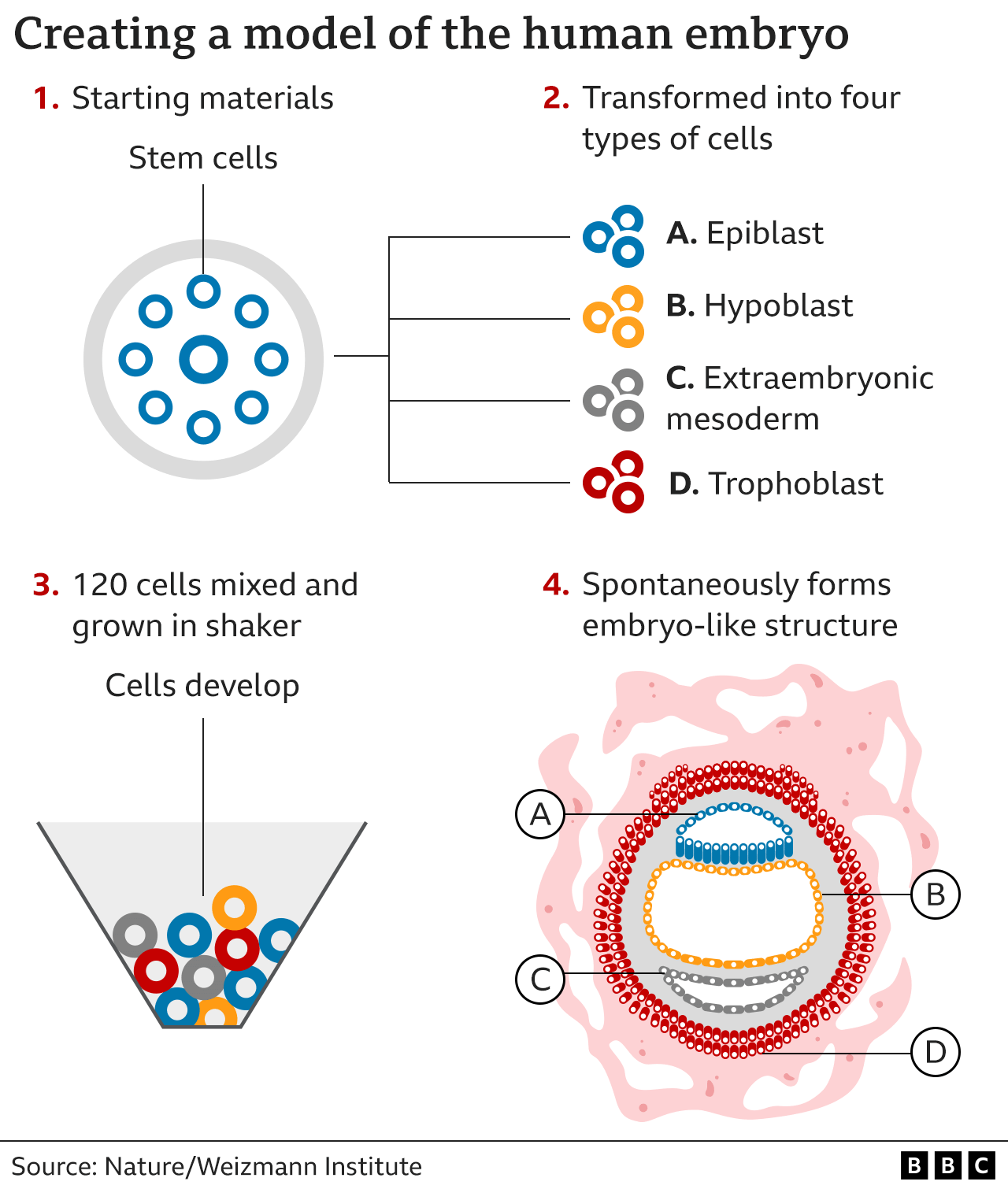
Scientists have grown an entity that closely resembles an early human embryo, without using sperm, eggs or a womb.
The Weizmann Institute team say their "embryo model", made using stem cells, looks like a textbook example of a real 14-day-old embryo.
It even released hormones that turned a pregnancy test positive in the lab.
The ambition for embryo models is to provide an ethical way of understanding the earliest moments of our lives.
The first weeks after a sperm fertilises an egg is a period of dramatic change - from a collection of indistinct cells to something that eventually becomes recognisable on a baby scan.
https://www.bbc.co.uk/news/health-66715669
26 minutes ago
Scientists have grown an entity that closely resembles an early human embryo, without using sperm, eggs or a womb.
The Weizmann Institute team say their "embryo model", made using stem cells, looks like a textbook example of a real 14-day-old embryo.
It even released hormones that turned a pregnancy test positive in the lab.
The ambition for embryo models is to provide an ethical way of understanding the earliest moments of our lives.
The first weeks after a sperm fertilises an egg is a period of dramatic change - from a collection of indistinct cells to something that eventually becomes recognisable on a baby scan.
https://www.bbc.co.uk/news/health-66715669
-
weatheriscool
- Posts: 26097
- Joined: Sun May 16, 2021 6:16 pm
- Contact:
-
weatheriscool
- Posts: 26097
- Joined: Sun May 16, 2021 6:16 pm
- Contact:
Re: Artificial wombs, cloning, IVF, and other reproductive technology
Brain cell discovery sparks hope for fertility treatments
https://medicalxpress.com/news/2023-12- ... ments.html
by Nagoya University
https://medicalxpress.com/news/2023-12- ... ments.html
by Nagoya University
Researchers at Nagoya University's Graduate School of Bioagricultural Sciences and the National Institute of Physiological Sciences in Japan have demonstrated how a specific type of neuron in the brain affects the release of hormones that control ovarian function, such as follicular development and ovulation in females. These findings, published in Scientific Reports, could help researchers understand and treat reproductive disorders in animals and humans.
Kisspeptin neurons in the brain regulate the release of hypothalamic gonadotropin-releasing hormone (GnRH) and pituitary follicle-stimulating hormone/luteinizing hormone (LH). This process is important for reproduction, as pituitary hormones stimulate the ovaries to perform their reproductive functions. Examples include follicular development and ovulation in all mammals, including humans.
There are two main areas of the brain involved in the process: the arcuate nucleus (ARC), in which kisspeptin neurons maintain the regular rhythmic (pulsatile) secretion of GnRH/LH that maintains normal follicular development and sex steroid production, and the anteroventral periventricular nucleus (AVPV), in which kisspeptin neurons trigger a surge of GnRH/LH that leads to ovulation.
The researchers focused on the fact that kisspeptin neurons in the ARC produce and respond to dynorphin, an inhibitory substance.
"Kisspeptin neurons in the ARC express both dynorphin and its receptor, whereas those in the AVPV express the receptor only, suggesting a particular role of such kisspeptin neurons in fertilization," Mayuko Nagae, a postdoctoral fellow, and Yoshihisa Uenoyama, an associate professor at Nagoya University in Japan and corresponding author of the paper, say.
"However, the exact role of dynorphin and its receptor in the regulation of kisspeptin neurons was not clearly understood."
Re: Artificial wombs, cloning, IVF, and other reproductive technology
Premature babies could be treated with an artificial uterus in 2024
Premature lambs continued developing when placed in a sac-like artificial uterus. Off the back of this, US officials are hinting that the first in-human trial could soon be underway
27 December 2023
The groundwork is being laid for the first human trial of an artificial uterus, which could get the go-ahead from the US Food and Drug Administration (FDA) some time in 2024.
Artificial uteruses are designed to mimic the environment of the womb as closely as possible and may help support babies who are born extremely prematurely, at around 23 or 24 weeks’ gestation.
https://www.newscientist.com/article/mg ... s-in-2024/

The EXTEND system has kept more than 300 preterm lambs alive
Credit: Partridge, E., Davey, M., Hornick, M. et al. (2023)
Premature lambs continued developing when placed in a sac-like artificial uterus. Off the back of this, US officials are hinting that the first in-human trial could soon be underway
27 December 2023
The groundwork is being laid for the first human trial of an artificial uterus, which could get the go-ahead from the US Food and Drug Administration (FDA) some time in 2024.
Artificial uteruses are designed to mimic the environment of the womb as closely as possible and may help support babies who are born extremely prematurely, at around 23 or 24 weeks’ gestation.
https://www.newscientist.com/article/mg ... s-in-2024/
The EXTEND system has kept more than 300 preterm lambs alive
Credit: Partridge, E., Davey, M., Hornick, M. et al. (2023)
Re: Artificial wombs, cloning, IVF, and other reproductive technology
Cloned rhesus monkey created to speed medical research
1 hour ago
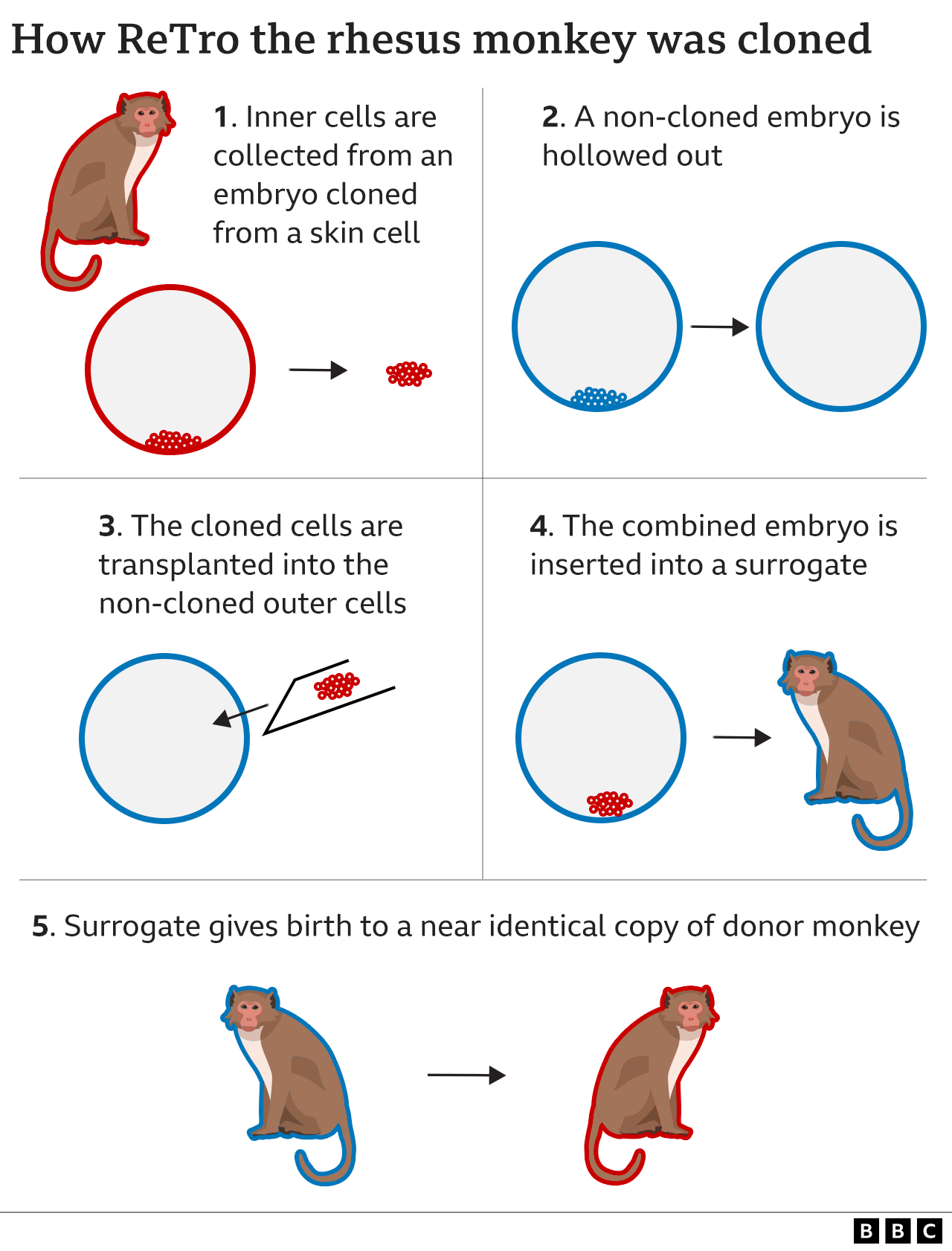
Chinese researchers have cloned the first rhesus monkey, a species which is widely used in medical research because its physiology is similar to humans.
They say they could speed up drug testing, as genetically identical animals give like-for-like results, providing greater certainty in trials.
Previous attempts to clone a rhesus have either not led to births or the offspring have died a few hours later.
One animal welfare group has said it is "deeply concerned" by the development.
In mammals, sexual reproduction leads to offspring made up of a mixture of genes from their father and mother. In cloning, techniques are used to create a genetically identical copy of a single animal.
https://www.bbc.co.uk/news/science-environment-67987633
1 hour ago
Chinese researchers have cloned the first rhesus monkey, a species which is widely used in medical research because its physiology is similar to humans.
They say they could speed up drug testing, as genetically identical animals give like-for-like results, providing greater certainty in trials.
Previous attempts to clone a rhesus have either not led to births or the offspring have died a few hours later.
One animal welfare group has said it is "deeply concerned" by the development.
In mammals, sexual reproduction leads to offspring made up of a mixture of genes from their father and mother. In cloning, techniques are used to create a genetically identical copy of a single animal.
https://www.bbc.co.uk/news/science-environment-67987633