Oil rich Saudi Arabia strikes gold at four locations; Total estimated volume is in millions
https://www.india.com/news/world/oil-ri ... 0-8268321/
Mining News and Discussions


Re: Mining News and Discussions
The Race to Mine Critical Minerals for AI and Clean Energy is Creating ‘Sacrifice Zones’ that Harm Water and Health of World’s Poor
By Abraham Nunbogu and Kaveh Madani
April 29, 2026
Introduction:
By Abraham Nunbogu and Kaveh Madani
April 29, 2026
Introduction:
Read more here: https://theconversation.com/the-race-t ... r-281524(The Conversation) There is a troubling contradiction at the heart of the global transition to a cleaner, greener, tech-driven future: Modern technologies – everything from AI to wind turbines, as well as cellphones, electric vehicles and defense systems – depend on critical minerals. But many of the communities where those minerals are mined end up with polluted water and poorer health because of the mining.
Lithium powers batteries. Cobalt stabilizes them. Copper carries electricity. Rare earth elements make wind turbines and digital devices efficient and durable. Each of these are essential to the technologies of the fourth industrial revolution, but they are also toxic and require enormous amounts of water to extract.
As researchers at the United Nations University Institute for Water, Environment and Health, we have been studying the impacts of critical mineral mining on communities around the world. Our new report shows why mining will end up worsening the lives of some of the world’s poorest people if critical mineral supply chains are not monitored and regulated.
One of us is from the Middle East, a region still suffering from the long-term consequences of supplying the fuel consumed for the remarkable economic developments of the 20th century. And one of us comes from Africa, the continent that is now serving as a major supplier of the critical minerals that fuel technological advancements in the 21st century.
Based on our experiences and our research, we believe that if there aren’t major changes in how countries, corporations and communities manage critical minerals, humanity risks reproducing the injustices of the oil extraction era, this time with the technological advancements meant to address the problems fossil fuels created.
Don't mourn, organize.
-Joe Hill
-Joe Hill
-
weatheriscool
- Posts: 26094
- Joined: Sun May 16, 2021 6:16 pm
- Contact:
Re: Mining News and Discussions
The Brazilian Government Keeps Giving out Mining Licenses in the Amazon – in Spite of Evidence of Gold ‘Laundering’
By Fábio Bispo
May 14, 2026
Introduction:
By Fábio Bispo
May 14, 2026
Introduction:
Read more here: https://grist.org/accountability/the-b ... ndering/(Grist) In the kitchen of Alnice Poxo Munduruku, fresh fish keeps the ancestral traditions of those who live along the vast Tapajós River alive. As the fire burns, the family cleans the fish while keeping a close eye on 11-year-old Aleckson. Born with cerebral palsy, which limits his mobility and speech, he has needed continuous care since birth. Like everyone here, he loves fish.
But the village’s food carries an invisible danger. Tests by scientists from the Oswaldo Cruz Foundation, or Fiocruz, show that Aleckson, his parents, and nearly everyone in neighboring communities have mercury levels above the safe threshold. Research by Fiocruz indicates that the contamination stems from gold mining, where mercury is used to separate the metal and then spreads through the rivers into the food chain.
This poisoning results not only from illegal mining but also from decisions and omissions by the Brazilian government. An exclusive InfoAmazonia investigation has found that Brazil’s National Mining Agency, or ANM, still maintains mining permits with signs of irregularities, such as reported gold production with no evidence of extraction consistent with the declared volumes — a practice identified by oversight bodies as illegal gold laundering.
Created in 1989 to regulate mining during the Tapajós gold rush that ran from the late 1970s to the 1990s, Garimpeiro Mining Permits (PLGs) were meant to be a simplified authorization for supposedly small-scale, low-impact operations. Decades later, what began as artisanal mining has become industrial-scale extraction involving heavy equipment, dredges, and mercury. These permits now give a veneer of legality to large-scale illegal mining in Tapajós, sidestepping legal limits.
Don't mourn, organize.
-Joe Hill
-Joe Hill
Re: Mining News and Discussions
Vampire Planet: China’s (Green) Economic Imperialism
By Joshua Frank
May 15, 2026
Introduction:
By Joshua Frank
May 15, 2026
Introduction:
Read more here: https://www.counterpunch.org/2026/05/ ... erialism/(Counterpunch) We often laud China for its boom in renewable energy projects, but seem to ignore the fact that it’s still building coal-fired power plants at a faster pace than any other country. Experts are questioning whether China’s gains in green energy will be clouded by the black smoke billowing from its robust fleet of coal plants. Air pollution in China kills 2 million a year.
On the topic of China’s “green” energy boom, it’s also important to note that many of the critical mineral operations key to its renewable projects are harming workers and the environment across South America and Africa. This week, as Trump landed for talks in Beijing, the feeble US Congress released a paper on China’s “mineral mafia”. The report wasn’t driven so much by criticism of China’s practices but by imperial jealousy. China dominates critical mineral mining in Africa, and the US doesn’t (but wants to). On China’s intentions in Africa, the usually spot-on Jason Hickel missed the mark, arguing that China is not engaging in green imperialism.
Some numbers. China controls 90% of Zimbabwe’s lithium supply and over 70% of the DRC’s copper and cobalt mining (the DRC holds 50% of the world’s cobalt). In Zambia, China and Canada dominate the copper industry. China also controls nearly 90% of global critical mineral processing. While Hickel points out that Chinese-backed development loans aren’t your typical “structural adjustment” loans that the IMF and World Bank dole out (thank God!), many of these loans are what we call “resource-backed loans.” This collateral (often in the form of natural resources like critical minerals) ensures that China will maintain access to Africa’s mineral supplies even if the countries can’t repay their loans. It’s a new form of forever debt, and it’s very, very bad.
Don't mourn, organize.
-Joe Hill
-Joe Hill
Re: Mining News and Discussions
Dig it: mine goes 155 consecutive hours on 100% renewable energy
Jun 13 2026
Last month, the Bellevue Gold mine did something that was previously unthinkable. For over 155 consecutive hours – a full six-and-a-half day work week – the mine operated on 100% renewable energy. The future is now, kids: engines off!
Bellevue Gold’s 90 MW hybrid power station brought together a 27 MW solar panel array, 24 MW of wind turbines, and 15 MW (33 MWh) of battery energy storage to power the Australian mine’s operation. Originally designed to meet at least 80% of the site’s energy needs, the system recently proved that, in the right conditions, it can do much more.
“We’ve put out a strategy that’s ahead of the market that will have us producing net zero carbon gold by 2026 and we couldn’t do it without renewable energy as a core part,” Bellevue Gold’s managing director Darren Stralow said, in a statement. “(It’s) a significant milestone, not only for the project, but for what is possible in the Australian energy sector.”
https://electrek.co/2026/06/13/dig-it-m ... le-energy/
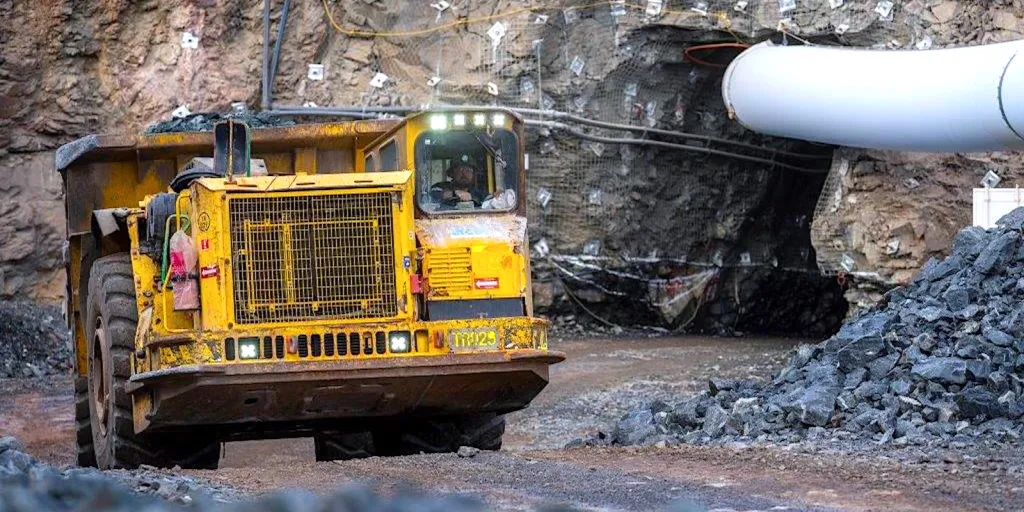
Image by Bellevue Gold, via The West Australian.
Jun 13 2026
Last month, the Bellevue Gold mine did something that was previously unthinkable. For over 155 consecutive hours – a full six-and-a-half day work week – the mine operated on 100% renewable energy. The future is now, kids: engines off!
Bellevue Gold’s 90 MW hybrid power station brought together a 27 MW solar panel array, 24 MW of wind turbines, and 15 MW (33 MWh) of battery energy storage to power the Australian mine’s operation. Originally designed to meet at least 80% of the site’s energy needs, the system recently proved that, in the right conditions, it can do much more.
“We’ve put out a strategy that’s ahead of the market that will have us producing net zero carbon gold by 2026 and we couldn’t do it without renewable energy as a core part,” Bellevue Gold’s managing director Darren Stralow said, in a statement. “(It’s) a significant milestone, not only for the project, but for what is possible in the Australian energy sector.”
https://electrek.co/2026/06/13/dig-it-m ... le-energy/
Image by Bellevue Gold, via The West Australian.
Re: Mining News and Discussions
U.S. Defense Spending on Critical Minerals Surges in the Last Decade
By Aimee Gabay
June 10, 2026
Introduction:
By Aimee Gabay
June 10, 2026
Introduction:
Read more here: https://news.mongabay.com/2026/06/us-d ... t-decade(Mongabay) Over the past decade, the U.S. Department of Defense (DoD) spending for critical minerals transformed from virtually nonexistent into a major revenue stream, with the last five years delivering a dramatic surge in both contract volume and dollar value. The Pentagon and other defense-adjacent agencies’ growing appetite for these projects is already visible in affected communities.
Several of these communities impacted by DoD-funded projects told Mongabay that state backing has fast-tracked approvals without essential environmental safeguards or meaningful consultation by companies.
For this research, Mongabay aggregated information from the USAspending database — an official open data source of federal spending information — about U.S. Department of Defense grants spending on critical mineral projects for military purposes between 2015 and 2025.
This figure excludes Pentagon contracts, which is a major way that the Department of Defense (DoD) spends its money. The actual amount is likely larger given that some projects may not be public due to national security reasons, according to the Congressional Research Service (CRS).
Don't mourn, organize.
-Joe Hill
-Joe Hill