Virtual/Augmented/Mixed Reality News & Discussions
-
weatheriscool
- Posts: 26094
- Joined: Sun May 16, 2021 6:16 pm
- Contact:
-
firestar464
- Posts: 8408
- Joined: Wed Oct 12, 2022 7:45 am
Re: Virtual/Augmented/Mixed Reality News & Discussions
the "shen yun" joke killed me
-
weatheriscool
- Posts: 26094
- Joined: Sun May 16, 2021 6:16 pm
- Contact:
-
weatheriscool
- Posts: 26094
- Joined: Sun May 16, 2021 6:16 pm
- Contact:
-
weatheriscool
- Posts: 26094
- Joined: Sun May 16, 2021 6:16 pm
- Contact:
Re: Virtual/Augmented/Mixed Reality News & Discussions
Project Orion is looking fucking good. I'd strongly consider buying a pair.
-
weatheriscool
- Posts: 26094
- Joined: Sun May 16, 2021 6:16 pm
- Contact:
Re: Virtual/Augmented/Mixed Reality News & Discussions
Top 10 vr headsets
Based on recent reviews and expert analyses, here’s a list of the top 10 VR headsets for 2025, focusing on performance, features, and value. I’ve prioritized headsets that balance quality, affordability, and versatility for gaming, mixed reality, and other applications. Note that rankings may vary slightly depending on specific use cases (e.g., PC VR vs. standalone, gaming vs. productivity). I’ve also considered key factors like resolution, field of view (FOV), refresh rate, comfort, and game library.
Meta Quest 3 Price: ~$500 (128GB)
Why It’s Great: The best all-around VR headset for most users, offering standalone and PC VR capabilities. Features a Snapdragon XR2 Gen 2 processor, 2064x2208 resolution per eye, 110° FOV, and 120Hz refresh rate. Its mixed reality passthrough is excellent, and it supports a vast library of games and apps. Comfortable design and improved Touch Plus controllers make it versatile.
Best For: Beginners, gamers, and mixed reality enthusiasts.
Downside: Battery life (~2 hours).
Meta Quest 3S Price: ~$300 (128GB)
Why It’s Great: A budget-friendly version of the Quest 3, with the same processor and mixed reality capabilities but slightly lower resolution (1832x1920 per eye) and Fresnel lenses. At $249 during sales, it’s the best entry-level VR headset. Great for casual gamers and those new to VR.
Best For: Budget-conscious users wanting a solid VR experience.
Downside: Lower clarity compared to Quest 3 due to lenses.
PlayStation VR2 (PSVR 2) Price: ~$550
Why It’s Great: Best for console gamers with a PS5, featuring dual 2K OLED displays (2000x2040 per eye), 120° FOV, 120Hz refresh rate, and advanced features like eye tracking and haptic feedback. Exclusive titles like Horizon Call of the Mountain shine, though it requires a PS5.
Best For: PS5 owners seeking high-end VR gaming.
Downside: Limited game library and no PC VR without adapters.
Apple Vision Pro Price: ~$3,500
Why It’s Great: A premium mixed reality headset with stunning 4K micro-OLED displays (23 million pixels total), unmatched passthrough cameras, and intuitive eye/hand tracking. Best for productivity, media consumption, and Apple ecosystem users. Runs visionOS with iOS app support.
Best For: Professionals and early adopters.
Downside: Extremely expensive, limited VR gaming library, and heavy for long sessions.
Valve Index Price: ~$999 (full kit)
Why It’s Great: The gold standard for PC VR, with a 1440x1600 resolution per eye, up to 144Hz refresh rate, and 130° FOV. Its precise tracking (via external sensors) and excellent controllers make it ideal for immersive games like Half-Life: Alyx.
Best For: PC VR enthusiasts with high-end rigs.
Downside: Requires a powerful PC and complex setup.
HTC Vive Pro 2 Price: ~$1,399 (full kit)
Why It’s Great: Offers the sharpest PC VR display at 2448x2448 per eye, 120° FOV, and 120Hz refresh rate. Works with SteamVR and Viveport, making it great for enthusiasts and professionals. Comfortable for long sessions.
Best For: High-end PC VR gaming and professional use.
Downside: Expensive and requires a powerful PC.
HTC Vive XR Elite Price: ~$899
Why It’s Great: A versatile standalone and PC VR headset with 1920x1920 resolution per eye, 110° FOV, and a lightweight design (1.13 lbs). Supports mixed reality and SteamVR, with a convertible form factor for portability.
Best For: Users wanting flexibility between standalone and PC VR.
Downside: Smaller software library in standalone mode.
Pimax Crystal Price: ~$1,599
Why It’s Great: A high-end PC VR headset with up to 8K resolution (3840x2160 per eye), 130° FOV, and excellent audio. Ideal for sim racing and ultra-immersive experiences, though it requires a top-tier PC.
Best For: Sim racers and VR enthusiasts with powerful PCs.
Downside: Complex setup and limited standalone capabilities.
Pimax Crystal Light Price: ~$699
Why It’s Great: A more affordable version of the Pimax Crystal, with the same high-resolution display but no battery or standalone mode. Great for PC VR users who prioritize visuals over portability.
Best For: Budget-conscious PC VR users seeking high resolution.
Downside: Tethered only, no mixed reality features.
Bigscreen Beyond Price: ~$1,000
Why It’s Great: An ultra-lightweight (under 150g) PC VR headset with micro-OLED displays (2560x2560 per eye) and a 90° FOV. Custom-fitted for comfort, it’s ideal for long sessions and immersive visuals.
Best For: PC VR users prioritizing comfort and display quality.
Downside: Requires external tracking and a high-end PC.
Notes:Standalone vs. Tethered: Standalone headsets (Quest 3, Quest 3S, Vision Pro, Vive XR Elite) don’t require a PC or console, making them more accessible. Tethered headsets (Valve Index, Vive Pro 2, Pimax) offer superior visuals but need powerful PCs.
Mixed Reality: Quest 3, Quest 3S, and Vision Pro excel in blending virtual and real worlds, great for AR-like experiences.
Budget Options: For smartphone-based VR, options like Google Cardboard or DESTEK V5 (~$20-$40) are cheap but limited to basic experiences.
Future Considerations: The Oculus Quest 4 is rumored for 2026, and Valve may release a new headset, so waiting could be an option for some.
Based on recent reviews and expert analyses, here’s a list of the top 10 VR headsets for 2025, focusing on performance, features, and value. I’ve prioritized headsets that balance quality, affordability, and versatility for gaming, mixed reality, and other applications. Note that rankings may vary slightly depending on specific use cases (e.g., PC VR vs. standalone, gaming vs. productivity). I’ve also considered key factors like resolution, field of view (FOV), refresh rate, comfort, and game library.
Meta Quest 3 Price: ~$500 (128GB)
Why It’s Great: The best all-around VR headset for most users, offering standalone and PC VR capabilities. Features a Snapdragon XR2 Gen 2 processor, 2064x2208 resolution per eye, 110° FOV, and 120Hz refresh rate. Its mixed reality passthrough is excellent, and it supports a vast library of games and apps. Comfortable design and improved Touch Plus controllers make it versatile.
Best For: Beginners, gamers, and mixed reality enthusiasts.
Downside: Battery life (~2 hours).
Meta Quest 3S Price: ~$300 (128GB)
Why It’s Great: A budget-friendly version of the Quest 3, with the same processor and mixed reality capabilities but slightly lower resolution (1832x1920 per eye) and Fresnel lenses. At $249 during sales, it’s the best entry-level VR headset. Great for casual gamers and those new to VR.
Best For: Budget-conscious users wanting a solid VR experience.
Downside: Lower clarity compared to Quest 3 due to lenses.
PlayStation VR2 (PSVR 2) Price: ~$550
Why It’s Great: Best for console gamers with a PS5, featuring dual 2K OLED displays (2000x2040 per eye), 120° FOV, 120Hz refresh rate, and advanced features like eye tracking and haptic feedback. Exclusive titles like Horizon Call of the Mountain shine, though it requires a PS5.
Best For: PS5 owners seeking high-end VR gaming.
Downside: Limited game library and no PC VR without adapters.
Apple Vision Pro Price: ~$3,500
Why It’s Great: A premium mixed reality headset with stunning 4K micro-OLED displays (23 million pixels total), unmatched passthrough cameras, and intuitive eye/hand tracking. Best for productivity, media consumption, and Apple ecosystem users. Runs visionOS with iOS app support.
Best For: Professionals and early adopters.
Downside: Extremely expensive, limited VR gaming library, and heavy for long sessions.
Valve Index Price: ~$999 (full kit)
Why It’s Great: The gold standard for PC VR, with a 1440x1600 resolution per eye, up to 144Hz refresh rate, and 130° FOV. Its precise tracking (via external sensors) and excellent controllers make it ideal for immersive games like Half-Life: Alyx.
Best For: PC VR enthusiasts with high-end rigs.
Downside: Requires a powerful PC and complex setup.
HTC Vive Pro 2 Price: ~$1,399 (full kit)
Why It’s Great: Offers the sharpest PC VR display at 2448x2448 per eye, 120° FOV, and 120Hz refresh rate. Works with SteamVR and Viveport, making it great for enthusiasts and professionals. Comfortable for long sessions.
Best For: High-end PC VR gaming and professional use.
Downside: Expensive and requires a powerful PC.
HTC Vive XR Elite Price: ~$899
Why It’s Great: A versatile standalone and PC VR headset with 1920x1920 resolution per eye, 110° FOV, and a lightweight design (1.13 lbs). Supports mixed reality and SteamVR, with a convertible form factor for portability.
Best For: Users wanting flexibility between standalone and PC VR.
Downside: Smaller software library in standalone mode.
Pimax Crystal Price: ~$1,599
Why It’s Great: A high-end PC VR headset with up to 8K resolution (3840x2160 per eye), 130° FOV, and excellent audio. Ideal for sim racing and ultra-immersive experiences, though it requires a top-tier PC.
Best For: Sim racers and VR enthusiasts with powerful PCs.
Downside: Complex setup and limited standalone capabilities.
Pimax Crystal Light Price: ~$699
Why It’s Great: A more affordable version of the Pimax Crystal, with the same high-resolution display but no battery or standalone mode. Great for PC VR users who prioritize visuals over portability.
Best For: Budget-conscious PC VR users seeking high resolution.
Downside: Tethered only, no mixed reality features.
Bigscreen Beyond Price: ~$1,000
Why It’s Great: An ultra-lightweight (under 150g) PC VR headset with micro-OLED displays (2560x2560 per eye) and a 90° FOV. Custom-fitted for comfort, it’s ideal for long sessions and immersive visuals.
Best For: PC VR users prioritizing comfort and display quality.
Downside: Requires external tracking and a high-end PC.
Notes:Standalone vs. Tethered: Standalone headsets (Quest 3, Quest 3S, Vision Pro, Vive XR Elite) don’t require a PC or console, making them more accessible. Tethered headsets (Valve Index, Vive Pro 2, Pimax) offer superior visuals but need powerful PCs.
Mixed Reality: Quest 3, Quest 3S, and Vision Pro excel in blending virtual and real worlds, great for AR-like experiences.
Budget Options: For smartphone-based VR, options like Google Cardboard or DESTEK V5 (~$20-$40) are cheap but limited to basic experiences.
Future Considerations: The Oculus Quest 4 is rumored for 2026, and Valve may release a new headset, so waiting could be an option for some.
Re: Virtual/Augmented/Mixed Reality News & Discussions
Meta's massive prototype headset could offer the most realistic VR experience yet
Will it come with a sore-neck warning?
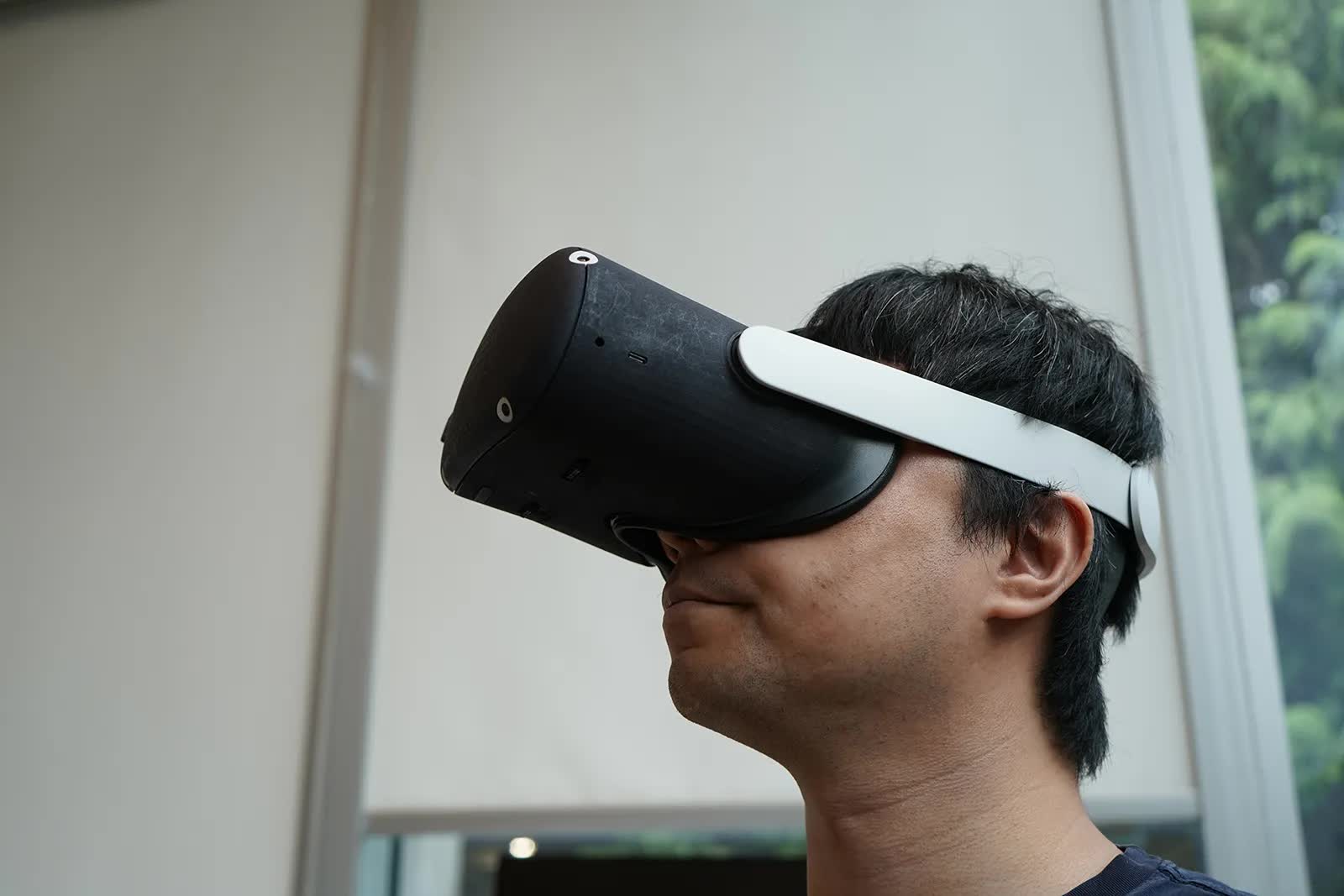
The virtual and mixed-reality industries haven't been in the spotlight as much since the advent of generative AI, but companies are still making new and interesting headsets. Meta, which dominates this market, has announced several prototypes that will be shown off next week, including an absolute monster that it says will bring a "new milestone for realism in VR."
Meta is showing off several prototype headsets at SIGGRAPH 2025 next week. The one receiving the most attention is called Tiramisu, which Meta says enables "hyperrealistic VR."
That incredible realism is the result of several impressive specs. The first is the contrast, which is around three times that of the Meta Quest 3. It also has a brightness level that reaches 1,400 nits, which is 14 times what the Quest 3 offers and an industry first.
Finally, there's the Tiramisu's angular resolution of 90 pixels per degree (PPD), which is 3.6 times more than the Quest 3. A higher angular resolution means finer detail and fewer visible pixels (screen door effect), with most high-end headsets in the 18-25 PPD range.
https://www.techspot.com/news/108995-me ... istic.html
Will it come with a sore-neck warning?
The virtual and mixed-reality industries haven't been in the spotlight as much since the advent of generative AI, but companies are still making new and interesting headsets. Meta, which dominates this market, has announced several prototypes that will be shown off next week, including an absolute monster that it says will bring a "new milestone for realism in VR."
Meta is showing off several prototype headsets at SIGGRAPH 2025 next week. The one receiving the most attention is called Tiramisu, which Meta says enables "hyperrealistic VR."
That incredible realism is the result of several impressive specs. The first is the contrast, which is around three times that of the Meta Quest 3. It also has a brightness level that reaches 1,400 nits, which is 14 times what the Quest 3 offers and an industry first.
Finally, there's the Tiramisu's angular resolution of 90 pixels per degree (PPD), which is 3.6 times more than the Quest 3. A higher angular resolution means finer detail and fewer visible pixels (screen door effect), with most high-end headsets in the 18-25 PPD range.
https://www.techspot.com/news/108995-me ... istic.html
-
weatheriscool
- Posts: 26094
- Joined: Sun May 16, 2021 6:16 pm
- Contact:
-
weatheriscool
- Posts: 26094
- Joined: Sun May 16, 2021 6:16 pm
- Contact:
Re: Virtual/Augmented/Mixed Reality News & Discussions
VR Market Share: PICO 46%, Meta 28%, Goovis 7%
AR Market Share: RayNeo 35%, XREAL 22%, Meizu (3rd place without published number)
87% of AR devices sold used OLED
13% Waveguide (most of these probably with microLED)
https://mp.weixin.qq.com/s/EMaXQ4uRwTASJoGo5evkEg
The fact that these AR glasses can be weared on your face and looks just like normal glasses is a serious problem for vr/ar headsets. The xreal utra that just came out also has 6 degree's of tracking and can do nearly everything the meta 3 can do in ar. These companies are going to have to figure out how to make xi glasses with the ability to do both...Even if you have to have a square thing in your pocket.
-
weatheriscool
- Posts: 26094
- Joined: Sun May 16, 2021 6:16 pm
- Contact:
Re: Virtual/Augmented/Mixed Reality News & Discussions
With XREAL One Pro + Eye’s built-in 6DoF, you can move naturally in all directions — forward/back, side to side, even lean in — just like in real life.
That means you can walk closer to the stage, peek from a different angle, or step back for the full view.
While 6DoF is mainly used for immersive viewing today, it’s also paving the way for richer interactions with virtual objects in the future.
One day, maybe we’ll be high-fiving Miku instead of just watching.
I have a meta 3 but this is pretty fucking cool that you can go places with these and the ar capability is close to my meta.
-
weatheriscool
- Posts: 26094
- Joined: Sun May 16, 2021 6:16 pm
- Contact:
Re: Virtual/Augmented/Mixed Reality News & Discussions
Meta’s New 2mm Laser Display Could Enable True AR Glasses
Meta researchers just solved one of the big impediments to building wearable, reactive transparent displays.
By Graham Templeton August 21, 2025
https://www.extremetech.com/science/met ... ar-glasses
Meta researchers just solved one of the big impediments to building wearable, reactive transparent displays.
By Graham Templeton August 21, 2025
Researchers at Meta have made a breakthrough in laser-based display technology, and it could have major implications for augmented reality. It has excellent color rendition and even has a respectable resolution, at 1920x1080. The most important part, though, is that it's just two millimeters thick.
This type of technology could become the basis of authentic, science fiction-style augmented-reality glasses.
Laser-based displays aren't terribly common, but they do have some desirable properties, such as being very bright and color-accurate. They would be the perfect type of display for augmented reality, since their brightness could compete with the outdoor lighting scenarios that challenge many other display technologies. The problem is that laser-based displays are bulky, hard to manufacture, and inefficient.
With this research, Meta set out to fix these problems.
https://www.extremetech.com/science/met ... ar-glasses
Last edited by weatheriscool on Sun Aug 24, 2025 4:00 pm, edited 1 time in total.
-
weatheriscool
- Posts: 26094
- Joined: Sun May 16, 2021 6:16 pm
- Contact:
Re: Virtual/Augmented/Mixed Reality News & Discussions
Rokid is set to launch its latest smart glasses, the Rokid Glasses, at a launch event in New York City on August 26. The company claims the device is the world's lightest full-function AI and AR smart glasses, designed to integrate advanced technology into an everyday form factor.
Features and Technology
Powered by Qualcomm’s AR1 platform, the Rokid Glasses project information onto a binocular monochrome display. This setup enables a suite of practical features, including:
Real-time multilingual translation
Live transcription
A teleprompter function for presentations
Navigation assistance
Object recognition
A built-in first-person camera
-
weatheriscool
- Posts: 26094
- Joined: Sun May 16, 2021 6:16 pm
- Contact:
-
weatheriscool
- Posts: 26094
- Joined: Sun May 16, 2021 6:16 pm
- Contact:
-
weatheriscool
- Posts: 26094
- Joined: Sun May 16, 2021 6:16 pm
- Contact:
-
weatheriscool
- Posts: 26094
- Joined: Sun May 16, 2021 6:16 pm
- Contact:
Re: Virtual/Augmented/Mixed Reality News & Discussions
Amazon Reportedly Working on Augmented Reality Glasses for Everyday Users, Delivery Drivers
The glasses, codenamed "Jayhawk," will likely compete with Meta's upcoming Hypernova smart glasses.
By Devesh Beri September 11, 2025
The glasses, codenamed "Jayhawk," will likely compete with Meta's upcoming Hypernova smart glasses.
By Devesh Beri September 11, 2025
https://www.extremetech.com/electronics ... yday-usersAmazon is working on its own augmented reality (AR) glasses, reports The Information, which cites two people familiar with the e-commerce giant's plans. The glasses, codenamed "Jayhawk," are said to contain microphones, speakers, a camera, and a full‑color display positioned in one eye. The company is hoping to bring the glasses to market in late 2026 or early 2027.
If the rumors are true, Jayhawk would be Amazon's first effort to create AR glasses for everyday consumers. The company is simultaneously working on a version of the AR glasses designed for its delivery drivers; these would reportedly provide turn‑by‑turn directions as drivers conduct their routes.
Both the consumer version and delivery driver version are said to use the same display system, though the consumer version is expected to have a sleeker design and a higher-quality full‑color screen. The delivery glasses could arrive as early as the second quarter of 2026, Reuters reports.
-
weatheriscool
- Posts: 26094
- Joined: Sun May 16, 2021 6:16 pm
- Contact:
-
weatheriscool
- Posts: 26094
- Joined: Sun May 16, 2021 6:16 pm
- Contact:
-
weatheriscool
- Posts: 26094
- Joined: Sun May 16, 2021 6:16 pm
- Contact:
Re: Virtual/Augmented/Mixed Reality News & Discussions
Meta unveils new smart glasses with a display and wristband controller
Maxwell Zeff
5:25 PM PDT · September 17, 2025
Maxwell Zeff
5:25 PM PDT · September 17, 2025
https://techcrunch.com/2025/09/17/meta- ... ontroller/Meta on Wednesday unveiled a new pair of Ray-Ban branded smart glasses with a built-in display for apps, alerts, and directions on the right lens. The smart glasses are controlled by a wristband that picks up on subtle hand gestures, called Meta Neural Band, the same one it unveiled at last year’s Connect as part of its Orion demo.
CEO Mark Zuckerberg announced the new product, called Meta Ray-Ban Display, onstage at the company’s annual developer conference, Meta Connect 2025. Unlike Orion, Zuckerberg says this is a product that people can buy in a couple of weeks, starting September 30, and they’ll cost $799.
This is Meta’s latest attempt to ship a pair of consumer smart glasses that can handle many of the tasks users traditionally do on a smartphone. For years, Meta has been forced to reach users through its competitors’ devices, namely those sold by Google and Apple. While Meta has invested billions in virtual reality headsets, AI-powered smart glasses now seem like the most promising way for the company to connect with users on its own hardware.
With the Meta Ray-Ban Display, Meta aims to build off the success of its original Ray-Ban Meta smart glasses, which the company has sold millions of pairs of with its eyewear partner, EssilorLuxottica. Much like Ray-Ban Meta, the Meta Ray-Ban Display comes equipped with an on-board AI assistant, as well as cameras, speakers, and microphones. The glasses let users connect to the cloud to access the internet and social media apps.
-
weatheriscool
- Posts: 26094
- Joined: Sun May 16, 2021 6:16 pm
- Contact:
Re: Virtual/Augmented/Mixed Reality News & Discussions
Samsung's Android XR Headset Reportedly Launching in South Korea Next Month
A wider international release is expected later, but Samsung has yet to confirm any details.
By Devesh Beri September 23, 2025
https://www.extremetech.com/electronics ... next-month
A wider international release is expected later, but Samsung has yet to confirm any details.
By Devesh Beri September 23, 2025
Samsung's Android "extended reality" (XR) headset, Project Moohan, is nearing the first leg of its launch. A new report from South Korea's Newsworks says preorders will begin on Sept. 29 ahead of an October release exclusively in that country. A wider international release is expected later, but Samsung has yet to confirm any details.
The device is said to be priced between ₩2.5 million and ₩4 million (roughly $1,800 to $2,900). That's cheaper than Apple's Vision Pro, which has been on sale in South Korea since November at around ₩5 million.
The headset was first announced more than two years ago, when it was said Google would handle the software and Qualcomm would provide the chipset. That chipset was confirmed to be the Snapdragon XR2+ Gen 2. Reports from earlier this year also claimed Samsung would use Sony's new 1.35-inch, 3552-by-3840 micro OLED displays, which means higher resolution and better color than those in Apple's Vision Pro, which was released in the early parts of last year.
https://www.extremetech.com/electronics ... next-month