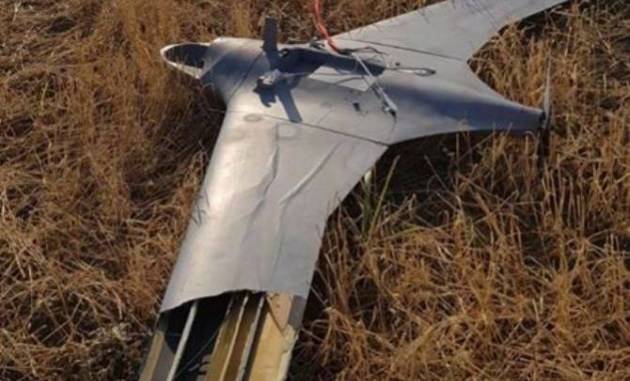
Azerbaijan's Defense Ministry Monday said an unmanned aerial vehicle (UAV) belonging to the Armenian armed forces was intercepted at the border.
The drone called Griphon-12 was downed by Azerbaijani forces in the western Kalbajar region of the Armenian-Azerbaijani border, the ministry said in a statement.
Relations between the two former Soviet republics have been tense since 1991, when the Armenian military occupied Nagorno-Karabakh, also known as Upper Karabakh, a territory internationally recognized as part of Azerbaijan, and seven adjacent regions.
The conflict between the two flared up last year and six weeks of fighting ended with a Russian-brokered truce on Nov. 10.
And remember my friend, future events such as these will affect you in the future
As of 17:00, the situation in the eastern border zone of the Republic of Armenia continues to be extremely tense after the Azerbaijani armed forces undertook a large-scale attack, the Ministry of Defense reports.
The intensity of the battles has not decreased. The enemy continues to use artillery, armored vehicles and firearms of different calibers.
As a result of the retaliatory actions of the Armenian side, the enemy has suffered huge losses in personnel, about a dozen units of armored vehicles have been destroyed or damaged.
Casualties on the Armenian side are also reported, details are being verified.
And remember my friend, future events such as these will affect you in the future
A number of Armenian soldiers have been killed and captured in a flare-up of violence on the border with Azerbaijan, Armenian officials say.
Armenia said some of its troops had been killed and two combat positions had been lost, while Azerbaijan said two of its soldiers were injured.
Later on Tuesday, both sides reportedly agreed to a Russian-brokered ceasefire.
More than 6,000 lives were lost in last year's war over the disputed territory of Nagorno-Karabakh.
Azerbaijani forces, backed by Turkey, managed to recapture large swathes of the region of what is internationally regarded as part of Azerbaijan.
On Tuesday, Armenia asked Russia, a key security ally with long-standing ties to the former Soviet republic, to help defend its territorial sovereignty against Azerbaijan.
And remember my friend, future events such as these will affect you in the future
Armenia has announced a Russian-mediated cease-fire with Azerbaijan after asking for Moscow's assistance amid deadly hostilities that erupted earlier in the day along their shared border.
"Under the mediation of the Russian side, an agreement was reached to cease-fire at Armenia's eastern border from 1830 (1430 GMT/UTC). The situation has relatively stabilized," the Armenian Defense Ministry announced on November 16, adding that at least one Armenian soldier died in the clashes. Earlier reports had put the number of the Armenian deaths at 15.
The renewed deadly clashes along the border started about a year after a cease-fire stopped an intense war over the breakaway region of Nagorno-Karabakh.
And remember my friend, future events such as these will affect you in the future
As the war in Ukraine captures the world’s attention, tensions have spiked yet again in Nagorno-Karabakh, with some local residents fearing that an attack by Azerbaijan is imminent.
Over the past week, both Armenia and Azerbaijan have accused each other of violating the ceasefire between the two countries, though few of these violations could be independently confirmed.
Some of the violence that could be confirmed included the shelling of Armenian-inhabited villages in Nagorno-Karabakh — which lead to one civilian being wounded, as well as an exchange of fire on the border between Armenia and Nakhchivan in which one Armenian soldier was killed.
And remember my friend, future events such as these will affect you in the future
Looks like Russia's weakness in Ukraine and removal of troops from Nagorno-Karabakh is going to reignite the conflict here as Azerbaijan looks to complete it's conquest in its entirety.
Nagorno-Karabakh: Russia says Azeri troops entered peacekeeping zone
Top UN Court Tells Azerbaijan to Allow Armenians Back to Nagorno-Karabakh by Molly Quell
November 17, 2023
Introduction:
THE HAGUE, Netherlands (Courthouse News) — The International Court of Justice on Friday ordered Azerbaijan to allow Armenians to safely return to the disputed region of Nagorno-Karabakh.
In a case stemming from a bloody 2020 war over the South Caucasus enclave, the top U.N. court partially granted provisional measures requested by Armenia to allow some of the 100,000 people displaced to return.
Armenia told the Hague-based court during hearings in October that ethnic cleansing was underway in Nagorno-Karabakh and, without intervention from judges against Azerbaijan, tens of thousands of people would be forced out. According to Human Rights Watch, since the latest escalation, more than 100,000 people have now fled — nearly the entire population.
Nagorno-Karabakh, a 1,700-square-mile area that technically falls within the borders of Azerbaijan but is overwhelmingly ethnically Armenian, has been a source of friction since the fall of the Soviet Union.
The 15-judge panel found there was a serious risk of harm to the ethnic Armenian population. “Individuals forced to leave their own place of residence without the possibility of return could be subject to a serious risk of irreparable prejudice,” the court's president, Joan E. Donoghue, said in reading out the decision.
Breakthrough In Azerbaijani–Armenian Peace Negotiations? by Robert Cutler
December 11, 2023
Introduction:
(Eurasia Review) In a first-of-a-kind bilateral statement, without any external participation, Azerbaijan and Armenia have arrived at an extremely important humanitarian and diplomatically symbolic agreement. It is the first time Azerbaijan and Armenia agreed to coordinate on any international matter.
The humanitarian aspect is that the Republic of Azerbaijan—”driven,” according to the statement, “by the values of humanism and as a gesture of goodwill”—agreed to the release of 32 Armenian military servicemen, while the Republic of Armenia, equally “driven by the values of humanism and as a gesture of goodwill,” is releasing two Azerbaijani military servicemen. But that’s not all.
The Twenty-eighth Session of the Conference of Parties (COP28) to the UN Framework Convention on Climate Change is now concluding in Abu Dhabi. The Twenty-ninth Session (COP29) will be held next year somewhere in Eastern Europe. In what might be called the most constructive and progressive act that “climate diplomacy” has ever accomplished, Armenia has withdrawn its own candidacy to host COP29 in support of Azerbaijan’s bid.
“The Republic of Armenia and the Republic of Azerbaijan,” the joint statement says, “do hope that the other countries within the Eastern European Group will also support Azerbaijan’s bid to host.” In return, Azerbaijan is supporting the Armenian candidature for membership in the Eastern European Group COP Bureau. This choice has now garnered Russia’s backing.
Additional extract:
The bilateral statement reconfirms the two countries’ intentions “to normalize relations and to reach a peace treaty on the basis of respect for the principles of sovereignty and territorial integrity.” It concludes that they “will continue their discussions regarding the implementation of more confidence-building measures,” to take effect in the near future, that “will positively impact the entire South Caucasus region.” This agreement was worked out through direct contacts between the Presidential Administration of the Republic of Azerbaijan and the Office of the Prime Minister of the Republic of Armenia.
Russian troops leave Karabakh, now back under Azerbaijan's control
May 16, 20249:49 AM GMT+1
KHOJALY, Azerbaijan, May 15 (Reuters) - This May 15 story has been corrected to say 'recaptured' instead of 'captured' in paragraph 1
Russia shut down a military base in Azerbaijan on Wednesday where nearly 2,000 of its troops had been deployed, after Azeri forces recaptured the area last year despite a two-year Russian mission to prevent war between Azerbaijan and Armenia.
A total of 1,960 Russian peacekeepers had been housed in 10 barracks at the base in Khojaly, a town in the Karabakh region. Despite the deployment, Azerbaijan recaptured Karabakh in a lightning offensive last September, prompting an exodus of 100,000 ethnic Armenians who had enjoyed de facto independence since breaking away in the 1990s in the first of two wars between the South Caucasus neighbours.
"The presence of Russian peacekeepers made it possible to establish peace on Azerbaijani soil," Russian Colonel General Yevgeny Nikiforov said at the departure ceremony.
Azerbaijan's chief of the general staff, Colonel General Kerim Valiyev, said Russia had made "every effort to establish peace in the Karabakh economic region" and bring decades of conflict to an end.