"Crazy Li" arms drones with powerful lasers that can cut through metal
By Joe Salas
December 16, 2024
Drones have another weapon in the arsenal thanks to "Crazy Li" Xiao: lasers. Not just lasers, but ones powerful enough to vaporize human tissue on contact and cut through metal.
We've seen plenty of directed energy weapons lately designed to take down drone threats in combat operations – now, it seems, the drones have some lasers of their own.
The Hong Kong-based South China Morning Post just posted an article that begins like this:
"A squad of fully armed soldiers follow closely behind a Humvee armoured vehicle, cautiously advancing through the ruins of an urban battlefield. About a kilometre ahead of them in the sky, a small drone hovers in place. Suddenly, one soldier lets out a scream, clutching his eyes with both hands as smoke curls between his fingers."
What looks like an armored scout car complete with a 30-mm gun but no crew? It's Milrem Robotics' latest HAVOC 8x8 advanced hybrid-electric Robotic Combat Vehicle (RCV) just unveiled at IDEX 2025 in Abu Dhabi, United Arab Emirates.
Milrem has been fielding an increasingly sophisticated range of military robots for over a decade now based on a common platform of tracked vehicles that can be adapted to a variety of missions, including resupply of frontline units, reconnaissance, and even combat. HAVOC takes this concept one step further by adapting the 15-tonne platform with eight independently powered wheels capable of carrying five tonnes of interchangeable payloads that range from missiles to mine layers to gun turrets.
According to the company, HAVOC's hybrid drivetrain provides the robotic fighter with extended range, a near-silent stealth capability, and superior off-road performance thanks to its reduced weight. With an electric motor in the loop, it enjoys maximum torque at minimum load for fast starts, quicker response times, and an enhanced ability to handle rough terrain.
In addition, the pivot steering system allows all eight wheels to turn at once for a reduced turning radius. Milrem claims that this gives it better maneuverability in urban areas and high mountain passes.
Another advantage of the common platform approach is that it reduces development, procurement, and maintenance costs and improves logistics.
Multi-fuel military drone can spy, jam, and strike from the sea
By Michael Franco
February 18, 2025
AeroVironment has just revealed its latest heavy-duty medium uncrewed aircraft system known as the Jump 20-X. With an impressive range of capabilities, the drone could easily become a cornerstone of sea-based combat and surveillance.
AeroVironment (AV), an Arlington, Virginia, based manufacturer, is no stranger to creating cutting-edge unmanned military systems. Here at New Atlas, we've previously covered its quadrotor packable surveilance drone; its DARPA-funded Wasp unmanned aircraft system with "perch-and-stare" capabilities; and its Swtichblade suicide drones, hundreds of which have been sent to Ukraine to help the country fight its war against Russia. And that just scratches the surface of the company's output.
Adding to its impressive family of autonomous solutions, AV unveiled the Jump 20-X at the 2025 International Defence Exhibition & Conference in Abu Dhabi this week in what is, according to Breaking Defense, a bid to court Middle Eastern customers and development partners. The drone is meant to be launched from and collected by naval ships.
Looking like something out of a science fiction thriller, Diehl Defence is showing off its CICADA eMissile, which is the centerpiece of the company's Sky Sphere system for defending against Class 1 and 2 small drones with minimal collateral damage.
This year's Enforce Tac trade fair in Nuremberg, Germany this week spotlighted a host of products aimed at the international security sector. One that stood out was the latest Sky Sphere system, with its modular CICADA eMissile featuring a distinct pyramidal shape thanks to the four delta wings folded the length of its 27.6-in (700-mm) hull with a diameter of 11.8 in (300 mm).
This configuration is designed so that the CICADA can engage small, low-speed drones coming in at under 1,320 lb (600 kg). It comes in two configurations to allow it to be used in both a battlefield environment and civilian areas.
USX-1 Defiant: The warship without a crew or a place to put one
By David Szondy
March 06, 2025
https://newatlas.com/military/usx-1-def ... place-one/
DARPA has launched a new prototype warship for the US Navy that not only won't need any sailors, it can't even accommodate them. The 180-ft (55-m), 240-tonne No Manning Required Ship (NOMARS) put to sea last month ahead of sea trials.
It may look smaller than a conventional surface warship, but looks can be deceiving. Designated USX-1 Defiant, the new NOMARS shows just how much space aboard a ship is devoted to the crew. Take away the living quarters, corridors, ventilators, ladders, access ways, and work spaces, and a warship can be shrunk to a remarkable degree.
In the case of the Defiant, you get a small, dagger-like vessel that can operate at sea for months without human supervision, autonomously navigate, avoid collisions and bad weather, and even refuel – all while properly paying attention to maritime regulations and the rules of the road.
Early NOMARS concept
US Air Force first to accept official combat drones
By David Szondy
March 10, 2025
The age of the piloted fighter aircraft may not be over but the US Air Force has shown that it may be time to start collecting the coats, as it has designated two prototype combat drones as official combat aircraft.
The major military powers have for years been keen on the idea of uncrewed combat aircraft, to the point where it isn't uncommon to see analysis pieces online speculating as to whether this or another fighter jet will be the last one designed to carry a human pilot.
Things haven't reached the point where pilots are being put out to pasture, but the military advantages of increasingly sophisticated autonomous aircraft are becoming more apparent as time passes. One particularly important application is to create a new class of combat aircraft that can act as a loyal wingman for the human pilot, serving as a force multiplier while keeping the more valuable human less in harm's way and acting more like an executive officer in charge of the overall mission.
Autonomous, armed, and fast: Meet the Bengal MC warship
By David Szondy
April 24, 2025
https://newatlas.com/military/robotic-s ... bengal-mc/
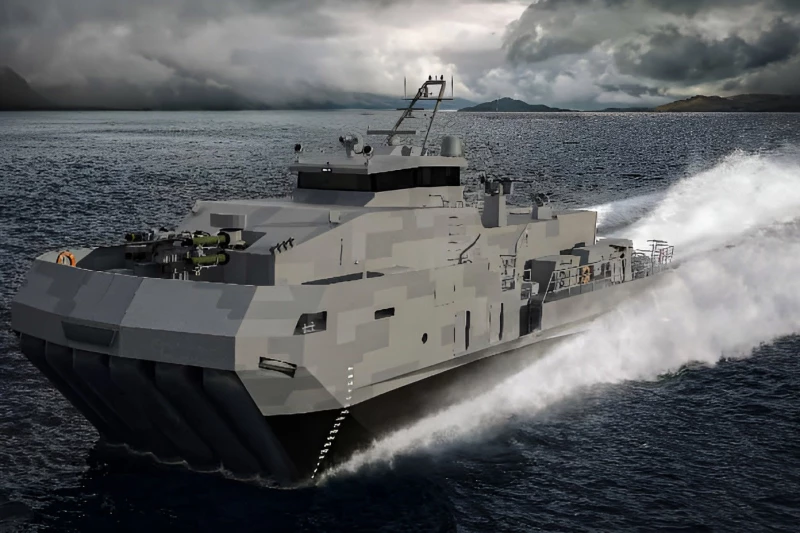
Autonomous warships have moved into the large fast-attack league as Eureka Naval Craft announces what it describes as the most advanced autonomous naval attack vessel in the world. It can carry 40 tonnes and reach speeds of up to 50 knots (57 mph, 92 km/h).
The gap between conventional warships and autonomous ones keeps getting blurred as the latter grow in size and capabilities. Case in point is Eureka's AIRCAT Bengal Module Carrier (MC), which was unveiled at the recent Sea Air and Space Exhibition in Maryland. A variant of the company's previous crewed Bearcat model, it boasts not only improved payload capacity, but AI-powered autonomy courtesy of Greenroom Robotics.
A Ukrainian sea drone downed a $50-million Russian fighter jet over the Black Sea in what has been described as a world first, according to military intelligence in Kyiv.
Ukraine's intelligence agency, the GUR, published video of what it said was an unprecedented operation near the Russian port of Novorossiysk using a Magura sea drone that was equipped with a missile warhead.
Ukraine's claims have not been independently verified and Newsweek has contacted the Russian defense ministry for comment.
Why it matters
Since the start of Vladimir Putin's full-scale invasion, Ukraine has developed its drones which have been used to make headline-grabbing strikes in the Black Sea pushing Russia's Navy back from its main site in Crimea.
As a sign of these developing capabilities, Ukraine used the Magura V5 drone to down two Russian Mi-8 helicopters on December 31, 2024 in what was then considered a world-first drone strike on airborne targets from the sea. A drone strike on a Russian fighter jet demonstrates a new threat for Moscow.
It looks like the age of the robotic warrior is here. The RAF has revealed that a radar-jamming combat drone called StormShroud will be deployed to support Britain's F-35B Lightning II and Typhoon fighters using lessons learned from Russia's invasion of Ukraine.
The idea of combat drones taking their place alongside conventional warplanes has been accepted for well over a quarter of a century, but the 2022 Russian invasion of Ukraine has pushed the trend into top gear as both sides have shown innovative new ways to use drones in the conflict.
While Loyal Wingman-type autonomous fighters are still in the works and two have officially joined the US Air Force, they're still in the prototype or pre-production phase. The Royal Air Force has taken its Autonomous Collaborative Platforms (ACP) a step further with StormShroud, whose job is to use electronic countermeasures to punch a hole in hostile air defenses.
High-energy laser takes down drone in world-first combat engagement
By David Szondy
May 28, 2025
The age of laser weapons looks to have officially dawned. Rafael Advanced Defense Systems says that, for the first time in history, a high-energy laser system has been used to destroy multiple drone targets in combat.
Though we tend to think of laser weapons as something that is still futuristic, lasers and laser weapons have been around for a long time. In fact, scientists and engineers were studying military applications for lasers almost as soon as the first laser was invented in 1960. By the end of the Vietnam War, lasers were being used as rangefinders and for illuminating targets for bombs and missiles to home in on.
Even the use of laser weapons in combat isn't entirely new. The first laser weapons were deployed by the Royal Navy during the Falklands War in 1982, though these were what is known as dazzler lasers. Their purpose wasn't to destroy things. Instead, their function was to momentarily dazzle or distract enemy pilots, spoiling their missile and bomb runs.
Report Concludes Israeli Commandos Attacked Iranian Air Defenses with Drones from Inside the Country by Thomas Newdick
Updated June 13, 2025
Introduction:
(The War Zone) Israel’s Operation Rising Lion, which aims to neuter Iran’s nuclear and long-range weapons capabilities, began with an overnight attack on a wide array of targets. These strikes included the use of drones and missiles launched by operatives from deep within Iran. This is the conclusion of a report from Israeli outlet N12, which cites an unnamed Israeli security source.
While details understandably remain thin, the implication is that Mossad meticulously prepared for the attack over many months, including placing agents in Iran. From there, they would operate one-way attack drones and loitering anti-armor missiles, as well as establish a covert drone base “in the heart of Iran,” to neutralize Iranian air defenses and create other critical effects to kick off the long-awaited campaign.
“As part of their activities, Mossad agents implemented significant moves to introduce special weapons on a large scale, deploy them throughout Iran, and launch them towards the attack targets in a precise and effective manner,” the security source told N12.
Among the targets reportedly prosecuted by Israeli operatives within Iran was an air defense site near Tehran. Shortly before the operation began, Israeli drones launched from within Iran struck surface-to-air missile launchers there, clearing the way for the larger strike, which also involved Israeli Air Force (IAF) fighter jets. This would also explain the apparent inactivity by Iranian air defense sites during the Israeli bombardment. At the same time, the IAF has also been flying suppression and destruction of enemy air defenses (SEAD/DEAD) operations that the service says have destroyed “dozens of radars and surface-to-air missile launchers.”
DARPA fast tracks flight tests for new military drones
By David Szondy
June 27, 2025
In an effort to supercharge the development of military drones, DARPA will this year fast track flight testing of five advanced Unmanned Aerial Systems (UAS) prototypes as part of the agency's Early VTOL Aircraft Demonstration (EVADE) project.
With recent conflicts demonstrating how inexpensive drones are quickly revolutionizing warfare, DARPA is seeking ways to get ahead of the technological curve as fast as possible. To that end, it is shaping the second phase of its AdvaNced airCraft Infrastructure-Less Launch And RecoverY (ANCILLARY) program by prioritizing rapid prototyping and accelerated flight testing of Group 3 drones (weighing 330 lb or 150 kg). The focus is on addressing problems as they emerge through testing, rather than aiming for perfection on the first flight.