
Soft microrobots can manipulate individual cells
22nd July 2024
Researchers in Hungary have developed microscopic tools able to capture and move individual cells with more ease and efficiency.
[...]
The microrobots are made using a laser-based, additive microfabrication technique known as two-photon polymerisation. This method allows the creation of intricate 3D structures that are both robust and flexible. The deformable parts of the structures are as thin as 300 nanometres, which is necessary for the optical tweezers to bend them.
Read more: https://www.futuretimeline.net/blog/202 ... lation.htm
Nanobots and Nanoparticles
Re: Nanobots and Nanoparticles
Scientists invent nanorobots that can repair brain aneurysms
September 5, 2024
Tiny robots much smaller than blood cells could deliver clot-forming drugs where they're needed most, a study in rabbits suggests. The tech has yet to be tested in humans.
https://www.livescience.com/health/scie ... -aneurysms

Credit: University of Edinburgh
September 5, 2024
Tiny robots much smaller than blood cells could deliver clot-forming drugs where they're needed most, a study in rabbits suggests. The tech has yet to be tested in humans.
https://www.livescience.com/health/scie ... -aneurysms
Credit: University of Edinburgh
-
weatheriscool
- Posts: 26094
- Joined: Sun May 16, 2021 6:16 pm
- Contact:
Re: Nanobots and Nanoparticles
Nanorobots move closer to clinical trials with new model that helps them navigate through the bloodstream
https://phys.org/news/2024-11-nanorobot ... tream.html
by Erin Matthews, University of Saskatchewan
https://phys.org/news/2024-11-nanorobot ... tream.html
by Erin Matthews, University of Saskatchewan
From repairing deadly brain bleeds to tackling tumors with precise chemotherapy, micro/nano-robots (MNRs) are a promising, up-and-coming tool that have the power to substantially advance health care. However, this tool still has difficulty navigating within the human body—a limitation that has prevented it from entering clinical trials.
Mathematical models are crucial to the optimal design and navigation of MNRs, but the current models are inadequate. Now, new, promising research from the University of Saskatchewan (USask) may allow MNRs to overcome the limitations that previously prevented their widespread use.
Re: Nanobots and Nanoparticles
Nanoparticles shrink arterial plaque in new study
Researchers in Australia have engineered nanoparticles that detect and treat arterial plaque, reducing its size by up to 52% in preclinical trials.
4th September 2025
Atherosclerosis – the build-up of plaque inside arteries – is a major driver of cardiovascular disease, the world's leading cause of death. Over time, this mixture of fats, cholesterol, calcium, and fibrous tissue narrows blood vessels and restricts blood flow, greatly increasing the risk of heart attack and stroke. Each year, cardiovascular disease claims an estimated 17.9 million lives, more than 30% of all deaths globally. Although current treatments can lower cholesterol levels and reduce risk, they often struggle to reverse plaque that has already formed.
Now, scientists at the South Australian Health and Medical Research Institute (SAHMRI) have developed porphyrin-lipid nanoparticles (Por-NPs) that could transform how we approach the disease. These particles are coated with R4F, a short peptide, allowing them to home in on immune cells that drive inflammation inside artery walls. Once there, they function as both a diagnostic tool and a therapy – a so-called "theranostic" strategy – lighting up plaques for imaging while also helping to shrink them.
In laboratory studies, the nanoparticles increased the removal of cholesterol from immune cells and sharply reduced levels of inflammatory molecules linked with atherosclerosis. In mouse models, they cut early plaque size by around 23% and unstable, high-risk plaques by as much as 52%. They also lowered the numbers of circulating monocytes and aortic monocytes – the inflammatory cells that help drive the disease – by 32% and 81%, respectively.
"These nanoparticles don't just detect arterial plaque in arteries, they can also suck it up and take it to the liver, lowering inflammation," said study lead Dr Victoria Nankivell from SAHMRI. "What sets these nanoparticles apart is their ability to interact directly with immune cells in the arteries, drawing out cholesterol and helping the body process it more effectively."
Read more: https://www.futuretimeline.net/blog/202 ... -study.htm
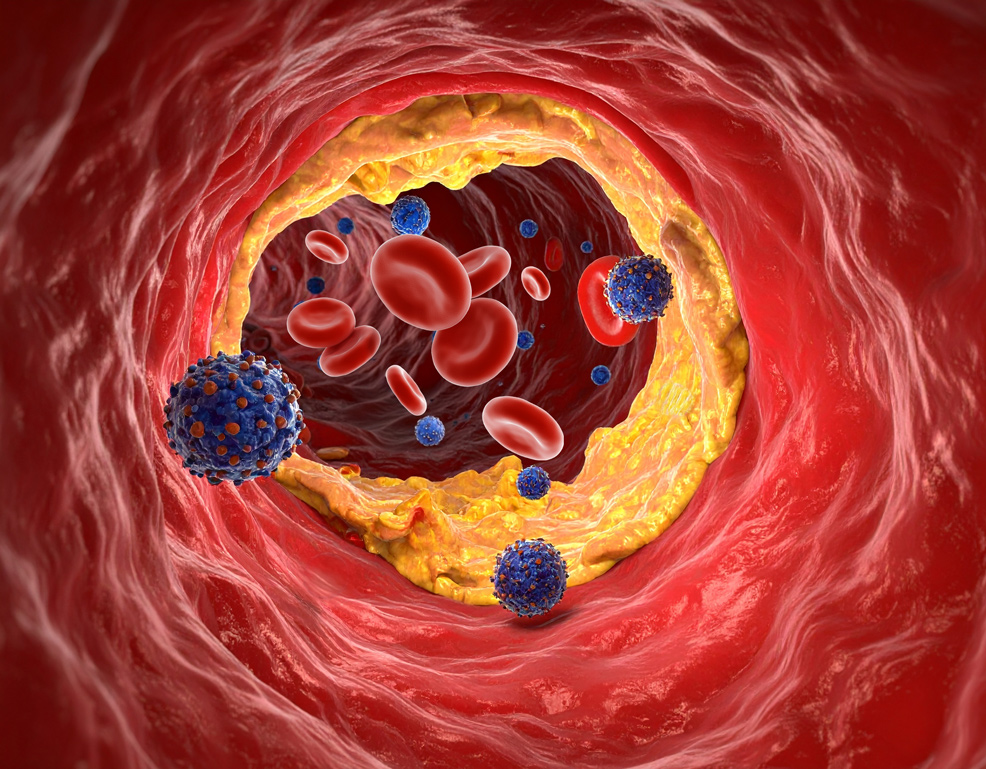
Researchers in Australia have engineered nanoparticles that detect and treat arterial plaque, reducing its size by up to 52% in preclinical trials.
4th September 2025
Atherosclerosis – the build-up of plaque inside arteries – is a major driver of cardiovascular disease, the world's leading cause of death. Over time, this mixture of fats, cholesterol, calcium, and fibrous tissue narrows blood vessels and restricts blood flow, greatly increasing the risk of heart attack and stroke. Each year, cardiovascular disease claims an estimated 17.9 million lives, more than 30% of all deaths globally. Although current treatments can lower cholesterol levels and reduce risk, they often struggle to reverse plaque that has already formed.
Now, scientists at the South Australian Health and Medical Research Institute (SAHMRI) have developed porphyrin-lipid nanoparticles (Por-NPs) that could transform how we approach the disease. These particles are coated with R4F, a short peptide, allowing them to home in on immune cells that drive inflammation inside artery walls. Once there, they function as both a diagnostic tool and a therapy – a so-called "theranostic" strategy – lighting up plaques for imaging while also helping to shrink them.
In laboratory studies, the nanoparticles increased the removal of cholesterol from immune cells and sharply reduced levels of inflammatory molecules linked with atherosclerosis. In mouse models, they cut early plaque size by around 23% and unstable, high-risk plaques by as much as 52%. They also lowered the numbers of circulating monocytes and aortic monocytes – the inflammatory cells that help drive the disease – by 32% and 81%, respectively.
"These nanoparticles don't just detect arterial plaque in arteries, they can also suck it up and take it to the liver, lowering inflammation," said study lead Dr Victoria Nankivell from SAHMRI. "What sets these nanoparticles apart is their ability to interact directly with immune cells in the arteries, drawing out cholesterol and helping the body process it more effectively."
Read more: https://www.futuretimeline.net/blog/202 ... -study.htm