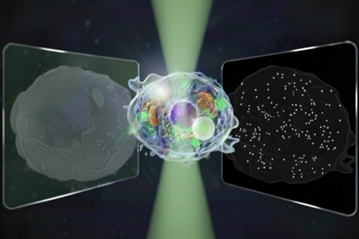
The “Great Unified Microscope” can see both micro and nanoscale structures
2025.11.14
Researchers unify two conventional techniques that so far have been used to make either micro- or nanoscale observations
Researchers Kohki Horie, Keiichiro Toda, Takuma Nakamura, and Takuro Ideguchi of the University of Tokyo have built a microscope that can detect a signal over an intensity range fourteen times wider than conventional microscopes. Moreover, the observations are made label-free, that is, without the use of additional dyes. This means the method is gentle on cells and adequate for long-term observations, holding potential for testing and quality control applications in the pharmaceutical and biotechnology industries. The findings are published in the journal Nature Communications.
Microscopes have played a pivotal role in the development of science since the 16th century. However, progress has required not only more sensitive and accurate equipment and analysis, but also more specialized ones. Therefore, modern, cutting-edge techniques have had to straddle tradeoffs. Quantitative phase microscopy (QPM) leverages forward-scattered light and can detect structures at the microscale (in this study, over 100 nanometers), but not smaller. Consequently, this technique has been primarily used to take static pictures of relatively complex cell structures. Interferometric scattering (iSCAT) microscopy, on the other hand, exploits back-scattered light and can detect structures as small as single proteins. As such, it can be used to “track” single particles, allowing insight into dynamical changes within the cell, but it cannot provide the comprehensive view that QPM can.
“I would like to understand dynamic processes inside living cells using non-invasive methods,” says Horie, one of the first authors.
Thus, the research team set out to investigate whether measuring both directions of light simultaneously could overcome the tradeoff and reveal a wide range of sizes and motions from the same image. To test the idea and confirm their newly built microscope was working as hoped, the researchers set out to observe what happened during cell death. They recorded one image encoding information from both forward and backward-traveling light.
https://www.s.u-tokyo.ac.jp/en/press/10974/