Material Science News and Discussions

weatheriscool
Posts: 24482
Joined: Sun May 16, 2021 6:16 pm
Contact:

Re: Material Science News and Discussions

Post by weatheriscool »

Strong shape-memory adhesive could put Spider-Man to shame
By Michael Irving
May 02, 2024
https://newatlas.com/materials/spiderma ... -adhesive/
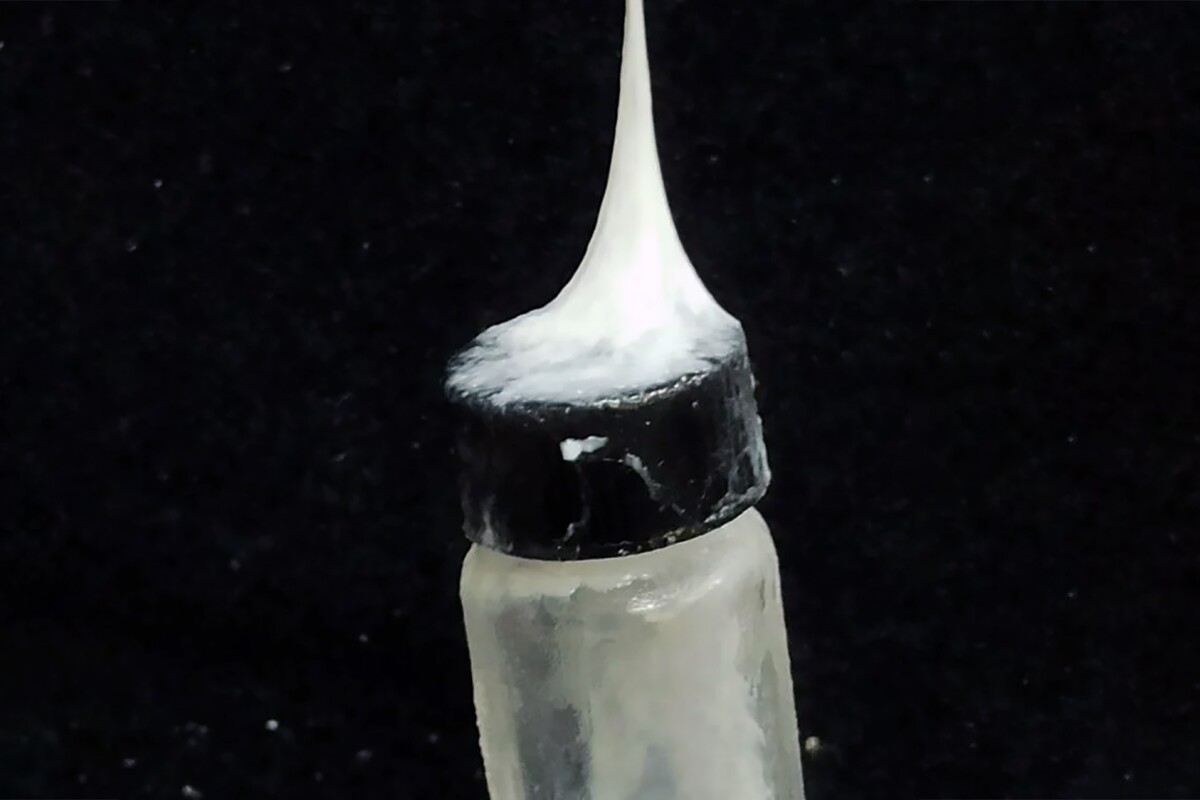
You can stop skulking around labs trying to get bitten by radioactive spiders – a new breakthrough could make it easier than ever to get Spider-Man’s wall-crawling powers. Scientists in Singapore have created a strong and reusable adhesive out of a shape-memory polymer, sticking to and detaching from surfaces by changing the temperature.

The polymer is called E44 epoxy, and at room temperature it’s a stiff and glassy plastic, but once heated up it becomes soft and rubbery. In that state, it can ooze into the tiny crannies and crevices of another surface, allowing it to form extra-strong bonds if it’s then cooled down. If you later want to remove it, all you need to do is heat it back up.

In tests conducted by scientists at Nanyang Technological University (NTU) Singapore, the adhesive was able to grab onto a range of different textures and didn’t leave any sticky residue behind. Through experimentation, the team found that the best shape for the material was a series of hair-like structures called fibrils, each a few millimeters wide.

For example, one setup used fibrils with a cross section of 19.6 mm2 (0.03 in2), with each being able to hold up to 1.56 kg (3.4 lb). Adding more fibrils increases the maximum weight the material can hold, with a palm-sized pad of 37 fibrils holding a 60-kg (132-lb) weight.
weatheriscool
Posts: 24482
Joined: Sun May 16, 2021 6:16 pm
Contact:

Re: Material Science News and Discussions

Post by weatheriscool »

Long-life low-carbon concrete switches 80% of its cement for coal ash
By Loz Blain
May 21, 2024
RMIT researchers have developed a new type of "green concrete" that incorporates twice as much recycled coal ash as existing low-carbon concretes, halves the amount of cement required, and lasts even longer than regular Portland cement concrete.

Coal ash is abundant around coal-fired power stations. In fact, that might be considerably understating things – globally, power stations produce around 1.2 billion tonnes annually, and in Australia coal ash accounts for nearly 20% of all waste. It's a staggering figure – and it's also a safe bet that this stuff will remain abundant long into the renewable energy transition.

Hence, it's an enormous potential material resource, and low-carbon concrete manufacturers have been using it as a cement substitute, typically replacing up to 40% of the cement. In an environmental sense, this kills two birds with one stone, making use of a massive waste product while cutting down on cement – which by itself accounts for somewhere around 8% of all global carbon emissions.
https://newatlas.com/materials/rmit-ash-concrete/
weatheriscool
Posts: 24482
Joined: Sun May 16, 2021 6:16 pm
Contact:

Re: Material Science News and Discussions

Post by weatheriscool »

Game-changing nanostrings vibrate longer than any solid-state material
By Michael Franco
May 22, 2024
"Imagine a swing that, once pushed, keeps swinging for almost 100 years because it loses almost no energy through the ropes." So says a Delft University of Technology researcher who has helped his team accomplish a parallel feat at the nanoscale.

In creating their super-vibrational nanostrings, Norte and his fellow TU Delft colleagues – along with scientists from Brown University – stretched out a strand of extremely resilient silicon nitride (Si3N4) to a length of 3 cm (1.2 in) while maintaining it at a thickness of just 70 nanometers. This is "equivalent to reliably producing ceramic structures with a thickness of one millimeter, suspended over nearly half a kilometer," write the researchers in a paper published in Nature Communications.

"Our manufacturing process goes in a different direction with respect to what is possible in nanotechnology today," says study co-author Andrea Cupertino, also from TU Delft.

"These kinds of extreme structures are only feasible at nanoscales where the effects of gravity and weight enter differently," she adds. "This allows for structures that would be unfeasible at our everyday scales but are particularly useful in miniature devices used to measure physical quantities such as pressure, temperature, acceleration and magnetic fields, which we call MEMS sensing."

Once the nanostrings were manufactured, they were clamped above a microchip. The strings were then shown to be able to vibrate 100,000 times per second without losing much momentum at ambient temperatures. Such a feat has previously only been exhibited by materials near absolute zero temperatures.

"The newly developed nanostrings boast the highest mechanical quality factors ever recorded for any clamping object in room temperature environments; in their case clamped to a microchip," says the TU Delft report.
https://newatlas.com/materials/nanostri ... te-longer/
weatheriscool
Posts: 24482
Joined: Sun May 16, 2021 6:16 pm
Contact:

Re: Material Science News and Discussions

Post by weatheriscool »

'Absolute miracle' breakthrough provides recipe for zero-carbon cement
By Michael Irving
May 23, 2024
https://newatlas.com/materials/concrete ... on-cement/
Concrete and steel production are major sources of CO2 emissions, but a new solution from Cambridge could recycle both at the same time. Throwing old concrete into steel-processing furnaces not only purifies iron but produces “reactivated cement” as a byproduct. If done using renewable energy, the process could make for completely carbon-zero cement.

Concrete is the world’s most used building material, and making it is a particularly dirty business – concrete production alone is responsible for about 8% of total global CO2 emissions. Unfortunately it’s not easy to recycle back into a form that can be used to make new concrete structures.
weatheriscool
Posts: 24482
Joined: Sun May 16, 2021 6:16 pm
Contact:

Re: Material Science News and Discussions

Post by weatheriscool »

More transparent than glass, new material cools rooms and self-cleans
By Michael Irving
May 27, 2024
Having lots of glass surfaces can brighten up a room, but it also lets in too much heat as well as neighbors’ prying eyes. A new metamaterial is not only more transparent to light, but adds privacy, cools the room inside, and automatically cleans itself.

Known as a Polymer-based Micro-photonic Multi-functional Metamaterial (PMMM), the team’s creation takes the form of a thin film that can be stuck onto a pane of regular glass. It gets its special properties from the microscopic structure of its surface, which is etched with a pattern of pyramids each just 10 microns wide.

These mini-pyramids scatter 73% of the light that hits them, which gives the material that frosted look. But despite that, it’s surprisingly more transparent to light than regular glass – 95% transmittance compared to the usual 91% of most glass. The team says that makes for a more comfortable lighting not just for people, but plants as well.

“When the material is used in roofs and walls, it allows for bright yet glare-free and privacy-protected indoor spaces for work and living,” said Gan Huang, lead author of the study. “In greenhouses, the high light transmittance could increase yields because the photosynthesis efficiency is estimated to be 9% higher than in greenhouses with glass roofs.”

PMMM’s coolest trick (pun intended) is its ability to beam heat directly into outer space, thus cooling a room. It sounds like sci-fi stuff, but it’s a well-studied phenomenon called radiative cooling that takes advantage of the fact that the Earth’s atmosphere is transparent to infrared wavelengths. By using the universe as one colossal heat sink, tests showed that the material kept a room 6 °C (10.8 °F) cooler than the ambient air.
https://newatlas.com/materials/metamate ... -cleaning/
weatheriscool
Posts: 24482
Joined: Sun May 16, 2021 6:16 pm
Contact:

Re: Material Science News and Discussions

Post by weatheriscool »

Concrete-nitrogen mix may provide major health and environment benefits
https://techxplore.com/news/2024-06-con ... nment.html
by University of Birmingham
Adding nitrogen to concrete could significantly reduce global levels of potentially harmful nitrogen oxides (NOx) created by the construction industry in developing towns and cities, a new study reveals.

Researchers believe that concrete nitrogenation could contribute to a reduction in NOx emissions by 3.4–6.9 megatonnes (Mt)—representing 6–13% of industry-related emissions in 2021.

By 2050 the process could reduce NOx by a total of 131–384 Mt. It could represent the equivalent to 75–260 years potentially lost to premature death and reduced quality of life, estimated in terms of disability-adjusted life years (DALY).
weatheriscool
Posts: 24482
Joined: Sun May 16, 2021 6:16 pm
Contact:

Re: Material Science News and Discussions

Post by weatheriscool »

Researchers Create Gelatin-Based Textiles That Dissolve For Easy Disposal
Plus, a $560 open-source machine that spins gelatin-based fibers on our desktop.
By Adrianna Nine June 19, 2024
https://www.extremetech.com/science/res ... y-disposal
Textile scientists in Colorado have found a way to make clothing out of the stuff used in jiggly, jewel-colored desserts. Gelatin, a byproduct of the meat and leather industries, can be spun into threads to make fabrics that are resilient while dry, but dissolve in hot water when the wearer no longer wants them. Researchers have also landed on a method of production that requires just one small, inexpensive machine, rather than a room-sized manufacturing setup.

The unexpected new textile comes from the Unstable Design Lab at the University of Colorado at Boulder. This lab focuses on all angles of the textile production process—not just the fabrics themselves, but also the equipment, materials, weaving methods, and designs used to create them. In an effort to create a textile that would skirt the landfill when it was no longer wanted, researchers at the Unstable Design Lab experimented with gelatin, a cheap, accessible, and biodegradable byproduct.
weatheriscool
Posts: 24482
Joined: Sun May 16, 2021 6:16 pm
Contact:

Re: Material Science News and Discussions

Post by weatheriscool »

Researchers create new class of materials called 'glassy gels'
https://phys.org/news/2024-06-class-mat ... -gels.html
by North Carolina State University
Researchers have created a new class of materials called "glassy gels" that are very hard and difficult to break despite containing more than 50% liquid. Coupled with the fact that glassy gels are simple to produce, the material holds promise for a variety of applications.

A paper describing this work, titled "Glassy Gels Toughened by Solvent," appears in the journal Nature.

Gels and glassy polymers are classes of materials that have historically been viewed as distinct from one another. Glassy polymers are hard, stiff and often brittle. They're used to make things like water bottles or airplane windows. Gels—such as contact lenses—contain liquid and are soft and stretchy.
weatheriscool
Posts: 24482
Joined: Sun May 16, 2021 6:16 pm
Contact:

Re: Material Science News and Discussions

Post by weatheriscool »

New "glassy gel" materials are strangely strong, stretchy and sticky
By Michael Irving
July 01, 2024
https://newatlas.com/materials/glassy-g ... hy-sticky/
Gels and glasses are on opposite ends of the material spectrum, but engineers at North Carolina State University (NCSU) have developed a new class called “glassy gels” that are both strong and flexible, as well as sticky and self-healing.

Glassy polymers are plastics made to have properties like glass – they’re strong, hard, and stiff, but also usually brittle, fracturing if you try to bend or stretch them. Gels on the other hand are soft and flexible, but also weak. The NCSU team has now developed a new material that combines the best of both worlds.
weatheriscool
Posts: 24482
Joined: Sun May 16, 2021 6:16 pm
Contact:

Re: Material Science News and Discussions

Post by weatheriscool »

'Superlubricious' coating radically drops friction between metal parts
By Michael Franco
July 16, 2024
https://newatlas.com/materials/superlub ... -machines/
Using biowaste from cassava plants, scientists have created a coating that virtually eliminates friction in metal parts. The breakthrough has the potential to deliver better fuel economy, extend the lifespan of moving parts, and deliver enormous savings in myriad industries.

For all they can do for us, moving parts inside machinery come with an inherent problem: friction.

According to a research paper just released by scientists from various institutions in Africa and the United States, friction is responsible for consuming about one-fifth of all energy generated globally each year. Furthermore, the authors write, damage caused by friction in machinery eats up between one to four percent of industrialized economies' GDP. In the automotive industry, the researchers say that about 30% of fuel put into passenger vehicles is used to overcome friction.
firestar464
Posts: 7202
Joined: Wed Oct 12, 2022 7:45 am

Re: Material Science News and Discussions

Post by firestar464 »

Coaxing purple bacteria into becoming bioplastic factories

https://phys.org/news/2024-08-coaxing-p ... ories.html
weatheriscool
Posts: 24482
Joined: Sun May 16, 2021 6:16 pm
Contact:

Re: Material Science News and Discussions

Post by weatheriscool »

Stanford breakthrough promises 50% cheaper, cleaner lithium extraction
By Abhimanyu Ghoshal
August 27, 2024
https://newatlas.com/materials/cheaper- ... xtraction/
You know how EVs and practically anything else that runs on lithium batteries aren't really all that 'green' because producing lithium takes a huge toll on the planet?

Scientists at Stanford say they've worked out a way to extract lithium from brine solutions that's far more efficient, cheaper by half, and a lot more eco-friendly than current methods.

That's good news for a bunch of reasons. Thanks to EVs and renewable energy storage systems, in the future we're going to need far more lithium – not less. Lithium extraction firm Lilac Solutions estimates the auto industry alone will require a 20-fold increase in lithium supply.

Next, conventional lithium extraction requires a lot of resources, including energy, land, and water. As things stand, it takes about 500,000 liters of water to extract one ton of lithium.
weatheriscool
Posts: 24482
Joined: Sun May 16, 2021 6:16 pm
Contact:

Re: Material Science News and Discussions

Post by weatheriscool »

No glue required: Wood and metal bonded with sound and 3D printing
By Michael Franco
August 28, 2024
https://newatlas.com/materials/adhesive ... ood-metal/
Manufacturing could be dramatically changed thanks to two new techniques for joining materials created by scientists in Austria. The two methods create super strong bonds at the pore level, eliminating the need for caustic adhesives.

While industrial adhesives are great for joining part A to part B, they're not really very good for the environment, especially those made from petroleum-based chemicals. Not only do these adhesives require a good deal of energy and resources to produce, but their manufacture can produce harmful pollutants; plus, once the items in which they've been used reach the end of their lifecycle, they can contaminate soil and groundwater. Additionally, some of the chemicals used in adhesive production can be harmful to the workers using them.

While there has been quite a push to create more eco-friendly adhesives, from such things as a reusable glue made from plants to an adhesive that biodegrades after use, researchers at the Graz University of Technology (TU Graz) in Austria took another approach. Two other approaches, actually, both of which achieved bonds between a variety of wood types and two types of plastics, stainless steel, and a titanium alloy.
weatheriscool
Posts: 24482
Joined: Sun May 16, 2021 6:16 pm
Contact:

Re: Material Science News and Discussions

Post by weatheriscool »

Team develops tougher concrete, inspired by bone
https://techxplore.com/news/2024-09-tea ... -bone.html
by Princeton University
Inspired by the architecture of human bone's tough outer layer, engineers at Princeton have developed a cement-based material that is 5.6 times more damage-resistant than standard counterparts. The bio-inspired design allows the material to resist cracking and avoid sudden failure, unlike conventional, brittle cement-based counterparts.

In a new article in the journal Advanced Materials, the research team led by Reza Moini, an assistant professor of civil and environmental engineering, and Shashank Gupta, a third-year Ph.D. candidate, demonstrates that cement paste deployed with a tube-like architecture can significantly increase resistance to crack propagation and improve the ability to deform without sudden failure.

"One of the challenges in engineering brittle construction materials is that they fail in an abrupt, catastrophic fashion," Gupta said.
weatheriscool
Posts: 24482
Joined: Sun May 16, 2021 6:16 pm
Contact:

Re: Material Science News and Discussions

Post by weatheriscool »

Spider-Man-inspired sticky silk fibers lift 80 times their weight
By Paul McClure
October 10, 2024
It’s straight out of a comic book: a shot of liquid silk quickly hardens into a sticky, strong fiber that can lift objects 80 times heavier. Sound familiar? Researchers have described the Spider-Man-inspired tech in a new study.

A newly-created web-like material will make many people who read comics as kids (or adults) very happy. Spider-Man is officially a step closer to existing in real life. Sure, we’re not at the swinging-from-building-to-building stage yet, but it feels like it’s not too far off.

In a new study, a team of researchers from Tufts University’s Silklab, whose goal is to reimagine natural materials as ‘living materials,’ has created the first web-slinging technology in which a fluid material shot from a needle almost immediately solidifies – and is strong enough to adhere to and pick up objects.
Image
https://newatlas.com/materials/spider-m ... lk-fibers/
weatheriscool
Posts: 24482
Joined: Sun May 16, 2021 6:16 pm
Contact:

Re: Material Science News and Discussions

Post by weatheriscool »

Ultra-thin film that absorbs nearly all electromagnetic waves could improve reliability of wireless communication
https://techxplore.com/news/2024-10-ult ... ility.html
by National Research Council of Science and Technology
The research team of Dr. Byeongjin Park and Dr. Sang Bok Lee from the Composites & Convergence Materials Research Division at the Korea Institute of Materials Science (KIMS), has developed the world's first ultra-thin film composite material capable of absorbing over 99% of electromagnetic waves from various frequency bands (such as 5G/6G, WiFi, and autonomous driving radar) using a single material.

The findings were published as the cover article in the October 1 edition of Advanced Functional Materials.

This electromagnetic wave absorption and shielding material is less than 0.5mm thick and is distinguished by its low reflectance of less than 1% and high absorbance of over 99% across three different frequency bands.

Electromagnetic waves emitted by electronic components can cause interference, leading to performance degradation in other nearby electronic devices.
weatheriscool
Posts: 24482
Joined: Sun May 16, 2021 6:16 pm
Contact:

Re: Material Science News and Discussions

Post by weatheriscool »

New method successfully recycles carbon fiber composite into reusable materials
https://phys.org/news/2024-10-method-su ... fiber.html
by University of Southern California
USC researchers have developed a new process to upcycle the composite materials appearing in automobile panels and light rail vehicles, addressing a current environmental challenge in the transportation and energy sectors. The study recently appeared in the Journal of the American Chemical Society.

"I wasn't sure if it was possible to fully recycle composite materials," said Travis Williams, professor of chemistry at the USC Dornsife College of Letters, Arts and Sciences. "As wonderful as these materials are for making energy-efficient vehicles, the problem with composites is we don't have a practical route to recycle them, so the materials end up in landfills."

The chemistry demonstrated in the study, a partnership among Williams and professors Steven Nutt of the M.C. Gill Composites Center at the USC Viterbi School of Engineering, Clay C.C. Wang of the USC Alfred E. Mann School of Pharmacy and Pharmaceutical Sciences and Berl Oakley of the University of Kansas, is a new approach that shows that composite materials can be recovered and recycled in a manner that preserves the integrity of the materials.
weatheriscool
Posts: 24482
Joined: Sun May 16, 2021 6:16 pm
Contact:

Re: Material Science News and Discussions

Post by weatheriscool »

Durable supramolecular plastic is fully ocean-degradable and doesn't generate microplastics
https://phys.org/news/2024-11-durable-s ... ocean.html
by RIKEN
Researchers led by Takuzo Aida at the RIKEN Center for Emergent Matter Science (CEMS) have developed a new durable plastic that won't pollute our oceans. The new material is as strong as conventional plastics and biodegradable, but what makes it special is that it breaks down in seawater. The new plastic is therefore expected to help reduce harmful microplastic pollution that accumulates in oceans and soil and eventually enters the food chain.

The experimental findings are published Nov 22 in Science.

Scientists have been trying to develop safe and sustainable materials that can replace traditional plastics, which are non-sustainable and harm the environment. While some recyclable and biodegradable plastics exist, one big problem remains. Current biodegradable plastics like PLA often find their way into the ocean where they cannot be degraded because they are water insoluble. As a result, microplastics—plastic bits smaller than 5 mm—are harming aquatic life and finding their way into the food chain, including our own bodies.
weatheriscool
Posts: 24482
Joined: Sun May 16, 2021 6:16 pm
Contact:

Re: Material Science News and Discussions

Post by weatheriscool »

Prototype device produces critical fertilizer ingredient from thin air, cutting carbon emissions
https://techxplore.com/news/2024-12-pro ... dient.html
by Stanford University
The air around us contains a powerful solution for making agriculture more sustainable. Researchers at Stanford University and King Fahd University of Petroleum and Minerals in Saudi Arabia have developed a prototype device that can produce ammonia—a key fertilizer ingredient—using wind energy to draw air through a mesh.

The approach they developed, if perfected, might eliminate the need for a century-old method that produces ammonia by combining nitrogen and hydrogen at high pressures and temperatures. The older method consumes 2% of global energy and contributes 1% of annual carbon dioxide emissions from its reliance on natural gas.
weatheriscool
Posts: 24482
Joined: Sun May 16, 2021 6:16 pm
Contact:

Re: Material Science News and Discussions

Post by weatheriscool »

A football field in a teaspoon: New material has insane surface area
By Michael Franco
December 20, 2024
Using principles from rocket science, researchers have created carbon with a record-breaking surface area. The material can soak up about twice the amount of CO2 as current activated carbon materials and has impressive energy-storage capabilities.

As you might remember from combining baking soda and vinegar to make a volcano in high school, when certain chemicals come in contact with each other, the results can be explosive.

Taking this principle to much more serious degrees, rocket scientists have been using something known as hypergolic reactions as fuel for a range of space craft for years. These are reactions between two chemicals (typically a fuel and an oxidizer) that are so violent that they can provide propulsion if channeled correctly. One of the more common combinations in the world of hypergolic propulsion, for instance, is mixing the fuel hydrazine with the oxidizer nitrogen tetroxide.
https://newatlas.com/materials/cornell- ... face-area/
Post Reply