Microscopy & Imaging News and Discussions

weatheriscool
Posts: 24482
Joined: Sun May 16, 2021 6:16 pm
Contact:

Re: Microscopy & Imaging News and Discussions

Post by weatheriscool »

Researchers use nanoparticles to increase light frequency and resolution of imaging systems
https://phys.org/news/2023-04-nanoparti ... aging.html
by Australian National University

Physicists at the Australian National University (ANU) are using nanoparticles to develop new sources of light that will allow us to "peel back the curtain" into the world of extremely small objects—thousands of times smaller than a human hair—with major gains for medical and other technologies.

The findings, published in Science Advances, could have major implications for medical science by offering an affordable and effective solution to analyze tiny objects that are too small for microscopes to see, let alone the human eye. The work could also be beneficial for the semiconductor industry and improving quality control of the fabrication of computer chips. The ANU technology uses carefully engineered nanoparticles to increase the frequency of light that cameras and other technologies see by up to seven times. The researchers say there is "no limit" to how high the frequency of light can be increased. The higher the frequency, the smaller the object we are able to see using that light source.

The technology, which requires only a single nanoparticle to work, could be implemented into microscopes to help scientists zoom into the world of super small things at 10 times the resolution of conventional microscopes. This would enable researchers to study objects that would otherwise be too small to see, such as the inner structures of cells and individual viruses.

Being able to analyze such small objects could help scientists better understand and fight certain diseases and health conditions.

weatheriscool
Posts: 24482
Joined: Sun May 16, 2021 6:16 pm
Contact:

Re: Microscopy & Imaging News and Discussions

Post by weatheriscool »

Quantum microscope taps "spooky" physics to double resolution of images
By Michael Irving
May 02, 2023
https://newatlas.com/science/quantum-mi ... esolution/

Scientists at Caltech have created a quantum microscope that taps into the quirky quantum rules to see tiny details much more clearly. Using pairs of entangled photons allows the instrument to double the resolution of images without damaging the sample.

A key limitation of microscopes is that they can only image objects or details that are half the wavelength of the light used – so for optical microscopes, details can be seen down to about 200 nanometers. Using photons with shorter wavelengths, such as ultraviolet, can allow microscopes to look closer.

But, of course, there’s a catch. The shorter the wavelength the higher the energy, so by the time you get down to these scales the photons used to image the samples are damaging or even destroying them.

But the Caltech team’s quantum microscope gets around this problem thanks to the spooky properties of quantum physics. Entanglement is a strange phenomenon where two or more particles can become so entwined with each other that it becomes impossible to describe one without the other. In this case, the scientists entangle two photons into one unit called a biphoton, which behaves like a single photon with lower energy and half the wavelength.

“Cells don't like UV light,” said Lihong Wang, lead researcher on the study. “But if we can use 400-nanometer light to image the cell and achieve the effect of 200-nm light, which is UV, the cells will be happy, and we're getting the resolution of UV.”
weatheriscool
Posts: 24482
Joined: Sun May 16, 2021 6:16 pm
Contact:

Re: Microscopy & Imaging News and Discussions

Post by weatheriscool »

Magnetic guidewire steering at ultrahigh magnetic fields for medical imaging
https://medicalxpress.com/news/2023-05- ... dical.html
by Thamarasee Jeewandara , Medical Xpress
Physicists and bioengineers can manipulate magnetically driven guidewires by using remote magnetic steering with scope for minimally invasive medical procedures. Magnetic steering strategies are presently limited by low magnetic fields, thereby preventing their integration in medical systems operating at ultrahigh fields, including magnetic resonance imaging (MRI) scanners. In a new study now published in Science Advances, Mehmet Tiryaki and a research team at the departments of physical intelligence, biomedical engineering, and medicine in Germany, Switzerland and Turkey, developed a magnetic guidewire design alongside steering strategies at ultrahigh fields.

The work demonstrated an extensive research scope, alongside its potential for in situ re-magnetization. The outcomes illustrated steering principles of magnetic guidance made of neodymium magnets and a fiber optic rod in a preclinical magnetic resonance imaging scanner. The newly developed ultrahigh field magnetic actuation framework can facilitate next-generation magnetic automation to function in clinical MRI scanners.
User avatar
caltrek
Posts: 9280
Joined: Mon May 17, 2021 1:17 pm

Re: Microscopy & Imaging News and Discussions

Post by caltrek »

World's First X-Ray Of A Single Atom Achieved
by Dr. Alfredo Carpineti
May 31, 2023

Introduction:
(IFL Science) Thinking of X-rays might trigger memories of broken bones or dental check-ups. But this extremely energetic light can show us more than just our bones: it is also used to study the molecular world, even biochemical reactions in real-time. One issue, though, is that researchers have never been able to study a single atom with X-rays. Until now.

Scientists have been able to characterize a single atom using X-rays. Not only they were able to distinguish the type of atoms they were seeing (there were two different ones), but they also managed to study the chemical behavior these atoms were showing.

“Atoms can be routinely imaged with scanning probe microscopes, but without X-rays, one cannot tell what they are made of. We can now detect exactly the type of a particular atom, one atom-at-a-time, and can simultaneously measure its chemical state,” senior author Professor Saw Wai Hla, from the University of Ohio and the Argonne National Laboratory, said in a statement.

“Once we are able to do that, we can trace the materials down to ultimate limit of just one atom. This will have a great impact on environmental and medical sciences and maybe even find a cure that can have a huge impact for humankind. This discovery will transform the world.”

Read more here: https://www.iflscience.com/first-x-ray ... ed-69189
Don't mourn, organize.

-Joe Hill
User avatar
Powers
Posts: 1183
Joined: Fri Apr 07, 2023 7:32 pm
Location: a.k.a Lurking, Member, Lorem Ipsum, ..., --- and ººº.

Re: Microscopy & Imaging News and Discussions

Post by Powers »

caltrek wrote: Sun Jun 04, 2023 6:05 pm World's First X-Ray Of A Single Atom Achieved
by Dr. Alfredo Carpineti
May 31, 2023

Introduction:
(IFL Science) Thinking of X-rays might trigger memories of broken bones or dental check-ups. But this extremely energetic light can show us more than just our bones: it is also used to study the molecular world, even biochemical reactions in real-time. One issue, though, is that researchers have never been able to study a single atom with X-rays. Until now.

Scientists have been able to characterize a single atom using X-rays. Not only they were able to distinguish the type of atoms they were seeing (there were two different ones), but they also managed to study the chemical behavior these atoms were showing.

“Atoms can be routinely imaged with scanning probe microscopes, but without X-rays, one cannot tell what they are made of. We can now detect exactly the type of a particular atom, one atom-at-a-time, and can simultaneously measure its chemical state,” senior author Professor Saw Wai Hla, from the University of Ohio and the Argonne National Laboratory, said in a statement.

“Once we are able to do that, we can trace the materials down to ultimate limit of just one atom. This will have a great impact on environmental and medical sciences and maybe even find a cure that can have a huge impact for humankind. This discovery will transform the world.”

Read more here: https://www.iflscience.com/first-x-ray ... ed-69189
Is this really the first visible atom!!?
weatheriscool
Posts: 24482
Joined: Sun May 16, 2021 6:16 pm
Contact:

Re: Microscopy & Imaging News and Discussions

Post by weatheriscool »

Research team achieves near-perfect light absorption in atomic-scale material
https://phys.org/news/2023-08-team-near ... erial.html
by University of Minnesota

A University of Minnesota-led team has, for the first time, engineered an atomically thin material that can absorb nearly 100% of light at room temperature, a discovery that could improve a wide range of applications from optical communications to stealth technology. Their paper has been published in Nature Communications.

Materials that absorb nearly all of the incident light—meaning not a lot of light passes through or reflects off of them—are valuable for applications that involve detecting or controlling light.

"Optical communications are used in basically everything we do," said Steven Koester, a professor in the College of Science and Engineering and a senior author of the paper. "The internet, for example, has optical detectors connecting fiber optic links. This research has the potential to allow these optical communications to be done at higher speeds and with greater efficiency."
weatheriscool
Posts: 24482
Joined: Sun May 16, 2021 6:16 pm
Contact:

Re: Microscopy & Imaging News and Discussions

Post by weatheriscool »

Physicists employ synthetic complex frequency waves to overcome optical loss in superlenses
https://phys.org/news/2023-08-physicist ... uency.html
by The University of Hong Kong
A collaborative research team led by Interim Head of Physics Professor Shuang Zhang from The University of Hong Kong (HKU), along with National Center for Nanoscience and Technology, Imperial College London and University of California, Berkeley, has proposed a new synthetic complex frequency wave (CFW) approach to address optical loss in superimaging demonstration. The research findings were recently published in the journal Science.
weatheriscool
Posts: 24482
Joined: Sun May 16, 2021 6:16 pm
Contact:

Re: Microscopy & Imaging News and Discussions

Post by weatheriscool »

New camera offers ultrafast imaging at a fraction of the normal cost
https://phys.org/news/2023-09-camera-ul ... ction.html
by Optica
Capturing blur-free images of fast movements like falling water droplets or molecular interactions requires expensive ultrafast cameras that acquire millions of images per second. In a new paper, researchers report a camera that could offer a much less expensive way to achieve ultrafast imaging for a wide range of applications such as real-time monitoring of drug delivery or high-speed lidar systems for autonomous driving.

"Our camera uses a completely new method to achieve high-speed imaging," said Jinyang Liang from the Institut national de la recherche scientifique (INRS) in Canada. "It has an imaging speed and spatial resolution similar to commercial high-speed cameras but uses off-the-shelf components that would likely cost less than a tenth of today's ultrafast cameras, which can start at close to $100,000."
User avatar
wjfox
Site Admin
Posts: 13575
Joined: Sat May 15, 2021 6:09 pm
Location: Essex, UK
Contact:

Re: Microscopy & Imaging News and Discussions

Post by wjfox »

X-ray laser could transform atomic-scale research

21st September 2023

A major upgrade of the Linac Coherent Light Source has been completed at the SLAC National Accelerator Laboratory, California. This latest version is 8,000 times faster and 10,000 times brighter, enabling scientists to observe molecular events in unprecedented detail.

Read more: https://www.futuretimeline.net/blog/202 ... meline.htm


Image
User avatar
wjfox
Site Admin
Posts: 13575
Joined: Sat May 15, 2021 6:09 pm
Location: Essex, UK
Contact:

Re: Microscopy & Imaging News and Discussions

Post by wjfox »

User avatar
caltrek
Posts: 9280
Joined: Mon May 17, 2021 1:17 pm

Re: Microscopy & Imaging News and Discussions

Post by caltrek »

Physics-Defying Quasiparticles Could Open a Whole New World of Microscopy
by Felicity Nelson
October 20, 2023

Introduction:
(Science Alert) To pry into the private lives of objects in the microscopic domain (and beyond), scientists often rely on extremely bright sources of light.

The free electron lasers that get the best results accelerate electrons over several kilometers towards light speed, wiggling them through a large hall of magnets to shake free intense pulses of photons that light up materials for study.

Now, an international team of physicists think they can achieve the same effect with a much smaller device using quasiparticles – particle-like entities that emerge out of the complex interactions of a collective of other particles.

If their concept can be developed into a workable technology, it may give even more researchers around the world unparalleled visibility into the tiniest structures they are studying, yielding insights into viruses, computer chips, photosynthesis, and the chemistry of the stars.

Particle accelerators that can fit inside a building are much less powerful than those like the Linac Coherent Light Source (LCLS) in California. The size of a small town, its lengthy electron racetrack is capable of emitting highly energetic waves of light in the X-ray part of the spectrum.
Read more here: https://www.sciencealert.com/physics-d ... roscopy
Don't mourn, organize.

-Joe Hill
User avatar
wjfox
Site Admin
Posts: 13575
Joined: Sat May 15, 2021 6:09 pm
Location: Essex, UK
Contact:

Re: Microscopy & Imaging News and Discussions

Post by wjfox »

Unbreakable Barrier Broken: New “Superlens” Technique Will Finally Allow Scientists to See the Infinitesimal

October 18, 2023

Researchers have developed a potentially revolutionary superlens technique that once seemed impossible to see things four times smaller than even the most modern microscopes have seen before. Known as the ‘diffraction limit’ because the diffraction of light waves at the tiniest levels has prevented microscopes from seeing things smaller than those waves, this barrier once seemed unbreakable.

Many have tried to peer below this optical barrier using a technique that researchers in the field term ‘superlensing,” including making customized lenses out of novel materials. But all have gathered too much light. Now, a team of physicists from the University of Sydney says they have discovered a viable path that peeks beyond the diffraction limit by a factor of four times, allowing researchers to see things smaller than ever seen before. And the way they did, it is like nothing anyone else has tried.

https://thedebrief.org/unbreakable-barr ... nitesimal/


Image
firestar464
Posts: 7202
Joined: Wed Oct 12, 2022 7:45 am

Re: Microscopy & Imaging News and Discussions

Post by firestar464 »

Is this for optical or atomic telescopes?
weatheriscool
Posts: 24482
Joined: Sun May 16, 2021 6:16 pm
Contact:

Re: Microscopy & Imaging News and Discussions

Post by weatheriscool »

Engineers pair laser light to crystal lattice vibrations to enhance optical properties of 2D material
https://phys.org/news/2023-12-pair-lase ... tions.html
by Columbia University School of Engineering and Applied Science

Engineers at Columbia University and theoretical collaborators at the Max Planck for the Structure and Dynamics of Matter have found that pairing laser light to crystal lattice vibrations can enhance the nonlinear optical properties of a layered 2D material. The research is published in the journal Nature Communications.

Cecilia Chen, a Columbia Engineering Ph.D. student and co-author of the recent paper, and her colleagues from Alexander Gaeta's Quantum and Nonlinear Photonics group, used hexagonal boron nitride (hBN). hBN is a 2D material similar to graphene: its atoms are arranged in a honey-combed-shaped repeating pattern and can be peeled into thin layers with unique quantum properties. Chen noted that hBN is stable at room temperature, and its constituent elements—boron and nitrogen—are very light. That means they vibrate very quickly.
User avatar
wjfox
Site Admin
Posts: 13575
Joined: Sat May 15, 2021 6:09 pm
Location: Essex, UK
Contact:

Re: Microscopy & Imaging News and Discussions

Post by wjfox »

firestar464 wrote: Sat Oct 21, 2023 1:59 am Is this for optical or atomic microscopes?
Optical.
weatheriscool
Posts: 24482
Joined: Sun May 16, 2021 6:16 pm
Contact:

Re: Microscopy & Imaging News and Discussions

Post by weatheriscool »

Camera captures the world as animals see it, with up to 99% accuracy
By Bronwyn Thompson
January 25, 2024
It’s easy to forget that most animals don’t see the world the way humans do. In fact, with infrared and ultraviolet sight, many animals experience a world that is completely invisible to us.

Now, however, scientists have developed hardware and software that allows you to capture footage as if it was filmed through the eyes of animals such as honeybees and birds.

It’s an intriguing, revealing look at nature and animal behavior, and one the researchers from the University of Sussex and the Hanley Color Lab at George Mason University believe will have a wide range of uses. As such, they’ve made the software open-source, encouraging everyone from nature documentary makers and ecologists to outdoors enthusiasts and bird-watchers to take a peek inside these animals’ very different visual realities.
https://phys.org/news/2024-01-sea-metha ... lands.html
firestar464
Posts: 7202
Joined: Wed Oct 12, 2022 7:45 am

Re: Microscopy & Imaging News and Discussions

Post by firestar464 »

AI technique 'decodes' microscope images, overcoming fundamental limit

https://phys.org/news/2024-02-ai-techni ... mages.html
weatheriscool
Posts: 24482
Joined: Sun May 16, 2021 6:16 pm
Contact:

Re: Microscopy & Imaging News and Discussions

Post by weatheriscool »

World’s fastest camera shoots at 156.3 trillion frames per second
By Michael Irving
March 26, 2024
https://newatlas.com/technology/scarf-w ... er-second/
Engineers at INRS Énergie Matériaux Télécommunications Research Centre in Canada have developed the world’s fastest camera, which can shoot at an astonishing 156.3 trillion frames per second (fps).

The best slow-mo cameras in phones are usually working with a few hundred fps. Professional cinematic cameras might use a few thousand, to achieve a smoother effect. But if you want to see what’s going on at the nanoscale, you’ll need to slow things way down, to the billions or even trillions of frames per second.

The new camera can reportedly capture events that occur in the realm of femtoseconds – quadrillionths of a second. For reference, there’s about as many of those in one second as there are seconds in 32 million years.
weatheriscool
Posts: 24482
Joined: Sun May 16, 2021 6:16 pm
Contact:

Re: Microscopy & Imaging News and Discussions

Post by weatheriscool »

weatheriscool
Posts: 24482
Joined: Sun May 16, 2021 6:16 pm
Contact:

Re: Microscopy & Imaging News and Discussions

Post by weatheriscool »

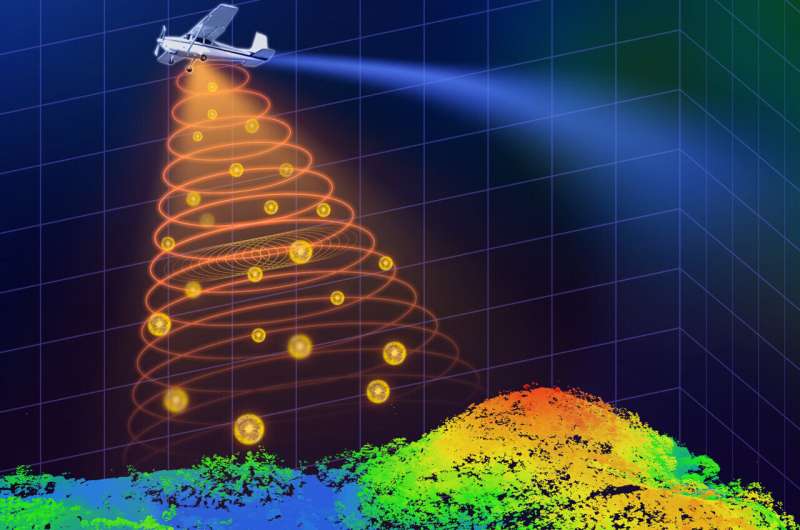
Airborne single-photon lidar system achieves high-resolution 3D imaging
https://phys.org/news/2024-04-airborne- ... ution.html
by Optica
Researchers have developed a compact and lightweight single-photon airborne lidar system that can acquire high-resolution 3D images with a low-power laser. This advance could make single-photon lidar practical for air and space applications such as environmental monitoring, 3D terrain mapping and object identification.

Single-photon lidar uses single-photon detection techniques to measure the time it takes laser pulses to travel to objects and back. It is particularly useful for airborne applications because it enables highly accurate 3D mapping of terrain and objects even in challenging environments such as dense vegetation or urban areas.
Image
Post Reply