Was looking at this article.
https://www.space.com/space-exploration ... from-earth
This settles it; we're most likely the most advanced civilization in the universe. Any species this old progressing at the same rate as us would have already developed ASI.
The hunt for alien civilizations
-
weatheriscool
- Posts: 25725
- Joined: Sun May 16, 2021 6:16 pm
- Contact:

Re: The hunt for alien civilizations
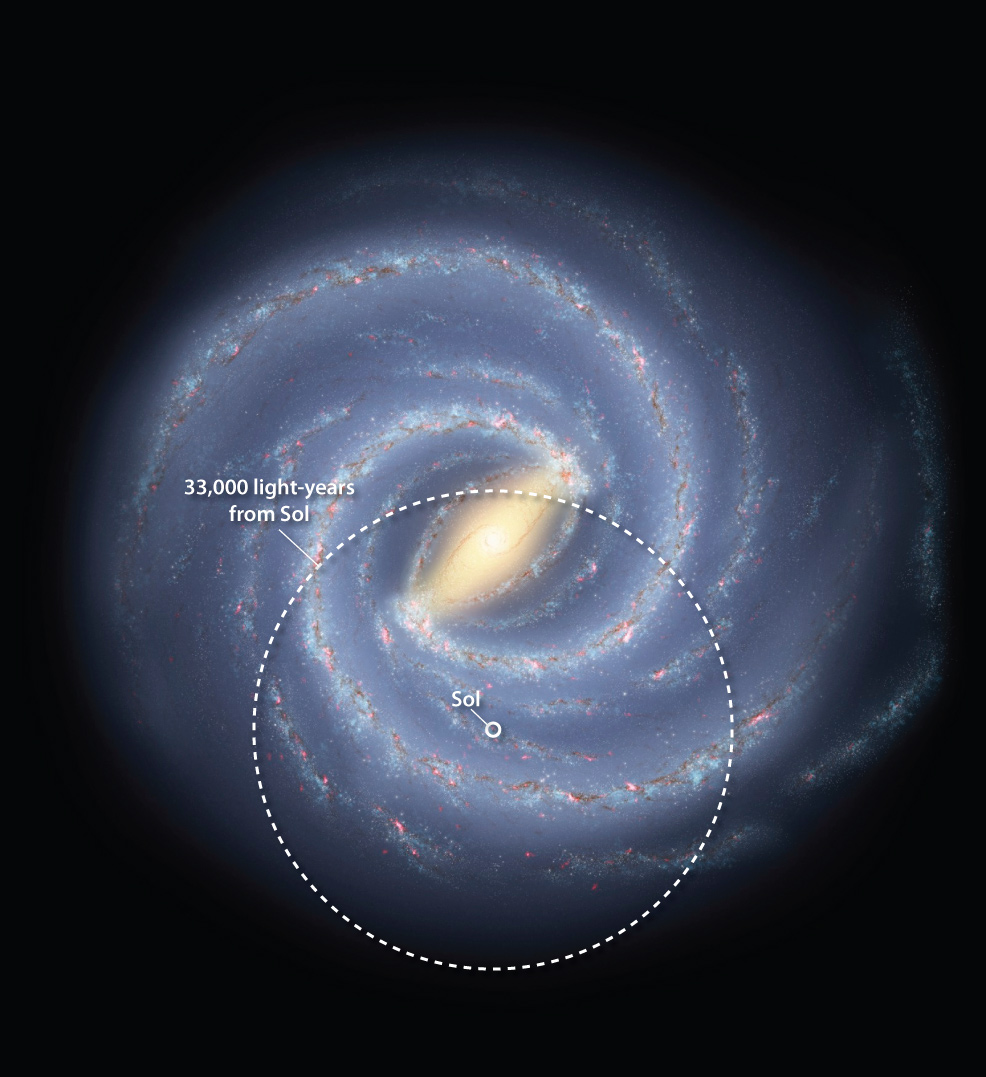
Closest alien civilisation could be 33,000 light years away
15th October 2025
New modelling suggests that advanced life in the Milky Way galaxy is extremely rare – and that any surviving civilisations are likely to be far older than our own.
https://www.futuretimeline.net/blog/202 ... -years.htm
15th October 2025
New modelling suggests that advanced life in the Milky Way galaxy is extremely rare – and that any surviving civilisations are likely to be far older than our own.
https://www.futuretimeline.net/blog/202 ... -years.htm

Re: The hunt for alien civilizations
The Eschatian Hypothesis: Why Our First Contact From Aliens May Be Particularly Bleak, And Nothing Like The Movies
By James Felton
December 16, 2025
Extract:
By James Felton
December 16, 2025
Extract:
Read more here: https://www.iflscience.com/the-eschati ... es-81927(IFL Science) "As a twist on Arthur C. Clark's famous words, science fiction author Carl Schroeder once wrote, 'Any sufficiently advanced civilization is indistinguishable from nature'," Kipping explained in an accompanying Cool Worlds video. "So advanced, mature alien civilizations could be out there, but we would never know about them because they become so sustainable that there's no signature left us to grab onto anymore. The Escation hypothesis leans into this idea and suggests that the most detectable alien civilizations will be the unstable ones."
…
"The 'Eschatian Hypothesis', Kipping writes, "thus argues that humanity’s first confirmed detection of another intelligence could be that of an inherently unstable, transitory, atypical but very loud example."
In our search for signs of life it has been suggested we should look for the ways which we ourselves may be detectable, for example through signs that a species is heating its own planet through a greenhouse effect and pollution. As should be plainly obvious by now, such departures from equilibrium are unsustainable, and may be short-lived.
But according to Kipping, during a short-lived "loud" phase, these civilizations may be much more detectable than the (hopefully more abundant) quiet civilizations who are more sustainable, and less distinguishable from the natural.
During a "loud" phase, an alien civilization may use a significant amount of the total power that they expended over their overall lifetimes, and like a supernova shining briefly and powerfully against the backdrop, they may for a short time be more detectable because of it.
Don't mourn, organize.
-Joe Hill
-Joe Hill
-
firestar464
- Posts: 8302
- Joined: Wed Oct 12, 2022 7:45 am
Re: The hunt for alien civilizations
Largest crowd-sourced hunt for alien intelligence reveals 12 billion 'signals of interest' in collapsed Arecibo Observatory data
https://www.livescience.com/space/extra ... ear-search
https://www.livescience.com/space/extra ... ear-search
-
firestar464
- Posts: 8302
- Joined: Wed Oct 12, 2022 7:45 am
Re: The hunt for alien civilizations
Proteins before planets: How space ice may have created the 1st building blocks of life
https://www.space.com/space-exploration ... ks-of-life
https://www.space.com/space-exploration ... ks-of-life
-
weatheriscool
- Posts: 25725
- Joined: Sun May 16, 2021 6:16 pm
- Contact:
Re: The hunt for alien civilizations
He didn't "confirm" anything. Usual clickbait rubbish from Newsweek.
-
weatheriscool
- Posts: 25725
- Joined: Sun May 16, 2021 6:16 pm
- Contact:
Re: The hunt for alien civilizations
Search for radio signals finds no hint of alien civilisation on K2-18b
Planet K2-18b, an apparent water world 124 light years away, has been seen as a promising location in the search for aliens, but telescopes on Earth failed to pick up any radio transmissions
By Alex Wilkins
20 February 2026
The planet K2-18b, which drew intense speculation last year due to apparent signs of life, shows no signs of advanced civilisation after a comprehensive search for radio signals from it.
In 2025, Nikku Madhusudhan at the University of Cambridge and his colleagues sensationally claimed that K2-18b, an apparent water world 124 light years away, showed hints in its atmosphere of the molecule dimethyl sulphide (DMS). Significant quantities of this molecule on Earth are produced only by life, so Madhusudhan and his team argued that the signals suggest we may be seeing signs of life from K2-18b, too.
However, subsequent observations and more rigorous analyses showed that the evidence for DMS could instead have come from other molecules not associated with life. Scientists concluded that the most we could say about the planet is that it is rich in water, either in the form of an ocean or a water-rich atmosphere.
Now, Madhusudhan and other researchers have looked for whether K2-18b might show signs of intelligent life in the form of radio signals blasted out to space, like the signals humans have been transmitting since the 1960s.
They observed K2-18b for several orbits around its star, using the Very Large Array telescope in New Mexico and the MeerKAT radio telescope in South Africa, looking for radio signals in similar frequencies to those emitted on Earth. The search would have picked up any signals from transmitters similar in strength to Arecibo, the now-defunct radio telescope in Puerto Rico.
https://www.newscientist.com/article/25 ... on-k2-18b/

Credit: NASA
Planet K2-18b, an apparent water world 124 light years away, has been seen as a promising location in the search for aliens, but telescopes on Earth failed to pick up any radio transmissions
By Alex Wilkins
20 February 2026
The planet K2-18b, which drew intense speculation last year due to apparent signs of life, shows no signs of advanced civilisation after a comprehensive search for radio signals from it.
In 2025, Nikku Madhusudhan at the University of Cambridge and his colleagues sensationally claimed that K2-18b, an apparent water world 124 light years away, showed hints in its atmosphere of the molecule dimethyl sulphide (DMS). Significant quantities of this molecule on Earth are produced only by life, so Madhusudhan and his team argued that the signals suggest we may be seeing signs of life from K2-18b, too.
However, subsequent observations and more rigorous analyses showed that the evidence for DMS could instead have come from other molecules not associated with life. Scientists concluded that the most we could say about the planet is that it is rich in water, either in the form of an ocean or a water-rich atmosphere.
Now, Madhusudhan and other researchers have looked for whether K2-18b might show signs of intelligent life in the form of radio signals blasted out to space, like the signals humans have been transmitting since the 1960s.
They observed K2-18b for several orbits around its star, using the Very Large Array telescope in New Mexico and the MeerKAT radio telescope in South Africa, looking for radio signals in similar frequencies to those emitted on Earth. The search would have picked up any signals from transmitters similar in strength to Arecibo, the now-defunct radio telescope in Puerto Rico.
https://www.newscientist.com/article/25 ... on-k2-18b/
Credit: NASA
Re: The hunt for alien civilizations
Why Haven't We Heard from Aliens? SETI Scientist Says Stars "Can Wipe Out Any Possible Technosignature We Can Detect"
By Stephen Luntz
March 9, 2026
Introduction:
By Stephen Luntz
March 9, 2026
Introduction:
Read more here: https://www.iflscience.com/why-havent- ... ct-82782(IFL Science) The reason we haven’t heard from aliens could be remarkably simple: interstellar communication is hard, and turbulent plasma emitted by stars makes it harder. A new study proposes that when listening for signals from extraterrestrial civilizations, we’ve failed to allow for the distortion stars can cause.
When radio astronomers detect a signal unlike anything they’ve seen before, non-astronomers rush to pronounce it aliens, but the finders often know that’s unlikely without needing any sophisticated testing. Although there are many ways to distinguish between signals that are probably natural or might be from aliens, the easiest is the bandwidth of the spectrum. Natural sources usually emit at a wide range of wavelengths. Artificial ones are expected to be narrow, particularly if they want to reach us, because broad signals waste vast amounts of energy.
Consequently, the Search for Extra Terrestrial Intelligence (SETI) concentrates on finding narrow signals, particularly searching at wavelengths we think aliens might choose. However, the new paper raises a problem with this, besides the one everyone can see: that without knowing aliens’ psychology, we can’t be sure of their favorite frequencies.
According to SETI’s Dr Vishal Gajjar and Grayce C. Brown, radio signals that pass through turbulent plasma broaden out, with their energy dispersed over a wider range of wavelengths. The plasma emitted by the Sun in its solar wind fluctuates even outside of major events like coronal mass ejections (CMEs) and could cause signal "smearing".
Astronomers already allow for some smearing induced by travel through interstellar space, but they haven’t previously considered what might happen within the signal’s home system.
Don't mourn, organize.
-Joe Hill
-Joe Hill