New Webb Image Reveals Dusty Disk Like Never Seen Before
Jan 11, 2023
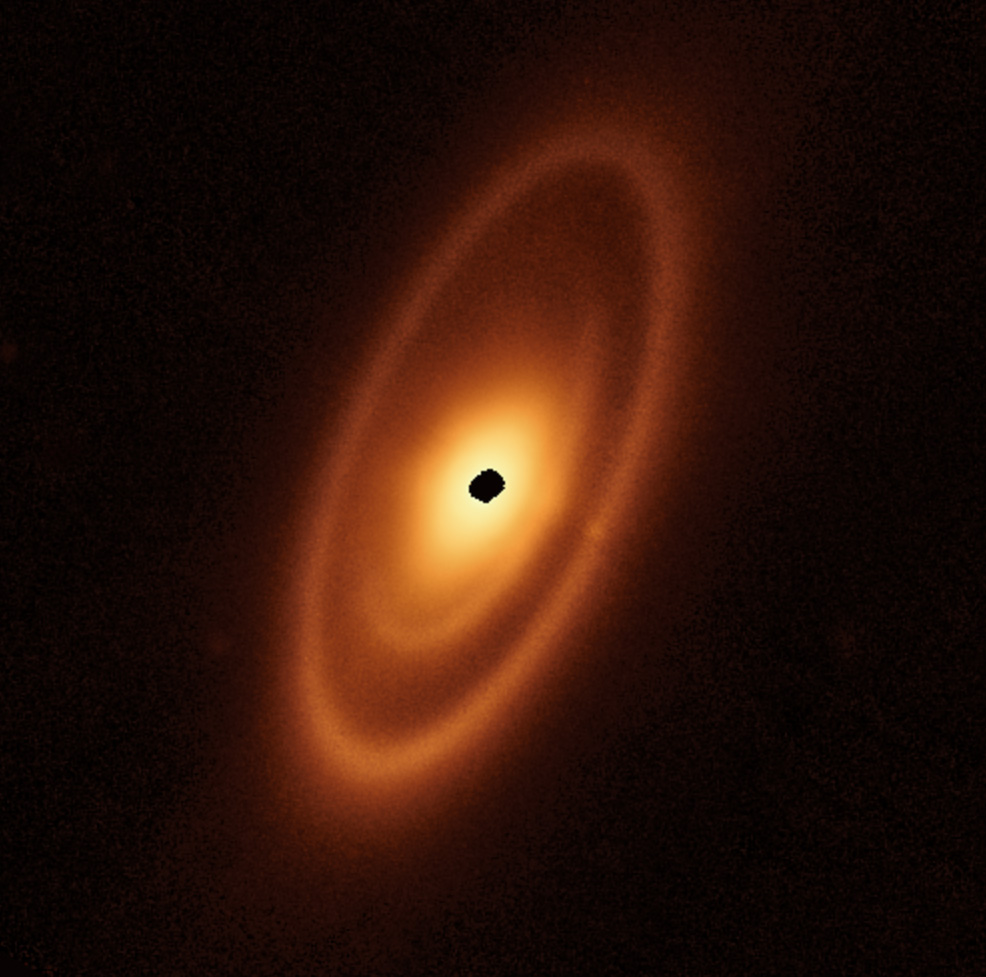
NASA’s James Webb Space Telescope has imaged the inner workings of a dusty disk surrounding a nearby red dwarf star. These observations represent the first time the previously known disk has been imaged at these infrared wavelengths of light. They also provide clues to the composition of the disk.
The star system in question, AU Microscopii or AU Mic, is located 32 light-years away in the southern constellation Microscopium. It’s approximately 23 million years old, meaning that planet formation has ended since that process typically takes less than 10 million years. The star has two known planets, discovered by other telescopes. The dusty debris disk that remains is the result of collisions between leftover planetesimals – a more massive equivalent of the dust in our solar system that creates a phenomenon known as zodiacal light.
“A debris disk is continuously replenished by collisions of planetesimals. By studying it, we get a unique window into the recent dynamical history of this system,” said Kellen Lawson of NASA’s Goddard Space Flight Center, lead author on the study and a member of the research team that studied AU Mic.
“This system is one of the very few examples of a young star, with known exoplanets, and a debris disk that is near enough and bright enough to study holistically using Webb’s uniquely powerful instruments,” said Josh Schlieder of NASA’s Goddard Space Flight Center, principal investigator for the observing program and a study co-author.
The team used Webb’s Near-Infrared Camera (NIRCam) to study AU Mic. With the help of NIRCam's coronagraph, which blocks the intense light of the central star, they were able to study the region very close to the star. The NIRCam images allowed the researchers to trace the disk as close to the star as 5 astronomical units (460 million miles) – the equivalent of Jupiter’s orbit in our solar system.
https://www.nasa.gov/feature/goddard/20 ... een-before

Credits: NASA, ESA, CSA, and K. Lawson (Goddard Space Flight Center). Image processing: A. Pagan (STScI)