Sunspot launches 27 solar flares in 24 hours, including strongest outburst in years
https://www.livescience.com/space/the-s ... t-in-years
Stars, supernovae, black holes and stellar remnants
-
firestar464
- Posts: 8408
- Joined: Wed Oct 12, 2022 7:45 am
-
firestar464
- Posts: 8408
- Joined: Wed Oct 12, 2022 7:45 am
-
firestar464
- Posts: 8408
- Joined: Wed Oct 12, 2022 7:45 am
Re: Stars, supernovae, black holes and stellar remnants
Did we just see a black hole explode? Physicists think so—and it could explain (almost) everything
https://phys.org/news/2026-02-black-hol ... cists.html
https://phys.org/news/2026-02-black-hol ... cists.html
-
firestar464
- Posts: 8408
- Joined: Wed Oct 12, 2022 7:45 am

Re: Stars, supernovae, black holes and stellar remnants
Astronomers Witness a Star's Direct Collapse into a Black Hole in Incredibly Rare View
By Stephen Luntz
February 13, 2026
Introduction:
By Stephen Luntz
February 13, 2026
Introduction:
Read more here: https://www.iflscience.com/astronomers ... ew-82549(IFL Science) Astronomers combing through years of images collected by the NEOWISE mission have found the clearest known evidence of a star converting directly to a black hole, without passing through the supernova stage. This process has been proposed for some time, and hints of past examples have been found, but now it seems the process was occurring under the noses of everyone with a telescope.
Once a subject of pure theory, stellar-mass black holes have been found to be common since the discovery of the first in 1973. We know that supernovae leave either black holes or neutron stars behind, depending on the mass and composition of the former star, but doubts have grown that this accounts for the entire stellar black hole population. Modeling suggests that when collapsing some stars, neutrinos are not able to trigger a supernova, instead creating a direct collapse to a black hole. However, finding an example has proven difficult.
Although NEOWISE’s primary role was to search for asteroids and comets, it also captured images of the Andromeda Galaxy. A team led by Professor Kishalay De of Columbia University reviewed these images and noticed something unprecedented. Starting in 2014, a massive star, once one of the most luminous in Andromeda, brightened in the infrared part of the spectrum, and stayed that way for a remarkable two years. It then faded rapidly to nothing in visible light, appearing to vanish. Here, the team argues, is the evidence astronomers have been seeking.
“This has probably been the most surprising discovery of my life,” De said in a statement. “The evidence of the disappearance of the star was lying in public archival data and nobody noticed for years until we picked it out.”
Don't mourn, organize.
-Joe Hill
-Joe Hill
-
firestar464
- Posts: 8408
- Joined: Wed Oct 12, 2022 7:45 am
-
firestar464
- Posts: 8408
- Joined: Wed Oct 12, 2022 7:45 am
Re: Stars, supernovae, black holes and stellar remnants
Is a Dwarf Galaxy Ramming Through the Milky Way’s Disk?
By Philip Plait
February 24, 2026
Entire Article (less a "chunky" map of of the velocities of stars in the structure):
By Philip Plait
February 24, 2026
Entire Article (less a "chunky" map of of the velocities of stars in the structure):
Source: https://badastronomy.beehiiv.com/p/sol ... rom-space(Bad Astronomy Newsletter) An anomaly of star velocities indicates something weird is going on
Our Milky Way galaxy is huge, and grew that way by colliding and merging with other galaxies. Most of that happened billions of years ago, but it still happens today. For example, the Sagittarius Dwarf Spheroidal galaxy is a small elliptical galaxy that is currently getting torn apart by our galaxy’s gravity as it plunges through the Milky Way’s disk every few hundred million years.
In a new paper, a team of astronomers presents evidence of another collision, but on a far smaller scale [link to journal paper]: https://iopscience.iop.org/article/10. ... rom-space . Earlier work by other astronomers found some strange structures in the disk located about 13,000 light-years from us. There’s a lot of hydrogen gas floating around the galaxy, but in this location there’s a void, a hole in the gas, as if something has pushed its way through. There’s also a shell of carbon monoxide at that same spot that may also have a similar or shared origin. On top of that is a long narrow filament of hydrogen gas that really does look as if something plowed vertically through the galactic disk and excited the gas there.
All of this points toward the collision by a very small galaxy indeed. In the new work, the astronomers looked at the velocities of stars in that region (using data from Gaia) to see if there was any indication of such a galaxy. What they found is a bunch of stars with velocities that indicate they’re moving through the disk in a vertical direction! They called it a vertical velocity anomaly (in this case, “anomaly” means a deviation from the average velocities of the stars in that region, as opposed to the more vernacular meaning of something strange).
Don't mourn, organize.
-Joe Hill
-Joe Hill
-
weatheriscool
- Posts: 26097
- Joined: Sun May 16, 2021 6:16 pm
- Contact:

Re: Stars, supernovae, black holes and stellar remnants
Did the Very Young Universe Make Swarms of Tiny Black Holes?
By Phil Plait
March 27, 2026
Introduction:
By Phil Plait
March 27, 2026
Introduction:
Read more here: https://www.scientificamerican.com/art ... ck-holes/(Scientific American) Black holes are weird. You heard it here first.
But really, they’re even more bizarre than most of us realize. They warp space. They warp time. They can spin so rapidly they wrap the fabric of spacetime around them like a warm blanket on a winter’s day. Despite greedily pulling in everything around them, they are the engines that power some of the most luminous objects in the entire cosmos.
And yet, if you stand back and squint a little, the task of making one is quite simple: just squeeze enough matter into a small enough volume. As you do so, the gravity of the resulting object gets stronger and stronger until eventually the escape velocity equals the speed of light—that is, the fastest anything can move through space. At that point whatever falls in can never get back out, and voilà! Black hole.
In today’s universe, there aren’t too many ways to do this. The classic method is to blow up a massive star at the end of its life. The outer layers explode away as a supernova, but the star’s core collapses, and, if it’s massive enough (about three times as massive as the sun), it collapses all the way down, becoming a black hole.
I may have skipped a few steps here, but that’s the general picture. There are other ways of making these mindless eating machines, as well, including smashing neutron stars together, letting two black holes merge into a bigger black hole (though, in the spirit of this discussion, I consider this cheating) or, back in the day some 12 billion years ago, streaming matter into a single spot via the influence of dark matter and letting it pile up enough to directly create a supermassive black hole, which just grows from there. Astronomers still argue over this last method.
Don't mourn, organize.
-Joe Hill
-Joe Hill
-
weatheriscool
- Posts: 26097
- Joined: Sun May 16, 2021 6:16 pm
- Contact:
Re: Stars, supernovae, black holes and stellar remnants
A New Class of Star: Merger Remnant
By Evan Gough
April 8, 2026
Introduction:
By Evan Gough
April 8, 2026
Introduction:
Read more here: https://www.universetoday.com/articles ... -remnant(Universe Today) Sometimes it can seem like science has Nature all figured out. In mainstream press, that idea is hard to avoid, even if it's never stated overtly. But scientists, and maybe astronomers especially, see things differently.
When you're a scientist you understand better than most that our names for things like types of stars or stellar remnants are convenient dividing lines of our own devising. They're practical, useful, and serve an important purpose. But there are always objects that don't fit neatly into the dividing lines. One way of dealing with that is to create sub-types of objects, and sub-types of sub-types in an illustrative hierarchy.
But there comes a point where an object can't really be shoe-horned into an existing definition and sub-type. Gather enough examples of this object and it's time for a new category.
That's what's happening with a new type of stellar remnant.
Don't mourn, organize.
-Joe Hill
-Joe Hill
-
weatheriscool
- Posts: 26097
- Joined: Sun May 16, 2021 6:16 pm
- Contact:
Re: Stars, supernovae, black holes and stellar remnants
Student Team Finds One of the Oldest Stars in the Universe that Migrated to the Milky Way
By Matthew Williams
April 10, 2026
Introduction:
By Matthew Williams
April 10, 2026
Introduction:
Read more here: https://www.universetoday.com/articles ... milky-way(Universe Today) Ten undergraduate students from the University of Chicago made an astounding discovery using data from the Sloan Digital Sky Survey (SDSS). As part of their "Field Course in Astrophysics," they located one of the oldest stars in the Universe living in the Milky Way. The star, SDSS J0715-7334, is a red giant with 29 times as much mass as our Sun, located 79,256 light-years away. But here's where things truly get interesting: according to their findings, this star wasn't born in the Milky Way, but migrated here from another galaxy. The team is led by Professor Alex Ji, the deputy Project Scientist for SDSS-V, and graduate teaching assistants Hillary Andales and Pierre Thibodeaux.
The SDSS-V program began in 2020 and is the latest phase of the Survey's 25-year commitment to acquiring spectra of millions of objects in the Milky Way and beyond, to improve our understanding of how stars, black holes, and galaxies grow and evolve. The program relies on two telescopes in both hemispheres to provide full-sky coverage, including the 2.5-meter Sloan Foundation Telescope at Apache Point Observatory in New Mexico and the 100-inch du Pont Telescope at Las Campanas Observatory in Chile.
In Ji's class, the SDSS is embedded into the class curriculum, and the student team spent the first several weeks looking through its data for interesting stars. After examining several thousand candidates, they flagged 77 for follow-up observations using the Magellan Inamori Kyocera Echelle (MIKE) instrument on the Magellan telescopes at the Las Campanas Observatory. On the evening of March 21st, 2025, they found SDSS J0715-7334 and observed it for three hours.
From its composition, almost entirely hydrogen/helium, they determined that it is one of the oldest stars in the Universe. With only 0.005% of the metals found in stars like our own, SDSSJ0715-7334 has the lowest metallicity of any star yet observed in the Universe. These stars formed when the Universe was very young, after the first generation (Population III) of stars reached the end of their lifespans and exploded as massive supernovae.
In the process, they shed their outer layers, creating heavier elements (such as carbon, oxygen, nitrogen, and metals) through the fusion of their hydrogen and helium.
Don't mourn, organize.
-Joe Hill
-Joe Hill
Re: Stars, supernovae, black holes and stellar remnants
Earliest Flickering Quasar Ever Seen Could Explain Monster Black Holes
By Ivan Farkas
June 13, 2026
Introduction:
By Ivan Farkas
June 13, 2026
Introduction:
Read more here: https://www.sciencealert.com/earliest ... ack-holes(Science Alert) Astronomers have discovered the earliest known flickering quasar, whose light has traveled more than 13 billion years to reach us.
It can help reveal how some of the Universe's biggest black holes grew so unexpectedly monstrous so early in cosmic history.
Surprisingly, this ancient quasar, designated J0439+1634, appears to have a pancake-shaped accretion disk of matter swirling into its mammoth maw, suggesting it is mysteriously mature for its age.
"This provides direct evidence that the same feeding processes and structures observed in the nearby Universe were already in place at very early times, despite very different cosmic environments, says Anna-Christina Eilers, an observational astrophysicist at MIT.
"Which had never been seen before."
Don't mourn, organize.
-Joe Hill
-Joe Hill
-
weatheriscool
- Posts: 26097
- Joined: Sun May 16, 2021 6:16 pm
- Contact:
Re: Stars, supernovae, black holes and stellar remnants
Astronomers' surprise at discovery of new stars
3 hours ago
Astronomers have described their discovery of four new hidden white dwarf stars "local" to Earth as a "surprise".
The University of Warwick team used the Hubble Space Telescope to pinpoint the small, dim stars orbiting in double systems within 65 light years of Earth.
The four white dwarf stars in this "nearby region" of space each have larger and brighter red dwarf companions that had previously concealed them.
University of Warwick research fellow Dr Mairi O'Brien said: "Nearby isolated white dwarfs are usually easy to find, but we couldn't see these four stars directly in visible wavelengths because their red dwarf companions were drowning out their light."
"It's a reminder that even in our own cosmic neighbourhood, we can still find surprises if we look in the right way, at the right wavelengths."
https://www.bbc.co.uk/news/articles/ce8k80zpkkdo
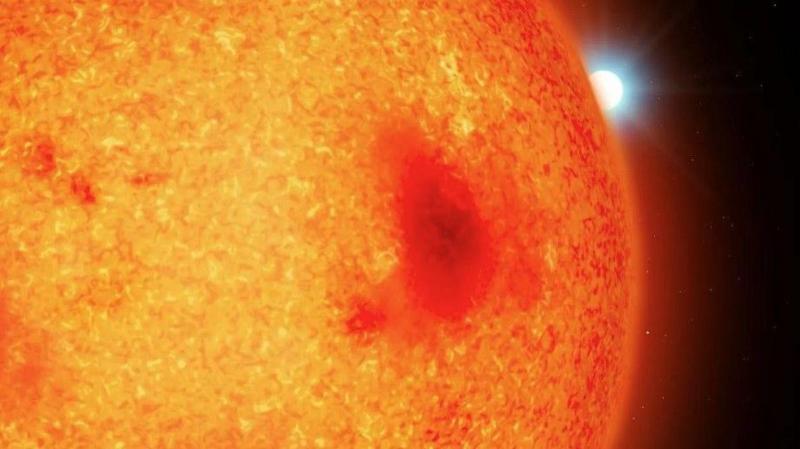
Credit: University of Warwick/Mark A. Garlick
3 hours ago
Astronomers have described their discovery of four new hidden white dwarf stars "local" to Earth as a "surprise".
The University of Warwick team used the Hubble Space Telescope to pinpoint the small, dim stars orbiting in double systems within 65 light years of Earth.
The four white dwarf stars in this "nearby region" of space each have larger and brighter red dwarf companions that had previously concealed them.
University of Warwick research fellow Dr Mairi O'Brien said: "Nearby isolated white dwarfs are usually easy to find, but we couldn't see these four stars directly in visible wavelengths because their red dwarf companions were drowning out their light."
"It's a reminder that even in our own cosmic neighbourhood, we can still find surprises if we look in the right way, at the right wavelengths."
https://www.bbc.co.uk/news/articles/ce8k80zpkkdo
Credit: University of Warwick/Mark A. Garlick
Re: Stars, supernovae, black holes and stellar remnants
A Black Hole Confirmed in Omega Centauri
By Philip Plait
July 20, 2026
Introduction:
By Philip Plait
July 20, 2026
Introduction:
Read more here: https://badastronomy.beehiiv.com/p/a-b ... centauri(Bad Astronomy) Omega Centauri is the largest of the Milky Way Galaxy’s globular clusters, huge collections of hundreds of thousands or even millions of stars packed together into a roughly spherical ball generally a hundred light years across or so. Omega Cen (as its friends call it) is close to twice that size, and so massive it may not actually be a globular cluster at all; instead it’s likely the core of a small galaxy that was stripped of its stars by the Milky Way long ago.
Either way, it’s so big and relatively close by as these things go (about 17,000 light-years) that it’s been an object of intense scrutiny for decades. In fact, it’s that long baseline of observations that has finally revealed a treasure long sought-after: a stellar mass black hole amongst the stellar crowd.
Black holes like this form when a massive star explodes, and its core collapses. Globular clusters probably had lots of these stars when they first formed billions of years ago, but stars like that are short-lived and all exploded long ago. This means there should be thousands of black holes in clusters like Omega Cen, but until now none has been found (with the exception of an intermediate mass black hole in its very center, but that’s a different species of black hole and not what we’re talking about here).
It’s possible the black holes all got flung away. Due to a process called mass segregation, heavy objects like black holes fall to the center of the cluster as they interact gravitationally with all the stars around them, and lighter stars propagate outward. If two black holes happen to get too close together during the process they could give each other a gravity assist (the so-called “slingshot”) and throw each other out of the cluster. Others might get close enough to a binary star that one of the two stars gets ejected and the black hole winds up in orbit around the other. It’s complex, and there are lots of possibilities.
Don't mourn, organize.
-Joe Hill
-Joe Hill