Space News and Discussions

Re: Space News and Discussions
And remember my friend, future events such as these will affect you in the future
Re: Space News and Discussions
China will carry on its moon research in the future with Chang'e-6, Chang'e-7 and Chang'e-8 missions by 2030, chief designer of the country's lunar exploration program Wu Weiren said.
The Chang'e-6 is scheduled to bring back to Earth lunar samples with a mass of up to 2 kilograms; the Chang'e-7 will be tasked with landing on the lunar south pole and detecting local natural resources; and the Chang'e-8, working in collaboration with Chang'e-7, is going to scout how to exploit lunar resources.
According to Wu, the Chang'e-6 and Chang'e-7 are expected to be launched around 2025.
And remember my friend, future events such as these will affect you in the future

Re: Space News and Discussions
Advance in Understanding of Black Holes Assisted by Einstein's Theory of General Relativity
by Danielle Sedbrook
March 17, 2022
https://www.inverse.com/science/black-h ... s-einstein
Introduction:
by Danielle Sedbrook
March 17, 2022
https://www.inverse.com/science/black-h ... s-einstein
Introduction:
(Inverse) The problem with black holes is that they are really big and really, really far away. They block our view of their backsides, and signals from the side we can detect are faint. That makes studying the swirling, superheated matter draining into them (the accretion disk) hard to understand and even harder— if not impossible — to see.
But this past summer a team of X-ray astronomers announced in Nature a fortuitous discovery that provides a new way to study black holes and their immediate surroundings in jaw-dropping detail — with a little help from one of Einstein’s most remarkable predictions.
“We’re seeing light coming from the bit of gas that's all the way behind the black hole getting bent all the way round into our line of sight,” says Dan Wilkins, the study’s lead author and a research scientist at the Kavli Institute for Particle Astrophysics & Cosmology, Stanford University.
The light the astronomers detect is a reflection, or echo, of X-ray flares, emitted from a halo of ultra-hot gas surrounding the black hole known as its corona, as they bounce off the part of the accretion disk that lies in the black hole’s shadow.
Last edited by caltrek on Thu Mar 17, 2022 6:25 pm, edited 1 time in total.
Don't mourn, organize.
-Joe Hill
-Joe Hill
-
weatheriscool
- Posts: 25824
- Joined: Sun May 16, 2021 6:16 pm
- Contact:
Re: Space News and Discussions
NASA rolls out its mega Moon rocket—here's what you need to know
https://phys.org/news/2022-03-nasa-mega ... there.html
by Issam Ahmed
https://phys.org/news/2022-03-nasa-mega ... there.html
by Issam Ahmed
This handout illustration courtesy of NASA released on October 22, 2020 shows Nasa's new rocket, the Space Launch System (SLS), in its Block 1 crew vehicle configuration that will send astronauts to the Moon on the Artemis missions.
NASA's massive new rocket is poised to make its first journey to a launchpad on Thursday ahead of a battery of tests that will clear it to blast off to the Moon this summer.
It will leave the Kennedy Space Center's Vehicle Assembly Building at 5:00 pm Eastern Time (2100 GMT) and begin its glacially slow, 11-hour crawl on a transporter to the hallowed Launch Complex 39B, four miles (6.5 kilometers) away.
Here's what you need to know.
Huge rocket, huge cost
With the Orion crew capsule fixed on top, the Space Launch System (SLS) Block 1 stands 322 feet (98 meters) high—taller than the Statue of Liberty, but a little smaller than the 363 feet Saturn V rockets that powered the Apollo missions to the Moon.
Despite this, it will produce 8.8 million pounds of maximum thrust (39.1 Meganewtons), 15 percent more than the Saturn V, meaning it's expected to be the world's most powerful rocket at the time it begins operating.
Re: Space News and Discussions
Elon Musk’s Starlink Becomes Most-Downloaded App In Ukraine
I'd imagine this requires a lot more satellites in the sky to keep steady. I wonder if the war has actually accelerated Starlink's time tables? Not just Starlink but SpaceX as well. For all of "Elona's" blusters and goofs, I can't imagine he isn't endearing himself to some people in Cape Canaveral. Plus the loss of Russian access to space is going to all but force SpaceX to step things up in the coming years. As in "get Falcon Heavy and Starship ready for regular use by 2025."
If Blue Origin wants to keep up, they'll have to work triple-overtime.
Starlink, the app that enables mobile users to access SpaceX’s satellite internet service of the same name, was the most-downloaded app in Ukraine Monday afternoon after reaching the top spot Sunday, according to data seen by the Wall Street Journal, following SpaceX CEO Elon Musk’s rapid delivery of the terminals that provide the service to the war-torn country last month.
I'd imagine this requires a lot more satellites in the sky to keep steady. I wonder if the war has actually accelerated Starlink's time tables? Not just Starlink but SpaceX as well. For all of "Elona's" blusters and goofs, I can't imagine he isn't endearing himself to some people in Cape Canaveral. Plus the loss of Russian access to space is going to all but force SpaceX to step things up in the coming years. As in "get Falcon Heavy and Starship ready for regular use by 2025."
If Blue Origin wants to keep up, they'll have to work triple-overtime.
And remember my friend, future events such as these will affect you in the future

Re: Space News and Discussions
There's also an unexpected side effect of this - Ukrainians are trading in cryptocurrencies like crazy. BTC, ETH and few other big name coins had their volumes markedly increased right after they received the Starlink shipments. And of course, the fact that the Russians are now buying them to get around the sanctions is helping shepherding this crypto craze. This could be the event that starts the wide adoption of crypto by mainstream society.Yuli Ban wrote: ↑Thu Mar 17, 2022 10:11 pm Elon Musk’s Starlink Becomes Most-Downloaded App In UkraineStarlink, the app that enables mobile users to access SpaceX’s satellite internet service of the same name, was the most-downloaded app in Ukraine Monday afternoon after reaching the top spot Sunday, according to data seen by the Wall Street Journal, following SpaceX CEO Elon Musk’s rapid delivery of the terminals that provide the service to the war-torn country last month.
I'd imagine this requires a lot more satellites in the sky to keep steady. I wonder if the war has actually accelerated Starlink's time tables? Not just Starlink but SpaceX as well. For all of "Elona's" blusters and goofs, I can't imagine he isn't endearing himself to some people in Cape Canaveral. Plus the loss of Russian access to space is going to all but force SpaceX to step things up in the coming years. As in "get Falcon Heavy and Starship ready for regular use by 2025."
If Blue Origin wants to keep up, they'll have to work triple-overtime.
To know is essentially the same as not knowing. The only thing that occurs is the rearrangement of atoms in your brain.
-
weatheriscool
- Posts: 25824
- Joined: Sun May 16, 2021 6:16 pm
- Contact:
Re: Space News and Discussions
Gaia finds parts of the Milky Way much older than expected
23/03/2022 628 views 16 likes
ESA / Science & Exploration / Space Science / Gaia
23/03/2022 628 views 16 likes
ESA / Science & Exploration / Space Science / Gaia
https://www.esa.int/Science_Exploration ... n_expected
Using data from ESA’s Gaia mission, astronomers have shown that a part of the Milky Way known as the ‘thick disc’ began forming 13 billion years ago, around 2 billion years earlier than expected, and just 0.8 billion years after the Big Bang.
This surprising result comes from an analysis performed by Maosheng Xiang and Hans-Walter Rix, from the Max-Planck Institute for Astronomy, Heidelberg, Germany. They took brightness and positional data from Gaia’s Early Data Release 3 (EDR3) dataset and combined it with measurements of the stars’ chemical compositions, as given by data from China’s Large Sky Area Multi-Object Fiber Spectroscopic Telescope (LAMOST) for roughly 250 000 stars to derive their ages.
Re: Space News and Discussions
The History of Venus in Air, Rock, and Water
by Arwen Rimmer
March 22, 202
https://skyandtelescope.org/astronomy-n ... ock-water/
Introduction:
by Arwen Rimmer
March 22, 202
https://skyandtelescope.org/astronomy-n ... ock-water/
Introduction:
(Sky & Telescope) Presentations at the Lunar and Planetary Science Conference usually focus on the Moon, Mars, asteroids, and comets. But at this year’s symposium, an entire day’s worth of talks were dedicated instead to Venus. Why is Earth’s “evil twin” so hot right now?
The unofficial end of NASA’s Venus program, following the completion of the Magellan mission, was part reactionary disappointment, part practicality. Instead of a primordial jungle teeming with alien life, we had found an impassable, barren hellscape. Departments all over the world shifted their focus to Mars, because although it’s further off, it’s a much easier planet to visit and study.
Recently, however, interest in Venus has risen again. This is due in part to new high-resolution data from the European Space Agency (ESA) Venus Express and Japan’s Akatsuki orbiter, and in part because of interest from the exoplanet community. Materials science advances enable electronics to survive Venus’s hot and acidic conditions for longer, making in-situ missions more feasible.
Amid these developments, early career astronomers have begun to see our nasty neighbor’s hellish environs as an upside: a mystery begging to be solved. The slate of Venus missions recently approved by NASA, ISRO, ESA as well as planned by private entities reflects this resurgent interest and promises to address a host of open questions.
This year’s “Venus Day” at the LPSC provides a good forecast of the various topics in geology, seismology, and atmospheric science that planetary scientists are hoping to explore over the years to come. Here is a brief, non-comprehensive selection of the research presented. Some of the studies have been peer reviewed, while others are at earlier stages of development. See link above quote box).
Don't mourn, organize.
-Joe Hill
-Joe Hill
-
weatheriscool
- Posts: 25824
- Joined: Sun May 16, 2021 6:16 pm
- Contact:
Re: Space News and Discussions
Giant ice volcanoes identified on Pluto
https://phys.org/news/2022-03-giant-ice ... pluto.html
Strange lumpy terrain on Pluto unlike anything previously observed in the solar system indicates that giant ice volcanoes were active relatively recently on the dwarf planet, scientists said on Tuesday.
The observation, which was made by analyzing images taken by NASA's New Horizons spacecraft, suggests that Pluto's interior was hotter much later than previously thought, according to a new study in the Nature Communications journal.
Rather than shooting lava into the air, ice volcanoes ooze a "thicker, slushy icy-water mix or even possibly a solid flow like glaciers", said Kelsi Singer, study author and planetary scientist at Colorado's Southwest Research Institute.
Ice volcanoes were already thought to be on several chilly moons in the solar system, but Pluto's "look so different from anything else we ever have seen", Singer told AFP.
"The features on Pluto are the only vast field of very large icy volcanoes and they have a unique texture of undulating terrain."
Singer said it was difficult to pinpoint exactly when the ice volcanoes were formed "but we believe they could be as young as a few hundred million years or even younger".
-
weatheriscool
- Posts: 25824
- Joined: Sun May 16, 2021 6:16 pm
- Contact:
Re: Space News and Discussions
Space weather model could determine exoplanetary habitable zones
https://phys.org/news/2022-03-space-wea ... zones.html
by Jim Steele, University of Alabama in Huntsville
https://phys.org/news/2022-03-space-wea ... zones.html
by Jim Steele, University of Alabama in Huntsville
A refinement to a space weather model developed by a center director at the University of Alabama in Huntsville (UAH) could help scientists check out which planets outside our solar system are likely to have someone home.
Exoplanets are what planets are called when they orbit stars outside our own solar system, and the effort to winnow out those that could harbor life has been intensifying.
Now at the Center for Space Plasma and Aeronomic Research (CSPAR) at UAH, a part of the University of Alabama System, research by Dr. Junxiang Hu along with collaborators has developed a model for tracking stellar energetic particles that can influence the creation of life on exoplanets. These stellar energetic particles are too far away to be directly measured, so they need to be modeled from remote sensing inputs.
"The energetic particles associated with superflares from young solar-like stars will impact the atmospheric chemistry of their close-in exoplanets, possibly generating prebiotic chemicals that could trigger life," says Dr. Hu. "The characterization of these impacts may be important in assessing chemical signatures of the habitability of exoplanets."
Prior modeling used empirical approaches, but the new research applies physics to the endeavor. It doesn't directly identify habitable exoplanets, says Dr. Hu, but it can inform that search.
-
weatheriscool
- Posts: 25824
- Joined: Sun May 16, 2021 6:16 pm
- Contact:
Re: Space News and Discussions
NASA Set To Reveal Mysterious “Record-Breaking” Hubble Discovery This Week
https://www.iflscience.com/space/nasa-s ... this-week/
https://www.iflscience.com/space/nasa-s ... this-week/

Re: Space News and Discussions
Hubble Spots Most Distant Single Star Ever Seen, at a Record Distance of 28 Billion Lightyears
March 30, 2022
https://www.eurekalert.org/news-releases/948148
Introduction:
March 30, 2022
https://www.eurekalert.org/news-releases/948148
Introduction:
Conclusion:(EurekAlert) With a fortuitous lineup of a massive cluster of galaxies, astronomers from among other institutes the University of Copenhagen and DTU discovered a single star across most of the entire observable Universe. This is the farthest detection of a single star ever. The star may be up to 500 times more massive than the Sun. The discovery has been published today in the scientific journal Nature.
Closeup of the region on the sky, 1/250 of a degree across, where the gravity of a foreground cluster of galaxies magnifies the distant background star — nicknamed Earendil — thousands of times. Credit: NASA/ESA/Brian Welch (JHU)/Dan Coe (STScI)/Alyssa Pagan (STScI).
Gazing at the night sky, all the stars that you see lie within our own galaxy, the Milky Way. Even with the most powerful telescopes, under normal circumstances individual stars can only be resolved in our most nearby galactic neighbors. In general, distant galaxies are seen as the blended light from billions of stars.
But with the marvelous natural phenomenon known as "gravitational lensing", astronomers from the Cosmic Dawn Center at the Niels Bohr Institute and DTU Space were nevertheless able to detect a distance where even detecting entire galaxies is challenging.
"With James Webb, we will be able to confirm that Earendel is indeed just one star, and at the same time quantify which type of star it is,” says Sune Toft, leader of the Cosmic Dawn Center and professor at the Niels Bohr Institute, who also participated in the study. “Webb will even allow us to measure its chemical composition. Potentially, Earendel could be the first known example of the Universe's earliest generation of stars.”
Don't mourn, organize.
-Joe Hill
-Joe Hill
-
weatheriscool
- Posts: 25824
- Joined: Sun May 16, 2021 6:16 pm
- Contact:
Re: Space News and Discussions
Thirteen new pulsars discovered with MeerKAT
https://phys.org/news/2022-03-thirteen- ... erkat.html
by Tomasz Nowakowski , Phys.org
https://phys.org/news/2022-03-thirteen- ... erkat.html
by Tomasz Nowakowski , Phys.org
Using the MeerKAT radio telescope, an international team of astronomers has detected 13 new pulsars in the globular cluster NGC 1851. Twelve of them turned out to be millisecond pulsars (MSPs). The discovery was reported March 23 on the arXiv pre-print server.
Pulsars are highly magnetized, rotating neutron stars emitting a beam of electromagnetic radiation. They are usually detected in the form of short bursts of radio emission; however, some of them are also observed via optical, X-ray and gamma-ray telescopes.
The most rapidly rotating pulsars, those with rotation periods below 30 milliseconds, are known as MSPs. Researchers assume that they are formed in binary systems when the initially more massive component turns into a neutron star that is then spun up due to accretion of matter from the secondary star.
Now, astronomers led by Alessandro Ridolfi of the Cagliari Observatory in Italy, report the finding of another 13 new sources that belong to the pulsar family. The new pulsars were detected in the globular cluster NGC 1851, located some 39,000 light years away, as part of the TRansients And PUlsars with MeerKAT (TRAPUM) Large Survey Project.
-
weatheriscool
- Posts: 25824
- Joined: Sun May 16, 2021 6:16 pm
- Contact:
Re: Space News and Discussions
Blue Origin launches its fourth crew to final frontier
https://phys.org/news/2022-03-blue-four ... ntier.htmlThe New Shepard suborbital rocket blasted off from the company's Launch Site One base in west Texas at 8:58 am local time (1358 GMT) with six crew.
Jeff Bezos' Blue Origin successfully carried out its fourth crewed spaceflight Thursday, a ten-minute joyride beyond the planet's atmosphere and back again.
The New Shepard suborbital rocket blasted off from the company's Launch Site One base in west Texas at 8:58 am local time (1358 GMT) with six crew members.
The crew included Gary Lai, chief architect of the New Shepard program, plus five paying customers—though the ticket price hasn't been disclosed.
"I felt my skin pulling taut," Lai said, of the rocket ride.
Lai's inclusion came after comedian Pete Davidson, the boyfriend of reality star Kim Kardashian, canceled his participation without disclosing a reason.
After launch, the reusable, zero greenhouse gas emissions rocket landed vertically at a pad, while the capsule continued soaring, crossing the Karman line that marks the start of space, 100 kilometers (62 miles) high.
Passengers unbuckled and enjoyed a few minutes of weightlessness, taking in the majesty of Earth before the capsule re-entered the atmosphere, deployed its chutes and floated to the surface for a gentle desert landing.
Re: Space News and Discussions
Where Did the Ice Giant Planets Form?
by Jure Japelj
March 29, 2022
https://skyandtelescope.org/astronomy-n ... nets-form/
Introduction: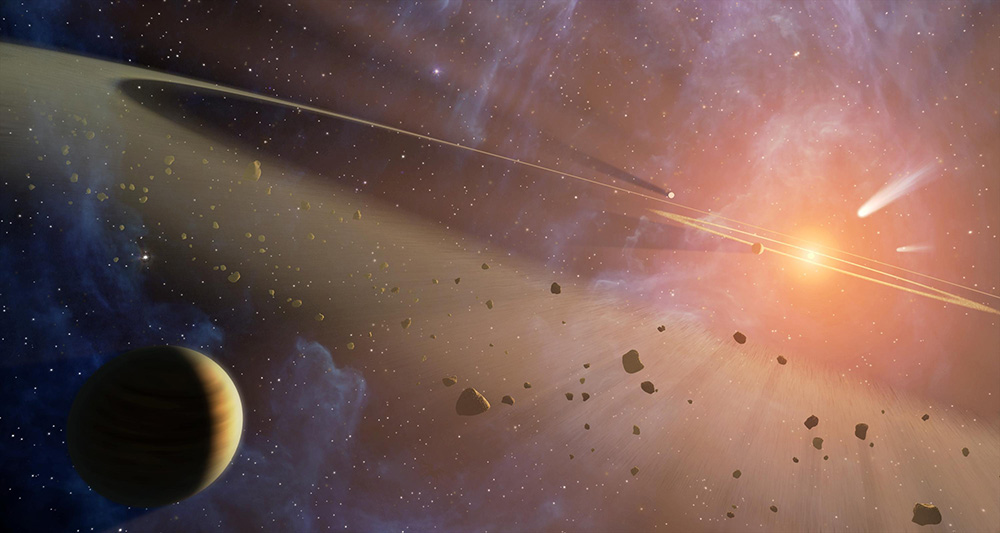
Artist’s concept of a young planetary system
NASA / JPL-Caltech
by Jure Japelj
March 29, 2022
https://skyandtelescope.org/astronomy-n ... nets-form/
Introduction:
(Sky & Telescope) Conventional planet formation scenarios have Neptune and Uranus forming closer to the Sun. But a new study shows that the ice giant planets could have formed right where they are now.
Reconstructing the events that led to the present configuration of planets in the solar system is a formidable task. The orderly perennial motions emerged from the hectic conditions within the newborn protoplanetary disk, marked by violent collisions and radial migrations of forming protoplanets. Planet by planet, scientists have tried to put together the pieces of the puzzle. How do Uranus and Neptune, the outermost planets of the solar system, fit in?
The two ice giants are probably the most enigmatic planets in the solar system. Their distances (20 and 30 times the Earth's distance from the Sun, respectively) and unique mass regime (between that of the gas giants and the terrestrial planets) challenge the models. Scientists aren't sure how or where the two planets formed, but evidence has until recently suggested that Uranus and Neptune could not have formed where they are today.
Now, a new study contradicts those arguments, claiming that the planets could, in fact, have formed at their current locations. The intriguing result, to appear in The Astrophysical Journal (preprint available here), provides an alternative to the migration scenario.
"I don't say they didn't form farther in; they could also have formed farther out," says study team member Ravit Helled (University of Zurich, Switzerland). "But we cannot say anymore that they cannot form in situ — yes, they can!"
Artist’s concept of a young planetary system
NASA / JPL-Caltech
Don't mourn, organize.
-Joe Hill
-Joe Hill
-
weatheriscool
- Posts: 25824
- Joined: Sun May 16, 2021 6:16 pm
- Contact:
Re: Space News and Discussions
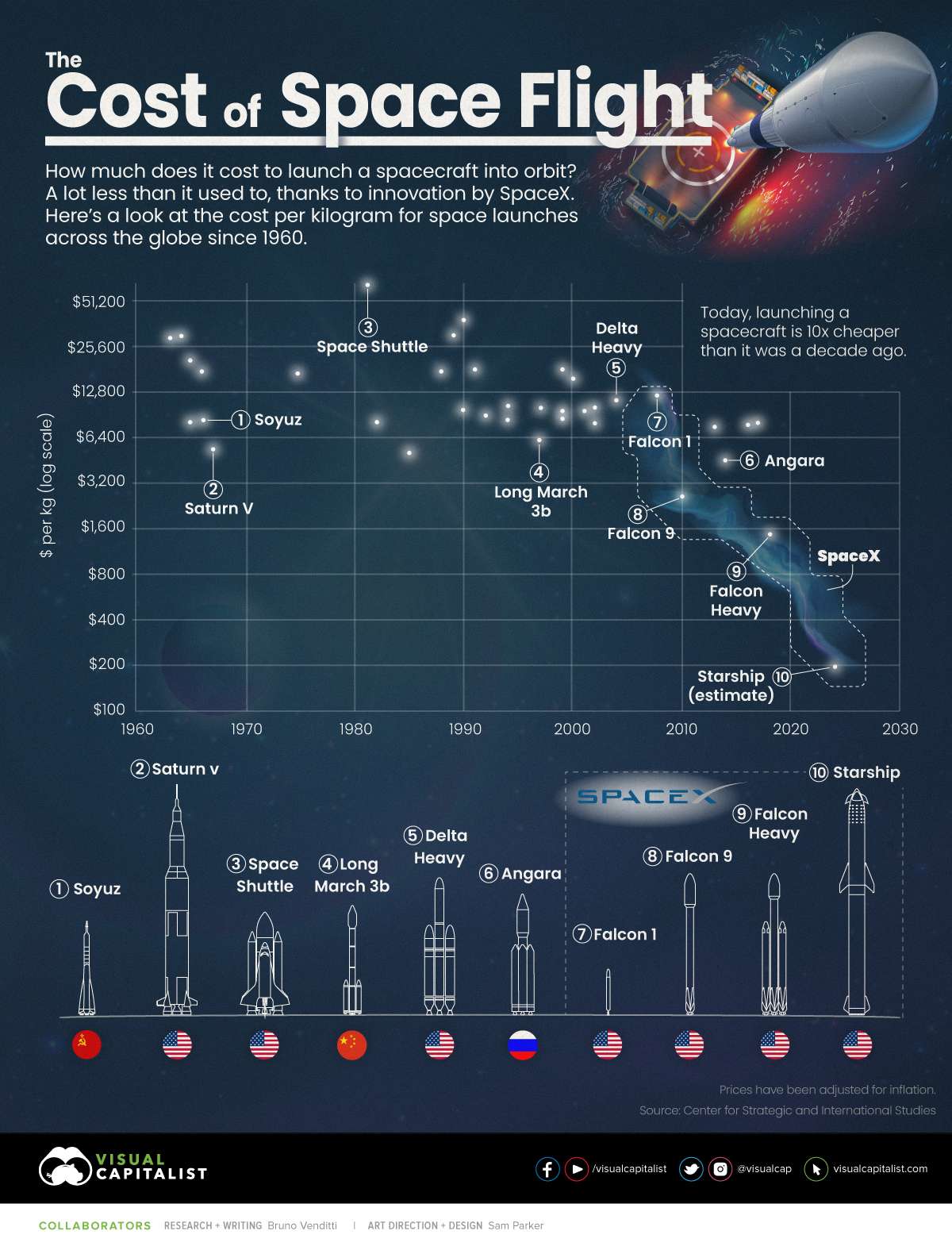
Elon musk is one of the greatest innovators in space flight in history! If this continues our ability to go to space and to spread could rest on this man.
-
weatheriscool
- Posts: 25824
- Joined: Sun May 16, 2021 6:16 pm
- Contact:
Re: Space News and Discussions
Astrophysicists set constraints on compact dark matter from gravitational wave microlensing
https://phys.org/news/2022-04-astrophys ... ional.html
by Ingrid Fadelli , Phys.org
https://phys.org/news/2022-04-astrophys ... ional.html
by Ingrid Fadelli , Phys.org
The existence of dark matter remains one of the greatest mysteries of the universe. While studies have indirectly hinted at its existence, its invisible nature makes this elusive substance very difficult to detect, thus its composition remains unknown.
Dark matter could be made of fundamental and exotic particles that are yet to be discovered. Alternatively, it could consist of many massive and compact objects, such as primordial black holes (i.e., black holes formed in the early universe).
Over the past decades, many teams of scientists worldwide have been searching for dark matter, using a multitude of techniques, telescopes, detectors and observational data. While most of these searches were unsuccessful, they helped to guide and narrow down subsequent searches.
Researchers at Tata Institute of Fundamental Research's International Centre for Theoretical Studies in Bangalore, India, have recently set new constraints on the fraction of compact dark matter from gravitational wave microlensing. Their paper, published in The Astrophysical Journal Letters, introduces a new way of probing the nature of dark matter by looking for microlensing effects in gravitational waves.
-
weatheriscool
- Posts: 25824
- Joined: Sun May 16, 2021 6:16 pm
- Contact:
Re: Space News and Discussions
The head of Russia's space agency says it is suspending ISS cooperation with NASA and the European S
Source: Business Insider
Space Agency amid Western sanctions
Read more: https://www.msn.com/en-us/news/world/th ... li=BBnb7Kz
Source: Business Insider
Space Agency amid Western sanctions
Russia is suspending its cooperation on the International Space Station (ISS), according to Dmitry Rogozin, head of Russian space agency Roscosmos.
The country will also suspend its partnership with NASA, the European Space Agency (ESA), and the Canadian Space Agency (CSA), Rogozin said.
Newsweek and others first reported the story.
In a series of tweets written in Russian on Saturday, Rogozin said: "I believe that the restoration of normal relations between partners in the International Space Station and other joint projects is possible only with the complete and unconditional lifting of illegal sanctions."
Read more: https://www.msn.com/en-us/news/world/th ... li=BBnb7Kz
-
weatheriscool
- Posts: 25824
- Joined: Sun May 16, 2021 6:16 pm
- Contact:
Re: Space News and Discussions
Confirmed: Pluto Has Gigantic Cryovolcanoes As Tall As the Himalayas
https://www.extremetech.com/extreme/333 ... -himalayas
By Jessica Hall on March 31, 2022 at 1:42 pm
https://www.extremetech.com/extreme/333 ... -himalayas
By Jessica Hall on March 31, 2022 at 1:42 pm
Ever since New Horizons first beamed back its beauty shots of Pluto in 2015, we’ve been poring over the data. Now, planetary scientists have reported evidence confirming the presence of cryovolcanoes on Pluto. The cryovolcanic region borders the southwest aspect of Sputnik Planitia, a brightly reflective, heart-shaped plateau of nitrogen ice.
At up to 7km tall, these enormous mountains of ice are in the height class of the tallest peaks on Earth. Only the Himalayas and Karakoram reach higher. But unlike the craggy peaks of the Himalayas, these cryovolcanoes are like a frozen version of Hawaii’s shield volcanoes. Their shape and mass are like Mauna Loa, with the largest measuring up to 100km wide at the base.