TESS detects new sub-Neptune exoplanet more than three times larger than Earth
https://phys.org/news/2025-04-tess-nept ... earth.html
Exoplanets – worlds of other suns

Re: Exoplanets – worlds of other suns
Scientists discover super-Earth exoplanets are more common in the universe than we thought
By Robert Lea published 22 hours ago
Astronomers have discovered that "super-Earth" planets may exist on wider orbits than previously thought — and this implies these rocky, or "terrestrial," worlds are far more common than was suspected. Super-Earths, in short, are planets with masses up to 10 times that of our planet, but still less than the masses of gas giant planets.
The discovery came after a small extrasolar planet, or "exoplanet," in a wide orbit around its star was discovered, courtesy of a gravitational "microlensing" event designated OGLE-2016-BLG-0007. This event indicated the exoplanet had a planet-to-star mass ratio that roughly doubles the Earth-sun mass ratio.
"We found a small planet in an orbit similar to Saturn's. This planet is part of a larger sample that shows super-Earth planets between the orbits of Earth and Saturn are abundant," team member Jennifer Yee of the Center for Astrophysics | Harvard & Smithsonian told Space.com. "The abundance of super-Earths was a surprise."
Yee explained that scientists previously knew from data delivered by the Kepler space telescope mission that super-Earths are common around other stars, but only within a distance from their respective stars equivalent to the distance between Earth and the sun. That expected distance is represented by one astronomical unit (au).
This new work, however, shows that super-Earths are also common at larger distances from their host stars, in this case around 10 au (or 10 times the distance between our planet and the sun).
https://www.space.com/the-universe/exop ... we-thought

Image credit: Robert Lea (created with Canva
By Robert Lea published 22 hours ago
Astronomers have discovered that "super-Earth" planets may exist on wider orbits than previously thought — and this implies these rocky, or "terrestrial," worlds are far more common than was suspected. Super-Earths, in short, are planets with masses up to 10 times that of our planet, but still less than the masses of gas giant planets.
The discovery came after a small extrasolar planet, or "exoplanet," in a wide orbit around its star was discovered, courtesy of a gravitational "microlensing" event designated OGLE-2016-BLG-0007. This event indicated the exoplanet had a planet-to-star mass ratio that roughly doubles the Earth-sun mass ratio.
"We found a small planet in an orbit similar to Saturn's. This planet is part of a larger sample that shows super-Earth planets between the orbits of Earth and Saturn are abundant," team member Jennifer Yee of the Center for Astrophysics | Harvard & Smithsonian told Space.com. "The abundance of super-Earths was a surprise."
Yee explained that scientists previously knew from data delivered by the Kepler space telescope mission that super-Earths are common around other stars, but only within a distance from their respective stars equivalent to the distance between Earth and the sun. That expected distance is represented by one astronomical unit (au).
This new work, however, shows that super-Earths are also common at larger distances from their host stars, in this case around 10 au (or 10 times the distance between our planet and the sun).
https://www.space.com/the-universe/exop ... we-thought
Image credit: Robert Lea (created with Canva
-
weatheriscool
- Posts: 26094
- Joined: Sun May 16, 2021 6:16 pm
- Contact:
-
weatheriscool
- Posts: 26094
- Joined: Sun May 16, 2021 6:16 pm
- Contact:
Re: Exoplanets – worlds of other suns
Astronomers Capture Planetary Formation With Unprecedented Clarity
These 15 protoplanetary disks are taking on a number of captivating shapes.
By Adrianna Nine May 2, 2025
These 15 protoplanetary disks are taking on a number of captivating shapes.
By Adrianna Nine May 2, 2025
https://www.extremetech.com/science/ast ... ed-clarity
Astronomers have unlocked the sharpest visual yet of planets beginning to form within young solar systems. Using the Atacama Large Millimeter/submillimeter Array (ALMA) in Chile, they've developed new ways to identify the hallmarks of planetary accretion, obtaining 15 captivating images—and writing an impressive 17 scientific papers—along the way.
Every planet is thought to start with a protoplanetary disk, or a carousel of dust and gas that orbits a newly formed star. This disk is the young star's leftovers—the material left behind after the star accreted its own matter at the beginning of its life. Some of the material coalesces as it spins, forming an infant planet. Other bits of dust and gas escape the disk, scattering throughout the interstellar medium and (sometimes) eventually forming other objects.

-
weatheriscool
- Posts: 26094
- Joined: Sun May 16, 2021 6:16 pm
- Contact:
Re: Exoplanets – worlds of other suns
Webb confirms the coldest planet ever found. It's orbiting a white dwarf
by Matthew Williams, Universe Today
by Matthew Williams, Universe Today
https://phys.org/news/2025-04-webb-cold ... white.htmlIn 2020, astronomers detected WD 1856+534 b, a gas giant that orbits a star 81 light-years from Earth. This exoplanet, which is roughly six times the mass of Jupiter (making it a "super-Jupiter"), was the first transiting planet known to orbit a white dwarf (WD) star. In a recent paper, an international team of astronomers describes their observations of this exoplanet using the Mid-Infrared Instrument (MIRI) aboard the James Webb Space Telescope (JWST). Their observation confirmed that WD 1856+534 b is the coldest exoplanet ever observed.
The research was led by Mary Anne Limbach, an Assistant Research Scientist with the Department of Astronomy at the University of Michigan, Ann Arbor. She was joined by researchers from the Kavli Institute for Astrophysics and Space Research at MIT, the Johns Hopkins University Applied Physics Lab (JHUAPL), the University of Victoria, the University of Texas at Austin, the Center for Interdisciplinary Research and Exploration in Astrophysics (CIERA), Center for Astrophysics, University of Southern Queensland, and the NSF NOIRLab and Gemini Observatory.
-
weatheriscool
- Posts: 26094
- Joined: Sun May 16, 2021 6:16 pm
- Contact:
Re: Exoplanets – worlds of other suns
Two exoplanets discovered orbiting sun-like star
https://phys.org/news/2025-05-exoplanet ... -star.html
by Tomasz Nowakowski , Phys.org
https://phys.org/news/2025-05-exoplanet ... -star.html
by Tomasz Nowakowski , Phys.org
An international team of astronomers reports the discovery of two new exoplanets, a few times more massive than Earth, orbiting a sun-like star known as HD 35843. The finding was reported in a research paper published May 1 on the arXiv pre-print server.
To date, NASA's Transiting Exoplanet Survey Satellite (TESS) has identified more than 7,600 candidate exoplanets (TESS Objects of Interest, or TOI), of which 622 have been confirmed by follow-up observations. The satellite's main aim is to complete a survey of about 200,000 of the nearest brightest stars, searching for transiting exoplanets—from small, rocky worlds to gaseous giants.
-
weatheriscool
- Posts: 26094
- Joined: Sun May 16, 2021 6:16 pm
- Contact:
-
weatheriscool
- Posts: 26094
- Joined: Sun May 16, 2021 6:16 pm
- Contact:
-
weatheriscool
- Posts: 26094
- Joined: Sun May 16, 2021 6:16 pm
- Contact:
Re: Exoplanets – worlds of other suns
An international team of astronomers has conducted a preliminary search for exoplanets around Alpha Centauri A using the #JWST.
https://iopscience.iop.org/article/10.3 ... dd880/meta
Their initial findings suggest that JWST is capable of detecting Jupiter-sized planets and bright zodiacal dust disks in the system.
Alpha Centauri A, a Sun-like star, is part of a close binary system with Alpha Centauri B. This configuration presents observational challenges, as the light from Alpha Centauri B can interfere with the detection of faint planetary signals around Alpha Centauri A.
To mitigate this, the team employed a technique called "blind offset," using a nearby reference star to position Alpha Centauri A behind JWST's coronagraph, which blocks out starlight to reveal potential planets.
The study established an upper limit on the presence of a Jupiter-sized planet orbiting Alpha Centauri A at distances between 1.5 and 2 AU.
While no such planet was detected in this range, the researchers emphasize that this is just the beginning of JWST's observation campaign. Further analyses of additional observations are underway, aiming to explore other regions around Alpha Centauri A where planets might exist.
-
weatheriscool
- Posts: 26094
- Joined: Sun May 16, 2021 6:16 pm
- Contact:
Re: Exoplanets – worlds of other suns
Super-Earth discovered in habitable zone of sun-like star via TTV technique, paving way for 'Earth 2.0' searches
https://phys.org/news/2025-06-super-ear ... e-sun.html
by Chinese Academy of Sciences
https://phys.org/news/2025-06-super-ear ... e-sun.html
by Chinese Academy of Sciences
"Are we alone?" This ancient question has occupied humanity's mind for a long time. In 1995, the discovery of the first exoplanet orbiting a sun-like star opened the door to exploring this profound mystery.
The study of exoplanets has now become one of the most critical scientific topics of the 21st century, with profound implications for understanding planetary formation, evolution, and the origin of life. Searching for Earth-like life remains the ultimate goal of planetary science, and identifying Earth-like planets in the habitable zones of sun-like stars is a key step.
In pursuing this exploration, an international research team led by the Yunnan Observatories of the Chinese Academy of Sciences (CAS), along with collaborators, has achieved a breakthrough by using the Transit Timing Variation (TTV) technique for the first time to discover a super-Earth.

Re: Exoplanets – worlds of other suns
Discovery of giant planet orbiting tiny star challenges theories on planet formation
June 4, 2025
Star TOI-6894 is just like many in our galaxy, a small red dwarf, and only ~20% of the mass of our sun. Like many small stars, it is not expected to provide suitable conditions for the formation and hosting of a large planet.
However, an international team of astronomers have found the unmistakable signature of a giant planet, called TOI-6894b, orbiting this tiny star. The work is published in Nature Astronomy.
This system has been discovered as part of a large-scale investigation of TESS (Transiting Exoplanet Survey Satellite) data, looking for giant planets around low-mass stars, led by Dr. Edward Bryant, who completed this work at the University of Warwick and at UCL's Mullard Space Science Laboratory.
Dr. Edward Bryant, Warwick Astrophysics Prize Fellow and first author said, "I was very excited by this discovery. I originally searched through TESS observations of more than 91,000 low-mass red-dwarf stars looking for giant planets.
"Then, using observations taken with one of the world's largest telescopes, ESO's VLT, I discovered TOI-6894b, a giant planet transiting the lowest mass star known to date to host such a planet. We did not expect planets like TOI-6894b to be able to form around stars this low-mass. This discovery will be a cornerstone for understanding the extremes of giant planet formation."
https://phys.org/news/2025-06-discovery ... -tiny.html

Credit: University of Warwick/Mark Garlick
June 4, 2025
Star TOI-6894 is just like many in our galaxy, a small red dwarf, and only ~20% of the mass of our sun. Like many small stars, it is not expected to provide suitable conditions for the formation and hosting of a large planet.
However, an international team of astronomers have found the unmistakable signature of a giant planet, called TOI-6894b, orbiting this tiny star. The work is published in Nature Astronomy.
This system has been discovered as part of a large-scale investigation of TESS (Transiting Exoplanet Survey Satellite) data, looking for giant planets around low-mass stars, led by Dr. Edward Bryant, who completed this work at the University of Warwick and at UCL's Mullard Space Science Laboratory.
Dr. Edward Bryant, Warwick Astrophysics Prize Fellow and first author said, "I was very excited by this discovery. I originally searched through TESS observations of more than 91,000 low-mass red-dwarf stars looking for giant planets.
"Then, using observations taken with one of the world's largest telescopes, ESO's VLT, I discovered TOI-6894b, a giant planet transiting the lowest mass star known to date to host such a planet. We did not expect planets like TOI-6894b to be able to form around stars this low-mass. This discovery will be a cornerstone for understanding the extremes of giant planet formation."
https://phys.org/news/2025-06-discovery ... -tiny.html
Credit: University of Warwick/Mark Garlick
-
weatheriscool
- Posts: 26094
- Joined: Sun May 16, 2021 6:16 pm
- Contact:
Re: Exoplanets – worlds of other suns
Webb Telescope Just Did Something It’s Never Done Before—and Astronomers Are Thrilled
The space-based observatory has revolutionized the way we see space, and it can now add another remarkable accomplishment to its growing list.
By Passant Rabie Published June 25, 2025 | Comments (0)
𝕏
https://gizmodo.com/webb-telescope-just ... 2000620073
https://gizmodo.com/app/uploads/2025/06 ... 8x512.jpeg
The space-based observatory has revolutionized the way we see space, and it can now add another remarkable accomplishment to its growing list.
By Passant Rabie Published June 25, 2025 | Comments (0)
𝕏
https://gizmodo.com/webb-telescope-just ... 2000620073
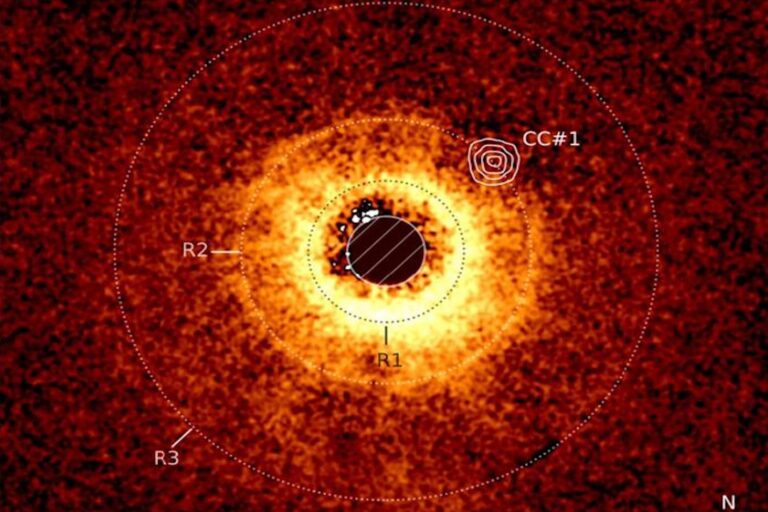
Since it began its science operations in July 2022, the James Webb Space Telescope has been probing the atmospheres of alien planets to study their potential for habitability. For the first time, however, Webb has discovered its own exoplanet, finding a young system hidden in a swirling cloud of dust and debris.
Webb has captured a previously unseen exoplanet, the lightest planet imaged so far—an accomplishment made possible by the space-based telescope’s advanced capabilities. The recent discovery, detailed in a paper published Wednesday in the journal Nature, marks Webb’s first discovery of an exoplanet and opens up a new window into hidden, Saturn-like worlds.
https://gizmodo.com/app/uploads/2025/06 ... 8x512.jpeg
-
weatheriscool
- Posts: 26094
- Joined: Sun May 16, 2021 6:16 pm
- Contact:
Re: Exoplanets – worlds of other suns
Astronomers discover a super-Earth exoplanet orbiting a nearby star
https://phys.org/news/2025-07-astronome ... iting.html
by Tomasz Nowakowski, Phys.org
https://phys.org/news/2025-07-astronome ... iting.html
by Tomasz Nowakowski, Phys.org
Using NASA's Transiting Exoplanet Survey Satellite (TESS), an international team of astronomers has discovered a new super-Earth exoplanet that orbits a nearby M dwarf star. The newfound alien world, designated TOI-1846 b, is about two times larger and four times more massive than Earth. The finding was detailed in a paper published June 23 on the arXiv preprint server.
Launched in April 2018, TESS has identified more than 7,600 candidate exoplanets (TESS Objects of Interest, or TOI), of which 636 have been confirmed so far. The satellite is conducting a survey of about 200,000 brightest stars near the sun, looking for transiting extrasolar worlds.
Now, a group of astronomers led by Abderahmane Soubkiou of the Oukaimeden Observatory in Morocco, reports that a transit signal has been identified in the star TOI-1846 monitored by TESS, which is located some 154 light years away. By conducting ground-based follow-up photometric and spectroscopic observations, they confirmed the planetary nature of this signal.
-
weatheriscool
- Posts: 26094
- Joined: Sun May 16, 2021 6:16 pm
- Contact:
Re: Exoplanets – worlds of other suns
Cosmic baby steps: For the first time, astronomers witness the dawn of a new solar system

by ESO
https://phys.org/news/2025-07-cosmic-ba ... -dawn.html
by ESO
https://phys.org/news/2025-07-cosmic-ba ... -dawn.html
For the first time, international researchers have pinpointed the moment when planets began to form around a star beyond the sun. Using the ALMA telescope, in which the European Southern Observatory (ESO) is a partner, and the James Webb Space Telescope, they have observed the creation of the first specks of planet-forming material—hot minerals just beginning to solidify. This finding marks the first time a planetary system has been identified at such an early stage in its formation and opens a window to the past of our own solar system.
"For the first time, we have identified the earliest moment when planet formation is initiated around a star other than our sun," says Melissa McClure, a professor at Leiden University in the Netherlands and lead author of the new study, published in Nature.

Re: Exoplanets – worlds of other suns
To know is essentially the same as not knowing. The only thing that occurs is the rearrangement of atoms in your brain.
-
firestar464
- Posts: 8408
- Joined: Wed Oct 12, 2022 7:45 am
Re: Exoplanets – worlds of other suns
(this acc is just rehashing old news)
Re: Exoplanets – worlds of other suns
Yeah, that was announced back in April. In any case, the science behind it has since been criticised and is likely flawed.
-
weatheriscool
- Posts: 26094
- Joined: Sun May 16, 2021 6:16 pm
- Contact:
Re: Exoplanets – worlds of other suns
New Earth-sized exoplanet orbiting nearby star detected
by Tomasz Nowakowski, Phys.org
https://phys.org/news/2025-07-earth-siz ... earby.html
by Tomasz Nowakowski, Phys.org
https://phys.org/news/2025-07-earth-siz ... earby.html
Using the Transiting Exoplanet Survey Satellite (TESS), an international team of astronomers has detected a new exoplanet orbiting a nearby star. The newfound alien world, designated TOI-2431 b, is comparable in size to Earth and has a very short orbital period. The finding was reported in a research paper published July 11 on the pre-print server arXiv.
NASA's TESS monitors about 200,000 bright stars near Earth, looking for temporary drops in brightness caused by planetary transits. Since its launch in April 2018, the satellite has identified more than 7,600 candidate exoplanets (TESS Objects of Interest, or TOI), of which 638 have been confirmed so far.
Now, a team of astronomers led by Kaya Han Taş of the University of Amsterdam in the Netherlands, reports the confirmation of another TOI monitored by TESS. According to the paper, a transit signal has been detected in the light curve of TOI-2431—a star of spectral type KV7 located some 117 light years away. The planetary nature of this signal was confirmed by follow-up ground-based observations.
-
weatheriscool
- Posts: 26094
- Joined: Sun May 16, 2021 6:16 pm
- Contact:
Re: Exoplanets – worlds of other suns
Proto-sub-Neptune detected with metal-poor atmosphere and a hot interior
https://phys.org/news/2025-07-proto-nep ... phere.html
by Netherlands Research School for Astronomy
https://phys.org/news/2025-07-proto-nep ... phere.html
by Netherlands Research School for Astronomy
Astronomers have characterized the atmosphere of a young (20 Myr old) transiting exoplanet and found it to be unusually clear and puffy. By analyzing the planet's atmospheric features, they were able to precisely measure the planet's mass surpassing traditional dynamical techniques like radial velocity, which poorly perform with such active young stars. They found that V1298 Tau b is a proto-sub-Neptune, still hot and inflated from its recent formation.
The team, led by Saugata Barat (MIT, MA, US) and his Ph.D. supervisor Jean-Michel Désert (UvA, Netherlands) used the James Webb Space Telescope to study the very young planet, and their results are accepted for publication in the Astrophysical Journal and currently available on the preprint server arXiv.