Stars, supernovae, black holes and stellar remnants

weatheriscool
Posts: 24486
Joined: Sun May 16, 2021 6:16 pm
Contact:

Re: Stars, supernovae, black holes and stellar remnants

Post by weatheriscool »

Astronomers discover irregularities in the cores of red giants
https://phys.org/news/2022-12-astronome ... iants.html
by Institute of Astrophysics and Space Sciences

Red giants are dying stars, in advanced stages of stellar evolution, which have depleted the hydrogen in their cores. In a study published today in Nature Communications, a team of astronomers mainly from Instituto de Astrofísica e Ciências do Espaço (IA), have found new evidence that red giant stars experience "glitches"—sharp structural variations—in their inner core.

Unfortunately, it is impossible to look directly inside a star. However, a technique dubbed asteroseismology, which measures oscillations similar to "earthquakes" in stars, can provide indirect glimpses of stellar interiors. The "glitches" can affect these oscillations, or the frequencies and paths of gravity and sound waves traveling through the stellar interior.

As IA researcher Margarida Cunha explains, "Waves propagating inside stars induce minute stellar brightness variations that can be detected with highly precise space-based instruments. These waves reveal the conditions of the medium where they propagate, which is to say, the physical properties of the stellar interiors."
weatheriscool
Posts: 24486
Joined: Sun May 16, 2021 6:16 pm
Contact:

Re: Stars, supernovae, black holes and stellar remnants

Post by weatheriscool »

NASA gets unusually close glimpse of black hole snacking on star
https://phys.org/news/2022-12-nasa-unus ... -hole.html
by Jet Propulsion Laboratory
Recent observations of a black hole devouring a wandering star may help scientists understand more complex black hole feeding behaviors.

Multiple NASA telescopes recently observed a massive black hole tearing apart an unlucky star that wandered too close. Located about 250 million light-years from Earth in the center of another galaxy, it was the fifth-closest example of a black hole destroying a star ever observed.

Once the star had been thoroughly ruptured by the black hole's gravity, astronomers saw a dramatic rise in high-energy X-ray light around the black hole. This indicated that as the stellar material was pulled toward its doom, it formed an extremely hot structure above the black hole called a corona.

NASA's NuSTAR (Nuclear Spectroscopic Telescopic Array) satellite is the most sensitive space telescope capable of observing these wavelengths of light, and the event's proximity provided an unprecedented view of the corona's formation and evolution, according to a new study published in the Astrophysical Journal.

The work demonstrates how the destruction of a star by a black hole—a process formally known as a tidal disruption event—could be used to better understand what happens to material that's captured by one of these behemoths before it's fully devoured.
User avatar
wjfox
Site Admin
Posts: 13579
Joined: Sat May 15, 2021 6:09 pm
Location: Essex, UK
Contact:

Re: Stars, supernovae, black holes and stellar remnants

Post by wjfox »

User avatar
caltrek
Posts: 9280
Joined: Mon May 17, 2021 1:17 pm

Re: Stars, supernovae, black holes and stellar remnants

Post by caltrek »

"Guest Star" Last Seen 840 Years Ago Finally Found Again, and It Looks Weird
by Dr Alfredo Carpineti, PhD.
January 16, 2023

Introduction:
(IFL Science) In the year 1181 CE, astronomers in China and Japan observed a new bright object appearing in the constellation of Cassiopea. These observers called it a "Guest Star". The most likely culprit was a supernova – but for 840 years, this object was lost. The object was seen again in 2013, but it was only in 2021 that the connection to the ancient event was made. Now, new follow-up observations reveal something absolutely peculiar.

The supernova remnant, the usually illuminated nebula that surrounds the remains of an exploded star, looks like a firework. Thin strands of material are seen radiating from a highly unusual star. The object, called Pa 30, does not look like your usual supernova.

"I have never seen any object—and certainly no supernova remnant in the Milky Way galaxy—that looks quite like this, and neither have any of my colleagues," lead author Professor Robert Fesen, from Dartmouth College, said in a statement. "This remnant will allow astronomers to study a particularly interesting type of supernova that up to now they could only investigate from theoretical models and examples in distant galaxies."

Models suggest that it is the result of a collision between two white dwarfs. This stellar merger creates a subclass of supernovae called Type Iax (pronounced One-a-x). The team reported that the structures contain little hydrogen and helium, but are rich in sulfur and argon.

"Our deeper images show that Pa 30 is not only beautiful, but now that we can see the nebula's true structure, we can investigate its chemical makeup and how the central star generated its remarkable appearance, then compare these properties to predictions from specific models of rare white dwarf mergers," Fesen said.
Read more here: https://www.iflscience.com/-guest-star ... ird-67105
Don't mourn, organize.

-Joe Hill
weatheriscool
Posts: 24486
Joined: Sun May 16, 2021 6:16 pm
Contact:

Re: Stars, supernovae, black holes and stellar remnants

Post by weatheriscool »

Volcano-like rupture could have caused magnetar slowdown
https://phys.org/news/2023-01-volcano-l ... wdown.html
by Jade Boyd, Rice University

On Oct. 5, 2020, the rapidly rotating corpse of a long-dead star about 30,000 light years from Earth changed speeds. In a cosmic instant, its spinning slowed. And a few days later, it abruptly started emitting radio waves.

Thanks to timely measurements from specialized orbiting telescopes, Rice University astrophysicist Matthew Baring and colleagues were able to test a new theory about a possible cause for the rare slowdown, or "anti-glitch," of SGR 1935+2154, a highly magnetic type of neutron star known as a magnetar.

In a study published this month in Nature Astronomy, Baring and co-authors used X-ray data from the European Space Agency's X-ray Multi-Mirror Mission (XMM-Newton) and NASA's Neutron Star Interior Composition Explorer (NICER) to analyze the magnetar's rotation. They showed the sudden slowdown could have been caused by a volcano-like rupture on the surface of the star that spewed a "wind" of massive particles into space. The research identified how such a wind could alter the star's magnetic fields, seeding conditions that would be likely to switch on the radio emissions that were subsequently measured by China's Five-hundred-meter Aperture Spherical Telescope (FAST).

"People have speculated that neutron stars could have the equivalent of volcanoes on their surface," said Baring, a professor of physics and astronomy. "Our findings suggest that could be the case and that on this occasion, the rupture was most likely at or near the star's magnetic pole."

SGR 1935+2154 and other magnetars are a type of neutron star, the compact remains of a dead star that collapsed under intense gravity. About a dozen miles wide and as dense as the nucleus of an atom, magnetars rotate once every few seconds and feature the most intense magnetic fields in the universe.

Magnetars emit intense radiation, including X-rays and occasional radio waves and gamma rays. Astronomers can decipher much about the unusual stars from those emissions. By counting pulses of X-rays, for example, physicists can calculate a magnetar's rotational period, or the amount of time it takes to make one complete rotation, as the Earth does in one day. The rotational periods of magnetars typically change slowly, taking tens of thousands of years to slow by a single rotation per second.

Glitches are abrupt increases in rotational speed that are most often caused by sudden shifts deep within the star, Baring said.

weatheriscool
Posts: 24486
Joined: Sun May 16, 2021 6:16 pm
Contact:

Re: Stars, supernovae, black holes and stellar remnants

Post by weatheriscool »

TESS discovers new warm brown dwarf
https://phys.org/news/2023-02-tess-brown-dwarf.html
by Tomasz Nowakowski , Phys.org
Using NASA's Transiting Exoplanet Survey Satellite (TESS), an international team of astronomers has detected a new warm brown dwarf. The newfound object, designated HIP 33609 b, transits a bright and rapidly rotating star. The discovery was presented in a paper published January 23 on the arXiv pre-print repository.

Brown dwarfs (BDs) are intermediate objects between planets and stars, occupying the mass range between 13 and 80 Jupiter masses (0.012 and 0.076 solar masses). Although many brown dwarfs have been detected to date, such objects orbiting other stars are a rare find.

Recently, a group of astronomers led by Noah Vowell of the Michigan State University, has found a new object of this rare type. The report that a transit signal has been identified in the light curve of a B-star known as HIP 33609. Follow-up spectroscopic and photometric observations confirmed that the transiting object is a large, massive and warm brown dwarf.

"In this paper, we present the discovery of a benchmark transiting BD in the HIP 33609 system. We use a combination of spectroscopic and photometric observations from both ground- and space-based facilities in order to characterize the host star and transiting BD," the researchers explained.

The newly found brown dwarf is inflated as its radius is about 58% larger than Jupiter, while its mass is estimated to be some 68 Jupiter masses. The observations show that the orbit of HIP 33609 b is highly eccentric, with an eccentricity of 0.56, and the orbital period was measured to be 39.47 days. The brown dwarf's equilibrium temperature was found to be 1,237 K.

The star HIP 33609 has a radius of about 1.86 solar radii and is 2.38 times more massive than the sun. It is a fast rotator as its rotation period was measured to be approximately 55.6 km/s. The star's effective temperature is about 10,400 K.

The astronomers noted the unusual parameters of HIP 33609 b, especially its long orbital period, could help advance our knowledge of transiting companions around hot stars. Therefore, HIP 33609 b is perceived as a benchmark for substellar evolutionary models. They added that all previously discovered transiting companions around B- and A-type stars have orbital periods less than 10 days.
weatheriscool
Posts: 24486
Joined: Sun May 16, 2021 6:16 pm
Contact:

Re: Stars, supernovae, black holes and stellar remnants

Post by weatheriscool »

James Webb Space Telescope captures the first phase of star formation in distant galaxies
https://phys.org/news/2023-02-james-web ... tures.html
by Stockholm University
Thanks to the James Webb Space Telescope's first images of galaxy clusters, researchers have, for the very first time, been able to examine very compact structures of star clusters inside galaxies, so-called clumps. In a paper published in the Monthly Notices of the Royal Astronomical Society, researchers from Stockholm University have studied the first phase of star formation in distant galaxies.

"The galaxy clusters we examined are so massive that they bend light rays passing through their center, as predicted by Einstein in 1915. And this in turn produces a kind of magnifying glass effect: the images of background galaxies are magnified," explains Adélaïde Claeyssens, Department of Astronomy, Stockholm University, one of the lead authors of the study.
weatheriscool
Posts: 24486
Joined: Sun May 16, 2021 6:16 pm
Contact:

Re: Stars, supernovae, black holes and stellar remnants

Post by weatheriscool »

For The First Time In Astronomy's History: NASA's Hubble Measures The Mass Of "Lone White Dwarf"
https://www.geopolitize.com/blog/for-th ... ite-dwarf/
"Space is an inspirational concept that allows you to dream big," says Peter Diamandis, and this is the best way to begin this article. The universe is vast, and it holds billions of surprises in its basket. One human lifetime will not be enough to explore the vastness, but we must try our hardest to learn everything we can.

The Lone White Dwarf is today's surprise. The scientist uses NASA's Hubble Space Telescope to measure the mass of the isolated White dwarf, LAWD 37, for the first time in the history of astronomy.

Peter Macgill, formerly of Cambridge University and now based at the University of California, Santa Cruz, determined the mass of the dwarf star. After submitting his report to the "Royal Astronomical Society's" monthly notices, the world learned about this miracle.
User avatar
Time_Traveller
Posts: 3025
Joined: Sun May 16, 2021 4:49 pm
Location: New York City, USA, November 5th 2032 C.E.

Re: Stars, supernovae, black holes and stellar remnants

Post by Time_Traveller »

The James Webb Space Telescope catches distant young galaxy devouring its neighbors
about 19 hours ago

Observations of the tiny Sparkler dwarf galaxy have revealed it sits embedded in a system of ancient star clusters and is greedily feasting on its smaller galactic companions to grow.

This means the galaxy, which was discovered in the first data from the James Webb Space Telescope (JWST), resembles the early cannibalistic Milky Way which also grew by feeding on smaller galaxies. Thus, the investigation of this galaxy provides astronomers with a unique insight into how the Milky Way has evolved.

The Sparkler, located in the southern constellation Volens, was given its name because it is surrounded by around two dozen shining globular clusters, tight groupings of ancient stars. Each of these clusters could contain around a million stars. Our galaxy currently hosts around 200 globular clusters of its own.

The team, led by Swinburne University professor Duncan Forbes, and San Jose State University professor Aaron Romanowsky, examined the age of Sparkler and its surroundings looking at the abundance of elements heavier than hydrogen and helium. Astronomers call these heavy elements "metals."

Looking at the galaxy's surrounding compact star clusters they realized they look like younger versions of the clusters around the Milky Way. Many are metal-rich, similar to globular clusters in the central bulge of our galaxy. The researchers also observed metal-poor intermediate-age clusters that are associated with a satellite galaxy that Sparkler is gobbling up, with its globular clusters acting as a desert.
https://www.space.com/webb-sees-young-c ... =space.com
“In the quantum multiverse, every choice, every decision you've ever and never made exists in an unimaginably vast ensemble of parallel universes.”
weatheriscool
Posts: 24486
Joined: Sun May 16, 2021 6:16 pm
Contact:

Re: Stars, supernovae, black holes and stellar remnants

Post by weatheriscool »

Hundreds of new high-redshift quasars discovered
https://phys.org/news/2023-02-hundreds- ... asars.html
by Tomasz Nowakowski , Phys.org

An international team of astronomers reports the detection of more than 400 new high-redshift quasars using the Dark Energy Spectroscopic Instrument (DESI). The discovery, published February 3 on the arXiv preprint server, greatly improves the number of known distant quasars and demonstrates the capability of DESI to identify more objects of this type in the future.

Quasars, or quasi-stellar objects (QSOs), are extremely luminous active galactic nuclei (AGN) containing supermassive central black holes with accretion disks. Their redshifts are measured from the strong spectral lines that dominate their visible and ultraviolet spectra.
User avatar
caltrek
Posts: 9280
Joined: Mon May 17, 2021 1:17 pm

Re: Stars, supernovae, black holes and stellar remnants

Post by caltrek »

Study Explains How Supermassive Black Holes Develop
February 15, 2023

Introduction:
(EurekAlert) The second paper (published in The Astrophysical Journal Letters finds that the growth in mass of these black holes matches predictions for black holes that not only cosmologically couple, but also enclose vacuum energy—material that results from squeezing matter as much as possible without breaking Einstein's equations, thus avoiding a singularity…

“Here's a toy analogy. You can think of a coupled black hole like a rubber band, being stretched along with the universe as it expands," said Croker. "As it stretches, its energy increases. Einstein's E = mc2 tells you that mass and energy are proportional, so the black hole mass increases, too."

How much the mass increases depends on the coupling strength, a variable the researchers call k.

"The stiffer the rubber band, the harder it is to stretch, so the more energy when stretched. In a nutshell, that's k," Croker said.

Because mass growth of black holes from cosmological coupling depends on the size of the universe, and the universe was smaller in the past, the black holes in the first study must be less massive by the correct amount in order for the cosmological coupling explanation to work.
Read more here: https://www.eurekalert.org/news-releases/979797
Don't mourn, organize.

-Joe Hill
weatheriscool
Posts: 24486
Joined: Sun May 16, 2021 6:16 pm
Contact:

Re: Stars, supernovae, black holes and stellar remnants

Post by weatheriscool »

A star is born: Images of nearby galaxies provide clues about star formation
https://phys.org/news/2023-02-star-born ... axies.html
by Michelle Franklin, University of California - San Diego
It is a popular notion that aside from large celestial objects like planets, stars and asteroids, outer space is empty. In fact, galaxies are filled with something called the interstellar medium (ISM)—that is, the gas and dust that permeate the space in between those large objects. Importantly, under the right conditions, it is from the ISM that new stars are formed.

Now researchers from the University of California San Diego, in collaboration with a worldwide project team, have released their findings in a special issue of The Astrophysical Journal Letters dedicated to their work using advanced telescope images through the JWST Cycle 1 Treasury Program.

"With JWST, you can make incredible maps of nearby galaxies at very high resolution that provide amazingly detailed images of the interstellar medium," stated Associate Professor of Physics Karin Sandstrom who is a co-principal investigator on the project.

Although JWST can look at very distant galaxies, the ones Sandstrom's group studied are relatively close at about 30 million light years away, including one known as the Phantom Galaxy. Also known as M74 or NGC 628, astronomers have known of the Phantom Galaxy's existence since at least the 18th century.

Sandstrom, along with postdoctoral scholar Jessica Sutter and former postdoctoral scholar Jeremy Chastenet (now at University of Ghent), focused on a specific component of the ISM called polycyclic aromatic hydrocarbons (PAHs). PAHs are small particles of dust—the size of a molecule—and it's their small size that makes them so valuable to researchers.

When PAHs absorb a photon from a star, they vibrate and produce emission features that can be detected in the mid-infrared electromagnetic spectrum—something that typically doesn't happen with larger dust grains from the ISM. The vibrational features of PAHs allow researchers to observe many important characteristics including size, ionization and structure.
User avatar
wjfox
Site Admin
Posts: 13579
Joined: Sat May 15, 2021 6:09 pm
Location: Essex, UK
Contact:

Re: Stars, supernovae, black holes and stellar remnants

Post by wjfox »


User avatar
wjfox
Site Admin
Posts: 13579
Joined: Sat May 15, 2021 6:09 pm
Location: Essex, UK
Contact:

Re: Stars, supernovae, black holes and stellar remnants

Post by wjfox »

'Runaway' black hole the size of 20 million suns found speeding through space with a trail of newborn stars behind it

By Robert Lea
published 5 days ago

Astronomers have discovered a "runaway" black hole, potentially the first observational evidence that supermassive black holes can be ejected from their host galaxies.

https://www.space.com/runaway-black-hol ... born-stars


Image
Image credit: Keio University
User avatar
wjfox
Site Admin
Posts: 13579
Joined: Sat May 15, 2021 6:09 pm
Location: Essex, UK
Contact:

Re: Stars, supernovae, black holes and stellar remnants

Post by wjfox »

Supermassive black hole in Milky Way centre will consume large object in 2036

5th March 2023

A mysterious object called X7 has evolved dramatically in a relatively short time as it approaches the centre of our galaxy. Astronomers now say it is likely to be a large cloud of dust and gas, created when two stars collided.

Read more: https://www.futuretimeline.net/blog/202 ... e-2036.htm


User avatar
Time_Traveller
Posts: 3025
Joined: Sun May 16, 2021 4:49 pm
Location: New York City, USA, November 5th 2032 C.E.

Re: Stars, supernovae, black holes and stellar remnants

Post by Time_Traveller »

'Missing link' protostar may prove solar system's water is older than the sun
published 1 day ago

Astronomers have detected an abundance of water in the form of gas in a disk of planet-forming material that surrounds a distant star. The disk appears to contain hundreds of times more water than in all of Earth's oceans.

The discovery could give clues as to how water moves from star-forming clouds of gas and dust to planets, and could also indicate that Earth's water may be older than the sun.

The team of astronomers reached their conclusion as a result of observations of V883 Orionis, an infant star or "protostar" located around 1,300 light-years from Earth in the Orion constellation using the Atacama Large Millimeter/submillimeter Array (ALMA) in Northern Chile.

"We can now trace the origins of water in our solar system to before the formation of the sun," National Radio Astronomy Observatory (NRAO) astronomer and research lead author, John J. Tobin, said in a statement.(opens in new tab) "V883 Orionis is the missing link in this case."
https://www.space.com/solar-system-wate ... =space.com
“In the quantum multiverse, every choice, every decision you've ever and never made exists in an unimaginably vast ensemble of parallel universes.”
weatheriscool
Posts: 24486
Joined: Sun May 16, 2021 6:16 pm
Contact:

Re: Stars, supernovae, black holes and stellar remnants

Post by weatheriscool »

Nearly 300 variable stars detected with Kepler spacecraft
https://phys.org/news/2023-03-variable- ... craft.html
by Tomasz Nowakowski , Phys.org
Using data from NASA's Kepler spacecraft, astronomers from the Pedagogical University of Cracow, Poland, and elsewhere have detected 278 variable stars in the open cluster NGC 6791 and its surroundings. The finding was reported in a paper published March 13 on the arXiv pre-print repository.

Variable stars could offer important hints into aspects of stellar structure and evolution. They could also be helpful for better understanding the distance scale of the universe. In particular, studies of variable stars in star clusters are of special interest for astronomers as they have the potential to help identify systematic errors that affect stellar distance indicators.

Located about 13,300 light years from the Earth in the Lyra constellation, NGC 6791 is one of the most studied open clusters (OCs). It has an estimated age of approximately 8 billion years and an iron to hydrogen abundance ratio that is more than twice that of our sun. This makes it one of the oldest and most metal-rich clusters in the Milky Way galaxy. With a mass of approximately 4,000 solar masses, it is also one of the most massive OCs known to date.
weatheriscool
Posts: 24486
Joined: Sun May 16, 2021 6:16 pm
Contact:

Re: Stars, supernovae, black holes and stellar remnants

Post by weatheriscool »

Astronomers discover helium-burning white dwarf
Image

https://phys.org/news/2023-03-astronome ... dwarf.html
by University of Bonn
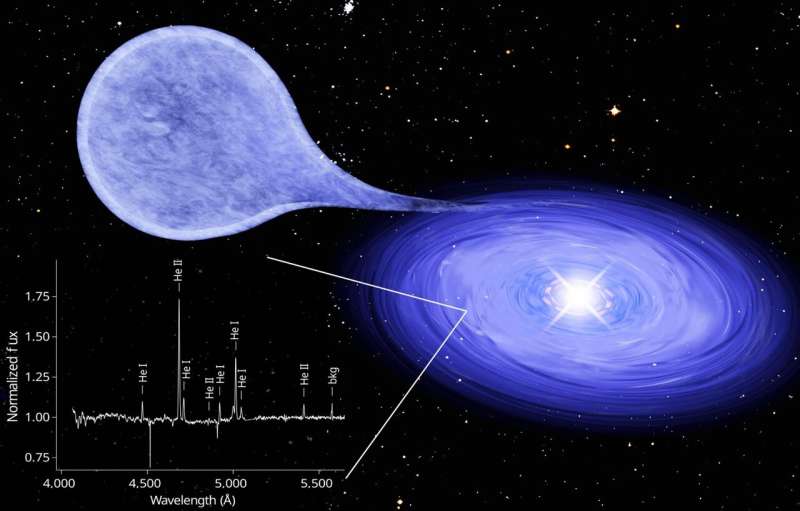
A white dwarf star can explode as a supernova when its mass exceeds the limit of about 1.4 solar masses. A team led by the Max Planck Institute for Extraterrestrial Physics (MPE) in Garching and involving the University of Bonn has now found a binary star system in which matter flows onto the white dwarf from its companion.

The system was found due to bright, so-called super-soft X-rays, which originate in the nuclear fusion of the overflowed gas near the surface of the white dwarf. The unusual thing about this source is that it is helium and not hydrogen that overflows and burns. The measured luminosity suggests that the mass of the white dwarf is growing more slowly than previously thought possible, which may help to understand the number of supernovae caused by exploding white dwarfs. The results have been published in the journal Nature.
User avatar
caltrek
Posts: 9280
Joined: Mon May 17, 2021 1:17 pm

Re: Stars, supernovae, black holes and stellar remnants

Post by caltrek »

Flattest Explosion In Space Is Bizarre Phenomenon Never Seen Before
by Dr. Alfredo Carpineti
March 31, 2023

Introduction:
(IFL Science) Back in 2018, astronomers discovered a very peculiar stellar explosion, which got the automatic name of AT2018cow. Since then, it's become known simply as the “cow” and it is the prototype of a new class of objects called Fast Blue Optical Transients (FBOTs). And researchers have now realized that the event was even weirder than previously assumed.

This explosion appeared to be extremely flat, spreading through a thick disk, with a thickness about one-tenth of the radius of the disk a handful of days after the explosion was recorded. Explosions in space can have a level of asymmetry, but this is the most aspherical ever recorded, which could be an indication of the properties of all FBOTs.

“Very little is known about FBOT explosions - they just don’t behave like exploding stars should, they are too bright and they evolve too quickly. Put simply, they are weird, and this new observation makes them even weirder,” lead author Dr Justyn Maund, from the University of Sheffield, said in a statement.

“What we now know for sure is that the levels of asymmetry recorded are a key part of understanding these mysterious explosions, and it challenges our preconceptions of how stars might explode in the Universe,” Dr Maund continued.

The crucial element in this work was the polarization of light. Light is made by oscillating electric and magnetic fields, and these oscillations can point in any direction. If the light is polarized, it means the oscillation is happening in a specific direction. This approach is what is used in 3D cinema. Light with two polarizations is sent out and each lens filters part of it out, giving the impression to our brains that we are seeing something in 3D.

Read more here: https://www.iflscience.com/flattest-ex ... ore-68264
Don't mourn, organize.

-Joe Hill
User avatar
Time_Traveller
Posts: 3025
Joined: Sun May 16, 2021 4:49 pm
Location: New York City, USA, November 5th 2032 C.E.

Re: Stars, supernovae, black holes and stellar remnants

Post by Time_Traveller »

Hubble telescope spies mysterious celestial object that defies classification
published 5 days ago

Space is hard, the adage goes. And we'd extrapolate that sentiment to the classification of celestial objects, particularly ones like Z 229-15.

A newly released image taken by the Hubble Space Telescope shows Z 229-15, which, at first glance, simply appears to be a spiral galaxy, given its two spiraling arms of stars emanating from a bright core. But it's far, far more than that.

Z 229-15 is one of those objects that fits several classifications, according to a statement released by the European Space Agency (ESA). "Z 229-15 is one of those interesting celestial objects that, should you choose to research it, you will find defined as several different things," the statement reads. While it's impossible to pin down a singular classification for Z 229-15, there are several overlapping definitions that together describe this wondrous celestial object.

First and foremost, Z 229-15 is indeed a galaxy, which is a gravitationally bound collection of stars.

Second, it's an active galactic nucleus (AGN), or rather, it contains an AGN. An AGN is a region at the center of a galaxy that is exceptionally bright due to a supermassive black hole at its core. It's not the black hole itself that's so luminous, but rather all the material from the galaxy that has been trapped in a spinning disk around it, having been drawn toward the black hole by its intense gravitational pull. That disk heats up and emits massive amounts of energy across the electromagnetic spectrum, resulting in the brightness.
https://www.space.com/hubble-telescope- ... cebook.com
“In the quantum multiverse, every choice, every decision you've ever and never made exists in an unimaginably vast ensemble of parallel universes.”
Post Reply