Exploration of the gas giants

User avatar
caltrek
Posts: 9280
Joined: Mon May 17, 2021 1:17 pm

Re: Exploration of the gas giants

Post by caltrek »

The Salty Belly of a Saturn Moon May Contain Building Blocks of Life
by Doris Ellin Urrutia
December , 2023

Introduction:
(Inverse) In 2017, the Cassini spacecraft barrelled toward Saturn for the final time. NASA officials had elected to terminate the mission in a death dive. Obliterating the probe in a controlled maneuver would safeguard Saturn’s precious rings, moons, plus whatever else Cassini’s Earthly material could damage, or even contaminate. Like, perhaps, life.

Currently, scientists have never detected biosignatures in another world. But space exploration is providing tantalizing ideas. The latest such notion comes from a frigid moon of Saturn. The work is detailed in a study published this week in the journal Nature Astronomy.

Six years before its fiery finale, Cassini flew through plumes of gas coming from Saturn’s moon Enceladus. The spray was coming through cracks on its icy surface. It was a natural delivery service, giving Cassini’s INMS, or Ion and Neutral Mass Spectrometer, a special taste of what’s inside the moon.

WHAT’S IN THE SPRAY?

Astronomers have been studying INMS data since Cassini’s 2011 and 2012 rendezvous of the plumes. So far, they’ve found compelling evidence that Enceladus may have conditions favorable to life. Inside the gaseous spray there was the presence of water, carbon dioxide, methane, ammonia, and molecular hydrogen. This suggests that life could potentially emerge far away from the Sun in another part of the solar system.

But that’s a big maybe. “We don't yet know how life originated on Earth, so it's difficult to say what the necessary conditions would be on Enceladus,” Jonah Peter, a graduate student at Harvard University and lead author of the new paper, tells Inverse.

Read more here: https://www.inverse.com/science/salty- ... cks-life
Don't mourn, organize.

-Joe Hill
weatheriscool
Posts: 24482
Joined: Sun May 16, 2021 6:16 pm
Contact:

Re: Exploration of the gas giants

Post by weatheriscool »

weatheriscool
Posts: 24482
Joined: Sun May 16, 2021 6:16 pm
Contact:

Re: Exploration of the gas giants

Post by weatheriscool »

NASA's Juno to get close look at Jupiter's volcanic moon Io on Dec. 30
https://phys.org/news/2023-12-nasa-juno ... -moon.html
by NASA
NASA's Juno spacecraft will on Saturday, Dec. 30, make the closest flyby of Jupiter's moon Io that any spacecraft has made in over 20 years. Coming within roughly 930 miles (1,500 kilometers) from the surface of the most volcanic world in our solar system, the pass is expected to allow Juno instruments to generate a firehose of data.

"By combining data from this flyby with our previous observations, the Juno science team is studying how Io's volcanoes vary," said Juno's principal investigator, Scott Bolton of the Southwest Research Institute in San Antonio, Texas. "We are looking for how often they erupt, how bright and hot they are, how the shape of the lava flow changes, and how Io's activity is connected to the flow of charged particles in Jupiter's magnetosphere."

A second ultra-close flyby of Io is scheduled for Feb. 3, 2024, in which Juno will again come within about 930 miles (1,500 kilometers) of the surface.

The spacecraft has been monitoring Io's volcanic activity from distances ranging from about 6,830 miles (11,000 kilometers) to over 62,100 miles (100,000 kilometers), and has provided the first views of the moon's north and south poles. The spacecraft has also performed close flybys of Jupiter's icy moons, Ganymede and Europa.
weatheriscool
Posts: 24482
Joined: Sun May 16, 2021 6:16 pm
Contact:

Re: Exploration of the gas giants

Post by weatheriscool »

Juno Probe Completes Ultra-Close Flyby of Volcanic Moon Io
Jupiter's innermost moon is the latest target of Juno's extended mission.
By Ryan Whitwam January 3, 2024
https://www.extremetech.com/science/jun ... ic-moon-io

NASA's Juno spacecraft arrived in the Jovian system in 2016, tasked with studying the solar system's largest planet up close. Of course, Jupiter also has the most moons in the solar system (by a hair), and Juno has had the opportunity to scan a few of those, as well. Its most recent flyby reveals the volcanic moon Io in all its sulfuric glory.

In order to study Jupiter, the spacecraft has to remain in a highly eccentric orbit. This minimizes the amount of time Junop spends close to the gas giant, which produces intense bands of radiation that could fry the probe's electronics. These long, swooping orbits also put Juno in close proximity to the planet's inner moons. In the past, Juno has conducted flybys of Ganymede and Europa. There was another Io flyby in 2022, but the spacecraft's closest approach was 64,000 km (40,000 miles). On Dec 30, Juno zipped over the surface at an altitude of just 1,500 km (930 miles).

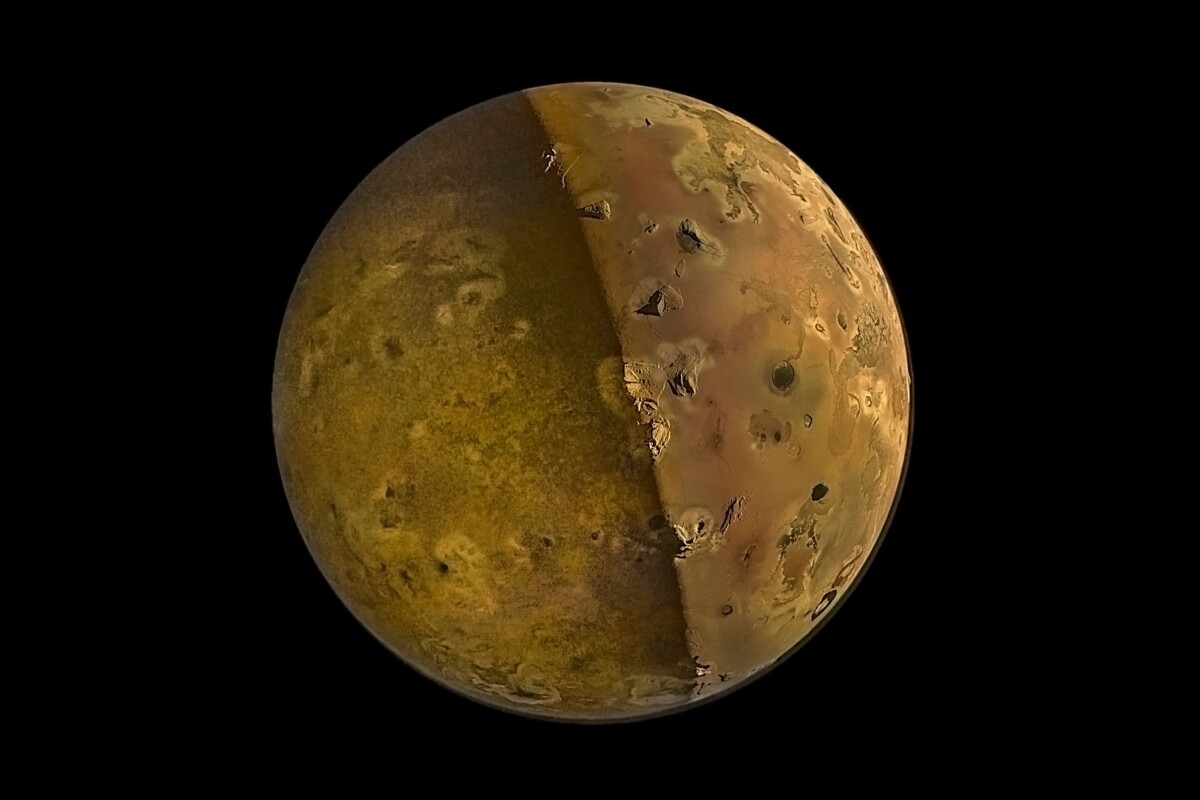
Io is a bit larger than Earth's moon, making it the third largest in the Jovian system. The constant pull of Jupiter's gravity causes tidal heating, which has produced an impressive 400 active volcanoes on the moon, belching out plumes of sulfur and sulfur dioxide. In the image above, you can see some sizable volcanic features, including the largest on the entire moon. It's Loki Patera, the dark circle toward the lower right. This 202-kilometer (126-mile) depression contains a lava lake, which shows evidence of frequent surface changes.
User avatar
wjfox
Site Admin
Posts: 13575
Joined: Sat May 15, 2021 6:09 pm
Location: Essex, UK
Contact:

Re: Exploration of the gas giants

Post by wjfox »

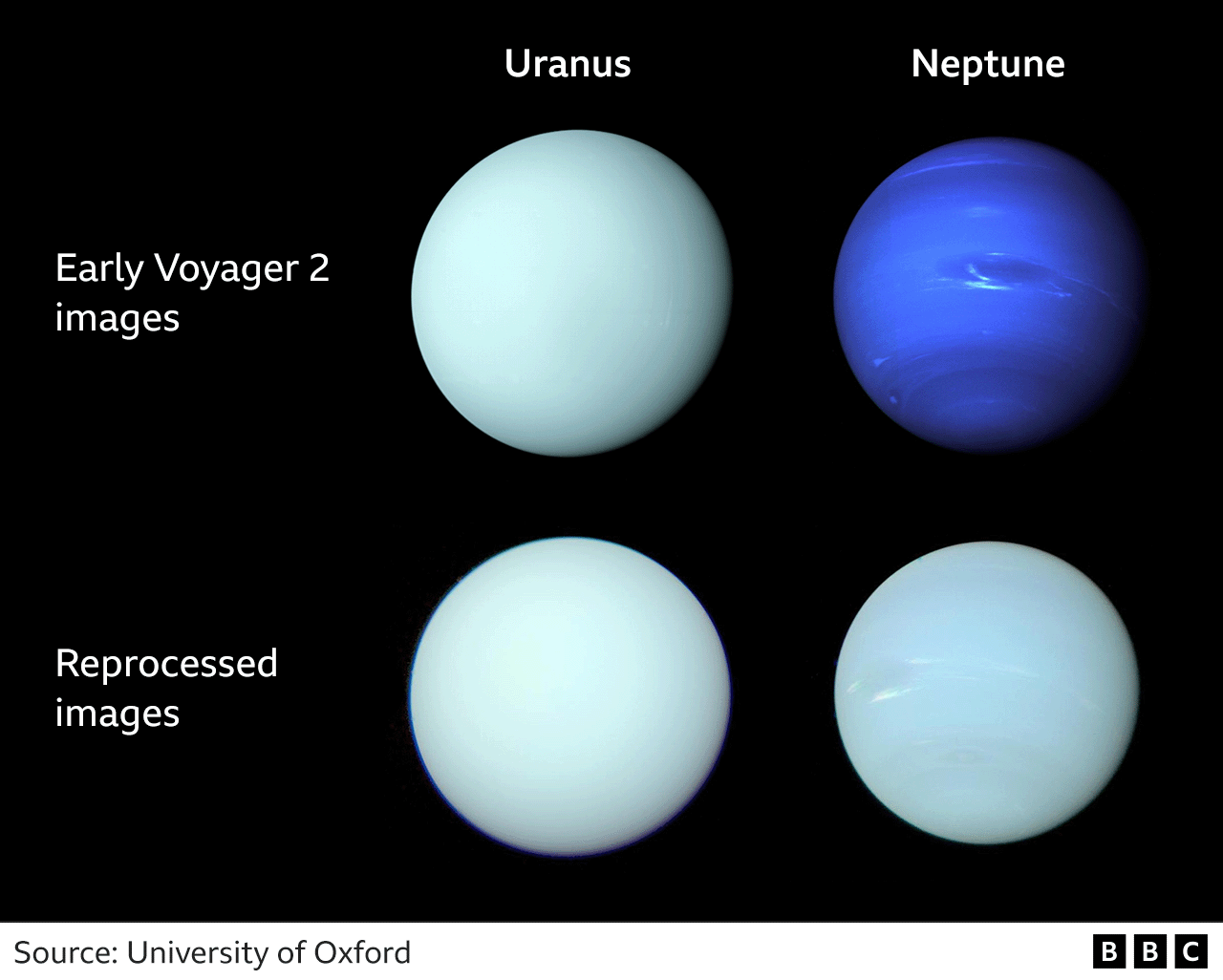
Neptune and Uranus seen in true colours for first time

2 hours ago

Our ideas of the colours of the planets Neptune and Uranus have been wrong, research led by UK astronomers reveals.

Images from a space mission in the 1980s showed Neptune to be a rich blue and Uranus green.

But a study has discovered that the two ice giant planets are both similar shades of greenish blue.

It has emerged that the earlier images of Neptune had been enhanced to show details of the planet's atmosphere, which altered its true colour.

"They did something that I think everyone on Instagram will have done at some time in their life, they tweaked the colours," Prof Catherine Heymans, Astronomer Royal for Scotland and a University of Edinburgh astrophysics professor, told BBC Radio 4's Today. "They accentuated the blue just to reveal the features that you can see in Neptune's atmosphere, and that's why the image looks very blue, but in reality, Neptune is actually pretty similar to Uranus."

https://www.bbc.co.uk/news/science-environment-67892275


Image
User avatar
raklian
Posts: 1981
Joined: Sun May 16, 2021 4:46 pm
Location: North Carolina

Re: Exploration of the gas giants

Post by raklian »

wjfox wrote: Fri Jan 05, 2024 3:07 pm Neptune and Uranus seen in true colours for first time

Image
Uranus looks quite bleached, eh?
To know is essentially the same as not knowing. The only thing that occurs is the rearrangement of atoms in your brain.
weatheriscool
Posts: 24482
Joined: Sun May 16, 2021 6:16 pm
Contact:

Re: Exploration of the gas giants

Post by weatheriscool »

Titan's 'magic islands' are likely to be honeycombed hydrocarbon icebergs, finds study
https://phys.org/news/2024-01-titan-mag ... arbon.html
by Liza Lester, American Geophysical Union
Titan's "magic islands" are likely floating chunks of porous, frozen organic solids, a new study finds, pivoting from previous work suggesting they were gas bubbles. The study was published in Geophysical Research Letters.

A hazy orange atmosphere 50% thicker than Earth's and rich in methane and other carbon-based, or organic, molecules blankets Saturn's largest moon, Titan. Its surface is covered with dark dunes of organic material and seas of liquid methane and ethane. Stranger yet are what appear in radar imagery as shifting bright spots on the seas' surfaces that can last a few hours to several weeks or more.

Scientists first spotted these ephemeral "magic islands" in 2014 with the Cassini-Huygens mission and have since been trying to figure out what they are. Previous studies suggested they could be phantom islands caused by waves or real islands made of suspended solids, floating solids, or bubbles of nitrogen gas.
weatheriscool
Posts: 24482
Joined: Sun May 16, 2021 6:16 pm
Contact:

Re: Exploration of the gas giants

Post by weatheriscool »

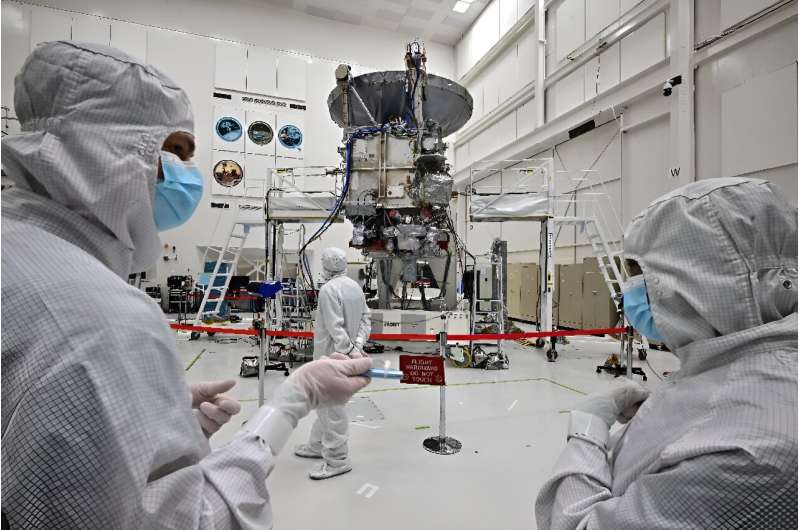
NASA Installs Europa Clipper Spacecraft's Scientific Instruments
JPL engineers can finally test the complete spacecraft ahead of launch in October.
By Ryan Whitwam February 2, 2024
NASA hopes to send the Europa Clipper on its way toward Jupiter later this year, and work is ongoing to get the spacecraft ready. There's a chance that Europa's subsurface ocean could have the ingredients for life, but reaching Europa and surviving in orbit of Jupiter is no simple feat. NASA says the mission has passed a major milestone: All nine instruments designed for the mission have been installed aboard Europa Clipper. This finally allows NASA engineers to test the complete spacecraft for the first time.

The Europa Clipper is being prepared for its mission at NASA's Jet Propulsion Laboratory (JPL) in southern California. In October, the spacecraft will be loaded aboard a SpaceX Falcon Heavy rocket to begin its long journey to the Jovian system. NASA initially wanted to launch this mission with the Space Launch System, but delays in building those rockets left NASA with little choice. SpaceX is the only launch services provider with a super-heavy lift vehicle ready to go.

This period in Europa Clipper development is vitally important to the mission's success. The Clipper gets its name from the way it will explore Jupiter's moon. Europa lies well within the intense radiation field of Jupiter, meaning the probe would be at great risk of failure if it entered the orbit of the moon and stayed there. So, the mission will employ a strategy similar to the one that kept the Juno spacecraft alive. It will swing past Europa 44 times, collecting more data on each flyby before its eccentric orbit takes it out of the danger zone.
https://www.extremetech.com/science/nas ... nstruments
weatheriscool
Posts: 24482
Joined: Sun May 16, 2021 6:16 pm
Contact:

Re: Exploration of the gas giants

Post by weatheriscool »

Juno Completes Second Flyby of Volcanic Moon Io
The rest of Juno's mission will focus once again on Jupiter.
By Ryan Whitwam February 6, 2024
NASA's Juno spacecraft began its scientific operations looping around the gas giant Jupiter, providing the most stunning images yet of the solar system's largest planet. But that was in 2016—Juno is still operational, but it's shifted focus to some of Jupiter's many moons. Late last year, Juno completed a close flyby of Io, and now the probe has done it again, zipping over the craggy surface of Jupiter's most volcanic moon to beam back photos of the alien landscape. Enjoy it—these might be the last up-close images of Io we get for a long time.

The Juno team says the latest flyby took place exactly as planned on Feb. 3, offering another glimpse of the moon's surface from a mere 930 miles (1,500 kilometers) above the surface. And what a surface it is—Io is Jupiter's innermost moon, which subjects Io to the intense tug of the gas giant's gravity. This results in tidal heating, which keeps the interior of Io toasty. That's why the moon has an estimated 400 active volcanoes.
https://www.extremetech.com/science/jun ... ic-moon-io
User avatar
Time_Traveller
Posts: 3025
Joined: Sun May 16, 2021 4:49 pm
Location: New York City, USA, November 5th 2032 C.E.

Re: Exploration of the gas giants

Post by Time_Traveller »

Saturn’s ‘Death Star’ moon has hidden ocean under its crust, say scientists
Wed 7 Feb 2024 16.00 GMT

A moon of Saturn that resembles the Death Star from Star Wars because of a massive impact crater on its surface has a hidden ocean buried miles beneath its battered crust, researchers say.

The unexpected discovery means Mimas, an ice ball 250 miles wide, becomes the latest member of an exclusive club, joining Saturn’s Titan and Enceladus and Jupiter’s Europa and Ganymede as moons known to harbour subterranean oceans.

“It’s quite a surprise,” said Valéry Lainey, an astronomer at the Observatoire de Paris in France. “If you look at the surface of Mimas, there’s nothing that betrays a subsurface ocean. It’s the most unlikely candidate by far.”

Peculiarities in Mimas’s orbit had led astronomers to entertain two possibilities: either it contained an elongated core shrouded in ice, or an internal ocean that allowed its outer shell to shift independently of the core.

By analysing thousands of images from Nasa’s Cassini mission to Saturn, Lainey and his colleagues reconstructed the precise spin and orbital motion of Mimas as it looped around the gas giant. Their calculations showed Mimas must possess a hidden subsurface ocean to move the way it does.
https://www.theguardian.com/science/202 ... dden-ocean
“In the quantum multiverse, every choice, every decision you've ever and never made exists in an unimaginably vast ensemble of parallel universes.”
weatheriscool
Posts: 24482
Joined: Sun May 16, 2021 6:16 pm
Contact:

Re: Exploration of the gas giants

Post by weatheriscool »

I'd bet money that some form of life lives on one or more of the half dozen under ice oceans on the moons of the giant planets in our solar systems. I find it highly unlikely that life is on Mecury, Venus or mars...It just makes sense in these massive oceans that are 10-100 times the water volume of our planet oceans with this kind of tidal forcing that something could have sprung up.

If I was in charge of finding life I'd look at these half dozen + moons and fund sub missions to them.
weatheriscool
Posts: 24482
Joined: Sun May 16, 2021 6:16 pm
Contact:

Re: Exploration of the gas giants

Post by weatheriscool »

Stunning Juno flyby image shows Io lit up by "Jupitershine"
By David Szondy
February 08, 2024
Image
NASA has released a high-resolution image taken by the Juno deep space probe during its close encounter with Jupiter's moon Io on December 30, 2023. The image of the volcanic satellite not only shows remarkable details, but an usual kind of lighting.

When the robotic Juno orbiter zoomed past Io in December, it was the closest flyby of the moon since the Galileo mission over 20 years ago. It also marked a generational jump in photographic capability thanks to its JunoCam, which can manage a resolution of 15 km/pixel (9.3 miles/pixel) from 4,300 km (2,700 miles).

As Juno passed over the southern hemisphere of Io, JunoCam sent back high-resolution images of many of the moon's features, including active volcanoes spewing clouds of sulfur into space.
https://newatlas.com/space/juno-flyby-i ... itershine/
User avatar
Time_Traveller
Posts: 3025
Joined: Sun May 16, 2021 4:49 pm
Location: New York City, USA, November 5th 2032 C.E.

Re: Exploration of the gas giants

Post by Time_Traveller »

Saturn's ocean moon Titan may not be able to support life after all
published about 17 hours ago

Image

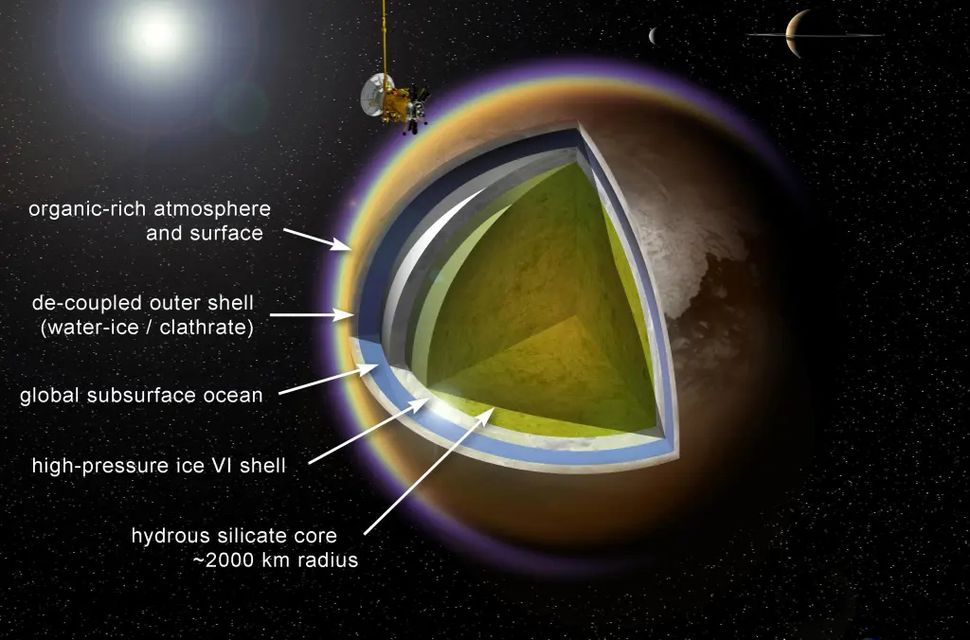
Titan's underground ocean, and similar oceans inside other icy moons in the outer solar system, may lack the organic chemistry necessary for life, according to new astrobiological research.

Titan is Saturn's largest moon, and the second largest moon in the entire solar system. It's famous for being shrouded in a smog of petrochemicals and for possessing a veritable soup of organic molecules — molecules that contain carbon — on its surface. Yet, despite all this fascinating chemistry, Titan is cold. Very cold. It has surface temperatures no warmer than –179 degrees Celsius (–290 degrees Fahrenheit). And in these frigid conditions, chemical reactions for life progress very slowly.

However, deep underground where it's warmer — the exact depth is not certain, but estimates suggest it's on the order of 100 kilometers (62 miles) — a liquid ocean with a volume 12 times that of Earth's oceans combined is thought to exist. Similar oceans inhabit the interiors of Titan's fellow Saturnian moon Enceladus, and Jupiter's moons Europa and Ganymede.

And where there is liquid water, there could be life. Right? Not so fast, says Catherine Neish of Western University in Ontario, Canada.

A planetary scientist, Neish led an international team that challenged the assumption Titan's ocean, and indeed the oceans of other icy moons, could be habitable.
https://www.space.com/titan-ocean-satur ... arth-study
“In the quantum multiverse, every choice, every decision you've ever and never made exists in an unimaginably vast ensemble of parallel universes.”
User avatar
wjfox
Site Admin
Posts: 13575
Joined: Sat May 15, 2021 6:09 pm
Location: Essex, UK
Contact:

Re: Exploration of the gas giants

Post by wjfox »

User avatar
Time_Traveller
Posts: 3025
Joined: Sun May 16, 2021 4:49 pm
Location: New York City, USA, November 5th 2032 C.E.

Re: Exploration of the gas giants

Post by Time_Traveller »

3 tiny new moons found around Uranus and Neptune — and one is exceptionally tiny
about 16 hours ago

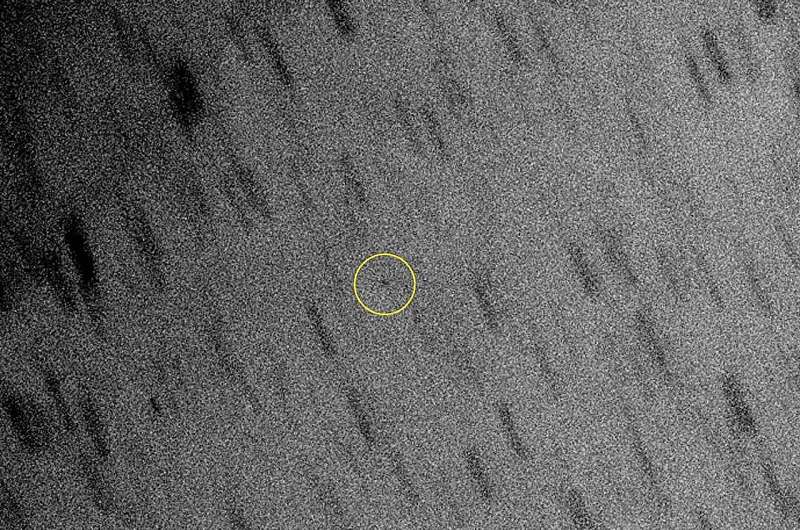
Astronomers have discovered two tiny moons orbiting Neptune and one circling Uranus, bringing the number of their known moons to 16 and 28 respectively.

Uranus' new moon, the first detected around the ice giant in over two decades and possibly the smallest of its ilk, is just 5 miles (8 kilometers) wide; it takes 680 days to complete one orbit around Uranus. In comparison, one Mars' moons named Deimos, considered to be among the tiniest known moons in our solar system, is 8 miles (13 km) wide.

The new moon of the blue-green planet is currently referred to as "S/2023 U1" while it awaits being named for a Shakespearean character, according to a statement by Carnegie Institution for Science (or Carnegie Science).

The brighter of Neptune's two new moons is provisionally named "S/2002 N5." At 14 miles (23 km) wide, this newly discovered satellite seems to be in a 9-year orbit around Neptune. The fainter moon, currently assigned the name "S/2021 N1," is 8.6 miles wide (14 km) and circles Neptune once every 27 years. Both Neptunian moons will be assigned permanent names based on sea gods and nymphs in Greek mythology.
https://www.space.com/new-moons-discove ... us-neptune
“In the quantum multiverse, every choice, every decision you've ever and never made exists in an unimaginably vast ensemble of parallel universes.”
weatheriscool
Posts: 24482
Joined: Sun May 16, 2021 6:16 pm
Contact:

Re: Exploration of the gas giants

Post by weatheriscool »

Subaru Telescope discovers the faintest moon around icy giant planets
https://phys.org/news/2024-03-subaru-te ... n-icy.html
by Subaru Telescope
Image
Using some of the largest telescopes in the world, including the Subaru Telescope, a team of astronomers discovered three new natural satellites orbiting the outermost planets in our solar system—one around Uranus and two around Neptune. One of the new moons, initially detected by the Subaru Telescope, is the faintest moon ever discovered by ground-based telescopes.

"The three newly discovered moons are the faintest ever found around these two ice giant planets using ground-based telescopes," explains Scott Sheppard (Carnegie Institution for Science), who leads the research.

The new moon around Uranus, S/2023 U1, increases the total number of known moons orbiting the ice giant planet to 28. Initially detected using the Magellan Telescope in Chile in 2023, it was subsequently confirmed in earlier images captured by the Subaru Telescope and Magellan Telescope in 2021. With a diameter of just 8 kilometers, it is likely the smallest among Uranus' moons. It completes one orbit around the planet in 680 days.
firestar464
Posts: 7202
Joined: Wed Oct 12, 2022 7:45 am

Re: Exploration of the gas giants

Post by firestar464 »

Scientists use James Webb Space Telescope to uncover clues about Neptune's evolution

https://phys.org/news/2024-03-scientist ... scope.html
weatheriscool
Posts: 24482
Joined: Sun May 16, 2021 6:16 pm
Contact:

Re: Exploration of the gas giants

Post by weatheriscool »

NASA unveils probe bound for Jupiter's possibly life-sustaining moon
https://phys.org/news/2024-04-nasa-unve ... piter.html
by Huw GRIFFITH
NASA's Europa Clipper Spacecraft is headed for one of Jupiter's moons to see if it has the right conditions to sustain life.

US space scientists on Thursday unveiled the interplanetary probe NASA plans to send to one of Jupiter's icy moons as part of humanity's hunt for extra-terrestrial life.

The Clipper spacecraft is due to blast off in October bound for Europa, one of dozens of moons orbiting the solar system's biggest planet, and the nearest spot in our celestial neighborhood that could offer a perch for life.

"One of the fundamental questions that NASA wants to understand is, are we alone in the cosmos?" Bob Pappalardo, the mission's project scientist told AFP.
Image
"If we were to find the conditions for life, and then someday actually find life in a place like Europa, then that would say in our own solar system there are two examples of life: Earth and Europa.
weatheriscool
Posts: 24482
Joined: Sun May 16, 2021 6:16 pm
Contact:

Re: Exploration of the gas giants

Post by weatheriscool »

weatheriscool
Posts: 24482
Joined: Sun May 16, 2021 6:16 pm
Contact:

Re: Exploration of the gas giants

Post by weatheriscool »

Unraveling water mysteries beyond Earth: Ground-penetrating radar will seek bodies of water on Jupiter
https://phys.org/news/2024-04-unravelin ... ating.html
by European Geosciences Union

Finding water on distant planets and moons in our solar system is a challenge, especially when the instrument is thousands of kilometers away from the surface, but scientists presenting at the European Geosciences Union General Assembly describe how ground-penetrating radar is used to discover bodies of water below the surface of distant planets and they are on their way to Jupiter.

The first clue for finding life on other planets is finding liquid water. The moons of Saturn and Jupiter like Enceladus, Ganymede, Europa, and Callisto are suspected of holding oceans of liquid water beneath icy crusts. Similarly, some exoplanets beyond our solar system likely host liquid water, crucial for habitability. But detecting water, when we can't physically access these celestial bodies, poses challenges. Ice-penetrating radar, a geophysical tool, has proven capable of detecting liquid water on Earth and beneath Mars' South polar cap.
Post Reply