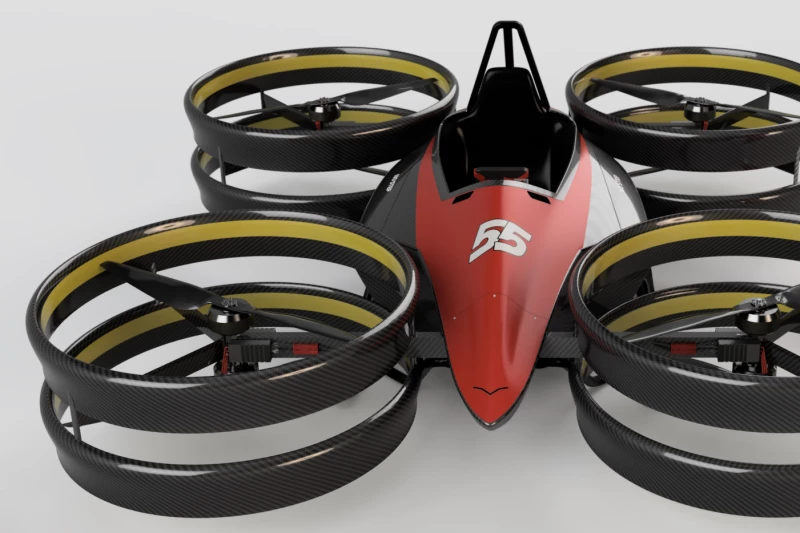
As of July 2025, the development of flying cars—primarily electric Vertical Take-Off and Landing (eVTOL) vehicles and roadable aircraft—has seen significant growth, driven by advancements in electric propulsion, autonomous systems, and regulatory progress. Based on available data, it’s challenging to pinpoint an exact number of flying car models in development due to the dynamic nature of the industry, with new startups emerging and some projects stalling. However, a comprehensive analysis of recent sources provides a clear picture of the scale and key players involved.Key Insights on Flying Cars in DevelopmentIndustry Scope: The term "flying car" encompasses eVTOLs (electric vehicles capable of vertical take-off and landing, often designed for urban air mobility) and roadable aircraft (vehicles that can drive on roads and fly). The broader "advanced air mobility" (AAM) industry includes over 400 startups globally, with many focused on eVTOLs, though not all are strictly "flying cars" (some are air taxis or drones).
Notable Models: Specific models highlighted in 2025 sources include a mix of roadable aircraft and eVTOLs, with several companies planning commercial launches by 2025-2026. Below is a list of prominent flying car models in active development or nearing production, based on recent data.
Flying Car Models in Development (2025)Based on sources like aerocrunch.com, simpleflying.com, and others, here are 12 key flying car models in development, with details on their status and capabilities:
Alef Aeronautics Model A (USA):Status: FAA Special Airworthiness Certification granted in 2023; pre-production models in testing. Over 3,400 pre-orders ($1 billion in value). Production planned for Q4 2025 or Q1 2026.
Capabilities: Fully electric, road-legal, vertical take-off, 200-mile driving range, 110-mile flying range, 25 mph top airspeed. Priced at $300,000.
Klein Vision AirCar (Slovakia):Status: Certified in 2022, completed over 170 flight hours. Pre-production model (AirCar 2) set for maiden flight in summer 2025, with sales planned for 2026. Priced at $800,000-$1 million.
Capabilities: Roadable aircraft, transforms in ~2 minutes, 280-300 hp engine, 150-knot cruise speed, 600 nautical mile range.
PAL-V Liberty (Netherlands):Status: Nearing EASA aviation certification, road-legal in Europe. Deliveries expected in 2025. Priced at ~$350,000 (Sport Edition).
Capabilities: Gyroplane, 5-10 minute transformation, 180 km/h airspeed, 500 km flying range, 1,315 km driving range.
XPeng AeroHT X2 / Land Aircraft Carrier (China):Status: Mass production facility under construction in Guangzhou, aiming for 10,000 units annually by 2026. Completed multi-aircraft formation tests.
Capabilities: Autonomous eVTOL, designed for low-altitude urban flight. Modular design with a road vehicle and detachable air module. Priced at ~$275,000.
Doroni Aerospace H1-X (USA):Status: FAA Special Airworthiness Certification in 2023, over 50 test flights completed. Deliveries planned for 2025, targeting 125 units annually. Priced at ~$300,000.
Capabilities: Semi-autonomous eVTOL, 50-mile range, 140 mph airspeed, requires 20-hour training.
ASKA A5 (USA):Status: FAA certified for road testing, over 300 miles completed. Pre-orders worth $50 million. Commercial launch planned for 2026.
Capabilities: Hybrid-electric eVTOL, SUV-sized, 250-mile flying range, 150 mph airspeed, 70 mph on roads.
Samson Sky Switchblade (USA):Status: Successful test flight in 2023, crowdfunding for production. Over 2,300 reservations. Deliveries expected in 2025. Priced at $170,000.
Capabilities: Hybrid-electric roadable aircraft, 99 sq ft wings, 13,000 ft altitude, uses auto gas.
Joby Aviation eVTOL (USA):Status: Targeting commercial air taxi services in 2025, working with FAA for certification. Extensive test flights completed.
Capabilities: Electric air taxi, 150-mile range, 200 mph airspeed, low-noise design for urban use.
Lilium Jet (Germany):Status: Completed first systems power-on test, aiming for commercial services in 2025. Funded by Tencent and others.
Capabilities: Electric eVTOL for regional mobility, 300 km range, 300 km/h speed, 5-passenger capacity.
EHang EH216 (China):Status: Fully autonomous, extensive tests in China, regulatory approvals in progress. Commercial rollout planned for 2025.
Capabilities: Autonomous eVTOL, 130 km/h speed, 2-passenger capacity, cloud-based navigation.
Bellwether Volar (UK):Status: Scaled-down prototype unveiled, full-size version planned for 2028. Aiming for high-end market.
Capabilities: Luxury eVTOL, vertical take-off, designed for urban air travel.
Pegasus E-Class (Australia):Status: CASA-certified, FAA approval in progress. Showcased at CES 2025. Deliveries expected in 2025.
Capabilities: Hybrid flying car, 300-mile range, 99 mph airspeed, 75 mph on roads, uses gasoline.
Estimated Number of Flying Cars in DevelopmentDirect Count: The above list identifies 12 distinct models in active development with clear plans for 2025-2026 commercialization. These are from companies like Alef Aeronautics, Klein Vision, PAL-V, XPeng, Doroni, ASKA, Samson Sky, Joby, Lilium, EHang, Bellwether, and Pegasus.
Broader Industry: A 2024 New Yorker article notes over 400 startups in the advanced air mobility sector, many working on eVTOLs or flying cars. Not all are roadable “flying cars” (e.g., Joby and Lilium focus on air taxis), but at least 20-30 companies are explicitly developing vehicles with road and air capabilities, based on MIT’s 2021 review and recent updates.
Conservative Estimate: Beyond the 12 named models, additional prototypes from startups and major players (e.g., Airbus CityAirbus, Archer Aviation’s Midnight, Beta Technologies’ Alia) suggest 15-25 unique flying car models in active development globally. This accounts for variations like manned vs. autonomous or eVTOL vs. gyroplane designs.
Key Trends and Changes (2020-2025)Since you asked about VR headset evolution over the past five years, it’s worth contextualizing flying car development to highlight parallels in emerging tech

Flying cars were largely experimental. Terrafugia Transition and PAL-V Liberty were early leaders, but certifications were pending, and eVTOL tech was nascent. The market was valued at ~$55.7 million, with few viable prototypes.
2025: The market is projected at $264.5 billion, with a CAGR of 42.9% to reach $6.56 trillion by 2034. Key advancements include:
eVTOL Dominance: Electric propulsion and vertical take-off enable urban use, unlike 2020’s runway-dependent designs.
Regulatory Progress: FAA and EASA certifications (e.g., Alef Model A, PAL-V) have accelerated, with “powered-lift” categories established.
Autonomy: EHang and XPeng focus on autonomous systems, reducing pilot requirements, a shift from 2020’s piloted focus.
Investment Surge: Over $180 million for Doroni, $100 million for LuftCar, and billions for Joby/Lilium, compared to limited funding in 2020.
Parallels with VR: Like VR’s shift to standalone headsets (e.g., Quest 3), flying cars have moved toward user-friendly, electric, and semi-autonomous designs, lowering barriers to adoption.
Challenges and OutlookChallenges: Battery life limits range (20-30 minutes for eVTOLs), safety concerns (midair collisions, emergency landings), and infrastructure (vertiports, air traffic management) remain hurdles. High costs ($170,000-$1 million) limit mainstream adoption.
2025 Outlook: Alef Model A, PAL-V Liberty, and Pegasus E-Class are closest to consumer markets, with deliveries expected by late 2025. Air taxi services (Joby, Lilium) may launch commercially, paving the way for personal flying cars by 2026-2028.
ConclusionApproximately 15-25 flying car models are in active development globally as of July 2025, with 12 prominent examples (e.g., Alef Model A, Klein Vision AirCar, PAL-V Liberty) nearing commercialization. The industry has grown from a niche concept in 2020 to a booming sector, driven by eVTOL technology, regulatory advancements, and significant investments. While VR headsets like the Meta Quest 3 have achieved broader consumer adoption, flying cars are on the cusp of transforming urban mobility, with 2025 marking a pivotal year for initial deployments.If you want details on specific models, companies, or comparisons to VR/AR tech evolution, let me know!


 Flying cars were largely experimental. Terrafugia Transition and PAL-V Liberty were early leaders, but certifications were pending, and eVTOL tech was nascent. The market was valued at ~$55.7 million, with few viable prototypes.