The Carnyx’s Eerie Cry Struck Fear Into Soldiers On Antiquity’s Battlefields by Oliver Parken
December 15, 2023
Introduction:
(The Drive) Throughout history, from ancient times to more modern conflicts, intimidating the enemy through aggressive noises and sounds has played an important part of warfare. During the Iron Age and Greek/Roman periods, a specific instrument was used to make the loudest, and most fear-inducing sounds possible — the carnyx.
These valveless, trumpet-like instruments were colossal — standing as tall, or even taller, than the people who played them. Made of beaten metal in a distinctive 'ſ' shape, the carnyx featured a long central tube section, allowing for low bass and shrieking high notes to be created, with a mouthpiece for blowing at one end. Typically, they had an ornately crafted horn at the top end sculpted into the shape of an animal’s head — often in the style of a boar, symbolizing the harsh, guttural sounds produced.
Although the word 'carnyx' is used to describe these objects in the present, that particular phrase was rarely used in historical texts in reference to them. Instead, they were usually referred to by the Greek or Latin words salpinx and tuba, meaning 'trumpet.' It's through Greek and Roman texts that we know the most about them.
Textual references, as well as archeological discoveries, indicate the carnyx was used widely throughout western and central Europe between 300 BC and 200 AD, with the instrument having a particular affinity within various Celtic tribes.
However, it should be noted that they were used further afield too, with representations of the carnyx having been discovered within Buddhist sculptures in India from the period. The carnyx was clearly seen, and heard, far and wide as Celtic mercenaries expanded the outer reach of Iron Age society.
Rise of Archery in Andes Mountains Dated to 5,000 Years Ago — Earlier than Previous Research December 20, 2023
Introduction:
(Eurekalert) When did archery arise in the Americas? And what were the effects of this technology on society?
These questions have long been debated among anthropologists and archaeologists. But a study led by a University of California, Davis, anthropologist, is shining light on this mystery.
Focusing on the Lake Titicaca Basin in the Andes mountains, anthropologists found through analysis of 1,179 projectile points that the rise of archery technology dates to around 5,000 years ago. Previous research held that archery in the Andes emerged around 3,000 years ago.
The new research indicates that the adoption of bow-and-arrow technology coincided with both the expansion of exchange networks and the growing tendency for people to reside in villages.
“We think our paper is groundbreaking because it gives us a chance to see how society changed throughout the Andes throughout ancient times by presenting a huge number of artifacts from a vast area of South America,” said Luis Flores-Blanco, an anthropology doctoral student and corresponding author of the paper. “This is among the first instances in which Andean archaeologists have investigated social complexity through the quantitative analysis of stone tools.”
Discovery of Immense Fortifications Dating Back 4,000 Years in North-western Arabia January 10, 2024
Introduction:
(Eurekalert) The North Arabian Desert oases were inhabited by sedentary populations in the 4th and 3rd millennia BCE. A fortification enclosing the Khaybar Oasis—one of the longest known going back to this period—was just revealed by a team of scientists from the CNRS1 and the Royal Commission for AlUla (RCU). This new walled oasis is, along with that of Tayma, one of the two largest in Saudi Arabia. While a number of walled oases dating back to the Bronze Age had already been documented, this major discovery sheds new light on human occupation in north-western Arabia, and provides a better grasp of local social complexity during the pre-Islamic period.
Cross-referencing field surveys and remote sensing data with architectural studies, the team estimated the original dimensions of the fortifications at 14.5 kilometres in length, between 1.70 and 2.40 metres in thickness, and approximately 5 metres in height. Preserved today over a little less than half of its original length (41%, 5.9 km and 74 bastions), this colossal edifice enclosed a rural and sedentary territory of nearly 1,100 hectares. The fortification’s date of construction is estimated between 2250 and 1950 BCE, on the basis of radiocarbon dating of samples collected during excavations.
While the study confirms that the Khaybar Oasis clearly belonged to a network of walled oases in north-western Arabia, the discovery of this rampart also raises questions regarding why it was built as well as the nature of the populations that built it, in particular their relations with populations outside the oasis.
This archaeological discovery, whose results will be published on 10 January in the Journal of Archaeological Science: Reports (JASREP), paves the way for major advances in understanding the prehistoric, pre-Islamic, and Islamic past of the north-western Arabian Peninsula.
Discovered in the Upper Amazon: 2500-year-old Landscape Providing Evidence for Early Urbanism in the Region January 11, 2024
Introduction:
(Eurekalert) A dense system of pre-Hispanic urban centers, characterized by constructed platforms and plazas and connected by large, straight roads, has been discovered in the upper Amazon, according to a new study. The research, based on more than 20 years of interdisciplinary research, suggests that this original 2500-year-old society constitutes the earliest and largest low-density agrarian urbanism documented in the Amazon thus far. Such extensive early development in the Upper Amazon resembles similar Maya urban systems in Central America. Although a growing body of research has begun to highlight the scope and scale of pre-Hispanic occupation of the Amazon, evidence for large-scale urbanism has remained elusive. Stéphen Rostain and colleagues present evidence for an agrarian-based civilization that began more than 2500 years ago in the Upano Valley of Amazonian Ecuador, a region in the eastern foothills of the Andes. Based on more than 20 years of interdisciplinary research that included fieldwork and light detection and ranging (LIDAR) mapping, Rostain et al. describe urbanism at a scale never before documented in Amazonia, consisting of more than 6000 anthropogenic rectangular earthen platforms and plaza structures connected by footpaths and roads and surrounded by expansive agricultural landscapes and river drainages within the 300 square kilometer survey area. The authors identified at least 15 distinct settlement sites of various sizes based on clusters of structures. However, according to Rostain et al., the most notable elements of this built environment are the extensive and complex regional-scale road network connecting urban centers and the surrounding hinterland. Archaeological excavations indicate that the construction and occupation of the platforms and roads occurred between ~500 BCE and 300 to 600 CE and was carried out by groups from the Kilamope and later Upano cultures. Rostain et al. note that the Upano sites are different from other monumental sites discovered in Amazonia, which are more recent and less extensive. “Such a discovery is another vivid example of the underestimation of Amazonia’s twofold heritage: environmental but also cultural, and therefore Indigenous,” write Rostain et al. “…we believe that it is crucial to thoroughly revise our preconceptions of the Amazonian world and, in doing so, to reinterpret contexts and concepts in the necessary light of an inclusive and participatory science.”
Researchers at the Universities of Basel and Zurich have discovered the genetic material of the pathogen Treponema pallidum in the bones of people who died in Brazil 2,000 years ago. This is the oldest verified discovery of this pathogen thus far, and it proves that humans were suffering from diseases akin to syphilis—known as treponematoses—long before Columbus's discovery of America.
The new findings, published in Nature, call into question previous theories concerning the spread of syphilis by the Spanish conquistadors.
The history of the emergence and spread of infectious diseases was of great importance for global health even before the COVID-19 pandemic. With modern laboratory methods, researchers can now detect the tiniest traces of DNA from pathogens in prehistoric finds. That means they can trace back how these pathogens spread historically and their evolutionary development.
Researchers at the Universities of Basel and Zurich have discovered the genetic material of the pathogen Treponema pallidum in the bones of people who died in Brazil 2,000 years ago. This is the oldest verified discovery of this pathogen thus far, and it proves that humans were suffering from diseases akin to syphilis—known as treponematoses—long before Columbus's discovery of America.
The new findings, published in Nature, call into question previous theories concerning the spread of syphilis by the Spanish conquistadors.
The history of the emergence and spread of infectious diseases was of great importance for global health even before the COVID-19 pandemic. With modern laboratory methods, researchers can now detect the tiniest traces of DNA from pathogens in prehistoric finds. That means they can trace back how these pathogens spread historically and their evolutionary development.
The idea that syphilis spread from the Western hemisphere to Europe is not new. For example, there was an article dated December 27, 2011 to that effect:
(Scientific America) In 1492, Columbus sailed the ocean blue, but when he returned from 'cross the seas, did he bring with him a new disease?
New skeletal evidence suggests Columbus and his crew not only introduced the Old World to the New World, but brought back syphilis as well, researchers say.
Cold, dry snaps accompanied three plagues that struck the Roman Empire
JANUARY 26, 2024 AT 2:00 PM
For those who enjoy pondering the Roman Empire’s rise and fall — you know who you are — consider the close link between ancient climate change and infectious disease outbreaks.
Periods of increasingly cooler temperatures and rainfall declines coincided with three pandemics that struck the Roman Empire, historian Kyle Harper and colleagues report January 26 in Science Advances. Reasons for strong associations between cold, dry phases and those disease outbreaks are poorly understood. But the findings, based on climate reconstructions from around 200 B.C. to A.D. 600, help “us see that climate stress probably contributed to the spread and severity of [disease] mortality,” says Harper, of the University of Oklahoma in Norman.
Harper has previously argued that the First Plague Pandemic (also known as the Justinianic Plague), combined with declining global temperatures to weaken the Roman Empire (SN: 5/18/20).
The new findings reinforce an idea that climate shifts can influence the origin and spread of infectious diseases, says Princeton University historian John Haldon. But it’s unclear whether a range of factors in the ancient Roman realm, including long-distance trade networks and densely populated settlements, heightened people’s vulnerability to disease outbreaks, says Haldon, who did not participate in the new study.
To reconstruct the ancient climate, marine palynologist Karin Zonneveld and colleagues turned to an extensive sample of fossilized dinoflagellates. These single-celled algae had been preserved in radiocarbon-dated slices from a sediment core previously extracted in southern Italy’s Gulf of Taranto.
‘World first’ intact Roman egg laid 1,700 years ago discovered by archaeologists
6 hours ago
An intact chicken egg estimated to be around 1,700 years old is believed to be the only of its type in the world, after scientists found it still had liquid inside.
It was discovered during a dig in Aylesbury in Buckinghamshire between 2007 and 2016, with researchers saying at the time that it was a “genuinely unique discovery”.
During the course of the excavation, archaeologists broke three other eggs which released a “potent stench”, but a fourth egg remained intact.
Experts from Oxford Archaeology think the waterlogged pit may have been used as a sort of Roman wishing well.
Now, a micro scan has found that the egg still contained the yolk and egg white and is believed to be the only intact egg from the period.
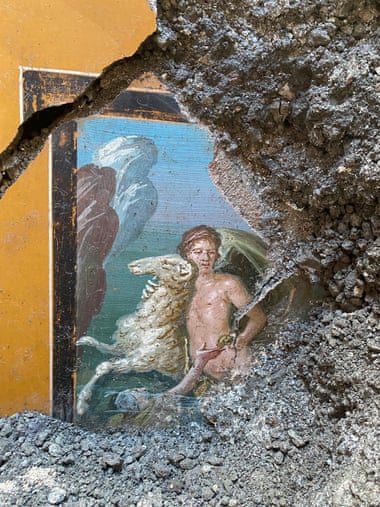
In a remarkable discovery at the ancient Roman city of Pompeii, archaeologists have unearthed a fresco depicting the Greek mythological siblings Phrixus and Helle.
Gabriel Zuchtriegel, the director of Pompeii Archaeological Park, described the find as a poignant reflection of history unfolding once more.
“History has repeated itself,” said Zuchtriegel, as he gave an update on excavation and restoration work. “It is a beautiful fresco in an excellent state of conservation. The myth of Phrixus and Helle is widespread at Pompeii but it is topical too. They are two refugees at sea, a brother and sister, forced to flee because their stepmother wants rid of them and she does so with deception and corruption. She [Helle] fell into the water and drowned.”
The fresco showcases vibrant colours and exquisite artistry, with Helle depicted on the verge of drowning, her face obscured by waves as she reaches out to her brother.
Zuchtriegel expressed optimism about making these meticulously preserved homes accessible to the public in the near future, highlighting the cultural and historical significance of this latest uncovering.
Archaeologists Find Preserved Remains of 3,000-Year-Old Village in England
The village was engulfed by fire back in 850 B.C., but many of its artifacts are still intact.
By Adrianna Nine March 25, 2024
Archaeologists have uncovered the "exquisitely" well-preserved remains of a 3,000-year-old settlement in eastern England. So many of the ancient village's artifacts are intact that researchers have dubbed the site "Britain’s Pompeii" for its eerily clear view into Late Bronze Age life.
Officially called Must Farm, the site is in the small town of Whittlesey, Peterborough. Archaeologists found Must Farm at the edge of a quarry pit in 1999, after which the Cambridge Archaeological Unit—east England's wetland and urban archaeology authority—launched a lengthy evaluation of the area. Though the unit wrapped up its excavation in 2016, its findings were published in a pair of papers this month by the McDonald Institute for Archaeological Research at the University of Cambridge.
A "remarkable" Roman villa has been unearthed on a housing development.
Archaeologists from the Red River Archaeology Group came across the complex while working on a Barratt and David Wilson Homes housing development at Brookside Meadows in Grove near Wantage, Oxfordshire.
The site sits on a landscape inhabited since the Bronze Age which has been described as "artefact-rich".
The group's project officer said it was "an important centre of activities for a long time".
The archaeologists said the villa complex was richly decorated with painted plaster and mosaics.
Pompeii: Breathtaking new paintings found at ancient city
5 hours ago
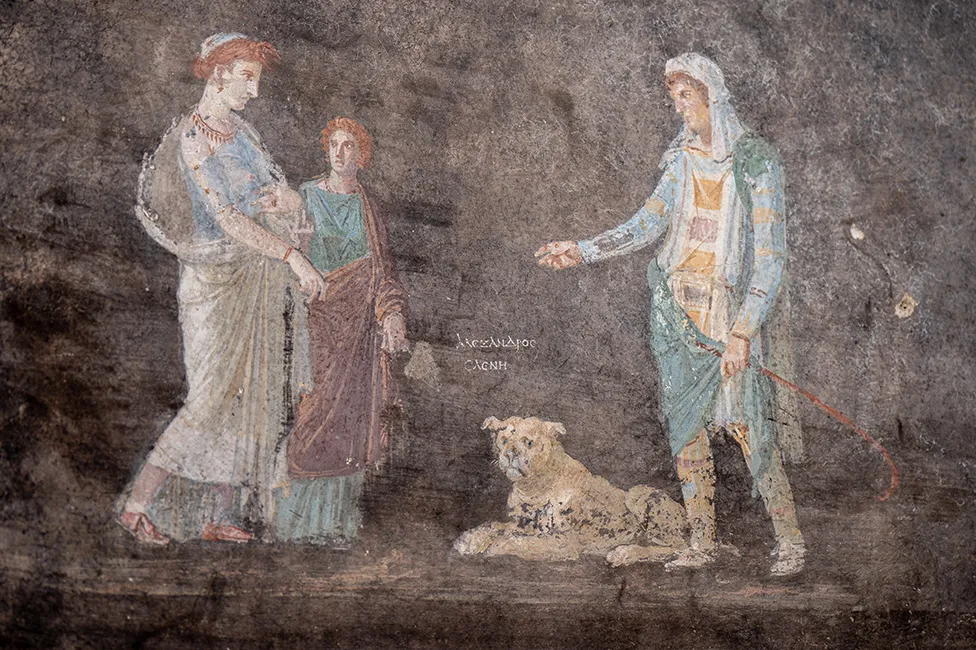
Stunning artworks have been uncovered in a new excavation at Pompeii, the ancient Roman city buried in an eruption from Mount Vesuvius in AD79.
Archaeologists say the frescos are among the finest to be found in the ruins of the ancient site.
Mythical Greek figures such as Helen of Troy are depicted on the high black walls of a large banqueting hall.
The room's near-complete mosaic floor incorporates more than a million individual white tiles.
A third of the lost city has still to be cleared of volcanic debris. The current dig, the biggest in a generation, is underlining Pompeii's position as the world's premier window on the people and culture of the Roman empire.
“Forgotten City:” the Identification of Dura-Europos’ Neglected Sister Site in Syria April 19, 2024
Introduction:
(Eurekalert) The Dura-Europos site in modern-day Syria is famous for its exceptional state of preservation. Like Pompeii, this ancient city has yielded many great discoveries, and serves as a window into the world of the ancient Hellenistic, Parthian, and Roman periods. Yet despite the prominence of Dura-Europos in Near Eastern scholarship, there is another city, only some miles down the Euphrates river, that presents a long-neglected opportunity for study. A new paper in the Journal of Near Eastern Studies, entitled "The Ancient City of Giddan/Eddana (Anqa, Iraq), the 'Forgotten Twin' of Dura-Europos," identifies the city of Anqa as a near mirror image of Dura-Europos, of the same size, comparable composition, and potentially equal value to scholars of the region.
Anqa is located just across the Syrian border from Dura-Europos, in the present-day Al-Qaim district of the Anbar Governorate in Iraq. Its remains include an identifying tell mound, at the northern end of the site, a polygonal inner wall circuit, and a large outer defensive wall, or enceinte. Situated at a point where the Euphrates floodplain drastically narrows, the city would have controlled movement between the populous section of the valley upstream and the trade route downstream linking Syria, Northern Mesopotamia, and Babylonia, giving it great strategic and economic significance.
Ancient scroll found at Mount Vesuvius reveals details of Plato’s final hours
6 hours ago
A groundbreaking discovery of a papyrus scroll buried in AD79 eruption of Mount Vesuvius may reveal more about the final hours of famous Greek philosopher Plato as well as his burial place.
The scroll, known as the History of the Academy and written by philosopher and poet Philodemus of Gadara, has been unreadable since it was found in 1750, in a villa in Herculaneum, now known as Ercolano in Italy.
Now, a team of researchers has used infrared and X-ray scanners to decipher about 1,000 words.
“It is the oldest history of Greek philosophy in our possession,” said professor Graziano Ranocchia, a papyrologist at the University of Pisa and the project’s lead researcher.
“It is an extraordinary outcome that enriches our understanding of ancient history.”