An archaeological find in the Huescan Pyrenees allowed researchers to identify for the first time livestock management strategies and feeding practices that demonstrate how the first high mountain societies at the start of the Neolithic period were already carrying out complex livestock and farming activities, instead of being limited to the transhumance of sheep and goats.
The study, published in Frontiers in Environmental Archaeology, is the first to combine carbon and nitrogen stable isotope analysis with archaeozoological analyses. The study, coordinated by the UAB and including the involvement of the CSIC, the University of Évora and the Government of Aragon, also documented how the economic importance of pigs in the Huescan region dates back to the Neolithic.
The research on management strategies and use of animal resources in high mountain areas during the Early Neolithic, approximately 6,500 to 7,500 years ago, was conditioned by the presumption that human occupancy of these regions were mainly seasonal and that economic practices focused greatly on making use of wild resources.
With regard to livestock rearing, the role of sheep and goat transhumance in high mountain areas has stood out traditionally, while only a marginal role has been given to other livestock activities, in which the temporary maintenance of these animal flocks has been highlighted
A team of researchers from China, Australia, France, Spain, and Germany has revealed advanced material culture in East Asia dating to 45,000 years ago. The new study is published in Nature Ecology & Evolution.
The researchers examined a previously excavated archaeological collection from the Shiyu site, located in Shanxi Province.
"Our new study identified an Initial Upper Paleolithic archaeological assemblage from the Shiyu site of North China dating to 45,000 years ago that includes blade technology, tanged and hafted projectile points, long-distance obsidian transfer, and the use of a perforated graphite disk," said associate Prof. Yang Shixia, first and corresponding author of the study and a researcher at the Institute of Vertebrate Paleontology and Paleoanthropology (IVPP) of the Chinese Academy of Sciences (CAS).
A team of researchers from China, Australia, France, Spain, and Germany has revealed advanced material culture in East Asia dating to 45,000 years ago. The new study is published in Nature Ecology & Evolution.
The researchers examined a previously excavated archaeological collection from the Shiyu site, located in Shanxi Province.
"Our new study identified an Initial Upper Paleolithic archaeological assemblage from the Shiyu site of North China dating to 45,000 years ago that includes blade technology, tanged and hafted projectile points, long-distance obsidian transfer, and the use of a perforated graphite disk," said associate Prof. Yang Shixia, first and corresponding author of the study and a researcher at the Institute of Vertebrate Paleontology and Paleoanthropology (IVPP) of the Chinese Academy of Sciences (CAS).
An international team of archaeologists has found and identified a trackway made by multiple humans approximately 90,000 years ago in what is now Morocco. In their paper published in the journal Scientific Reports, the group describes how they tested for its origins of the tracks.
Finding footprints left behind by people thousands of years ago is extremely rare due to their generally ephemeral nature. Still, occasionally, events will transpire to preserve footprints, such as encasement in sediment that hardens. Such prints can then over time be revealed as the material that once hid them erodes away. In this instance, the footprints were found in a sandy tract on a rocky part of the Moroccan shoreline.
As is often the case with archaeological finds, the tracks were found by accident. The research team happened to be in the area studying boulders near the ocean when they noticed an indentation in a nearby stretch of sand. A closer look revealed more indentations, which turned out be human footprints.
Bones Prove Homo Sapiens Came to Northern Europe Earlier Than Thought
Anatomically modern humans reached northern central and northwestern Europe 5,000 years earlier than previously believed.
By Adrianna Nine February 2, 2024
Shards of bone found in a German cave are transforming anthropologists’ understanding of our species’ earliest ancestors. Previously thought to have made their way to northern Europe around 38,000 BCE, the bones show that Homo sapiens reached the area 5,000 to 7,500 years sooner. Though the bones were found a few years ago, recent stable isotope analyses confirm the fragments’ age and definitively link them to Homo sapiens.
Up until now, anthropologists believed Homo sapiens made their way to northern central and northwestern Europe about 40,000 years ago. Long after evolving in Africa 300,000 years ago, Homo sapiens were thought to make their way around Earth and encounter other early humans—like Neanderthals—in parts of Europe and Asia. But Europe’s cold upper regions weren’t believed to have been explored by Homo sapiens until much later.
Contrary to what has long been believed, there was no peaceful transition of power from hunter-gather societies to farming communities in Europe, with new advanced DNA analysis revealing that the newcomers slaughtered the existing population, completely wiping them out within a few generations.
Researchers from Sweden's Lund University analyzed skeletons and teeth found in what is now Denmark, and found that 5,900 years ago, the region underwent a swift and total population change. Prior to this, Danish Mesolithic people of the Maglemose, Kongemose and Ertebølle cultures – genetically related to other Western European hunter-gatherers – were prominent inhabitants. But when Neolithic farmers arrived, an abrupt shift can be seen in DNA records, with next to no genetic contribution from the local hunter-gatherers.
Tracing the DNA timeline, the researchers could see that the hunter-gatherers had been swiftly wiped out by the late Stone Age, in what they suspect was a very bloody and very thorough takeover.
Scientists Identify a Universal Optimal Temperature For Life on Earth
20 February 2024
Have you ever wondered about the optimal temperature for life on Earth? For humans, 20°C is comfortable. Any warmer and we work less efficiently because releasing heat requires energy.
We know many species can live at much colder or warmer temperatures than humans. But our systematic review of published research found the thermal ranges of animals, plants and microbes living in air and water overlap at 20°C. Could this be a coincidence?
For all species, the relationship with temperature is an asymmetric bell-shaped curve. This means biological processes increase in line with temperature, reach a maximum, and then rapidly decline when it gets too hot.
Recently, a New Zealand research group noticed the number of marine species did not peak at the equator, as has been commonly assumed. Rather, the number dipped, with peaks in the subtropics.
Follow-up studies showed this dip has been getting deeper since the last ice age about 20,000 years ago. And it has been deepening faster due to global ocean warming.
Neanderthals were gluing handles onto their tools over 100,000 years ago, possibly making the species even smarter than previously thought. So says a new study that discovered the use of adhesives on ancient stone tools that were previously overlooked.
The finding came after a team of researchers examined stone tools that had been wrapped up and largely forgotten since the 1960s at Berlin’s Museum of Prehistory and Early History. The fact that the tools had been well-stored enabled the researchers to find traces of bitumen on them when they were examined. Bitumen is a sticky substance used in asphalt. It can be made from crude oil but it is also found occurring naturally in the ground.
The location of the bitumen residue led the researchers to believe that the substance formed a handle that would have made the tools easier to hold and use.
"The tools showed two kinds of microscopic wear: one is the typical polish on the sharp edges that is generally caused by working other materials," said Radu Iovita, an associate professor at New York University’s Center for the Study of Human Origins. "The other is a bright polish distributed all over the presumed hand-held part, but not elsewhere, which we interpreted as the results of abrasion from the ocher due to movement of the tool within the grip." Iovita is the co-author of a study detailing the find that's been published in the journal Science Advances.
Ancient stone tools found in western Ukraine may be the oldest known evidence of early human presence in Europe, according to research published Wednesday in the journal Nature.
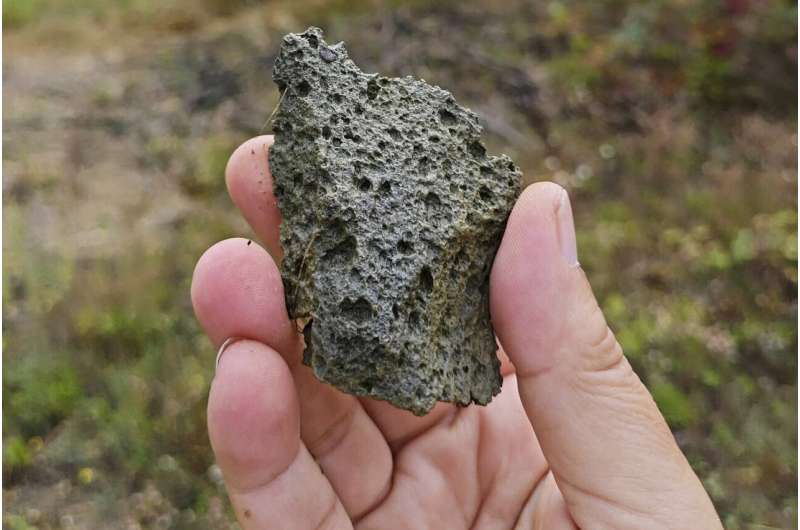
The chipped stones, deliberately fashioned from volcanic rock, were excavated from a quarry in Korolevo in the 1970s. Archaeologists used new methods to date the layers of sedimentary rock surrounding the tools to more than 1 million years old.
Toba Supereruption Unveils New Insights into Early Human Migration March 20, 2024
Introduction:
(Eurekalert) Modern humans dispersed from Africa multiple times, but the event that led to global expansion occurred less than 100,000 years ago. Some researchers hypothesize that dispersals were restricted to “green corridors” formed during humid intervals when food was abundant and human populations expanded in lockstep with their environments. But a new study in Nature, including ASU researchers Curtis Marean, Christopher Campisano, and Jayde Hirniak, suggests that humans also may have dispersed during arid intervals along “blue highways” created by seasonal rivers. Researchers also found evidence of cooking and stone tools that represent the oldest evidence of archery.
Working in the Horn of Africa, researchers have uncovered evidence showing how early modern humans survived in the wake of the eruption of Toba, one of the largest supervolcanoes in history, some 74,000 years ago. The behavioral flexibility of these people not only helped them live through the supereruption but may have facilitated the later dispersal of modern humans out of Africa and across the rest of the world.
“This study confirms the results from Pinnacle Point in South Africa – the eruption of Toba may have changed the environment in Africa, but people adapted and survived that eruption-caused environmental change,” said Marean, research scientist with the Institute of Human Origins and Foundation Professor with the School of Human Evolution and Social Change.
Early humans used sophisticated crafting techniques such as "wood splitting" to hunt and to clean animal hides, a new study has revealed.
Using new cutting-edge imaging techniques such as 3D microscopy and micro-CT scanning for the first time, scientists from the Lower Saxony State Office for Cultural Heritage (NLD) and the Universities of Reading and Göttingen examined the oldest complete hunting weapons known to humankind. The weapons, believed to be 300,000 years old, were found during archaeological excavations in Schöningen, Germany in 1994.
The research, published in the Proceedings of the National Academy of Sciences, identifies how pre-Homo sapiens hunters re-sharpened broken points of spears and throwing sticks. Other tools were made by splitting wood, a behavior previously thought only to be practiced by our own species, Homo sapiens. Some tools made from split wood were likely used not for hunting, but to soften and smooth animal skins.
Ancient humans hid in Saudi Arabian lava tube for over 7,000 years
1 hour ago
A lava tube in Saudi Arabia served as shelter to ancient humans for over 7,000 years, archaeologists have said in a new study.
While previous research established that Northern Arabia was a dynamic site of evolution and cultural development of ancient humans, the timing of their occupation and connection with the nearby Levant remained poorly understood, mainly due to poor preservation of organic remains in the arid conditions of the region.
Now, though, archaeologists are increasingly studying caves and underground settings in the region where ancient materials are sheltered from sun, wind and high fluctuations in temperature.
In the latest study, researchers assessed an archaeological site from a lava tube called Umm Jirsan located in the volcanic field of Harrat Khaybar in Saudi Arabia, about 125km north of Medina.
They found artefacts, rock art, and skeletal remains documenting repeated human occupation over the past 7,000 years at least.
Tibetan Plateau had Broader Social Dimensions than Previously Thought April 29, 2024
Introduction:
(Eurekalert) The Tibetan plateau—the world’s highest and largest plateau—poses a challenge to the people who live there because of its extreme climate. In a new study, researchers have discovered stone artifacts that suggest that there were more cultural exchanges between those who lived on the plateau and those living on its perimeter.
“The Tibetan plateau has an average elevation of more than 4500 meters, which makes Colorado seem like it is at sea level. It’s amazing that people have been able to occupy this area on and off for at least the last 40,000 years,” said Stanley Ambrose (MME), a professor of anthropology. “Unfortunately, very little research has been done in this big area.”
The plateau covers roughly four times the size of Texas and the researchers were focused on the Holocene period, which began about 11,700 years ago. “Although the world was warmer and wetter, this high-altitude location was arid and largely grassy, making it a challenging place to live in.”
The researchers focused on a region of the plateau that supported a small human population due to its cold, dry climate and reduced oxygen levels. However, this area was prime grazing territory for yaks and gazelles. Previously it was believed that the residents developed unique strategies to survive, including making specialized stone tools and having unique genetic adaptations that helped them adapt to low oxygen conditions.
“These tools were ideal because they could be reconfigured easily for different purposes. They were flexible and versatile, allowing the owners to carry a bag of bladelets that could be then shaped within seconds,” Ambrose said. “Before that, everybody was running around with big knives and spears, which were durable and strong, but weren’t diverse.”
Scientists show that ancient village adapted to drought, rising seas April 30, 2024 by University of California - San Diego
Around 6,200 BCE, the climate changed. Global temperatures dropped, sea levels rose and the southern Levant, including modern-day Israel, the Palestinian territories, Jordan, Lebanon, southern Syria and the Sinai desert, entered a period of drought.
Previously, archaeologists believed that this abrupt shift in global climate, called the 8.2ka event, may have led to the widespread abandonment of coastal settlements in the southern Levant. In a recent study published in the journal Antiquity, researchers at UC San Diego, the University of Haifa and Bar-Ilan University share new evidence suggesting at least one village formerly thought abandoned not only remained occupied, but thrived throughout this period.