Modern History (1800 – present)

Got something to say about the past? Say it here!
User avatar
caltrek
Posts: 9280
Joined: Mon May 17, 2021 1:17 pm

Re: Modern History (1800 – present)

Post by caltrek »

Autoworkers Staged Their First Big Strike in the 1930s. Here’s How They Won.
September 20, 2023

Introduction:
(Mother Jones) On Tuesday, leaders of the striking United Auto Workers vowed to expand their labor action against the Big Three automakers Friday if contract talks break down. Now in its second week, the strike has drawn widespread attention, but it’s only the latest indication of the broader resurgence of union organizing by the likes of Starbucks workers, big city teachers’ unions, Marvel digital effects workers, Uber and Lyft drivers, and, of course, Hollywood actors and screenwriters. In August, the threat of a United Parcel Service strike with Teamster support resulted in a new contract, and some of Amazon’s massive warehouses are simmering with labor unrest.

“It was an exhilarating period and it gave one new faith in what we call democracy.”

Yet all of today’s labor organizers stand on the shoulders of their forebears who, during the mid-1930s, amid the depths of the Great Depression, established or expanded key unions in the steel and auto industries and founded all of the Hollywood guilds. Central to many of their advances was a fresh tactic: “sit down strikes,” wherein workers would stay put in their factories and workspaces, not to be easily dislodged. This strategy brought about widespread victories, benefiting everyone from Woolworth’s lunch-counter workers to (as we’ll see) assembly line workers at GM and Ford. Unions remained powerful for decades, although a concerted effort by business leaders and their Republican friends in Congress, and moving of jobs overseas, would ultimately erode their membership gains. Today, only about 10 percent of US employees belong to a union.

The following commentary, adapted from my recent oral history book and PBS film, Memorial Day Massacre: Workers Die, Film Buried, takes us back to that earlier era and tells the story of how things went down in the 1930s.
The article continues with comments from Howard Zinn, John Hope Franklin, Victor Reuther, Studs Terkel, and Gore Vidal.

Read more here: https://www.motherjones.com/politics/2 ... ssion/

Don't mourn, organize.

-Joe Hill
User avatar
wjfox
Site Admin
Posts: 13587
Joined: Sat May 15, 2021 6:09 pm
Location: Essex, UK
Contact:

Re: Modern History (1800 – present)

Post by wjfox »

Wow.

22 years, and I'd never seen this clip before.


User avatar
wjfox
Site Admin
Posts: 13587
Joined: Sat May 15, 2021 6:09 pm
Location: Essex, UK
Contact:

Re: Modern History (1800 – present)

Post by wjfox »

User avatar
wjfox
Site Admin
Posts: 13587
Joined: Sat May 15, 2021 6:09 pm
Location: Essex, UK
Contact:

Re: Modern History (1800 – present)

Post by wjfox »


User avatar
wjfox
Site Admin
Posts: 13587
Joined: Sat May 15, 2021 6:09 pm
Location: Essex, UK
Contact:

Re: Modern History (1800 – present)

Post by wjfox »


User avatar
caltrek
Posts: 9280
Joined: Mon May 17, 2021 1:17 pm

Re: Modern History (1800 – present)

Post by caltrek »

Russia’s Slaughter of Indigenous People in Alaska Tells Us Something Important About Ukraine
by Casey Michael
October 27, 2023

Introduction:
(Politico) In the racial-reckoning summer of 2020, local leaders in a small American town gathered for a contentious vote on whether to take down a statue that honored a man who was, as one assessment read, “steeped in racial division, violence and injustice.” Would they join local leaders from cities in Virginia, Alabama and other states to remove a memorial praising a figure who symbolized a “historical trauma” that still caused anguish and anger among their constituents?

The town council listened, and debated, and finally decided. By a margin of 6-1, the seven members voted to join the floodtide of decisions elsewhere to take down another symbol of historic oppression.

This statue, though, had nothing to do with the Confederacy or the Civil War. Rather, this vote took place in Alaska, in the small coastal town of Sitka (population 8,400), located on an island about halfway between Anchorage and Vancouver, British Columbia. And the statue was of a Russian, a merchant by the name of Aleksandr Baranov, a key figure in Russia’s conquest of Alaska over 200 years ago. The resolution authorizing the removal said Baranov, who was Alaska’s first colonial governor, “directly over[saw] enslavement of Tlingit and Aleut people,” a policy that was “often justified under a theory of racial and cultural superiority.” Baranov’s criminality — which included, among other things, the “violation of Native women” and “murder and theft of Indigenous property” — was so depraved that local Tlingit nicknamed him “No Heart.”

The removal of Baranov’s statue never cracked into the national news cycle. And maybe that’s understandable, given the protests rocking the rest of the country at the time. But it’s also understandable for a related reason: Russia’s colonization of Alaska — and the rampant violence, spiraling massacres and decimation of local Alaska Native populations that came along with it — is hardly well-known among the broader American body politic. Even with new reassessments of European colonization of North America, as well as the recent spike in scholarship regarding the U.S.’s bloodied imperialism across the American West, Russia’s role in smothering and seizing Alaska stands apart as an overlooked chapter of colonialism on the continent.
Read more here: https://www.politico.com/news/magazine ... 0123352
Don't mourn, organize.

-Joe Hill
User avatar
caltrek
Posts: 9280
Joined: Mon May 17, 2021 1:17 pm

Re: Modern History (1800 – present)

Post by caltrek »

How Gilded Age Lawmakers Saved America From Plutocracy
by Daniel Schulman
November 13, 2023

Introduction:
(Mother Jones) On December 3, 1901, in his first annual message to Congress, Teddy ¬Roosevelt¬¬ began to articulate the new anti-¬monopoly doctrine that would define his presidency. “Great corporations exist only because they are created and safeguarded by our institutions,” he said in the address, read aloud to Congress by a succession of clerks who took turns slogging through the 80-page, leatherbound volume, “and it is therefore our right and our duty to see that they work in harmony with these institutions.” He asserted that the federal government should assume “power of supervision and regulation over all corporations doing an interstate business.”

The US economy had by then undergone decades of consolidation in which entire industries—oil, steel, sugar, tobacco, whiskey—were swallowed up into trusts, monopolistic arrangements wherein unlimited corporate assets, operating in a multitude of states, could be controlled by a single entity. America’s railroads, the arterial system of the economy, weren’t yet an outright monopoly, but things were barreling in that direction—they were ruled largely by six factions, which commanded about 165,000 of the nation’s 204,000 miles of trackage.

Northern Securities, formed in November 1901 under the permissive corporate laws of New Jersey, represented a new leap in the concentration of railroad ownership. This massive holding company (a new twist on the trust concept) controlled the Northern Pacific; Great Northern; and Chicago, Burlington, and Quincy railroads, whose lines collectively dominated northwestern rail traffic, and its board contained representatives of many of the six major railroad interests, including the Rockefellers, Vanderbilts, and Goulds.

To Roosevelt, this budding monopoly was an irresistible test case of the government’s regulatory clout. Several months after his speech, his administration sued to dismantle Northern Securities under the Sherman Anti-Trust Act, an 1890 law that had mostly lain dormant since its passage. The case eventually rose to the Supreme Court, which, in March 1904, sided with the administration in a 5–4 decision. Roosevelt went on to use the Sherman Act—and the precedent set by the Northern Securities case—to sue dozens of trusts, including John D. Rockefeller’s Standard Oil monopoly.
Read more here: https://www.motherjones.com/politics/2 ... tocracy/
Don't mourn, organize.

-Joe Hill
User avatar
wjfox
Site Admin
Posts: 13587
Joined: Sat May 15, 2021 6:09 pm
Location: Essex, UK
Contact:

Re: Modern History (1800 – present)

Post by wjfox »

User avatar
wjfox
Site Admin
Posts: 13587
Joined: Sat May 15, 2021 6:09 pm
Location: Essex, UK
Contact:

Re: Modern History (1800 – present)

Post by wjfox »

User avatar
wjfox
Site Admin
Posts: 13587
Joined: Sat May 15, 2021 6:09 pm
Location: Essex, UK
Contact:

Re: Modern History (1800 – present)

Post by wjfox »

Israeli prime minister Yitzhak Rabin (left), US President Bill Clinton (middle), and Palestinian leader Yasser Arafat (right) at the White House in 1993.

The Oslo Accords were a pair of agreements between Israel and the Palestine Liberation Organization (PLO): the Oslo I Accord, signed in Washington, D.C., in 1993; and the Oslo II Accord, signed in Taba, Egypt, in 1995.

A large portion of the Palestinian population, including various Palestinian militant groups, staunchly opposed the Oslo Accords; Palestinian-American philosopher Edward Said described them as a "Palestinian Versailles".

Far-right Israelis were also opposed to the Oslo Accords, and Rabin was assassinated in 1995 by a right-wing Israeli extremist for signing them.


Image
Public domain image


User avatar
wjfox
Site Admin
Posts: 13587
Joined: Sat May 15, 2021 6:09 pm
Location: Essex, UK
Contact:

Re: Modern History (1800 – present)

Post by wjfox »

Image
User avatar
caltrek
Posts: 9280
Joined: Mon May 17, 2021 1:17 pm

Re: Modern History (1800 – present)

Post by caltrek »

This Christmas, Remembering Sam Sharpe and the Baptist War in Jamaica
by Kristen Thomason
December 21, 2023

Introduction:
(Baptist News Global) “I would rather die upon yonder gallows than to live in slavery.”

Sam Sharpe wrote these words in a letter to the British Parliament from his jail cell in Jamaica. Sharpe, a Baptist deacon and lay preacher, faced execution for organizing and leading a rebellion of 60,000 enslaved persons — the largest such revolt in the British Caribbean.

The rebellion began the day after Christmas in 1831 and brought about the end of slavery in the empire. It became known as the Baptist War.

Sharpe was born in 1801 to an enslaved mother. She was one of 300,000 Africans in Jamaica laboring on sugar cane plantations to satisfy the British sweet tooth. The enslaved outnumbered the white plantocracy in Jamaica 12 to 1.
Conclusion:
There is still much work to be done. But Sam Sharpe and William Knibb show what is possible when Christians preach and live with conviction the gospel that sets all people free.
Read more here: https://baptistnews.com/article/this-c ... jamaica

Image
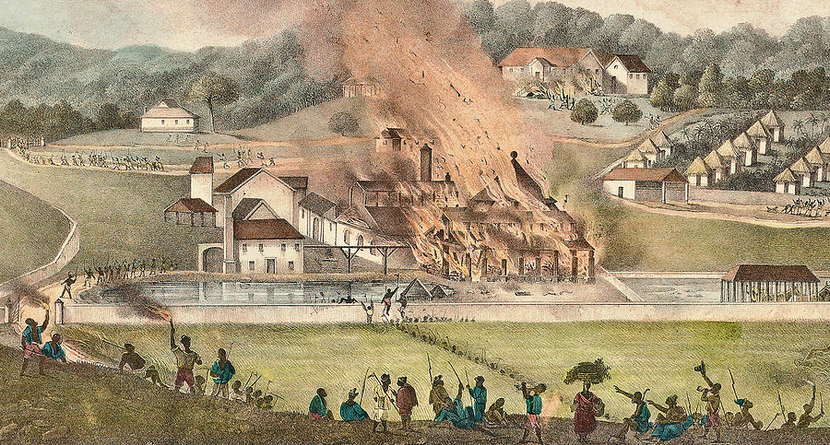
Destruction of the Roehampton Estate, January 1832
Public domain image, Painting by Adolphe Duperly
Don't mourn, organize.

-Joe Hill
User avatar
wjfox
Site Admin
Posts: 13587
Joined: Sat May 15, 2021 6:09 pm
Location: Essex, UK
Contact:

Re: Modern History (1800 – present)

Post by wjfox »

User avatar
caltrek
Posts: 9280
Joined: Mon May 17, 2021 1:17 pm

Re: Modern History (1800 – present)

Post by caltrek »

Don't mourn, organize.

-Joe Hill
User avatar
wjfox
Site Admin
Posts: 13587
Joined: Sat May 15, 2021 6:09 pm
Location: Essex, UK
Contact:

Re: Modern History (1800 – present)

Post by wjfox »

ELIZA, one of the very first chatbots, programmed from 1964–1967. https://web.njit.edu/~ronkowit/eliza.html
User avatar
wjfox
Site Admin
Posts: 13587
Joined: Sat May 15, 2021 6:09 pm
Location: Essex, UK
Contact:

Re: Modern History (1800 – present)

Post by wjfox »

User avatar
wjfox
Site Admin
Posts: 13587
Joined: Sat May 15, 2021 6:09 pm
Location: Essex, UK
Contact:

Re: Modern History (1800 – present)

Post by wjfox »

User avatar
wjfox
Site Admin
Posts: 13587
Joined: Sat May 15, 2021 6:09 pm
Location: Essex, UK
Contact:

Re: Modern History (1800 – present)

Post by wjfox »

User avatar
caltrek
Posts: 9280
Joined: Mon May 17, 2021 1:17 pm

Re: Modern History (1800 – present)

Post by caltrek »

Documents Show Fossil Fuel Industry Knew of Climate Danger as Early as 1954
by Oliver Milman
January 30, 2024

Introduction:
(The Guardian) The fossil fuel industry funded some of the world’s most foundational climate science as early as 1954, newly unearthed documents have shown, including the early research of Charles Keeling, famous for the so-called “Keeling curve” that has charted the upward march of the Earth’s carbon dioxide levels.

A coalition of oil and car manufacturing interests provided $13,814 (about $158,000 in today’s money) in December 1954 to fund Keeling’s earliest work in measuring CO2 levels across the western US, the documents reveal.
Additional Extract:
The fossil fuel interests backed a group, known as the Air Pollution Foundation, that issued funding to Keeling to measure CO2 alongside a related effort to research the smog that regularly blighted Los Angeles at the time. This is earlier than any previously known climate research funded by oil companies.

“The possible consequences of a changing concentration of the CO2 in the atmosphere with reference to climate, rates of photosynthesis, and rates of equilibration with carbonate of the oceans may ultimately prove of considerable significance to civilization,” Epstein, a researcher at the California Institute of Technology (or Caltech), wrote to the group in November 1954.

They contain smoking gun proof that by at least 1954, the fossil fuel industry was on notice about the potential for its products to disrupt Earth’s climate on a scale significant to human civilization,” said Geoffrey Supran, an expert in historic climate disinformation at the University of Miami.
Read more here: https://www.theguardian.com/us-news/20 ... e-denial
Don't mourn, organize.

-Joe Hill
User avatar
Time_Traveller
Posts: 3025
Joined: Sun May 16, 2021 4:49 pm
Location: New York City, USA, November 5th 2032 C.E.

Re: Modern History (1800 – present)

Post by Time_Traveller »

Shipwreck hunters stunned by discovery at bottom of world’s largest freshwater lake
3 minutes ago

Shipwreck hunters were stunned to find a ship that sank in Lake Superior, the world’s largest freshwater lake, that dated back to 1940.

The Great Lakes Shipwreck Historical Society and shipwreck researcher Dan Fountain announced on Monday the discovery of the 244ft (74-metre) bulk carrier Arlington in about 650ft (200 metres) of water some 35 miles north of Michigan’s Keweenaw peninsula.

The Arlington left Port Arthur, Ontario, on 30 April 1940, fully loaded with wheat and headed to Owen Sound, Ontario, under the command of Captain Frederick “Tatey Bug” Burke, a veteran of the Great Lakes.

But as the Arlington and a larger freighter, the Collingwood, made their way across Lake Superior, they encountered dense fog and then a storm after nightfall that battered both ships. The Arlington began to take on water.

The ship's first mate ordered the Arlington onto a course to hug the Canadian north shore, which would have provided some cover from wind and waves, but Burke countermanded and ordered his ship back onto a course across the open lake, the discoverers said.
https://www.independent.co.uk/news/scie ... 95249.html
“In the quantum multiverse, every choice, every decision you've ever and never made exists in an unimaginably vast ensemble of parallel universes.”
Post Reply