
Imagine the pyramids of Egypt being built. An incredibly ancient event.
Now, multiply that span of time by a factor of 10. That's how far back this specimen dates to.
-----
Baby mammoth in Russia is the ‘best-preserved’ ever found
Mon 23 Dec 2024 15.41 GMT
Russian scientists have displayed the remarkably well-preserved remains of a baby mammoth found in the permafrost-covered region of Yakutia in Siberia.
The 50,000-year-old female mammoth has been nicknamed Yana after the river in whose basin it was discovered this summer. Experts say it is the best-preserved mammoth carcass in the world and is one of only seven whole remains ever found.
Studies will be carried out to work out her exact age at death, estimated at “one year old or a bit more”.
The carcass was shown at North-Eastern Federal University in the regional capital of Yakutsk, the institution said in a statement. “We were all surprised by the exceptional preservation of the mammoth,” said the university rector, Anatoly Nikolayev.
Maksim Cheprasov, a researcher, said it was a “unique discovery”.
https://www.theguardian.com/science/202 ... -ever-yana
Human Prehistory (3.3 million years BC – 3500 BC)
-
weatheriscool
- Posts: 26097
- Joined: Sun May 16, 2021 6:16 pm
- Contact:
Re: Human Prehistory (3.3 million years BC – 3500 BC)
Romanian fossils show hominins in Europe 500,000 years earlier than thought
https://phys.org/news/2025-01-romanian- ... years.html
by Justin Jackson , Phys.org
https://phys.org/news/2025-01-romanian- ... years.html
by Justin Jackson , Phys.org
Research led by the Department of Sociology & Anthropology at Ohio University has found evidence of hominin activity at a Romanian fossil site dating to at least 1.95 million years ago. This discovery pushes back the known date of European hominins by half a million years and establishes Grăunceanu as the oldest confirmed European evidence of hominin activity.
Grăunceanu, part of the Tetoiu Formation in Romania, lies within a Late Villafranchian biochronological zone (2.2–1.9 Ma) and has yielded a diverse faunal assemblage indicative of a forest-steppe environment.
The timing of the earliest hominin dispersals into Eurasia has been elusive. Fossil evidence from Dmanisi, Georgia (~1.85–1.77 million years ago) represents the earliest indisputable hominin presence outside Africa. Isolated sites in Europe and Asia with lithics and bone modifications suggest earlier, intermittent hominin activity. Until now, no European site had reliably demonstrated hominin activity predating ~1.4 million years ago with robust age determinations.

Re: Human Prehistory (3.3 million years BC – 3500 BC)
Lost Continent Discovered Off the Coast of Australia
by Harriet Brewis
January 28, 2025
Introduction:
by Harriet Brewis
January 28, 2025
Introduction:
Read more here: https://www.msn.com/en-us/news/world/l ... 8a&ei=39(Indy 100 via MSN) A landmass which was once home to up to half a million people has been discovered off the coast of northern Australia.
The now-submerged continental shelf was a vast, habitable landscape for much of the past 65,000 years, covering some 390,000 square kilometres (around 242,300 miles) – an area bigger than New Zealand.
The scientists who made the landmark find, led by Kasih Norman of Queensland’s Griffith University, said that the “complex landscape” that existed on the Northwest Shelf of Australia was “unlike any landscape found on our continent today”.
Don't mourn, organize.
-Joe Hill
-Joe Hill
-
firestar464
- Posts: 8408
- Joined: Wed Oct 12, 2022 7:45 am
Re: Human Prehistory (3.3 million years BC – 3500 BC)
Money may have originated through long distance trade, new theory suggests
https://phys.org/news/2025-02-money-dis ... heory.html
https://phys.org/news/2025-02-money-dis ... heory.html
-
weatheriscool
- Posts: 26097
- Joined: Sun May 16, 2021 6:16 pm
- Contact:
Re: Human Prehistory (3.3 million years BC – 3500 BC)
Ancient seafarers in Southeast Asia may have built advanced boats 40,000 years ago
https://phys.org/news/2025-02-ancient-s ... built.html
by Timothy James Dimacali, Ateneo de Manila University
https://phys.org/news/2025-02-ancient-s ... built.html
by Timothy James Dimacali, Ateneo de Manila University
The ancient peoples of the Philippines and of Island Southeast Asia (ISEA) may have built sophisticated boats and mastered seafaring tens of thousands of years ago—millennia before Magellan, Zheng He, and even the Polynesians.
In a paper in the Journal of Archaeological Science, Ateneo de Manila University researchers Riczar Fuentes and Alfred Pawlik challenge the widely-held contention that technological progress during the Paleolithic only emerged in Europe and Africa.
They point out that much of ISEA was never connected to mainland Asia, neither by land bridges nor by ice sheets, yet it has yielded evidence of early human habitation. Exactly how these peoples achieved such daring ocean crossings is an enduring mystery, as organic materials like wood and fiber used for boats rarely survive in the archaeological record.
But archaeological sites in the Philippines, Indonesia, and Timor-Leste are now providing strong evidence that ancient seafarers had a technological sophistication comparable to much later civilizations.
Re: Human Prehistory (3.3 million years BC – 3500 BC)
22,000-year-old tracks are earliest evidence of transport vehicles
24 February 2025
Drag marks and human footprints made up to 22,000 years ago have been found on several sites at White Sands National Park in New Mexico. These are thought to have been made by people pulling long pieces of wood laden with goods and are the earliest evidence of such activity.
This kind of primitive vehicle is known as a travois. “Basically it’s a wheelbarrow without the wheel,” says Matthew Bennett at the University of Bournemouth in the UK, a member of the team that studied the tracks.
They were widely used across the world, but this is by far the oldest evidence of their use, says Bennett. “There’s nothing this old.”
https://www.newscientist.com/article/24 ... -vehicles/

Credit: Gabriel Ugueto
24 February 2025
Drag marks and human footprints made up to 22,000 years ago have been found on several sites at White Sands National Park in New Mexico. These are thought to have been made by people pulling long pieces of wood laden with goods and are the earliest evidence of such activity.
This kind of primitive vehicle is known as a travois. “Basically it’s a wheelbarrow without the wheel,” says Matthew Bennett at the University of Bournemouth in the UK, a member of the team that studied the tracks.
They were widely used across the world, but this is by far the oldest evidence of their use, says Bennett. “There’s nothing this old.”
https://www.newscientist.com/article/24 ... -vehicles/
Credit: Gabriel Ugueto
-
weatheriscool
- Posts: 26097
- Joined: Sun May 16, 2021 6:16 pm
- Contact:
Re: Human Prehistory (3.3 million years BC – 3500 BC)
New fossil discovery of an early human ancestor reveals that it walked upright, just like humans
https://phys.org/news/2025-03-fossil-di ... estor.html
by Wits University
https://phys.org/news/2025-03-fossil-di ... estor.html
by Wits University
Paranthropus robustus was a species of prehistoric human that lived in South Africa about 2 million years ago, alongside Homo ergaster, a direct ancestor of modern people. Fossils of Paranthropus robustus are found in abundance at Swartkrans Cave, situated about halfway between Johannesburg and Pretoria. Much has been revealed about the diet and social organization of this extinct species based on studies of its many skulls and hundreds of teeth, which have been recovered from Swartkrans since scientific excavations began there in 1948.
For instance, the extremely heavy jaws and thickly enameled teeth of Paranthropus robustus suggest that, when times were lean, it was capable of subsisting on low-quality foods that were difficult to chew. Moreover, some of the skulls and teeth of Paranthropus robustus are exceptionally large, while others are robust but not as large as those in the first group.
This suggests that Paranthropus robustus was characterized by larger males and smaller females, indicating a mating system called polygyny, in which a single dominant male mates with multiple females.
-
weatheriscool
- Posts: 26097
- Joined: Sun May 16, 2021 6:16 pm
- Contact:
Re: Human Prehistory (3.3 million years BC – 3500 BC)
Standardized production of bone tools by our ancestors pushed back 1 million years
https://phys.org/news/2025-03-standardi ... stors.html
by CNRS
https://phys.org/news/2025-03-standardi ... stors.html
by CNRS
Twenty-seven standardized bone tools dating back more than 1.5 million years were recently discovered in the Olduvai Gorge in Tanzania by a team of scientists from the CNRS and l'Université de Bordeaux, in collaboration with international and Tanzanian researchers.
The study was published in the journal Nature.
This discovery challenges our understanding of early hominin technological evolution, as the oldest previously known standardized bone tools date back approximately 500,000 years.
During these excavations, th
-
weatheriscool
- Posts: 26097
- Joined: Sun May 16, 2021 6:16 pm
- Contact:
Re: Human Prehistory (3.3 million years BC – 3500 BC)
Genomic study indicates our capacity for language emerged 135,000 years ago
https://phys.org/news/2025-03-genomic-c ... years.html
https://phys.org/news/2025-03-genomic-c ... years.html
It is a deep question, from deep in our history: when did human language as we know it emerge? A new survey of genomic evidence suggests our unique language capacity was present at least 135,000 years ago. Subsequently, language might have entered social use 100,000 years ago.
Our species, Homo sapiens, is about 230,000 years old. Estimates of when language originated vary widely, based on different forms of evidence, from fossils to cultural artifacts. The authors of the new analysis took a different approach. They reasoned that since all human languages likely have a common origin—as the researchers strongly think—the key question is how far back in time regional groups began spreading around the world.
"The logic is very simple," says Shigeru Miyagawa, an MIT professor and co-author of a new paper summarizing the results.
Re: Human Prehistory (3.3 million years BC – 3500 BC)
Previously Unknown Human Lineage Lived in The Sahara When It Was Green
by Benjamin Taub
April 4, 2025
Introduction:
For a presentation of study results as published in Nature:
https://www.nature.com/articles/s41586-025-08793-7
by Benjamin Taub
April 4, 2025
Introduction:
Additional extract:(IFL Science) People living in North Africa today can trace their ancestry back to a unique human population that lived in the Sahara at a time when the region was lush, green, and humid. Identifying this prehistoric lineage for the first time in the genomes of two 7,000-year-old mummies, the authors of a new study confirm that the group never mingled with people from sub-Saharan Africa, existing in complete isolation within their verdant oasis.
Today, the Sahara is the largest hot desert on Earth, yet archaeological evidence suggests that people once fished in the region’s rivers, hunted game in its sprawling forests, and herded livestock across vast grasslands. Known as the Green Sahara, this bountiful paradise existed during the so-called African Humid Period, which peaked roughly 11,000 to 5,000 years ago.
During this period, Saharans took up pastoralism, raising cattle that were brought to Africa from southwest Asia. However, because no genomes from the Green Sahara had ever previously been sequenced, researchers were unsure if the adoption of herding occurred as a result of immigration by farmers and shepherds from elsewhere, or simply represented the spread of cultural practices with no accompanying genetic intrusions.
Read more of the Eurekalert article here: https://www.iflscience.com/previously- ... en-78692Thus, the researchers suggest that animal herding wasn’t introduced to the region by immigrants, but probably arose as cattle were distributed through ancient trading networks. "This discovery reveals how pastoralism spread across the Green Sahara, likely through cultural exchange rather than large-scale migration,” says Salem.
For a presentation of study results as published in Nature:
https://www.nature.com/articles/s41586-025-08793-7
Don't mourn, organize.
-Joe Hill
-Joe Hill
-
weatheriscool
- Posts: 26097
- Joined: Sun May 16, 2021 6:16 pm
- Contact:
Re: Human Prehistory (3.3 million years BC – 3500 BC)
Radiocarbon dating reveals Mongolia's earliest pottery predates previous estimates by 2,000 years
https://phys.org/news/2025-04-radiocarb ... liest.html
by Sandee Oster , Phys.org
https://phys.org/news/2025-04-radiocarb ... liest.html
by Sandee Oster , Phys.org
Following a recent study, Dr. Przemysław Bobrowski and his colleagues published new radiocarbon dates on Holocene (11,700 years ago to the present) sites located in the Tsakhiurtyn Hundi (Flint Valley) region of Mongolia. The work has been published in the journal Radiocarbon.
Tsakhiurtyn Hundi is located about 700 km south of Mongolia's capital, Ulaanbaatar, and is within the Arts Bogdyn Nuruu massif.
According to Dr. Bobrowski, "[The] prehistoric sites associated with the Early, Middle, and Late Paleolithic in Tsakhiurtyn Hundi … were discovered at the turn of the 20th and 21st centuries by a Mongolian-Russian-American expedition. The site owes its name to the presence of numerous flint outcrops and an incalculable number of flint artifacts. It is one of the most extensive prehistoric sites in Central Asia.
"Despite the numerous remains of Stone Age settlements, only limited archaeological research has been carried out there so far. The aim of our project, carried out in recent years, is to analyze the nature of long-term prehistoric settlement around Tsakhiurtyn Hundi. Environmental reconstructions, settlements' chronological determinations, and raw materials economy are the main goals to obtain the picture of several hundred thousand years of human activity in this area.
Re: Human Prehistory (3.3 million years BC – 3500 BC)
Fingerprints of city-sized icebergs found off UK coast
2 hours ago
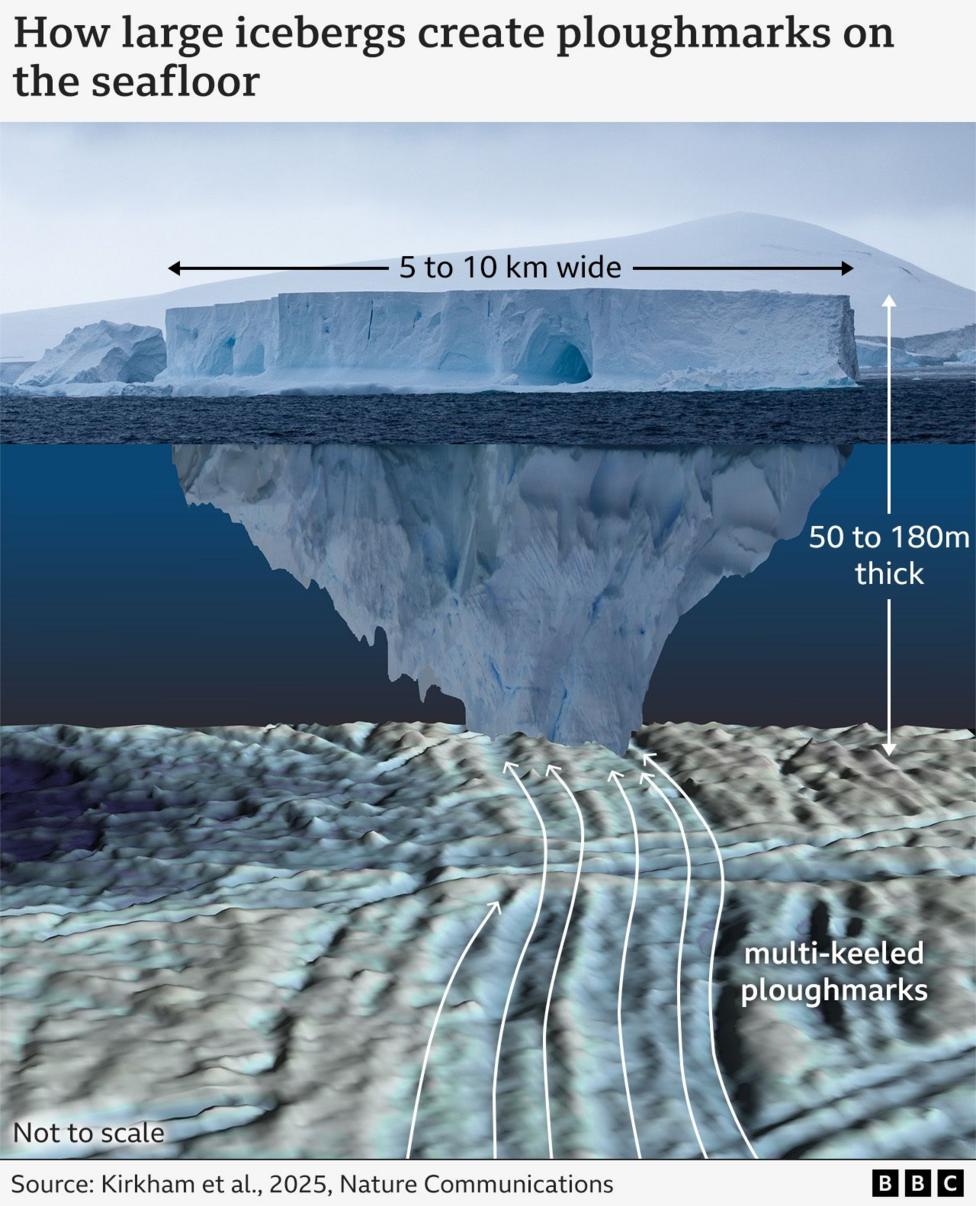
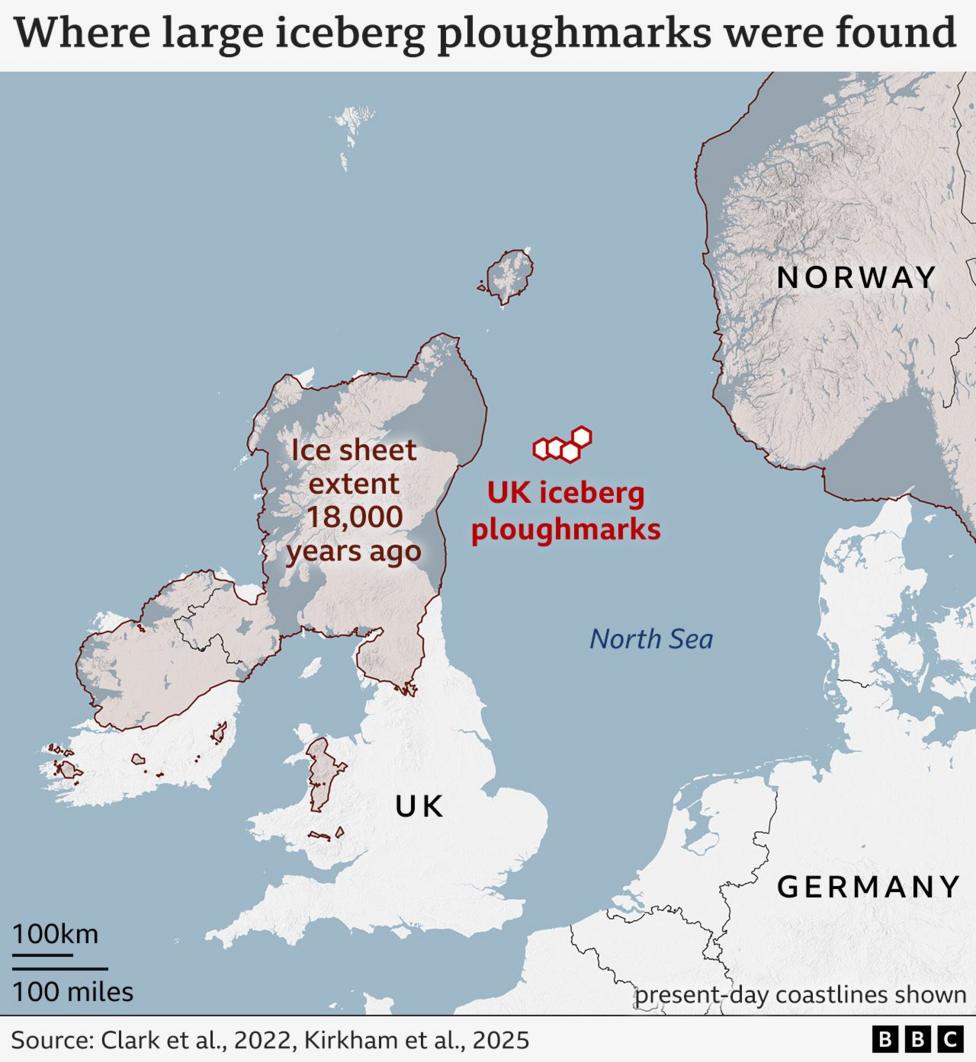
Icebergs as large as cities, potentially tens of kilometres wide, once roved the coasts of the UK, according to scientists.
Researchers found distinctive scratch marks left by the drifting icebergs as they gouged deep tracks into the North Sea floor more than 18,000 years ago.
It's the first hard evidence that the ice sheet formerly covering Britain and Ireland produced such large bergs.
The findings could provide vital clues in understanding how climate change is affecting Antarctica today.
The scientists searched for fingerprints of giant icebergs using very detailed 3D seismic data, collected by oil and gas companies or wind turbine projects doing ocean surveys.
https://www.bbc.co.uk/news/articles/cm2xz664r2do
2 hours ago
Icebergs as large as cities, potentially tens of kilometres wide, once roved the coasts of the UK, according to scientists.
Researchers found distinctive scratch marks left by the drifting icebergs as they gouged deep tracks into the North Sea floor more than 18,000 years ago.
It's the first hard evidence that the ice sheet formerly covering Britain and Ireland produced such large bergs.
The findings could provide vital clues in understanding how climate change is affecting Antarctica today.
The scientists searched for fingerprints of giant icebergs using very detailed 3D seismic data, collected by oil and gas companies or wind turbine projects doing ocean surveys.
https://www.bbc.co.uk/news/articles/cm2xz664r2do
Re: Human Prehistory (3.3 million years BC – 3500 BC)
Scientists Identify Extreme Solar Storm that Hit Earth in 12350 BC
May 15, 2025
Introduction:
For a technical presentation of research study results as published in Science Direct: https://www.sciencedirect.com/science/a ... ia%3Dihub
May 15, 2025
Introduction:
Read more of the Eurekalert article here: https://www.eurekalert.org/news-releases/1083969(News Alert) New research uncovers the strongest solar event ever detected — rewriting our understanding of space weather and radiocarbon dating.
An international team of scientists has discovered an extreme spike in radiocarbon corresponding to the year 12350 BC during the dusk of the last Ice Age. However, the strength of the event could not be assessed earlier because of the lack of an appropriate model. Presently, it has been identified as the most powerful solar particle storm known to date – a colossal space weather storm that struck Earth 14300 years ago. This recent finding expands the timeline and intensity of known solar activity and sets a new upper boundary for such solar phenomena.
In the study, Postdoctoral Researcher Kseniia Golubenko and Professor Ilya Usoskin at the University of Oulu, Finland utilised their newly developed chemistry–climate model called SOCOL:14C-Ex, specifically designed to reconstruct solar particle storms under ancient glacial climate conditions. The model confirmed that the detected solar event was approximately 18% stronger than the notorious AD 775 event — until now the strongest solar storm ever recorded in tree-ring archives.
“Compared to the largest event of the modern satellite era — the 2005 particle storm — the ancient 12350 BC event was over 500 times more intense, according to our estimates”, says Dr. Golubenko.
Other large known solar particle storms have occurred around 994 AD, 663 BC, 5259 BC and 7176 BC, and a few other candidates are under investigation. The new model was also verified using wood samples recently found in the French Alps, dating back some 14300 years.
For a technical presentation of research study results as published in Science Direct: https://www.sciencedirect.com/science/a ... ia%3Dihub
Don't mourn, organize.
-Joe Hill
-Joe Hill
-
weatheriscool
- Posts: 26097
- Joined: Sun May 16, 2021 6:16 pm
- Contact:
-
weatheriscool
- Posts: 26097
- Joined: Sun May 16, 2021 6:16 pm
- Contact:
-
weatheriscool
- Posts: 26097
- Joined: Sun May 16, 2021 6:16 pm
- Contact:
Re: Human Prehistory (3.3 million years BC – 3500 BC)
Cave records show that US's deepest river gorge Hells Canyon is only 2.1 million years old
https://phys.org/news/2025-06-cave-deep ... hells.html
by Sanjukta Mondal, Phys.org
https://phys.org/news/2025-06-cave-deep ... hells.html
by Sanjukta Mondal, Phys.org
North America's deepest gorge, Hells Canyon, which slithers along the border of Idaho and Oregon, is a surprisingly new addition to the Earth's ancient landscape. A recent study suggests that a monumental shift in Snake river drainage around 2.1 million years ago reshaped the topography, carving out Hells Canyon, which plunges an astonishing 2,400 m, significantly deeper than the Grand Canyon.
The research reported in PNAS collected ancient sediments transported by the Snake River and deposited in caves above the canyon to estimate their geological age using cosmogenic nuclide dating.
High-energy particles from space, known as cosmic rays, constantly bombard the Earth. When these particles strike rocks or sediments exposed at the surface, they can interact with certain elements, radioactive isotopes. These isotopes, called cosmogenic nuclides, accumulate over time in the uppermost layers of rock.
Cosmogenic nuclide dating involves measuring the concentration of these isotopes to determine how long a rock or sediment surface has been exposed to cosmic rays, giving us its age.