Natural History (13.8 billion years BC – 3.3 million BC)

Got something to say about the past? Say it here!
weatheriscool
Posts: 24482
Joined: Sun May 16, 2021 6:16 pm
Contact:

Re: Natural History (13.8 billion years BC – 3.3 million BC)

Post by weatheriscool »

Archaeologists report earliest evidence for plant farming in east Africa
https://phys.org/news/2024-07-archaeolo ... -east.html
by Washington University in St. Louis

A trove of ancient plant remains excavated in Kenya helps explain the history of plant farming in equatorial eastern Africa, a region long thought to be important for early farming but where scant evidence from actual physical crops has been previously uncovered.

In a study published in the Proceedings of the Royal Society B, archaeologists from Washington University in St. Louis, the University of Pittsburgh and their colleagues report the largest and most extensively dated archaeobotanical record from interior east Africa.

Up until now, scientists have had virtually no success in gathering ancient plant remains from east Africa and, as a result, have had little idea where and how early plant farming got its start in the large and diverse area comprising Kenya, Tanzania and Uganda.
User avatar
Powers
Posts: 1183
Joined: Fri Apr 07, 2023 7:32 pm
Location: a.k.a Lurking, Member, Lorem Ipsum, ..., --- and ººº.

Re: Natural History (13.8 billion years BC – 3.3 million BC)

Post by Powers »

weatheriscool wrote: Wed Jul 10, 2024 12:00 am Archaeologists report earliest evidence for plant farming in east Africa
https://phys.org/news/2024-07-archaeolo ... -east.html
by Washington University in St. Louis

A trove of ancient plant remains excavated in Kenya helps explain the history of plant farming in equatorial eastern Africa, a region long thought to be important for early farming but where scant evidence from actual physical crops has been previously uncovered.

In a study published in the Proceedings of the Royal Society B, archaeologists from Washington University in St. Louis, the University of Pittsburgh and their colleagues report the largest and most extensively dated archaeobotanical record from interior east Africa.

Up until now, scientists have had virtually no success in gathering ancient plant remains from east Africa and, as a result, have had little idea where and how early plant farming got its start in the large and diverse area comprising Kenya, Tanzania and Uganda.
In particular, the remnants of cowpea discovered at Kakapel rock shelter and directly dated to 2,300 years ago constitute the earliest documented arrival of a domesticated crop—and presumably of farming lifeways—to eastern Africa. Cowpea is assumed to have originated in west Africa and to have arrived in the Lake Victoria basin concurrent with the spread of Bantu-speaking peoples migrating from central Africa, the study authors said.
firestar464
Posts: 7202
Joined: Wed Oct 12, 2022 7:45 am

Re: Natural History (13.8 billion years BC – 3.3 million BC)

Post by firestar464 »

A new species of extinct crocodile relative rewrites life on the Triassic coastline

https://phys.org/news/2024-07-species-e ... -life.html
User avatar
caltrek
Posts: 9280
Joined: Mon May 17, 2021 1:17 pm

Re: Natural History (13.8 billion years BC – 3.3 million BC)

Post by caltrek »

Research Reveals the Most Complete Dinosaur Discovered in the UK in a Century
July 10, 2024

Introduction:
(Eurekalert) The most complete dinosaur discovered in this country in the last 100 years, with a pubic hip bone the size of a ‘dinner plate’, has been described in a new paper published today.

The specimen, which is around 125 million years old, was found in the cliffs of Compton Bay on the Isle of Wight in 2013 by fossil collector Nick Chase, before he tragically died of cancer.

Jeremy Lockwood, a retired GP and University of Portsmouth PhD student, helped with the dinosaur’s excavation and has spent years analysing the 149 different bones that make up the skeleton.

Jeremy determined that the skeleton represented a new genus and species, which he named Comptonatus chasei in tribute to Nick.

Jeremy said: “Nick had a phenomenal nose for finding dinosaur bones - he really was a modern-day Mary Anning. He collected fossils daily in all weathers and donated them to museums. I was hoping we’d spend our dotage collecting together as we were of similar ages, but sadly that wasn’t to be the case.
Read more here: https://www.eurekalert.org/news-releases/1050945
Don't mourn, organize.

-Joe Hill
User avatar
caltrek
Posts: 9280
Joined: Mon May 17, 2021 1:17 pm

Re: Natural History (13.8 billion years BC – 3.3 million BC)

Post by caltrek »

University of Bristol Study Finds Life on Earth Emerged 4.2 Billion Years Ago
by Michelle Starr
July 12, 2024

Introduction:
(Science Alert) Once upon a time, Earth was barren. Everything changed when, somehow, out of the chemistry available early in our planet's history, something started squirming – processing available matter to survive, to breed, to thrive.

What that something was, and when it first squirmed, have been burning questions that have puzzled humanity probably for as long as we've been able to ask "what am I?"

Now, a new study has found some answers – and life emerged surprisingly early.

By studying the genomes of organisms that are alive today, scientists have determined that the last universal common ancestor (LUCA), the first organism that spawned all the life that exists today on Earth, emerged as early as 4.2 billion years ago.

Earth, for context, is around 4.5 billion years old. That means life first emerged when the planet was still practically a newborn.
Read more here: https://www.sciencealert.com/gobsmacki ... ears-ago
Don't mourn, organize.

-Joe Hill
User avatar
caltrek
Posts: 9280
Joined: Mon May 17, 2021 1:17 pm

Re: Natural History (13.8 billion years BC – 3.3 million BC)

Post by caltrek »

Clues Hint Newly Discovered Dinosaur Lived Underground
by Tracey Peake
July 12, 2024

Introduction:
(Futurity) A newly discovered ancestor of Thescelosaurus shows evidence that these animals spent at least part of their time in underground burrows.

The new species contributes to a fuller understanding of life during the mid-Cretaceous—both above and below ground.

The new dinosaur, Fona [/Foat’NAH/] herzogae lived 99 million years ago in what is now Utah. At that time, the area was a large floodplain ecosystem sandwiched between the shores of a massive inland ocean to the east and active volcanoes and mountains to the west. It was a warm, wet, muddy environment with numerous rivers running through it.

Paleontologists from North Carolina State University and the North Carolina Museum of Natural Sciences unearthed the fossil—and other specimens from the same species—in the Mussentuchit Member of the Cedar Mountain Formation, beginning in 2013. The preservation of these fossils, along with some distinguishing features, alerted them to the possibility of burrowing.

Fona was a small-bodied, plant-eating dinosaur about the size of a large dog with a simple body plan. It lacks the bells and whistles that characterize its highly ornamented relatives such as horned dinosaurs, armored dinosaurs, and crested dinosaurs. But that doesn’t mean Fona was boring.
Read more here: https://www.futurity.org/new-dinosaur- ... -3238272/
Don't mourn, organize.

-Joe Hill
User avatar
Time_Traveller
Posts: 3025
Joined: Sun May 16, 2021 4:49 pm
Location: New York City, USA, November 5th 2032 C.E.

Re: Natural History (13.8 billion years BC – 3.3 million BC)

Post by Time_Traveller »

Rare fossils reveal secrets of mammal evolution
3 hours ago

Image

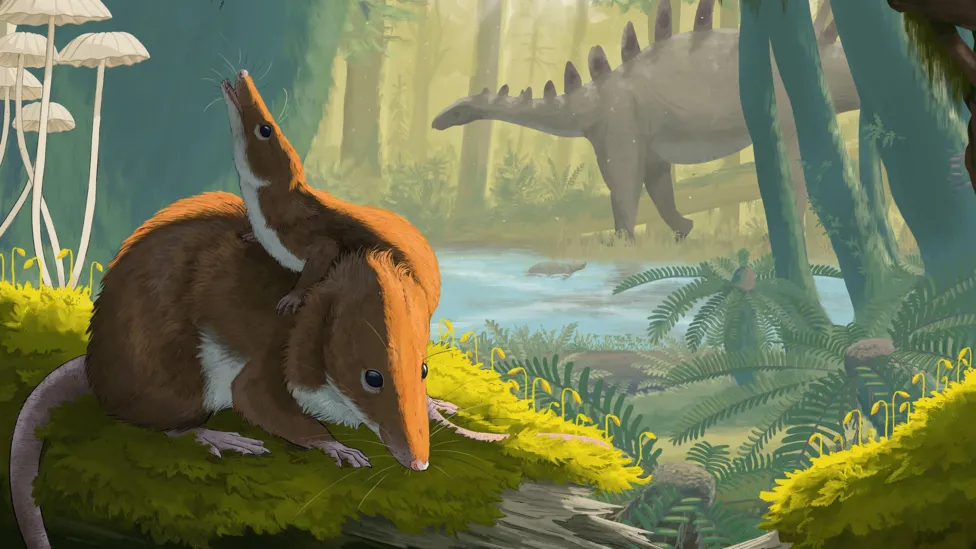
Two incredibly rare fossils found on Scotland's Isle of Skye are rewriting our understanding of how mammals evolved.

While modern small mammals live as little as a year, one of the first to roam the earth, alongside dinosaurs, could reach seven years and beyond, scientists have discovered.

Only a handful of fossils of the primitive shrew-like mammal, Krusatodon, have ever been found, including two exceptionally complete skeletons of a juvenile and an adult from Skye.

By studying fossils of the earliest mammals, scientists hope to unlock the secrets of how they rose to become super successful animals occupying every habitat on the planet.

The researchers used hi-tech X-ray imaging to peer through rock and study growth patterns in the teeth of the two fossils, much like counting tree rings.
https://www.bbc.co.uk/news/articles/c0xj65nelv0o
“In the quantum multiverse, every choice, every decision you've ever and never made exists in an unimaginably vast ensemble of parallel universes.”
User avatar
wjfox
Site Admin
Posts: 13575
Joined: Sat May 15, 2021 6:09 pm
Location: Essex, UK
Contact:

Re: Natural History (13.8 billion years BC – 3.3 million BC)

Post by wjfox »

Tyrannosaurus rex could have been even bigger than previously thought, study suggests

Wednesday 24 July 2024 23:06, UK

Tyrannosaurus rex could have been even bigger than previously thought, new research suggests.

Scientists now believe the dinosaur could have been 70% heavier and 25% longer.

The largest of the species may have weighed roughly 15 tonnes instead of 8.8, and measured 15 metres instead of 12.

Dr Jordan Mallon, of the Canadian Museum of Nature in Ottawa, said scientists "really have no idea from the fossil record about the absolute sizes they might have reached".

"It's fun to think about a 15 tonne T. rex, but the implications are also interesting from a biomechanical or ecological perspective," he added.

https://news.sky.com/story/tyrannosauru ... s-13184470


Image
User avatar
Time_Traveller
Posts: 3025
Joined: Sun May 16, 2021 4:49 pm
Location: New York City, USA, November 5th 2032 C.E.

Re: Natural History (13.8 billion years BC – 3.3 million BC)

Post by Time_Traveller »

Half-a-billion-year-old slug with spikes reveals origins of molluscs
Thursday 1 August 2024 18:59, UK

Image

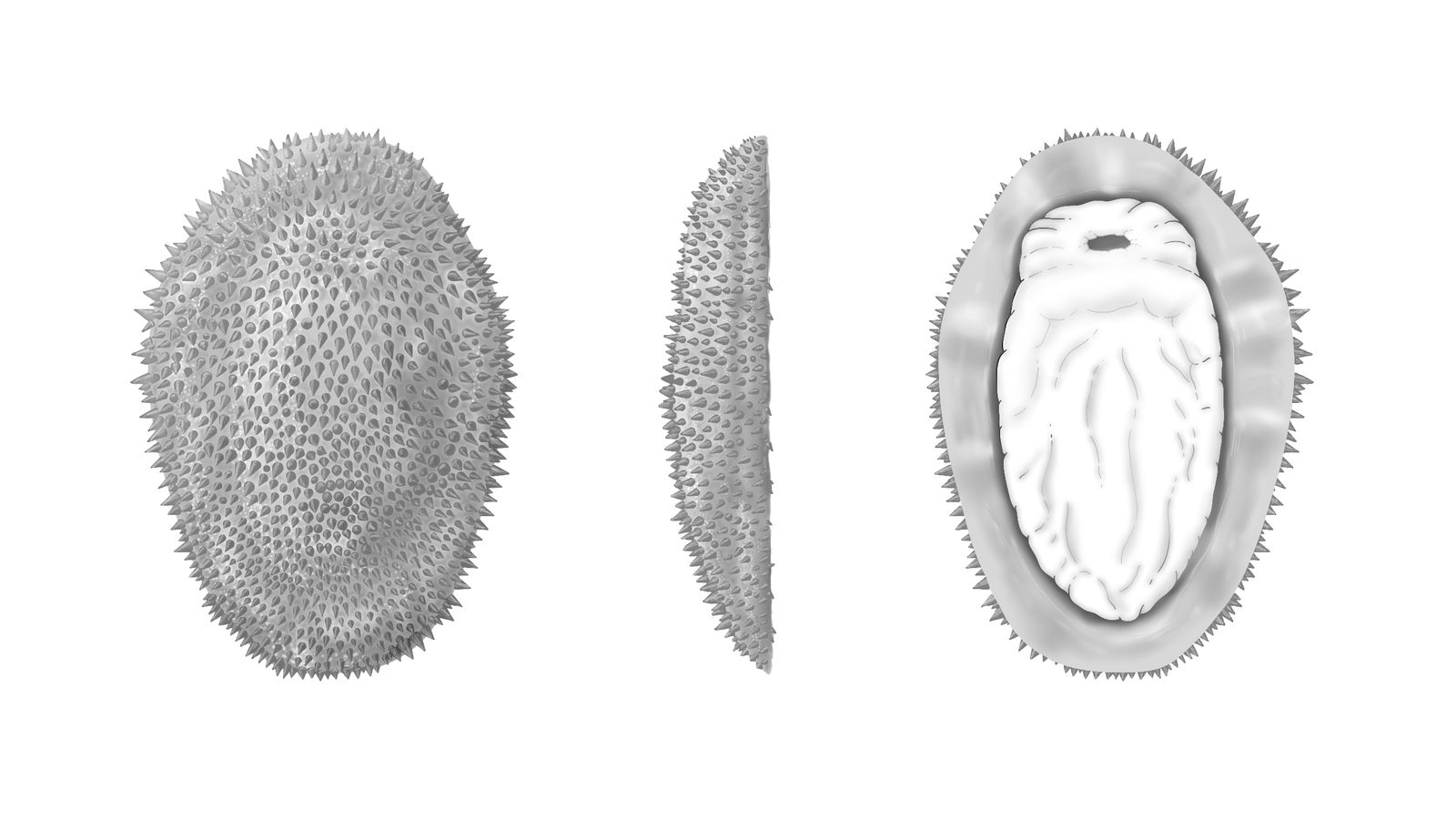
The discovery of a half-a-billion-year-old slug with spines has shed light on the origins of animals like oysters and octopuses, researchers have said.

The new fossil, called Shishania aculeata, reveals that the earliest molluscs (animals that do not have a backbone) were flat, shell-less slugs covered in a protective spiny armour.

Underneath, the animal was made up of a muscular foot, like that of a slug, and would have used it to crawl across the seabed, experts suggest in a new study.

The species was found in well-preserved fossils from eastern Yunnan Province in southern China and dates back to a geological period called the early Cambrian, approximately 514 million years ago.

Unlike most molluscs, Shishania did not have a shell that covered its body, suggesting that it represents a very early stage in the evolution of the animal.
https://news.sky.com/story/half-a-billi ... s-13188853
“In the quantum multiverse, every choice, every decision you've ever and never made exists in an unimaginably vast ensemble of parallel universes.”
User avatar
Time_Traveller
Posts: 3025
Joined: Sun May 16, 2021 4:49 pm
Location: New York City, USA, November 5th 2032 C.E.

Re: Natural History (13.8 billion years BC – 3.3 million BC)

Post by Time_Traveller »

Complex life on Earth began around 1.5 billion years earlier than thought, study claims
Monday 29 July 2024 11:42, UK

Image

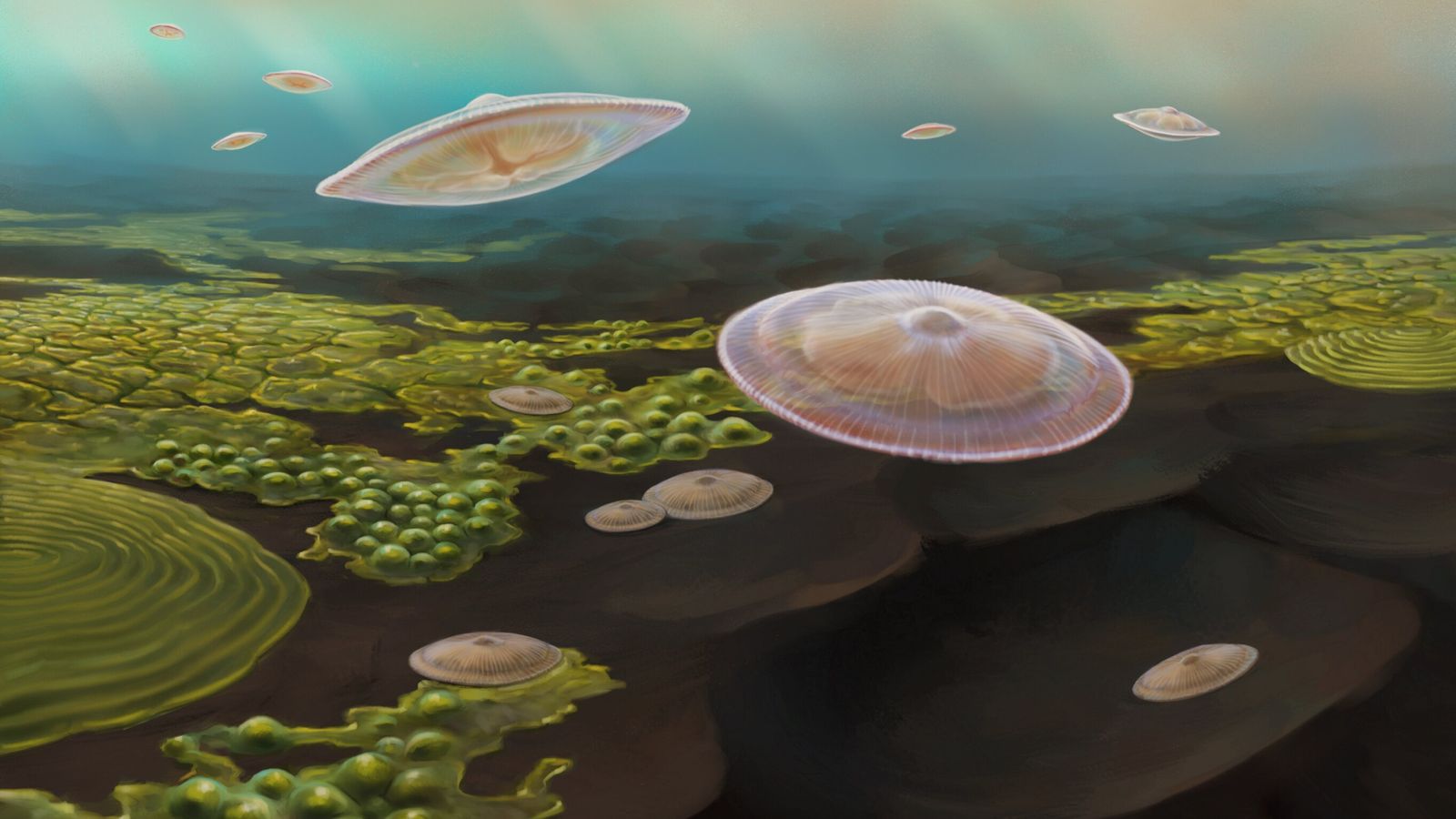
Complex life on Earth began around 1.5 billion years earlier than thought, according to a new study.

Scientists were broadly of the view that animals first emerged on Earth 635 million years ago, but the latest study, led by a research team at Cardiff University, has found signs of a much earlier ecosystem.

The ecosystem was found in the Franceville Basin near Gabon.

The study uncovers environmental evidence of the very first experiments in the evolution of complex life.

It describes an episode of unique underwater volcanic activity after two continents collided.
https://news.sky.com/story/complex-life ... s-13186690
“In the quantum multiverse, every choice, every decision you've ever and never made exists in an unimaginably vast ensemble of parallel universes.”
weatheriscool
Posts: 24482
Joined: Sun May 16, 2021 6:16 pm
Contact:

Re: Natural History (13.8 billion years BC – 3.3 million BC)

Post by weatheriscool »

Isolated community of complex life may have existed 2 billion years ago
By Michael Irving
August 03, 2024
Scientists have discovered evidence that an isolated pocket of complex life may have evolved on Earth more than 2 billion years ago – only to go extinct and take another 1.5 billion years to evolve to that level again. The controversial find could rewrite our understanding of life on, and beyond, Earth.

Life appears to have gotten started pretty quickly after Earth formed about 4.5 billion years ago. Direct evidence shows that microbes were abundant by 3.5 billion years ago, with other fossils dating back 3.7 billion years. Other finds even suggest Earth could have been inhabited extremely quickly, as far as 4.3 billion years ago, though these fossils are heavily contested.

Still, for most of its existence life on Earth has been simple, single-celled organisms. Complex life, including the ancestors of animals, are thought to have only evolved about 635 million years ago, when conditions became favorable to larger body sizes.
https://newatlas.com/biology/isolated-c ... years-ago/
User avatar
caltrek
Posts: 9280
Joined: Mon May 17, 2021 1:17 pm

Re: Natural History (13.8 billion years BC – 3.3 million BC)

Post by caltrek »

World’s Tallest Sand Dune, Caves with Early Human Tech Among UNESCO’s Newest World Heritage Sites
by Holly Large
August 5, 2024

Extract:
(IFL Science) UNESCO has added 24 new and two expanded sites to its World Heritage List, ranging from areas with some of the earliest evidence of modern human behavior to regions rich in natural beauty and biodiversity.

Keep reading (in link provided below) to find out more about some of our favorites (including):

Badain Jaran Desert (in China) – Towers of Sand and Lakes…

The Emergence of Modern Human Behavior: The Pleistocene Occupation Sites of South Africa …
Lençóis Maranhenses National Park…

The Archaeological Heritage of Niah National Park’s Caves Complex on Borneo Island…

Te Henua Enata – The Marquesas Islands (in the South Pacific)
Read more of the IFL Science article here: https://www.iflscience.com/worlds-tall ... es-75427

For a listing of new sties as found at the UNESCO website: https://whc.unesco.org/en/newproperties/
Don't mourn, organize.

-Joe Hill
User avatar
caltrek
Posts: 9280
Joined: Mon May 17, 2021 1:17 pm

Re: Natural History (13.8 billion years BC – 3.3 million BC)

Post by caltrek »

Heavy Rain Just Gifted Science One of The Oldest Dinosaurs Ever Found
by Rachael Funnell
August 6, 2024

Introduction:
(IFL Science) One of the oldest dinosaurs ever discovered may have just been delivered by torrential downpours in the southern state of Rio Grande do Sul, Brazil. Palaeontologists made the discovery after heavy rain sped up the process of erosion next to a reservoir dating back to the Triassic, meaning it’s estimated to be around 233 million years old.

If the dating is accurate, this puts the animal right at the very beginning of dinosaurs. The prehistoric animals are thought to have first emerged during the Triassic at a time when all the continents were connected in one giant landmass called Pangea.

The fossil find is awaiting further investigation and publication, but a fact sheet about the discovery was shared with The Associated Press. What’s being reported so far is that it was an apex predator from the Herrerasauridae, a family of carnivorous dinosaurs that walked on two legs, and may represent the most complete of its kind ever found.

When heavy rains disrupted the environment, a team of palaeontologists including Rodrigo Temp Müller from the Federal University of Santa Maria discovered several bones. As they dug a bit further, they realized that most of the skeleton was present, revealing an ancient animal that was around 2.5 meters (8.2 feet) long.

While being gifted such a monumental fossil find by rain could be seen as a stroke of good luck, the reality is that extreme weather can be damaging to palaeontological discoveries. Elsewhere, the team found a pelvis and leg bone being destroyed by the severe rains, making reading an already scant fossil record all the more difficult.
Read more here: https://www.iflscience.com/heavy-rain- ... nd-754 40
Don't mourn, organize.

-Joe Hill
User avatar
wjfox
Site Admin
Posts: 13575
Joined: Sat May 15, 2021 6:09 pm
Location: Essex, UK
Contact:

Re: Natural History (13.8 billion years BC – 3.3 million BC)

Post by wjfox »

Scottish isles may solve mystery of 'Snowball Earth'

16 August 2024

A cluster of Scottish islands could help solve one of our planet's greatest mysteries, scientists say.

The Garvellach islands off the west coast of Scotland are the best record of Earth entering its biggest ever ice age around 720 million years ago, researchers have discovered.

The big freeze, which covered nearly all the globe in two phases for 80 million years, is known as "Snowball Earth", after which the first animal life emerged.

Clues hidden in rocks about the freeze have been wiped out everywhere - except in the Garvellachs. Researchers hope the islands will tell us why Earth went into such an extreme icy state for so long and why it was necessary for complex life to emerge.

[...]

“We capture that moment of entering an ice age in Scotland that is missing in all other localities in the world,” Prof Graham Shields of University College London, who led the research, told BBC News.

https://www.bbc.co.uk/news/articles/cj9l2mrn43jo


Image
Credit: SPL
User avatar
Time_Traveller
Posts: 3025
Joined: Sun May 16, 2021 4:49 pm
Location: New York City, USA, November 5th 2032 C.E.

Re: Natural History (13.8 billion years BC – 3.3 million BC)

Post by Time_Traveller »

Ancient ocean of magma found on Moon south pole
1 hour ago

The Moon’s south pole was once covered in an ocean of liquid molten rock, according to scientists.

The findings back up a theory that magma formed the Moon's surface around 4.5 billion years ago.

Remnants of the ocean were found by India’s historic Chandrayaan-3 mission that landed on the south pole last August.

The mission explored this isolated and mysterious area where no craft had ever landed before.

The findings help back up an idea called the Lunar Magma Ocean theory about how the Moon formed.

Scientists think that when the Moon formed 4.5 billion years ago, it began to cool and a lighter mineral called ferroan anorthosite floated to the surface. This ferroan anorthosite - or molten rock - formed the moon’s surface.
https://www.bbc.co.uk/news/articles/cx2n0jgldn5o
“In the quantum multiverse, every choice, every decision you've ever and never made exists in an unimaginably vast ensemble of parallel universes.”
weatheriscool
Posts: 24482
Joined: Sun May 16, 2021 6:16 pm
Contact:

Re: Natural History (13.8 billion years BC – 3.3 million BC)

Post by weatheriscool »

Paleontologists find omnivorous ancestor of the giant panda, revealing it was not always just a bamboo eater
https://phys.org/news/2024-09-paleontol ... panda.html
by Universitaet Tübingen
The Hammerschmiede fossil site in southern Germany has yielded finds from about 11.5 million years ago that have rewritten evolutionary history. The sole species of bear discovered to date at the site was a relative of the giant panda. Its diet, however, more closely resembled the mixed diet of today's brown bears.

An international research team from Hamburg, Frankfurt, Madrid and Valencia headed by Professor Madelaine Böhme from the Senckenberg Center for Human Evolution and Palaeoenvironment at the University of Tübingen discovered this in their study of the dietary and life habits of 28 species of predator from the Hammerschmiede that have since died out.

Two publications on the investigation of these finds have been published in Papers in Palaeontology and Geobios.
User avatar
wjfox
Site Admin
Posts: 13575
Joined: Sat May 15, 2021 6:09 pm
Location: Essex, UK
Contact:

Re: Natural History (13.8 billion years BC – 3.3 million BC)

Post by wjfox »

firestar464
Posts: 7202
Joined: Wed Oct 12, 2022 7:45 am

Re: Natural History (13.8 billion years BC – 3.3 million BC)

Post by firestar464 »

User avatar
wjfox
Site Admin
Posts: 13575
Joined: Sat May 15, 2021 6:09 pm
Location: Essex, UK
Contact:

Re: Natural History (13.8 billion years BC – 3.3 million BC)

Post by wjfox »

The asteroid that killed the dinosaurs was not alone

3 October 2024

The huge asteroid that hit Earth and wiped out the dinosaurs 66 million years ago was not alone, scientists have confirmed.

A second, smaller space rock smashed into the sea off the coast of West Africa creating a large crater during the same era.

It would have been a “catastrophic event”, the scientists say, causing a tsunami at least 800m high to tear across the Atlantic ocean.

[...]

They cannot date the event exactly, or say whether it came before or after the asteroid which left the 180km-wide Chicxulub crater in Mexico. That one ended the reign of the dinosaurs.

But they say the smaller rock also came at the end of the Cretaceous period when they went extinct. As it crashed into Earth's atmosphere, it would have formed a fireball.

https://www.bbc.co.uk/news/articles/c62m04v0k0no


-----


Five-mile asteroid impact crater below Atlantic captured in 'exquisite' detail by seismic data

October 3, 2024

New images of an asteroid impact crater buried deep below the floor of the Atlantic Ocean have been published today by researchers at Heriot-Watt University.

The images confirm the 9km Nadir Crater, located 300m under the floor of the Atlantic Ocean, was caused by an asteroid smashing into Earth at the end of the Cretaceous period around 66 million years ago.

That's the same age as the dinosaur-killing 200 km wide, Chicxulub impact crater in Mexico.

The images have helped the researchers determine what happened in the minutes following impact: The formation of an initial bowl-shaped crater, rocks turned to a fluid-like state and flowing upwards to the crater floor, the creation of a damage zone covering thousands of square kilometers beyond the crater, and an 800-meter-plus high tsunami that would have traveled across the Atlantic ocean.

https://phys.org/news/2024-10-mile-aste ... antic.html


Image
User avatar
Time_Traveller
Posts: 3025
Joined: Sun May 16, 2021 4:49 pm
Location: New York City, USA, November 5th 2032 C.E.

Re: Natural History (13.8 billion years BC – 3.3 million BC)

Post by Time_Traveller »

Mega meteorite tore up seabed and boiled Earth's oceans
More on that: https://www.eurekalert.org/news-releases/1061598
“In the quantum multiverse, every choice, every decision you've ever and never made exists in an unimaginably vast ensemble of parallel universes.”
Post Reply