Natural History (13.8 billion years BC – 3.3 million BC)

Got something to say about the past? Say it here!
weatheriscool
Posts: 24482
Joined: Sun May 16, 2021 6:16 pm
Contact:

Re: Natural History (13.8 billion years BC – 3.3 million BC)

Post by weatheriscool »

The European roots of Africa's giant predatory dinosaurs
https://phys.org/news/2025-09-european- ... atory.html
by Katja Henßel, The Bavarian Natural History Collections

Studies of newly discovered fossils of the predatory dinosaur Camarillasaurus cirugedae from Spain show that the giant bipedal spinosaurids from Africa apparently originated in Europe. An international team led by SNSB paleontologist Oliver Rauhut has now published these findings in the journal Palaeontologia Electronica.

Tyrannosaurus is perhaps the best-known bipedal predatory dinosaur—but not the largest known representative of this group: Spinosaurus occurred in Africa in the early Late Cretaceous period (about 95 million years ago) and was even larger, measuring up to 18 meters in length.

In collaboration with Spanish colleagues, Rauhut has now found new evidence that the gigantic spinosaurs had their roots in Europe. New finds and the re-examination of previously collected remains of the little-known predatory dinosaur Camarillasaurus cirugedae from the Lower Cretaceous period (about 128 million years ago) in Spain show that this species was a close relative of the giant North African spinosaurs.

weatheriscool
Posts: 24482
Joined: Sun May 16, 2021 6:16 pm
Contact:

Re: Natural History (13.8 billion years BC – 3.3 million BC)

Post by weatheriscool »

User avatar
wjfox
Site Admin
Posts: 13575
Joined: Sat May 15, 2021 6:09 pm
Location: Essex, UK
Contact:

Re: Natural History (13.8 billion years BC – 3.3 million BC)

Post by wjfox »

weatheriscool
Posts: 24482
Joined: Sun May 16, 2021 6:16 pm
Contact:

Re: Natural History (13.8 billion years BC – 3.3 million BC)

Post by weatheriscool »

New ichthyosaur species with robust ribs discovered in Jurassic clay pit

by Pensoft Publishers
https://phys.org/news/2025-09-ichthyosa ... assic.html
An international research team from Switzerland and Germany, led by Gaël Spicher (JURASSICA Museum, Porrentruy, Switzerland), has described a new ichthyosaur species based on fossils curated at the Urwelt-Museum Oberfranken (Bayreuth, Germany). The study is published in the open-access journal Fossil Record.

The new species was named Eurhinosaurus mistelgauensis, in reference to the clay pit of Mistelgau in Upper Franconia—a fossil site that has yielded numerous important finds. "We wanted to highlight the scientific importance of the Mistelgau locality," explains lead author and doctoral student Gaël Spicher.

Excavations in the clay pit have been conducted regularly since 1998 by the Urwelt-Museum Oberfranken, which recovered and prepared the fossils prior to their scientific study. One specimen originates from a so-called "belemnite battleground"—dense accumulations of Jurassic cephalopod remains that are characteristic of the site.
weatheriscool
Posts: 24482
Joined: Sun May 16, 2021 6:16 pm
Contact:

Re: Natural History (13.8 billion years BC – 3.3 million BC)

Post by weatheriscool »

weatheriscool
Posts: 24482
Joined: Sun May 16, 2021 6:16 pm
Contact:

Re: Natural History (13.8 billion years BC – 3.3 million BC)

Post by weatheriscool »

weatheriscool
Posts: 24482
Joined: Sun May 16, 2021 6:16 pm
Contact:

Re: Natural History (13.8 billion years BC – 3.3 million BC)

Post by weatheriscool »

weatheriscool
Posts: 24482
Joined: Sun May 16, 2021 6:16 pm
Contact:

Re: Natural History (13.8 billion years BC – 3.3 million BC)

Post by weatheriscool »

Early experiment at the dawn of dinosaur evolution discovered
https://phys.org/news/2025-10-early-daw ... ution.html
by Justin Jackson, Phys.org

Argentinian researchers have described a Carnian theropod with features previously thought to belong only to much later neotheropods, indicating greater early dinosaur diversity than expected as well as a possible climate-related ebb and return of dinosaur abundance in northwestern Argentina.

Fossil assemblages in northwestern Argentina offer a way to examine abundance, body size structure, and faunal shifts during the dinosaur diversification event that followed the Carnian pluvial episode. Early dinosaur diversification remains hard to resolve because few rock units preserve continuous strata across the Carnian and Norian and several classic sites are either limited to Carnian time or poorly sampled.
firestar464
Posts: 7202
Joined: Wed Oct 12, 2022 7:45 am

Re: Natural History (13.8 billion years BC – 3.3 million BC)

Post by firestar464 »

firestar464
Posts: 7202
Joined: Wed Oct 12, 2022 7:45 am

Re: Natural History (13.8 billion years BC – 3.3 million BC)

Post by firestar464 »

Mating injuries may give us a new way of identifying dinosaur genders

https://phys.org/news/2025-11-injuries- ... nders.html
User avatar
caltrek
Posts: 9280
Joined: Mon May 17, 2021 1:17 pm

Re: Natural History (13.8 billion years BC – 3.3 million BC)

Post by caltrek »

Sudden Complexity Just 65 million Years Ago
November 1, 2025

Introduction:
(Eurekalert) Land plants – such as mosses, ferns and trees – are some of the most structurally complex photosynthesizing organisms on Earth. But their evolutionary story is deeply tied to their ancestors: simpler green algae that lived hundreds of millions of years ago. Among these algae, a group related to land plants that can still be found today – the Coleochaetophyceae – stands out. These freshwater algae form branching, disc-shaped structures that resemble some of the building blocks of plants’ bodies. Interestingly, the closest living algal relatives of land plants – the Zygnematophyceae – are much simpler in structure, suggesting that plant-like complexity appeared and disappeared multiple times throughout evolution. Now, an international team of researchers led by the University of Göttingen has used DNA and data from fossil evidence to shed new light on this enigmatic group of algae: Coleochaetophyceae. The results were published in Current Biology.

By studying the genes of Coleochaetophyceae, many of which were cultivated and obtained from the Culture Collection of Algae at the University of Göttingen (SAG), and comparing it with fossil evidence, the scientists estimated that this group originated over 600 million years ago, long before the first land plants. Within the group, there are subgroups such as the genus Coleochaete which itself dates back over 400 million years. Yet, the more complex disc-shaped forms, such as Coleochaete scutata, only appeared about 65 million years ago – relatively recently in evolutionary terms. “This tells us that we need to sample a broad diversity of ancient lineages to understand the evolution of complex traits such as body plans,” explains Professor Jan de Vries at Göttingen University’s Institute of Microbiology and Genetics. “The fact that the closest living relatives – the Zygnematophyceae – are much simpler means that body complexity wasn’t a one-off evolutionary gain: it happened over and over again at different times in different lineages.”
Read more here: https://www.eurekalert.org/news-releases/1104314

For a technical presentation of study results as published in Current Biology: https://www.cell.com/current-biology/fu ... ll%3Dtrue
Don't mourn, organize.

-Joe Hill
User avatar
wjfox
Site Admin
Posts: 13575
Joined: Sat May 15, 2021 6:09 pm
Location: Essex, UK
Contact:

Re: Natural History (13.8 billion years BC – 3.3 million BC)

Post by wjfox »

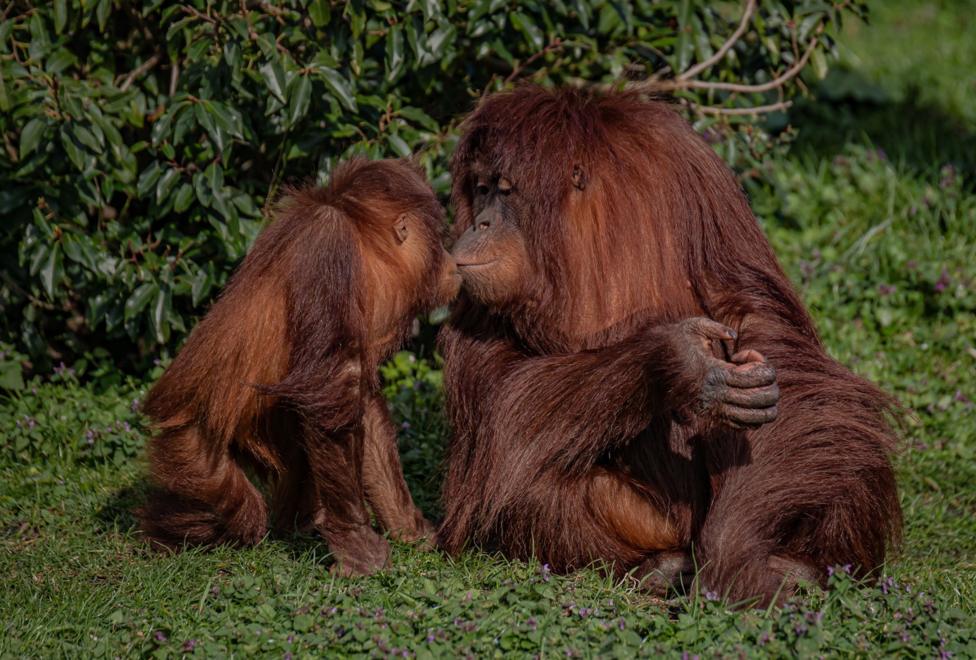
First kiss dates back 21 million years, say scientists

19 November 2025, 00:08 GMT

Humans do it, monkeys do it, even polar bears do it. And now researchers have reconstructed the evolutionary origins of kissing.

Their study suggests that the mouth-on-mouth kiss evolved more than 21 million years ago, and was something that the common ancestor of humans and other great apes probably indulged in.

The same research concluded that Neanderthals may have kissed too – and that humans and Neanderthals may even have smooched one another.

The scientists studied kissing because it presents something of an evolutionary puzzle - it has no obvious survival or reproductive benefits, and yet it is something that is seen not just in many human societies, but across the animal kingdom.

By finding evidence of other animals engaging in kissing, scientists were able to construct an "evolutionary family tree" to work out when it was most likely to have evolved.

https://www.bbc.co.uk/news/articles/cr43gq61g2qo


Image
Chester Zoo
weatheriscool
Posts: 24482
Joined: Sun May 16, 2021 6:16 pm
Contact:

Re: Natural History (13.8 billion years BC – 3.3 million BC)

Post by weatheriscool »

weatheriscool
Posts: 24482
Joined: Sun May 16, 2021 6:16 pm
Contact:

Re: Natural History (13.8 billion years BC – 3.3 million BC)

Post by weatheriscool »

Ancient mega-shark ruled Australian seas 15 million years before megalodon

by CHARLOTTE GRAHAM-McLAY
In the age of dinosaurs—before whales, great whites or the bus-sized megalodon—a monstrous shark prowled the waters off what's now northern Australia, among the sea monsters of the Cretaceous period.

Researchers studying huge vertebrae discovered on a beach near the city of Darwin say the creature is now the earliest known mega-predator of the modern shark lineage, living 15 million years earlier than enormous sharks found before.

And it was huge. The ancestor of today's 6-meter (20-foot) great white shark was thought to be about 8 meters (26 feet) long, the authors of a paper published in the journal Communications Biology said.
Image
https://phys.org/news/2025-12-ancient-m ... -seas.html
User avatar
wjfox
Site Admin
Posts: 13575
Joined: Sat May 15, 2021 6:09 pm
Location: Essex, UK
Contact:

Re: Natural History (13.8 billion years BC – 3.3 million BC)

Post by wjfox »

weatheriscool
Posts: 24482
Joined: Sun May 16, 2021 6:16 pm
Contact:

Re: Natural History (13.8 billion years BC – 3.3 million BC)

Post by weatheriscool »

Evidence of upright walking found in 7-million-year-old Sahelanthropus fossils
https://phys.org/news/2025-12-evidence- ... ropus.html
by New York University University of Alabama Birmingham
In recent decades, scientists have debated whether a seven-million-year-old fossil was bipedal—a trait that would make it the oldest human ancestor. A new analysis by a team of anthropologists offers powerful evidence that Sahelanthropus tchadensis—a species discovered in the early 2000s—was indeed bipedal by uncovering a feature found only in bipedal hominins.

Using 3D technology and other methods, the team identified Sahelanthropus's femoral tubercle, which is the point of attachment for the largest and most powerful ligament in the human body—the iliofemoral ligament—and vital for walking upright. The analysis also confirmed the presence of other traits in Sahelanthropus that are linked to bipedalism.

"Sahelanthropus tchadensis was essentially a bipedal ape that possessed a chimpanzee-sized brain and likely spent a significant portion of its time in trees, foraging and seeking safety," says Scott Williams, an associate professor in New York University's Department of Anthropology who led the research.
Image
firestar464
Posts: 7202
Joined: Wed Oct 12, 2022 7:45 am

Re: Natural History (13.8 billion years BC – 3.3 million BC)

Post by firestar464 »

firestar464
Posts: 7202
Joined: Wed Oct 12, 2022 7:45 am

Re: Natural History (13.8 billion years BC – 3.3 million BC)

Post by firestar464 »

weatheriscool
Posts: 24482
Joined: Sun May 16, 2021 6:16 pm
Contact:

Re: Natural History (13.8 billion years BC – 3.3 million BC)

Post by weatheriscool »

firestar464
Posts: 7202
Joined: Wed Oct 12, 2022 7:45 am

Re: Natural History (13.8 billion years BC – 3.3 million BC)

Post by firestar464 »

Snowball Earth: Ancient Scottish rocks reveal annual climate cycles

https://phys.org/news/2026-02-snowball- ... eveal.html
Post Reply