
The Middle Ages (500 – 1499 AD)

Got something to say about the past? Say it here!
User avatar
wjfox
Site Admin
Posts: 13575
Joined: Sat May 15, 2021 6:09 pm
Location: Essex, UK
Contact:

Re: The Middle Ages (500 – 1499 AD)

Post by wjfox »

User avatar
caltrek
Posts: 9280
Joined: Mon May 17, 2021 1:17 pm

Re: The Middle Ages (500 – 1499 AD)

Post by caltrek »

Skaftö Wreck’s Cargo Tells a Tale of 15th Century Trade Routes
October 24, 2022

Introduction:
(EurekAlert) Research at the University of Gothenburg has shown that the Skaftö wreck had probably taken on cargo in Gdańsk in Poland and was heading towards Belgium when it foundered in the Lysekil archipelago around 1440. Modern methods of analysis of the cargo are now providing completely new answers about the way trade was conducted in the Middle Ages.

“The analyses we have carried out give us a very detailed picture of the ship’s last journey and also tell us about the geographical origins of its cargo. Much of this is completely new knowledge for us,” says Staffan von Arbin, a maritime archaeologist.

For example, it was not previously known that calcium oxide (CaO), commonly known as quicklime or burnt lime, was exported from Gotland in the 15th century.

In 2003, the Skaftö wreck was found at the bottom of the sea off Lysekil, north of Gothenburg. But it is only now that researchers have been able to carry out analyses of its cargo using new, modern methods.

An international research team, headed by maritime archaeologist Staffan von Arbin at the University of Gothenburg, has succeeded in mapping the origins of its cargo and the probable route of the ship. The study contributes new knowledge about the goods traded in the Middle Ages and the trade routes in that period.
Read more here: https://www.eurekalert.org/news-releases/968872
Don't mourn, organize.

-Joe Hill
User avatar
wjfox
Site Admin
Posts: 13575
Joined: Sat May 15, 2021 6:09 pm
Location: Essex, UK
Contact:

Re: The Middle Ages (500 – 1499 AD)

Post by wjfox »

Fall of Constantinople

The Fall of Constantinople, also known as the Conquest of Constantinople, was the capture of the capital of the Byzantine Empire by the Ottoman Empire. The city fell on 29 May 1453 as part of the culmination of a 53-day siege which had begun on 6 April. The city's collapse marked the end of the Middle Ages.

The attacking Ottoman Army, which significantly outnumbered Constantinople's defenders, was commanded by the 21-year-old Sultan Mehmed II (later nicknamed "the Conqueror"), while the Byzantine army was led by Emperor Constantine XI Palaiologos. After conquering the city, Mehmed II made Constantinople the new Ottoman capital, replacing Adrianople.

The conquest of Constantinople and the fall of the Byzantine Empire was a watershed of the Late Middle Ages, marking the effective end of the last remains of the Roman Empire, a state which began in roughly 27 BC and had lasted nearly 1500 years. Among many modern historians, the Fall of Constantinople is considered the end of the medieval period. The city's fall also stood as a turning point in military history. Since ancient times, cities and castles had depended upon ramparts and walls to repel invaders. The Walls of Constantinople, especially the Theodosian Walls, were some of the most advanced defensive systems in the world at the time. These fortifications were overcome with the use of gunpowder, specifically in the form of large cannons and bombards, heralding a change in siege warfare.

https://en.wikipedia.org/wiki/Fall_of_Constantinople


Image
weatheriscool
Posts: 24482
Joined: Sun May 16, 2021 6:16 pm
Contact:

Re: The Middle Ages (500 – 1499 AD)

Post by weatheriscool »

Viking Age silver treasure found in Stjørdal municipality
https://phys.org/news/2022-11-viking-ag ... jrdal.html
by Frid Kvalpskarmo Hansen, Norwegian University of Science and TechnologyBirgit Maixner

On December 21, 2021, Pawel Bednarski made the discovery of a lifetime using a metal detector. It was actually a bit of a coincidence that he ventured out on this particular day. The weather had been uncooperative for a while, but the forecast was for a couple of days of better weather. Bednarski decided to take the chance and do a search on a plot of land at the Kongshaug plateau in Stjørdal.

"The first item I found was a small ring that didn't look particularly interesting at first glance. Then another ring appeared—and then a piece of a bangle," Bednarski says.

Eventually he had unearthed a whole trove of small silver objects, including pieces of coins, jewelry and silver wire—all a mere two to seven centimeters below the ground.

"The objects were covered in clay, so it wasn't easy to see what they looked like. It was only when I got home and rinsed off one of the bangle pieces that I realized this was an exciting find," says Bednarski.

Bednarski submitted the artifacts to the county municipality archaeologists, who confirmed that the find was of interest and presumably from the Viking Age.

It was only when researcher and archaeologist Birgit Maixner at the NTNU University Museum was contacted that Pawel found out just how exciting the find was.
User avatar
caltrek
Posts: 9280
Joined: Mon May 17, 2021 1:17 pm

Re: The Middle Ages (500 – 1499 AD)

Post by caltrek »

Human Expansion 1,000 Years Ago Linked to Madagascar’s Loss of Large Vertebrate Species
November 4, 2022

Introduction:
(EurekAlert) The island of Madagascar—one of the last large land masses colonized by humans—sits about 250 miles (400 kilometers) off the coast of East Africa. While it’s still regarded as a place of unique biodiversity, Madagascar long ago lost all its large-bodied vertebrates, including giant lemurs, elephant birds, turtles, and hippopotami. A human genetic study reported in the journal Current Biology on November 4 links these losses in time with the first major expansion of humans on the island, around 1,000 years ago.

“This human demographic expansion was simultaneous with a cultural and ecological transition on the island,” says Denis Pierron, French National Centre for Scientific Research (CNRS) researcher in Toulouse, France. “Around the same period, cities appeared in Madagascar and all the vertebrates of more than 10 kilograms disappeared.”

The origins of humans in Madagascar has long been an enigma, Pierron explained. Madagascar is home to 25 million people who speak an Asian language despite the island’s proximity to East Africa. Other groups who speak similar languages live more than 4,000 miles away. The people that live on Madagascar are known to trace their roots back to two small populations: one Bantu-speaking from Africa and another Austronesian-speaking from Asia. But, beyond that, the history remained rather murky.

To retrace the history and understand more about the origin of Malagasy people, a multi-disciplinary consortium launched in 2007 a project known as Madagascar Genetic and Ethnolinguistic (MAGE). Over a 10-year period, Malagasy and international researchers visited more than 250 villages across the country to sample the cultural and genetic human diversity.

In the new study, Pierron and his colleagues took a close look at the human genetic evidence. More specifically, they closely studied how various segments of human chromosomes were shared together with local ancestry information and computer-simulated genetic data. Together, they’ve inferred that the Malagasy ancestral Asian population was isolated on the island for more than 1,000 years with an effective population size of just a few hundred individuals.
Read more here: https://www.eurekalert.org/news-releases/969295

Image
Madagascar
Don't mourn, organize.

-Joe Hill
User avatar
caltrek
Posts: 9280
Joined: Mon May 17, 2021 1:17 pm

Re: The Middle Ages (500 – 1499 AD)

Post by caltrek »

Saladin Was A Land-Sea Warfare Innovator Of The Middle Ages
by Benjamin Duval
November 16, 2022

Introduction:
(The Drive) Joint land-sea operations were fairly uncommon in the Middle Ages. Rarer still was it for medieval generals to coordinate such actions across hundreds of miles and several months in advance. Almost unheard of was it to plan such complex offensives down to the week, in an attack that depended on speed, surprise, and timing. Yet this is exactly what Saladin did with his remarkable siege of Beirut in 1182.

Saladin is among the best-known generals of the Middle Ages, famous for his overwhelming victory at the Battle of Hattin in 1187, in which he destroyed the Kingdom of Jerusalem’s entire army, and his showdown with Richard the Lionheart and the Third Crusade, which confined their territory to a sliver of coastline for the next hundred years.

Less well-known are Saladin’s earlier exploits against these states. For nearly two decades before Hattin, he conducted a number of campaigns against the three Christian states which controlled the entire eastern shore of the Mediterranean – from north to south, these were the Principality of Antioch, the County of Tripoli, and the Kingdom of Jerusalem. The Crusaders were tough and wily opponents. Although usually outnumbered, they played a superb defensive game, capitalizing on their strengths and refusing to leave an opening that their enemies could exploit. They also made the most of their geographic advantages: their frontiers were protected by imposing coastal mountain ranges, the river Jordan, and formidable deserts. This forced Saladin to experiment with a variety of approaches to land a decisive blow. It was during one such attempt that he launched his attack on Beirut.
Read more here: https://www.thedrive.com/the-war-zone/ ... ddle-ages
Don't mourn, organize.

-Joe Hill
weatheriscool
Posts: 24482
Joined: Sun May 16, 2021 6:16 pm
Contact:

Re: The Middle Ages (500 – 1499 AD)

Post by weatheriscool »

First solid scientific evidence that Vikings brought animals to Britain
https://phys.org/news/2023-02-solid-sci ... ought.html
by Durham University
Archaeologists have found what they say is the first solid scientific evidence suggesting that Vikings crossed the North Sea to Britain with dogs and horses.

Research led by Durham University, UK, and the Vrije Universiteit Brussels, Belgium, examined human and animal remains from Britain's only known Viking cremation cemetery at Heath Wood, in Derbyshire.

Scientists looked at strontium isotopes contained within the remains. Strontium is a natural element found in different ratios across the world and provides a geographical fingerprint for human and animal movements.

Their analysis showed that within the context of the archaeology, one human adult and several animals almost certainly came from the Baltic Shield area of Scandinavia, covering Norway and central and northern Sweden, and died soon after arrival in Britain.

The researchers say this suggests that Vikings were not only stealing animals when they arrived in Britain, as accounts from the time describe, but were also transporting animals from Scandinavia, too.
User avatar
wjfox
Site Admin
Posts: 13575
Joined: Sat May 15, 2021 6:09 pm
Location: Essex, UK
Contact:

Re: The Middle Ages (500 – 1499 AD)

Post by wjfox »

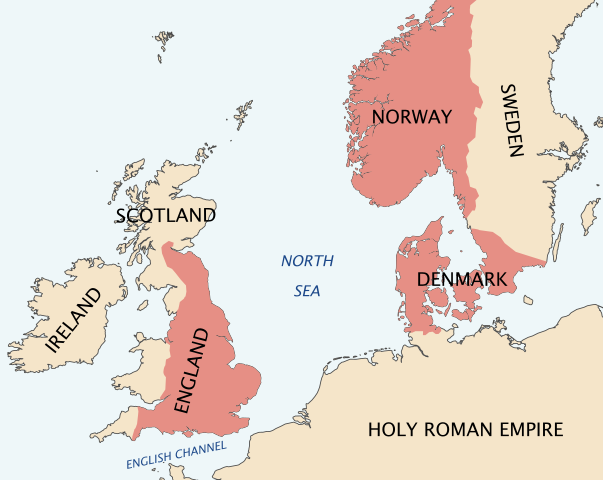
North Sea Empire

The North Sea Empire, also known as the Anglo-Scandinavian Empire, was the personal union of the kingdoms of England, Denmark[a] and Norway for most of the period between 1013 and 1042 towards the end of the Viking Age. This ephemeral Norse-ruled empire was a thalassocracy, its components only connected by and dependent upon the sea.

The first king to unite all three kingdoms was Sweyn Forkbeard, king of Denmark since 986 and of Norway since 1000, when he conquered England in 1013. He died in the following year, and his realm was divided. His son Cnut the Great acquired England in 1016, Denmark in 1018 and Norway in 1028. He died in 1035 and his realm was again divided, but his successor in Denmark, Harthacnut, inherited England in 1040 and ruled it until his death in 1042. At the height of his power, when Cnut ruled all three kingdoms (1028–1035), he was the most powerful ruler in western Europe after the Holy Roman Emperor.

https://en.wikipedia.org/wiki/North_Sea_Empire


Image
User avatar
ººº
Posts: 359
Joined: Fri Sep 16, 2022 3:54 am

Re: The Middle Ages (500 – 1499 AD)

Post by ººº »

Nanotechandmorefuture
Posts: 478
Joined: Fri Sep 17, 2021 6:15 pm
Location: At the moment Miami, FL

Re: The Middle Ages (500 – 1499 AD)

Post by Nanotechandmorefuture »

Wonder how this tech will affect them. Everything is going to change quite a bit.
User avatar
wjfox
Site Admin
Posts: 13575
Joined: Sat May 15, 2021 6:09 pm
Location: Essex, UK
Contact:

Re: The Middle Ages (500 – 1499 AD)

Post by wjfox »

User avatar
caltrek
Posts: 9280
Joined: Mon May 17, 2021 1:17 pm

Re: The Middle Ages (500 – 1499 AD)

Post by caltrek »

1,000-Year-Old Medieval Treasure Uncovered by Metal Detectorist in the Netherlands
by Francesca Aton
March 10, 2023

Introduction:
(Art World) A 1,000-year-old Medieval treasure trove, including four golden ear pendants, two strips of gold leaf, and 39 silver coins were found by a Dutch historian, according to the Dutch National Museum of Antiquities on Thursday.

Lorenzo Ruijter found the hoard using a metal detector in Hoogwoud, a small city in North Holland, in 2021. The metal detectorist had to keep it a secret for two years, while experts at the National Museum of Antiquities cleaned, researched, and dated the objects.

“It was very special discovering something this valuable, I can’t really describe it. I never expected to discover anything like this,” Ruijter told Reuters.

One of the coins dated back to 1250 CE, which researchers believe was around the time the treasure would have been buried. By that time, however, the jewelry would have already been at least two centuries old.
Read more here: https://www.artnews.com/art-news/news/ ... 34660442/
Don't mourn, organize.

-Joe Hill
User avatar
ººº
Posts: 359
Joined: Fri Sep 16, 2022 3:54 am

Re: The Middle Ages (500 – 1499 AD)

Post by ººº »

User avatar
caltrek
Posts: 9280
Joined: Mon May 17, 2021 1:17 pm

Re: The Middle Ages (500 – 1499 AD)

Post by caltrek »

^^^An interesting video. A lot that I did not know prior to viewing the video, including the extent to which archaeological remains have been discovered. I note reference toward the end to the writings of Don Miguel Ruiz and family. Ruiz does claim to be passing down Toltec wisdom through a largely oral tradition. Obviously, such an oral tradition is susceptible to influence from other cultures or newly created ideas and insights. So, distilling what is "purely" Toltec versus what has been introduced under the guise of being Toltec becomes a very challenging endeavor. Still, one misses the point in becoming too wrapped up in that endeavor. It is a bit like becoming obsessed with tracing the roots of Freud's thoughts. The point is are they applicable to the world of today?

If one reads Ruiz, one can also detect obvious Christian influences. Buddhism is also occasionally cited as a source of wisdom or inspiration. Charles Mann in 1493 points out the presence of Chinese immigrants in Mexico that goes back much farther than one might suppose. So, the influence of Buddhism might have also penetrated this oral tradition as it was passed down from generation to generation. Somebody like Ruiz might also be borrowing form Buddhism based on twentieth century translations into Spanish and English of elements of that tradition.

Also of interest is the reference to Aztlan. This somewhat mythologized land also has had a great influence on Mexican American identity. Art related to "Atzlan" may very much be traceable back to art that is considered to be of Toltec origin. It certainly does not look like anything derived from Eruopean tradition.

Much of Mexican identity involves a fusion of Spanish culture with nativistic traditions. One may thus suspect that "Aztec" is an umbrella term for a focus upon that which can be traced to such nativistic traditions. As the video suggests, "Aztec" may in turn have been very much influenced by "Toltec" traditions.

Also in the mix are the Yaqui, as popularized by Carlos Castaneda.

All of this adds up to a very rich tradition. Disentangling the roots of this tradition is challenging in the extreme.
Don't mourn, organize.

-Joe Hill
User avatar
caltrek
Posts: 9280
Joined: Mon May 17, 2021 1:17 pm

Re: The Middle Ages (500 – 1499 AD)

Post by caltrek »

Meanwhile, over in East Africa...

Persian Princes Fleeing to Africa May Have Helped Found Ancient Trading Empire
by Ben Taub
March 30, 2023

Introduction:
(IFL Science) Legend has it that seven Persian princes fleeing persecution once escaped across the Arabian Sea before landing in East Africa and establishing a trading dynasty that dominated the Swahili coast for centuries. Known as the Kilwa Chronicle, this ancient oral tradition had until now been dismissed as fiction, yet a new genetic study suggests that the fable may be rooted in reality.

The Swahili coast stretches from Ethiopia to Tanzania and was once a major hub of medieval trade. From here, merchants established commercial networks that spanned East Africa and the Indian Ocean, although scholars have spent the past 100 years debating whether this prosperous civilization was established by local African populations or foreign traders from South Asia.

Colonial chroniclers tended to favor the latter explanation, although postcolonial historians have pointed out that the medieval architecture and language of the Swahili coast were of African origin, thus suggesting that the culture was founded by local populations.

To settle the debate, researchers analyzed the DNA of 80 medieval individuals recovered from elite burial sites across the Swahili coast and an inland town. Dating from the 13th to 19th centuries, the skeletons derived much of their male ancestry from Persian men, while female lineages were almost exclusively African.

Based on the rate of genetic admixture, the study authors say the first Persian men probably arrived in the area around 1000 CE, which coincides with the adoption of Islam on the Swahili coast. Such a finding lends new credence to the Kilwa Chronicle, indicating that the mighty trading empire may indeed have been founded by royal Persian escapees.

Read more here: https://www.iflscience.com/persian-pri ... ire-68237
Don't mourn, organize.

-Joe Hill
weatheriscool
Posts: 24482
Joined: Sun May 16, 2021 6:16 pm
Contact:

Re: The Middle Ages (500 – 1499 AD)

Post by weatheriscool »

List all wars of the past 2,000 years up until 1800 that killed more then 50,000


Here is a list of wars from the past 2,000 years up until 1800 that resulted in more than 50,000 deaths:

Three Kingdoms War (China, 220-280 AD) - Estimated death toll of 36 million.
An Lushan Rebellion (China, 755-763 AD) - Estimated death toll of 36 million.
Conquest of the Americas (1492-1650 AD) - Estimated death toll of 20 million.
Thirty Years' War (Europe, 1618-1648) - Estimated death toll of 8 million.
Dzungar genocide (Central Asia, 1755-1758) - Estimated death toll of 480,000 to 600,000.
Great Turkish War (Europe, 1683-1699) - Estimated death toll of 300,000.
French Wars of Religion (France, 1562-1598) - Estimated death toll of 3 million.
Japanese invasions of Korea (Korea, 1592-1598) - Estimated death toll of 1 million.
Mongol conquests (Eurasia, 1206-1368) - Estimated death toll of 40 million.
Crusades (Middle East, 1096-1270) - Estimated death toll of 1-3 million.

Note that these death tolls are estimates and can vary depending on the sources used.
User avatar
caltrek
Posts: 9280
Joined: Mon May 17, 2021 1:17 pm

Re: The Middle Ages (500 – 1499 AD)

Post by caltrek »

Medieval Monks Made Unexpected Contribution to Study of Volcanos
by Alanna Madden
April 5, 2023

Introduction:
(Courthouse News) — Bubonic plague. Famine. Civil and political unrest. Faithfully documented lunar eclipses between 1100 and 1300 A.D. Besides obvious medieval timelines, all share ties to something seemingly unrelated: volcanic eruptions.

A study published in the journal Nature on Wednesday from a team of international researchers led by the University of Geneva details the five years they spent pouring over European and Middle Eastern texts from the 12th and 13th centuries to identify some of the most prolific volcanic eruptions known to date — eruptions that occurred between 1100 and 1300 or the “High Medieval Period.”

The collective effect of volcanic eruptions during the High Medieval Period is thought to have led to the “Little Ice Age,” a climate interval between the early 14th and mid-19th centuries where mountain glaciers expanded in several locations and temperatures dropped, particularly in the Northern Hemisphere.

To find what they were looking for, researchers had to dig through hundreds of annals and chronicles in search of references to a total lunar eclipse and descriptions of coloration, which left clues as to whether a volcanic eruption occurred at the time.

“I was listening to Pink Floyd’s 'Dark Side of the Moon' album when I realized that the darkest lunar eclipses all occurred within a year or so of major volcanic eruptions,” said lead author Sébastien Guillet in a statement. “Since we know the exact days of the eclipses, it opened the possibility of using the sightings to narrow down when the eruptions must have happened.”

Read more here: https://www.courthousenews.com/medieva ... volcanos/
Don't mourn, organize.

-Joe Hill
User avatar
caltrek
Posts: 9280
Joined: Mon May 17, 2021 1:17 pm

Re: The Middle Ages (500 – 1499 AD)

Post by caltrek »

Frozen "Mummies" Of The Mongol Empire Are Rising From Melted Permafrost
by Tom Hale
April 6, 2023

Introduction:
(IFL Science) The permafrost of east Eurasian mountains is slowly melting away, helping to reveal the buried bodies of the much-feared Mongol Empire – as well as their unquenchable thirst for yak milk.

New research has studied the remains of a cemetery at the so-called Khorig site, located high in the Khovsgol mountains. Dating suggests that the cemetery was operating in the 13th century starting around the time of the Mongol Empire’s unification in 1206 CE.

This was the year when the infamous Genghis Khan was proclaimed the ruler of all Mongols. With the help of a fearless horseback army, he launched a series of bloody military campaigns across Asia, laying the foundations for the largest contiguous land empire in history that spanned from the Pacific coast of Asia to Eastern Europe. The world was never the same again.

In 2018 and 2019, the skeletons of 11 individuals were discovered at the elite burial site after they had partially been revealed by melting permafrost. The bodies were still in surprisingly good condition, despite being over 800 years old, thanks to the sub-zero temperatures preserving the remains.

Buried alongside lavish grave goods and dressed in fine materials, it appears the people interred here held a high social status.

Read more of the IFL Science article here: https://www.iflscience.com/frozen-mumm ... ost-68341

For an article on the subject as published in Communications Biology: https://www.nature.com/articles/s42003-023-04723-3
Don't mourn, organize.

-Joe Hill
User avatar
caltrek
Posts: 9280
Joined: Mon May 17, 2021 1:17 pm

Re: The Middle Ages (500 – 1499 AD)

Post by caltrek »

“Unprecedented” Pre-Hispanic Ceremonial Structure May Have Been Used For Controlling The Weather
by Ben Taub
April 14, 2023

Introduction:
(IFL Science) A strange circular structure in the cold, harsh highlands of Bolivia may once have hosted rituals designed to control the region’s hostile climate, researchers have suggested. Reporting the discovery of the unusual pre-Hispanic ceremonial center, the study authors say the “surprising” construction is unlike any other ever found in the Andes.

The ruin was located during an archaeological survey in Carangas, which the researchers describe as “a region of the central-southern Andean Altiplano characterised by its extremely arid and cold climate.” After identifying 135 “noteworthy” religious sites in the area, the authors say that this unwelcoming wasteland was once “a dense ritual landscape.”

While the presence of so many ceremonial structures in this remote stretch of highland is itself somewhat unexpected, the researchers go on to explain that “of these sites, one ceremonial centre stands out for its unprecedented characteristics for the Andes.” Named Waskiri, the structure “surprises both in its large dimensions (140 meters [459 feet] in diameter) and its design and regularity,” they say.

Located near the Chilean border, Waskiri is described as “an impressive circular construction” that features a perimeter ring comprised of 39 adjoining enclosures. This outer structure surrounds a central plaza that was found to contain pottery from the Late Intermediate and Late Periods.
Based on these artifacts, the researchers believe the structure was in use some time between 1250 and 1600 CE.
Read more of the IFL Science article here: https://www.iflscience.com/unprecedent ... er-68420

The study is published in the journal Antiquity: https://www.cambridge.org/core/journal ... 6679939D6
Don't mourn, organize.

-Joe Hill
weatheriscool
Posts: 24482
Joined: Sun May 16, 2021 6:16 pm
Contact:

Re: The Middle Ages (500 – 1499 AD)

Post by weatheriscool »

https://www.theguardian.com/science/202 ... in-denmark

Hoard of 1,000-year-old Viking coins unearthed in Denmark

Artefacts believed to date back to 980s found by girl metal-detecting in cornfield last autumn

Agence France-Presse
Fri 21 Apr 2023 09.06 EDT

Nearly 300 silver coins believed to be more than 1,000 years old have been discovered near a Viking fortress site in north-west Denmark, a museum has said.

The trove – lying in two spots not far apart – was unearthed by a girl who was metal-detecting in a cornfield last autumn.

“A hoard like this is very rare,” Lars Christian Norbach, the director of the North Jutland Museum, where the artefacts will go on display, told Agence France-Presse.

The silver coins were found about 5 miles (8km) from the Fyrkat Viking ringfort, near the town of Hobro. From their inscriptions, they are believed to date back to the 980s.

The trove includes Danish, Arab and Germanic coins as well as pieces of jewellery originating from Scotland or Ireland, according to archaeologists. Norbach said the finds were from the same period as the fort, built by King Harald Bluetooth, and would offer a greater insight into the history of the Vikings.
Post Reply