Ancient History (3500 BC – 499 AD)

Got something to say about the past? Say it here!
Post Reply
User avatar
caltrek
Posts: 9280
Joined: Mon May 17, 2021 1:17 pm

Re: Ancient History (3500 BC – 499 AD)

Post by caltrek »

Genetic Population Structure of the Xiongnu Empire at Imperial and Local Scales
April 14 , 2023

Introduction:
(Courthouse News) — Long before the Mongol Empire was the Xiongnu — a society that a team of international researchers calls the first of several nomadic empires of Inner Asia. They buried their servants in satellite burials and interred their aristocratic elites in square tombs containing their wood-plank coffins.
Read more of the Courthouse News article here: https://www.courthousenews.com/women-o ... tudy-says/

Abstract::
(Sciences Advances) The Xiongnu established the first nomadic imperial power, controlling the Eastern Eurasian steppe from ca. 200 BCE to 100 CE. Recent archaeogenetic studies identified extreme levels of genetic diversity across the empire, corroborating historical records of the Xiongnu Empire being multiethnic. However, it has remained unknown how this diversity was structured at the local community level or by sociopolitical status. To address this, we investigated aristocratic and local elite cemeteries at the western frontier of the empire. Analyzing genome-wide data from 18 individuals, we show that genetic diversity within these communities was comparable to the empire as a whole, and that high diversity was also observed within extended families. Genetic heterogeneity was highest among the lowest-status individuals, implying diverse origins, while higher-status individuals harbored less genetic diversity, suggesting that elite status and power was concentrated within specific subsets of the broader Xiongnu population.

INTRODUCTION

The Xiongnu Empire was the first of many historically documented steppe empires to arise in Eurasia, and its formation foreshadowed the rise of subsequent nomadic imperial powers, including the Mongol Empire, whose reach a millennium later stretched from the East Sea to the Carpathian Mountains (1). Centered on the territory of present-day Mongolia, the Xiongnu empire controlled the Eastern Eurasian Steppe and surrounding regions in northern China, southern Siberia, and Central Asia for nearly three centuries, starting from ca. 209 BCE until their eventual disintegration in the late first century CE. At its height, the Xiongnu profoundly influenced the political economies of Central, Inner, and East Asia, becoming a major political rival of imperial China and establishing far-flung trade networks that imported Roman glass, Persian textiles, Egyptian faience, Greek silver, and Chinese bronzes, silks, and lacquerware deep into the heart of their empire (2).

The Xiongnu represented a radically new kind of political entity that incorporated heterogeneous nomadic and sedentary groups spanning the Eastern Steppes and as far west as the Altai Mountains, under a single authority. As the Xiongnu expanded their empire from its core in central and eastern Mongolia, they conquered and integrated numerous neighboring groups. They successfully expanded into western Mongolia and southern areas of Lake Baikal, while winning decisive victories in northern China (3).

1. D. Sinor, The Cambridge History of Early Inner Asia (Cambridge Univ. Press, 1990).
2. U. Brosseder, B. K. Miller, Eds., Xiongnu Archaeology: Multidisciplinary Perspectives of the First Steppe Empire in Inner Asia (Bonn Univ. Press, 2011).
3. N. Di Cosmo, Ancient China and Its Enemies: The Rise of Nomadic Power in East Asian History (Ancient China & its Enemies, Cambridge Univ. Press, 2002).

Read more of the Science Advnces article here: https://www.science.org/doi/10.1126/sciadv.adf3904
Don't mourn, organize.

-Joe Hill
weatheriscool
Posts: 24482
Joined: Sun May 16, 2021 6:16 pm
Contact:

Re: Ancient History (3500 BC – 499 AD)

Post by weatheriscool »

Oldest human remains from Puerto Rico reveal a complex cultural landscape since 1800 BC
https://phys.org/news/2023-04-oldest-hu ... eveal.html
by Public Library of Science
The earliest inhabitants of Puerto Rico might have used common burial sites and mortuary practices across many centuries, according to a study published April 26, 2023, in the open-access journal PLOS ONE by William J. Pestle of the University of Miami, Florida and colleagues.

Puerto Rico was inhabited by people for several thousand years prior to the Ceramic Age, but little is known about these earliest inhabitants due to a paucity of evidence and research, with only 20 ancient individuals reported from this time period. In this study, Pestle and colleagues describe five adult individuals from burials at the Ortiz site in Cabo Rojo, southwestern Puerto Rico, representing a substantial addition to archaeological information about this time period.

Radiocarbon dating of the remains yielded ages as old as 1800 BC and as young as 800 BC, thus including the oldest directly dated human remains from Puerto Rico and representing as much as 1,000 years of burials at the Ortiz site. The mortuary practices, including the positioning of the bodies and the associated grave goods, are similar to other early sites, indicating standard burial practices over many centuries. In addition, Strontium isotope analysis also indicates that these buried individuals were born in different nearby geographical locales. Thus, the Ortiz site might have held cultural significance as a common mortuary space for various local communities.
User avatar
caltrek
Posts: 9280
Joined: Mon May 17, 2021 1:17 pm

Re: Ancient History (3500 BC – 499 AD)

Post by caltrek »

Unique Discovery Of A Roman Doctor Buried With His Equipment
by Dr. Russell Moul
April 28 , 2023

Introduction:
(IFL Science) A team of archaeologists recently discovered the resting place of a Roman doctor who has been buried for around 2,000 years near Jászberény, Hungary. Amazingly, the doctor appears to have been buried with some of his equipment, a find that is extremely rare.

The body was excavated by researchers at the Eötvös Loránd University (ELTE), the Jász Museum, and the Eötvös Loránd Research Network (ELKH), in Hungary, in 2022. The site was initially identified through the use of a preliminary magnetometer field survey, a useful method used by archaeologists to detect and map small changes in the earth’s magnetic field which is caused by different natural and unnatural features in the soil. The survey identified a cemetery from the Avar period and small items from a shallow grave that came from the first century AD, according to radiocarbon dating analysis.

An examination of the items quickly revealed them to be from the Roman period and they were found in two small wooden boxes at the foot of a contemporary doctor’s grave. The items, which were specifically metallic medical tools used by the doctor, included forceps, needles, tweezers, and high-quality scalpels that would have been suitable for surgical interventions. The scalpels were intricately decorated and made of copper with replaceable blades. There was also a grinding stone among the find that had been placed by the doctor’s knee, which may have been used for the mixing of herbs and other medical remedies.

It is a remarkable find, not only for how well preserved it is but also for the information it holds for the period in question. Firstly, it is extremely rare to find a complete medical set from this era – the only other known equivalent was found at Pompeii, the ELTE press team explained. The find also sheds light on a period of Jászság history when the Sarmatian populations of the Celtic period was being incorporated into the Roman province of Pannonia. It is interesting that a doctor equipped with such prestigious equipment visited this area. The research team believes that this well-equipped physician, who was likely trained elsewhere in the empire, may have been visiting the area to treat

Read more here: https://www.iflscience.com/unique-disc ... ent-68678
Don't mourn, organize.

-Joe Hill
weatheriscool
Posts: 24482
Joined: Sun May 16, 2021 6:16 pm
Contact:

Re: Ancient History (3500 BC – 499 AD)

Post by weatheriscool »

Egypt unveils recently discovered ancient workshops, tombs in Saqqara necropolis
https://phys.org/news/2023-05-egypt-unv ... tombs.html
Egyptian antiquities authorities Saturday unveiled ancient workshops and tombs they say were discovered recently at a Pharaonic necropolis just outside the capital Cairo.

The spaces were found in the sprawling necropolis of Saqqara, which is a part of Egypt's ancient capital of Memphis, a UNESCO World Heritage site.

Mostafa Waziri, secretary-general of the Supreme Council of Antiquities, said the workshops had been used to mummify humans and sacred animals. They date back to the 30th Pharaonic Dynasty (380 BC to 343 BC) and Ptolemaic period (305 BC to 30 BC), he said.

Inside the workshops, archaeologists found clay pots and other items apparently used in mummification, as well as ritual vessels, Waziri said.
weatheriscool
Posts: 24482
Joined: Sun May 16, 2021 6:16 pm
Contact:

Re: Ancient History (3500 BC – 499 AD)

Post by weatheriscool »

Archaeologists identify Moluccan boats that may have visited Australia from Indonesia in rock art drawings
https://phys.org/news/2023-05-archaeolo ... nesia.html
by Flinders University

Archaeologists at Flinders University have identified rare images of Moluccan vessels from Indonesia's eastern islands in rock art paintings that may provide the first archaeological evidence of visitors from Southeast Asia from somewhere other than Makassar on Sulawesi.

The rock art offers new evidence of elusive and previously unrecorded encounters between Indigenous people from Awunbarna, Arnhem Land and visitors from the Moluccas to the north of Australia, according to the research.

Two watercrafts depicted in the rock art feature motifs that appear on the Moluccan types of Southeast Asian vessels that are unlike the Macassan prahus and Western boats shown at other contact sites in northern Australia and offer enough details to help confirm their identity.

As well as their distinctive shape and configuration, both boats appear to display triangular flags, pennants, and prow adornments indicating their martial status. Comparing these two depictions with historically recorded watercraft from Island Southeast Asia shows that they probably came from eastern Maluku Tenggara in Indonesia
User avatar
caltrek
Posts: 9280
Joined: Mon May 17, 2021 1:17 pm

Re: Ancient History (3500 BC – 499 AD)

Post by caltrek »

Ancient Walls Along River Nile Were A Vast Hydraulic Engineering System
by Tom Hale
June 14, 2023

Introduction:
(IFL Science) Across Egypt and Sudan, you can find a vast network of stone walls running across the landscape. In a new study, archaeologists detail how some of these ancient structures were constructed by humans over 3,000 years ago and served as an ancient form of hydraulic engineering that tempered the River Nile.

Researchers from the University of Western Australia and the University of Manchester mapped out nearly 1,300 of these so-called “river groynes” using a variety of techniques, including satellite imagery, drones, and ground surveys.

Many of these structures have since been submerged beneath the waters of the Aswan High Dam reservoir, so they also relied on the diaries of 19th-century travelers, a 200-year-old map, and archives of aerial photographs taken by the UK’s Royal Air Force in 1934.

Radiocarbon dating of the structures suggested that some were built over 3,000 years ago and played an important role in the success of ancient Egyptian civilization.

The large stone walls – some up to five meters thick and 200 meters long – were used to influence the river flow of the Nile and aided boat navigation through treacherous rapids.

Read more here: https://www.iflscience.com/ancient-wal ... em-69386

{Geoarchaeology) Ethnoarchaeological perspectives

While ground surveying walls in the villages of Quweyka (see below) and Suwarda, several local farmers were informally interviewed in their fields. They identified these structures as al-sudud (dams),1 constructed during their fathers' or grandfathers' generations. According to the farmers, the structures were built for two purposes: to capture Nile silt during the annual inundation and to prevent the erosion of existing channel margin alluvial silt deposits.

After the flood recedes, fertile and saturated silty soil (saluka) provides agricultural land that requires only limited, if any, mechanical or manual irrigation. Saluka land is divided into two categories by modern farmers in Nubia: jarf, the lower, sloping riverbank areas, and gurer, the higher, flat terraces that were also seasonally inundated but, due to lower floods since the completion of the Merowe Dam in 2009, must now be mechanically irrigated (Ryan et al., 2022).

These river groynes thus improve agricultural potential by increasing the amount of cultivable land and by protecting existing alluvial soils. Even though they have not been built in recent decades in these areas, the jarf land formed behind some walls remains in use…

The Nubian term kokkir is also attested (Abu Salim, 1980, pp. 122–123). See Ryan (2019) for a glossary of agricultural terms in Arabic and Nubian.

Read more from the Geoarchaeology study: https://onlinelibrary.wiley.com/doi/fu ... gea.21965
Don't mourn, organize.

-Joe Hill
User avatar
Powers
Posts: 1183
Joined: Fri Apr 07, 2023 7:32 pm
Location: a.k.a Lurking, Member, Lorem Ipsum, ..., --- and ººº.

Re: Ancient History (3500 BC – 499 AD)

Post by Powers »

Powers: Describe a typical diet for a Londoner in the 40th century BC – breakfast, lunch, dinner, etc.

ChatGPT: In the 40th century BC, London, as we know it today, did not exist. However, I can provide you with an overview of the typical diet during that period in ancient Britain, which would include the Neolithic era. Please keep in mind that the information available for this time period is limited, and the following description is based on archaeological evidence and general knowledge of ancient diets.

Breakfast:
During this time, the people of ancient Britain were primarily hunter-gatherers, so their meals would depend on the availability of resources in their immediate environment. For breakfast, they likely consumed a simple meal consisting of fruits, nuts, seeds, and possibly some gathered vegetables. It's important to note that the concept of distinct meals like breakfast, lunch, and dinner as we understand them today may not have existed during this time.

Lunch:
For lunch, ancient Britons would likely continue to rely on foods obtained through hunting and gathering. This could include fish, shellfish, wild game such as deer or boar, and foraged plant foods like berries, roots, and leafy greens. They might have also consumed grains if they were in the process of transitioning to agriculture, although large-scale agriculture was not common in Britain during this time.

Dinner:
Dinner in ancient Britain would be similar to lunch, with a focus on locally available resources. Meat and fish would likely be roasted or cooked over an open fire. They might have prepared stews or soups by combining various ingredients like meat, vegetables, and herbs. Some communities might have also begun experimenting with early forms of agriculture, cultivating crops such as wheat, barley, and pulses. These crops could be ground into flour and used to make flatbreads or porridge.

Snacks:
Throughout the day, people would have snacked on fruits, nuts, and seeds, as well as any other edible plants they could gather. They might have also consumed dried or preserved foods to sustain themselves during times of scarcity.

Beverages:
Water was the primary beverage for ancient Britons, obtained from rivers, streams, or wells. They might have also consumed herbal infusions or fermented beverages made from fruits or grains, although the evidence for this is limited.

It's important to remember that the diet of ancient Britons varied depending on the region, available resources, and the time of year. Their diet was heavily dependent on what they could hunt, gather, or cultivate locally, and it would have evolved over time as agriculture and food production practices developed.
User avatar
caltrek
Posts: 9280
Joined: Mon May 17, 2021 1:17 pm

Re: Ancient History (3500 BC – 499 AD)

Post by caltrek »

Enigmatic Ancient Kushan Empire Writing System Partially Deciphered After 70 Years
by Tom Hale
July 14, 2023

Introduction:
(IFL Science) In the rocky hills of Central Asia, a number of walls bear a mysterious script that’s scrawled in an unknown written language. Thanks to the recent work of a team from the University of Cologne, parts of this ancient script are starting to be revealed, shedding light onto the pre-eminent culture that wrote it.

The so-called “unknown Kushan script” is a writing system that’s been found across parts of Central Asia. The script has been seen across numerous sites in modern-day Tajikistan, Afghanistan, and Uzbekistan, but has never been successfully deciphered.

It was used between about 200 BCE and 700 CE by the early nomadic peoples of the Eurasian steppe, such as the Yuèzhī, and the ruling dynasty of the Kushans.

One of the most prominent legacies of the powerful Kushan empire was spreading Buddhism across Central Asia and China. They left behind amazing artworks and a collection of impressive fortresses, as well as this unusual writing system.
Read more of the IFL Science article here: https://www.iflscience.com/linguists-d ... uries-698


Abstract
(Transactions of the Philological Society) Several dozen inscriptions in an unknown writing system have been discovered in an area stretching geographically from Kazakhstan, Uzbekistan and Tajikistan to southern Afghanistan. Most inscriptions can be dated to the period from the 2nd century BCE to the 3rd century CE, yet all attempts at decipherment have so far been unsuccessful. The recent discovery of previously unknown inscriptions near the Almosi gorge, Tajikistan, however, allows for a renewed attempt at decipherment. Drawing upon a catalogue of characters and a distributional analysis, we report two identical sequences in the newly found Almosi inscriptions and in the Dašt-i Nāwur trilingual. Based on parallel texts in Bactrian, we suggest to read the name of the Kushan emperor Vema Takhtu in these sequences, accompanied by the title ‘king of kings’ and several epithets. This allows for the deduction of probable phonetic values of 15 different consonantal signs and four vocalic diacritics and the inference that the inscriptions record a previously unknown Middle Iranian language.
Read more of the Transactions of the Philological Society article here: https://onlinelibrary.wiley.com/doi/10 ... 68X.12268
Don't mourn, organize.

-Joe Hill
User avatar
Time_Traveller
Posts: 3025
Joined: Sun May 16, 2021 4:49 pm
Location: New York City, USA, November 5th 2032 C.E.

Re: Ancient History (3500 BC – 499 AD)

Post by Time_Traveller »

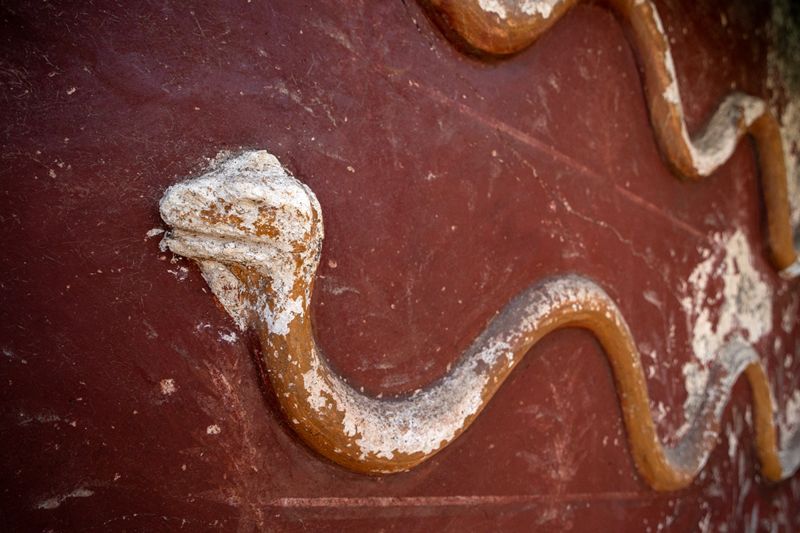
Kitchen shrine serpents and more fascinating new Pompeii discoveries
19 July 2023

Image

A kitchen shrine adorned with serpents, a bakery, human skeletons, exquisite frescos, and yes, a picture of something that looks very much like pizza. These are among the new finds being turned up at the Pompeii Archaeological Park.

Dig anywhere in the ancient city destroyed by Mount Vesuvius in AD79 and you will unearth a treasure - a snapshot of a lost Roman world.

It's extraordinary to think that one-third of the city buried under pumice and ash has yet to be excavated.

"Much of that will be for future generations," says Alessandro Russo, the co-lead archaeologist on the new dig.

"We have a problem to conserve what we've already found. Future generations may have new ideas, new techniques."
Map locating Pompeii near Naples in the south of Italy

The latest work returns to a sector in the park last explored in the late 19th Century.
https://www.bbc.co.uk/news/science-envi ... 226417.amp
“In the quantum multiverse, every choice, every decision you've ever and never made exists in an unimaginably vast ensemble of parallel universes.”
weatheriscool
Posts: 24482
Joined: Sun May 16, 2021 6:16 pm
Contact:

Re: Ancient History (3500 BC – 499 AD)

Post by weatheriscool »

Archaeologists uncover Europe's oldest stilt village
https://phys.org/news/2023-08-archaeolo ... stilt.html
by Briseida MEMA
A diver scouring an archaeological site at the bottom of Lake Ohrid in Albania, the site of Europe's oldest stilt village.

Beneath the turquoise waters of Lake Ohrid, the "Pearl of the Balkans", scientists have uncovered what may be one of Europe's earliest sedentary communities, and are trying to solve the mystery of why it sheltered behind a fortress of defensive spikes.

A stretch of the Albanian shore of the lake once hosted a settlement of stilt houses some 8,000 years ago, archaeologists believe, making it the oldest lakeside village in Europe discovered to date.

Radiocarbon dating from the site puts it at between 6000 and 5800 BC.

"It is several hundred years older than previously known lake-dwelling sites in the Mediterranean and Alpine regions," said Albert Hafner, a professor of archaeology from Switzerland's University of Bern.
User avatar
wjfox
Site Admin
Posts: 13575
Joined: Sat May 15, 2021 6:09 pm
Location: Essex, UK
Contact:

Re: Ancient History (3500 BC – 499 AD)

Post by wjfox »

User avatar
Powers
Posts: 1183
Joined: Fri Apr 07, 2023 7:32 pm
Location: a.k.a Lurking, Member, Lorem Ipsum, ..., --- and ººº.

Re: Ancient History (3500 BC – 499 AD)

Post by Powers »

Archaeologists Find 3,000-Year-Old Sword So Well Preserved It ‘Almost Still Shines’
June 21, 2023
The Bronze Age artifact was discovered in a grave during excavations in southern Germany
Image
The sword was unearthed alongside the bodies of a man, woman and child. Archäologie-Büro Dr. Woidich / Sergiu Tifui

A rare sight greeted archaeologists excavating a gravesite in the southern Bavarian town of Nördlingen last week: Nestled near the grave’s occupants was a 3,000-year-old sword.

The weapon barely shows its age. It has remained so well-preserved that it “almost still shines,” says Bavaria's State Office for Monument Protection in a statement, per Google Translate.

The weapon sports an octagonal bronze hilt that was cast over the blade, which few smiths were skilled enough to make at the time, according to Live Science’s Laura Geggel. Only two manufacturing regions were known to have made swords of this kind: one near the excavation site in southern Germany, and the other in northern Germany and Denmark.
https://www.smithsonianmag.com/smart-ne ... 180982399/
User avatar
Powers
Posts: 1183
Joined: Fri Apr 07, 2023 7:32 pm
Location: a.k.a Lurking, Member, Lorem Ipsum, ..., --- and ººº.

Re: Ancient History (3500 BC – 499 AD)

Post by Powers »


weatheriscool
Posts: 24482
Joined: Sun May 16, 2021 6:16 pm
Contact:

Re: Ancient History (3500 BC – 499 AD)

Post by weatheriscool »

Drought in Brazil's Amazon reveals ancient engravings

An extreme drought in parts of the Amazon has led to a dramatic drop in river water levels, exposing dozens of usually submerged rock formations with carvings of human forms that may date back some 2,000 years.

Livia Ribeiro, a longtime resident of the Amazon's largest city, Manaus, said she heard about the rock engravings from friends and wanted to check them out.

"I thought it was a lie ... I had never seen this. I've lived in Manaus for 27 years," said Ribeiro, an administrator, after viewing the dazzling relics.

The rock carvings are not usually visible because they are covered by the waters of the Negro River, whose flow recorded its lowest level in 121 years last week.
https://phys.org/news/2023-10-drought-b ... cient.html
weatheriscool
Posts: 24482
Joined: Sun May 16, 2021 6:16 pm
Contact:

Re: Ancient History (3500 BC – 499 AD)

Post by weatheriscool »

Skeletons discovered in rare 5,000-year-old tomb in Orkney

https://www.bbc.com/news/uk-scotland-no ... d-67195563
Skeletons have been found at the Neolithic site

Archaeologists say they have uncovered the ruins of an "incredibly rare" 5,000-year-old tomb in Orkney.

The Neolithic site at Holm, East Mainland, was largely destroyed by Victorian antiquarians 127 years ago.

Experts from National Museums Scotland (NMS) and Cardiff University rediscovered the tomb after a search for its precise location.

Despite the damage, the archaeologists have found 14 skeletons of men, women and children.
weatheriscool
Posts: 24482
Joined: Sun May 16, 2021 6:16 pm
Contact:

Re: Ancient History (3500 BC – 499 AD)

Post by weatheriscool »

Moroccan archaeologists unearth new ruins at Chellah, a tourism-friendly ancient port near Rabat
https://phys.org/news/2023-11-moroccan- ... endly.html
by Sam Metz
Archaeologists have unearthed more ancient ruins of what they believe was once a bustling port city near the capital of modern-day Morocco, digging out thermal baths and working class neighborhoods that the country hopes will lure tourists and scholars in the years ahead.

On Friday, researchers from Morocco's National Institute of Archaeological Sciences and Heritage presented new discoveries made this year at Chellah—a 1.2-square-mile (3.15-square-kilometer) UNESCO World Heritage Site with a footprint almost five times the size of Pompeii.

Scholars believe the area was first settled by the Phoenicians and emerged as a key Roman empire outpost from the second to fifth century. The fortified necropolis and surrounding settlements were built near the Atlantic Ocean along the banks of the Bou Regreg river. Findings have included bricks inscribed in neo-Punic, a language that predates the Romans' arrival in Morocco.

The main excavation site has been closed for renovations since the pandemic and archaeologists have worked on expanding it since March. The footprint—including the extended site presented on Friday—is larger than that of Volubilis, widely visited ruins 111 miles (179 kilometers) east of Rabat.
weatheriscool
Posts: 24482
Joined: Sun May 16, 2021 6:16 pm
Contact:

Re: Ancient History (3500 BC – 499 AD)

Post by weatheriscool »

User avatar
caltrek
Posts: 9280
Joined: Mon May 17, 2021 1:17 pm

Re: Ancient History (3500 BC – 499 AD)

Post by caltrek »

Archaeologists Have Unearthed a Lost Language From 3,000 Years Ago
by Carly Cassella
November 15, 2023

Introduction:
(Science Alert) A secret text has been discovered in Türkiye, scattered among tens of thousands of ancient clay tablets, which were written in the time of the Hittite Empire during the second millennium BCE.

No one yet knows what the curious cuneiform script says, but it seems to be a long-lost language from more than 3,000 years ago.

Experts say the mysterious idiom is unlike any other ancient written language found in the Middle East, although it seems to share roots with other Anatolian-Indo-European languages.

The sneaky scrawlings start at the end of a cultic ritual text written in Hittite – the oldest known Indo-European tongue – after an introduction that essentially translates to: "From now on, read in the language of the country of Kalašma".

Kalašma is referencing an organized society from the Bronze Age, which probably sat on the northwest fringe of the much larger Hittite Empire in ancient Anatolia – some distance from the capital city of Hattusa, where this clay tablet was later unearthed.
Read more of the Science Alert article here: https://www.sciencealert.com/archaeolo ... ears-ago

For a Wikipedia description of Kalašma: https://en.wikipedia.org/wiki/Kala%C5%A1ma
Don't mourn, organize.

-Joe Hill
User avatar
caltrek
Posts: 9280
Joined: Mon May 17, 2021 1:17 pm

Re: Ancient History (3500 BC – 499 AD)

Post by caltrek »

Radiocarbon Dating Meets Egyptology and Biblical Accounts in the City of Gezer
November 15, 2023


Introduction:
(Eurekalert) New dates provide detailed insights into the timing of events in the ancient city of Gezer, according to a study published November 15, 2023 in the open-access journal PLOS ONE by Lyndelle Webster of the Austrian Academy of Sciences and colleagues.

Gezer is an ancient southern Levantine city, well known from Egyptian, Assyrian, and Biblical texts and associated with stories of power struggles and significant historical figures. It is also a rich archaeological site with abundant Bronze Age and Iron Age remains and with great potential for research into the daily lives of its denizens. Recent excavations at the site have uncovered a continuous stratigraphic sequence that allows for detailed dating and the establishment of an absolute chronology for events at the site.

In this study, Webster and colleagues obtained 35 radiocarbon dates on organic materials (mostly seeds) from seven distinct stratigraphic layers at Gezer. These dates range from the 13th to the 9th centuries, a time period that covers numerous significant changes in the city, including multiple destructive events, rebuilding episodes, and the fortification of the city. Some of these events have been proposed to be linked to certain stories from ancient texts.

This study provides a detailed dataset that can be used to test proposed correlations between the archaeological record and ancient texts. These dates suggest, for example, that the correlation of a certain destructive episode with the actions of the pharaoh Merneptah is plausible, while the proposed link between another such episode and the campaign of Hazael is not. Ultimately, this new dataset provides an independent source of absolute dates that will allow researchers to better understand the events at Gezer and to place them in a regional perspective.

The authors add: “The development of a radiocarbon-based chronology at Tel Gezer – a site with uniquely rich historical connections – illustrates the crucial role radiocarbon dating can and must play in reconstructing individual site histories, resolving long-running debates and testing possible correlations between archaeological remains and written sources
Read more here: https://www.eurekalert.org/news-releases/1007476
Don't mourn, organize.

-Joe Hill
User avatar
caltrek
Posts: 9280
Joined: Mon May 17, 2021 1:17 pm

Re: Ancient History (3500 BC – 499 AD)

Post by caltrek »

Were the Biblical Prophets Anti-Semitic?
by Michael Hudson
November 20, 2023

Introduction:
(Counterpunch) If the prophets of ancient Israel such as Isaiah, Jeremiah, Ezekiel, Malachi and Amos were alive today, Benjamin Netanyahu would accuse them of anti-Semitism for daring to describe his government as a travesty of what the Mosaic covenant was all about. A common thread running throughout the Jewish Bible – Christianity’s Old Testament – was to criticize kings, the wealthy and corrupt courts for violating the Mosaic commandments to create a fair and equitable society protecting the poor from the economic oppression of debt bondage, and loss of their land. If the prophets were summoned to give judgment today, it is Netanyahu’s right-wing Likud Party and the steeply unequal economy of Israel that would be condemned as violating the most basic laws of Biblical Judaism.

Prophet after prophet described the Lord as being so displeased with Israel on so many occasions for deviating from his commandments that he withdrew his protection and condemned the land to which Moses had led his followers to be conquered as punishment. The Biblical prophets attributed Israel’s defeat by Sargon in 722 BC to the Lord’s punishment for its falling away from the covenant the Lord had offered. Israel’s punishment fit the crime: Just as its wealthy creditor elite had dispossessed their brethren from the land, so the ten tribes of Israel were deported to Mesopotamia and Media, and Judah’s size was reduced to only the region surrounding Jerusalem.

Ezekiel, the great prophet of the Exile, was taken to Babylonia in 597 BC as a military hostage. He became the leading influence on Ezra and the priestly school that edited the Torah’s early sources into a version that was finalized when the Jews returned from Babylon and wrote the Babylonian concepts of economic justice into the Mosaic Holiness Code. In an apocalyptic tone Ezekiel 7 announces: “The word of the Lord came to me: … ‘The end is now upon you and I will unleash my anger against you. I will judge you according to your conduct and repay you for all your detestable practices,’” citing the polarization of wealth by the wealthiest Jews, corrupting the law courts and violating the original covenant with the Lord.
Read more here: https://www.counterpunch.org/2023/11/2 ... semitic/
Don't mourn, organize.

-Joe Hill
Post Reply