The Future of Food, Agriculture, and Aquaculture

Post Reply
User avatar
caltrek
Posts: 9280
Joined: Mon May 17, 2021 1:17 pm

Re: The Future of Food, Agriculture, and Aquaculture

Post by caltrek »

Cotton Breeders are Using Genetic Insights to Make This Global Crop More Sustainable
by Serina Taluja
July 8, 2022

Introduction:
(The Conversation) Products derived from the cotton plant show up in many items that people use daily, including blue jeans, bedsheets, paper, candles and peanut butter. In the United States cotton is a US$7 billion annual crop grown in 17 states from Virginia to Southern California. Today, however, it’s at risk.

Cotton plants from fields in India, China and the U.S. – the world’s top three producers – all grow, flower and produce cotton fiber very similarly. That’s because they are genetically very similar.

This can be a good thing, since breeders select the best-performing plants and cross-breed them to produce better cotton every generation. If one variety produces the best-quality fiber that sells for the best price, growers will plant that type exclusively. But after many years of this cycle, cultivated cotton all starts to look the same: high-yielding and easy for farmers to harvest using machines, but wildly underprepared to fight disease, drought or insect-borne pathogens.

Breeding alone may not be enough to combat the low genetic diversity of the cultivated cotton genome, since breeding works with what exists, and what exists all looks the same. And genetic modification may not be a realistic option for creating cotton that is useful for farmers, because getting engineered crops approved is expensive and heavily regulated. My research focuses on possible solutions that lie at the intersection between these tools.
Read more here: https://theconversation.com/cotton-br ... e-185284

Image
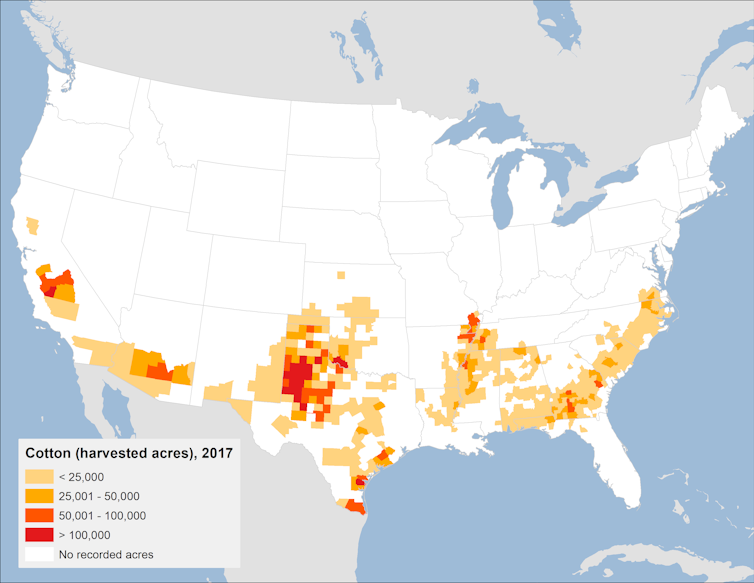
Cotton is grown in 13 states across the southern U.S. The western half of this belt has been in drought since 2000.
USDA

Don't mourn, organize.

-Joe Hill
User avatar
caltrek
Posts: 9280
Joined: Mon May 17, 2021 1:17 pm

Re: The Future of Food, Agriculture, and Aquaculture

Post by caltrek »

How Foreign Private Equity Hooked New England’s Fishing Industry
by Will Sennot
July 6, 2022

Extract:
(ProPublica) Blue Harvest and other companies linked to private equity firms and foreign investors have taken over much of New England’s fishing industry. As already harsh working conditions have deteriorated, the new group of owners has depressed income by pushing expenses onto fishermen, an investigation by ProPublica and The New Bedford Light has found. Blue Harvest has also benefited from lax antitrust rules governing how much fish it can catch.

Since it was founded in 2015, Blue Harvest has been acquiring vessels, fishing permits and processing facilities up and down the East Coast. It started with the self-proclaimed goal of “dominance” over the scallop industry. It has expanded into groundfish, tuna and swordfish, as well as becoming a government contractor, winning a $16.6 million contract from the U.S. Department of Agriculture this past February to supply food assistance programs.

The acquisitions are backed by $600 million in capital from Bregal Partners, a Manhattan-based private equity firm. Bregal is an arm of a firm owned by a Dutch billionaire family, who are best known for their multinational clothing company, which maintains a steady track record of environmental philanthropy and low-wage labor around the globe.

Bregal, its parent company and Blue Harvest President Chip Wilson did not respond to questions. Wilson said in an email that he has been “fighting a handful of fires” and that “speaking with the press has been low on my priority list of late.” He is more concerned “about moving our strategy forward so that the 200+ folks who work for Blue Harvest can be confident about their future,” he said.

“New Bedford is an interesting community, particularly in this ‘colorful’ sector, and the rumor mill is particularly vicious,” he added. “I cannot tell you how many times I have listened to employees scared to the core for themselves and their families due to unsubstantiated rumors about our company.”
Read more here: https://www.propublica.org/article/fis ... -equity
Don't mourn, organize.

-Joe Hill
User avatar
caltrek
Posts: 9280
Joined: Mon May 17, 2021 1:17 pm

Re: The Future of Food, Agriculture, and Aquaculture

Post by caltrek »

The Future of Food: Reimagining Climate-Resilient Food Systems in the Post Pandemic World
by Dr. Shoba Suri and Aparna Roy
July 3, 2022

Introduction:
(Observer Research Foundation) There is no dearth of problems associated with nutrition and public health: hunger, malnutrition, food-borne diseases, and food insecurity, among them. The World Health Organization (WHO) has found that every year, nearly 600 million people (7.5 percent of the global population) fall ill from eating contaminated food and 420,000 die because of it. Children under five bear 40 percent of the food-borne disease burden.[1] Almost one-third of the world’s population did not have access to adequate food in 2020; 3 billion could not get healthy food. The Food and Agriculture Organization (FAO) has found that around 720-811 million face hunger. Undernourishment rates among children have also been rising alarmingly.

The issues of poor food safety, food insecurity, and unsustainable food systems are closely interlinked. These have been further exacerbated by climate change and the COVID-19 pandemic, and have disproportionately affected some populations more than others. The importance of access to safe and nutritious food therefore cannot be overemphasised.

Food Composition and Human Health

With a rapidly growing human population and burgeoning demand for food, intensive use of agrochemicals—i.e., pesticides and fertilisers—has become the norm to ramp up production of livestock and crops. Without chemical pesticides, and crop protection in general, more than half of the world’s crops would be destroyed by insects, weeds, and diseases. Food production per acre would decline rapidly; the area of land used for crop cultivation would have to increase. This, in turn, would have detrimental effects on wildlife habitats and ecosystems and dilute the quality of soil due to erosion (see Figure 1). There is also the likelihood of a rise in food prices and reduced food output.

The use of agrochemicals, however, comes at a perilous cost.
Read more here: https://www.orfonline.org/research/the ... f-food/
Don't mourn, organize.

-Joe Hill
User avatar
funkervogt
Posts: 1365
Joined: Mon May 17, 2021 3:03 pm

Re: The Future of Food, Agriculture, and Aquaculture

Post by funkervogt »

weatheriscool wrote: Sun Jun 26, 2022 10:11 pm Artificial photosynthesis can produce food without sunshine
https://phys.org/news/2022-06-artificia ... shine.html
by Holly Ober, University of California - Riverside
Photosynthesis has evolved in plants for millions of years to turn water, carbon dioxide, and the energy from sunlight into plant biomass and the foods we eat. This process, however, is very inefficient, with only about 1% of the energy found in sunlight ending up in the plant. Scientists at UC Riverside and the University of Delaware have found a way to bypass the need for biological photosynthesis altogether and create food independent of sunlight by using artificial photosynthesis.

The research, published in Nature Food, uses a two-step electrocatalytic process to convert carbon dioxide, electricity, and water into acetate, the form of the main component of vinegar. Food-producing organisms then consume acetate in the dark to grow. Combined with solar panels to generate the electricity to power the electrocatalysis, this hybrid organic-inorganic system could increase the conversion efficiency of sunlight into food, up to 18 times more efficient for some foods.

"With our approach we sought to identify a new way of producing food that could break through the limits normally imposed by biological photosynthesis," said corresponding author Robert Jinkerson, a UC Riverside assistant professor of chemical and environmental engineering.
I bet this is how the Machines made the nutrient broth that they fed to their unconscious human slaves in The Matrix.
User avatar
caltrek
Posts: 9280
Joined: Mon May 17, 2021 1:17 pm

Re: The Future of Food, Agriculture, and Aquaculture

Post by caltrek »

Farms Under Threat


Introduction:
(American Farmland Trust) Farms Under Threat is AFT’s multi-year effort to advance cutting-edge solutions for farmland protection. We use high-resolution spatial analysis tools to identify exactly where agricultural land has been converted to urban and low-density residential land uses—and to anticipate future threats. We have also done a deep analysis of every state’s policies for protecting farmland and ranchland, promoting agricultural viability, and helping transfer land to the next generation of farmers and ranchers.

Farms Under Threat 2040: Choosing an Abundant Future projects three alternative development scenarios from 2016 to 2040 — Business as Usual, Runaway Sprawl and Better Built Cities. The report shows that development choices have a significant effect on the future of farmland and ranchland and urges Americans to embrace Better Built Cities to safeguard local farms and ranches, bolster the global food system, and improve people’s daily lives.
Read more here: https://farmland.org/project/farms-und ... 0lives.
Don't mourn, organize.

-Joe Hill
User avatar
caltrek
Posts: 9280
Joined: Mon May 17, 2021 1:17 pm

Re: The Future of Food, Agriculture, and Aquaculture

Post by caltrek »

Ultra-processed Foods Make Up Almost Two-thirds of Britain’s School Meals
July 19, 2022

Introduction:
(EurekAlert) School meals in the UK contain lots of highly processed foods, promoting poor health among children and increasing their risk of obesity.

British primary and secondary schoolchildren are getting the majority of their lunchtime calories from ‘ultra-processed’ foods, according to a study led by researchers at Imperial College London and published today in the journal Nutrients.

The analysis, which looked at the content of school lunches of more than 3,000 children between 2008-2017, finds that 64% of the calories in meals provided by the school come from ultra-processed foods, contributing to the consumption of high levels of processed foods and increasing the risk of childhood obesity. Ultra-processed bread, snacks, puddings and sugary drinks were among the biggest contributors, and on the whole packed lunches contained more calories from highly processed foods, compared to school meals.

According to the researchers, publicly funded school meals (i.e. free school meals and those that children buy in school) are a vital mechanism to deliver healthy food to children, especially those from families with low incomes. They explain the findings highlight a key opportunity for policy makers and educators to ‘level the playing field’ by improving the nutritional quality of school lunches. They argue that urgent policy changes are needed to cap the amount processed foods school lunches contain and to increase access to free school meals, which could help to boost the diets and health of Britain’s children.

Dr Jennie Parnham, from the School of Public Health at Imperial College London and first author on the paper, said: “This is the first study to look at the extent of ultra-processed food content in school lunches for children of all ages. We need to view these findings as a call to action to invest in policies that can promote healthy eating. Owing to the current cost of living crisis, school meals should be a way for all children to access a low-cost nutritious meal. Yet, our research suggests this is not currently the case.”
Read more here: https://www.eurekalert.org/news-releases/959210
Don't mourn, organize.

-Joe Hill
User avatar
caltrek
Posts: 9280
Joined: Mon May 17, 2021 1:17 pm

Re: The Future of Food, Agriculture, and Aquaculture

Post by caltrek »

How Germany is Kicking Its Meat Habit
by Kenny Torrella
July 22, 2022

Introduction:
(Vox) Oktoberfest — the annual two-week festival in Munich, Germany, that attracts some 6 million attendees a year — originally began in 1810 as the gaudy celebration of a royal marriage. Today, it’s primarily a good reason for visitors to drink about 2 million gallons of beer while eating nearly half a million roast chickens and over 400,000 sausages.

Once Oktoberfest is done, Germans will keep drinking beer; Germany, after all, ranks sixth in the world in per capita alcohol consumption. But the decadent displays of meat at Oktoberfest aren’t necessarily indicative of Germans’ year-round eating habits. In fact, Germany is one of the few places in the world where meat consumption is decreasing — and fast.

In 2011, Germans ate 138 pounds of meat each year. Today, it’s 121 pounds — a 12.3 percent decline. And much of that decline took place in the last few years, a time period when grocery sales of plant-based food nearly doubled.

The trend runs counter to virtually everywhere else on the planet, where meat consumption is quickly rising — from citizens of low-income countries adding more meat to their diet as incomes increase, to rich countries where meat consumption has more or less plateaued at a high level or continues to slowly increase. (Sweden, like Germany, is a notable exception.)

Understanding the causes behind Germany’s newfound love for vegetarian fare could be critical in figuring out how to slow climate change and improve overall health. Meat and dairy production account for around 15 percent of global greenhouse gas emissions, and most countries’ per capita meat consumption far exceeds the 57 pounds per year recommended by the EAT-Lancet Commission, a panel of climate and nutrition experts.
Read more here: https://www.vox.com/future-perfect/23 ... xitarian
Don't mourn, organize.

-Joe Hill
User avatar
caltrek
Posts: 9280
Joined: Mon May 17, 2021 1:17 pm

Re: The Future of Food, Agriculture, and Aquaculture

Post by caltrek »

Pollen and Heat: A Looming Challenge for Global Agriculture
by Carolyn Beans
June 14, 2022

Introduction:
(Yale Environment 360) Last June, Aaron Flansburg felt the temperature spike and knew what that meant for his canola crop. A fifth-generation grower in Washington state, Flansburg times his canola planting to bloom in the cool weeks of early summer. But last year, his fields were hit with 108-degree Fahrenheit heat just as flowers opened. “That is virtually unheard of for our area to have a temperature like that in June,” he says.

Yellow blooms sweltered, reproduction stalled, and many seeds that would have been pressed for canola oil never formed. Flansburg yielded about 600 to 800 pounds per acre. The previous year, under ideal weather conditions, he had reached as high as 2,700.

Many factors likely contributed to this poor harvest — heat and drought persisted throughout the growing season. But one point is becoming alarmingly clear to scientists: heat is a pollen killer. Even with adequate water, heat can damage pollen and prevent fertilization in canola and many other crops, including corn, peanuts, and rice.

For this reason, many growers aim for crops to bloom before the temperature rises. But as climate change increases the number of days over 90 degrees in regions across the globe, and multi-day stretches of extreme heat become more common, getting that timing right could become challenging, if not impossible.

Faced with a warmer future, researchers are searching for ways to help pollen beat the heat. They’re uncovering genes that could lead to more heat-tolerant varieties and breeding cultivars that can survive winter and flower before heat strikes. They’re probing pollen’s precise limits and even harvesting pollen at large scales to spray directly onto crops when weather improves.
Read more here: https://e360.yale.edu/features/pollen- ... riculture
Don't mourn, organize.

-Joe Hill
User avatar
caltrek
Posts: 9280
Joined: Mon May 17, 2021 1:17 pm

Re: The Future of Food, Agriculture, and Aquaculture

Post by caltrek »

How Some Cassava Plants Evade Mosiac Virus
by Peter Ruego
July 27, 2022

Extract:
(Futurity) Researchers have identified the gene responsible for resistance in certain cassava cultivars against the devastating cassava mosaic disease.

Cassava, also known as manioc, is a staple food for nearly one billion people and an important source of raw materials. It secures an income for smallholder farmers, especially in Africa. Cassava is an undemanding crop; it does not need fertilizer and even grows in dry areas.

Many pests and diseases affect cassava cultivation, however. Cassava mosaic disease (CMD) in particular is often damaging to the crop. CMD results from DNA geminiviruses that are transmitted to plants by sap-sucking whiteflies (Bemisia tabaci) and can destroy entire fields and decimate yields.

Working with several resistant and susceptible West African cassava cultivars, the research team led by Wilhelm Gruissem, professor of plant biotechnology at ETH Zurich, used genome analyses to identify the gene responsible for a specific resistance to cassava mosaic virus.

As reported in Nature Communications, the team shows that the resistance is caused by a single gene that is the blueprint for a DNA polymerase—an enzyme responsible for replicating DNA within a cell. However, the DNA polymerase not only replicates DNA, it also performs “proofreading” to correct errors in the sequence of DNA building blocks that may occur during replication. And it is precisely this enzyme that the geminiviruses require to replicate their own DNA and consequently to reproduce.
Read more here: https://www.futurity.org/cassava-mosa ... 773682-2/

For a technical review of the study: https://www.nature.com/articles/s41467-022-31414-0
Don't mourn, organize.

-Joe Hill
User avatar
caltrek
Posts: 9280
Joined: Mon May 17, 2021 1:17 pm

Re: The Future of Food, Agriculture, and Aquaculture

Post by caltrek »

How Year-round Crops Could Reduce Farm Pollution in the Mississippi River
by Chloe Johnson
August 2, 2022

Introduction:
(Investigate Midwest) Don Wyse’s field of winter barley used to be mostly empty in the spring.

Eight years ago, just a tenth of the grain would survive the winter in this experimental field in St. Paul. But this year, after repeatedly refining the plants’ genetics, the field was flush with swaying, pale yellow grain heads.

The winter is the first hurdle that researchers at the University of Minnesota’s Forever Green Initiative must get over as they attempt to breed new crops that can cover farm fields year round – and in the process, help water quality across the state.

For years, Minnesota has struggled to reduce the farm pollution from fertilizers and other sources that runs into streams, lakes, the Mississippi River and eventually, the Gulf of Mexico.

Additional extract:
“The only way to keep nitrogen from flushing through the soil is to have roots intercept that nitrogen,” DeHaan said.

Read more here: https://investigatemidwest.org/2022/08 ... pi-river/
Don't mourn, organize.

-Joe Hill
User avatar
caltrek
Posts: 9280
Joined: Mon May 17, 2021 1:17 pm

Re: The Future of Food, Agriculture, and Aquaculture

Post by caltrek »

This Genetically Modified Rice Could Transform the Global Food Supply
by Joanna Thompson
August 3, 2022

Introduction:
(Inverse) GENETICALLY MODIFIED FOODS are a hot-button issue. Many people are hesitant to eat plants or animals that have been enhanced with foreign genes, citing health and environmental concerns, the perceived “ick” factor, and occasionally conspiratorial thinking.

But GMO foods have the potential to feed the hundreds of millions of people worldwide who are undernourished. Given the benefits of tinkering with our meals’ genomes, a new study published in Science could offer a helpful compromise: a way to improve the yields of a crucial crop without adding genes from different organisms.

“Rice is one of the most important crops because it is a staple food for almost half of the world’s population,” Wenbin Zhou, a geneticist at the National Key Research and Development Program of China and co-author of the study, tells Inverse.

By duplicating one key gene, a team of researchers in China has successfully engineered a strain of agricultural rice that yields up to 40 percent more grain per plot compared to controls. If widely adopted, this breakthrough technique has the potential to feed magnitudes more people with fewer resources — but only if consumers and regulatory bodies are willing to give the transgenic dish a chance.
Read more here: https://www.inverse.com/innovation/gmo-rice-china
Don't mourn, organize.

-Joe Hill
User avatar
caltrek
Posts: 9280
Joined: Mon May 17, 2021 1:17 pm

Re: The Future of Food, Agriculture, and Aquaculture

Post by caltrek »

More Wheat for Global Food Security
August 4, 2022

Conclusion:
(EurekAlert ) We are approaching the biophysical limits of wheat yields. So we need to understand the functions of crops to boost yields further,” says the scientist (professor Senthold Asseng). He firmly believes that the genetic resources of wheat are considerable. In his experiments, he has identified the unused genetic resources in this cultivated plant with the potential to increase yields around the world. He speaks of a genetic yield gap of 51 percent. The goal is to mobilize this breeding gap. This can be done by targeted breeding that will utilize the yield potential of wheat and thus lead to richer harvests.

Genetics are important, but only an interdisciplinary approach will achieve the goal

However, Prof. Asseng is certain: “Genetics alone cannot solve the global nutrition problems. We can achieve this only with an interdisciplinary approach through the application of genetics combined with soil and climate science as well as research into cultivated plants.”

The use of advanced modern breeding instruments and the continual improvement of agricultural crop production through optimized plant and soil management will achieve the urgently needed increases in the global wheat harvest. "This can then bring about an effective solution for an adequate worldwide supply of food in the future," says Asseng.
Read more here: https://www.eurekalert.org/news-releases/960892
Don't mourn, organize.

-Joe Hill
User avatar
caltrek
Posts: 9280
Joined: Mon May 17, 2021 1:17 pm

Re: The Future of Food, Agriculture, and Aquaculture

Post by caltrek »

Nutrition Solution Can Help Heat-stressed Cows as U.S. Warms
by Caitlin Hayes
August 3, 2022

Introduction:
(Cornell Chronicle) Rising temperatures pose major challenges to the dairy industry – a Holstein’s milk production can decline 30 to 70% in warm weather – but a new Cornell-led study has found a nutrition-based solution to restore milk production during heat-stress events, while also pinpointing the cause of the decline.

The study, published Aug. 2 in the Journal of Dairy Science, confirmed for the first time that heat-stressed dairy cows develop gut permeability, or leaky gut, which contributes to a reduction in milk production. Researchers also found that milk production can be partially restored by feeding the cows organic acids and pure botanicals.

“This has immediate application,” said Joseph McFadden ‘03, associate professor of dairy cattle biology in the College of Agriculture and Life Sciences and senior author of the paper. “And we hope it serves as a catalyst for the field and ignites further research into dietary approaches.”

The paper’s first author is Ananda Fontoura, a doctoral student in McFadden’s lab.

The research will help maintain the efficiency and sustainability of the dairy industry as demand and temperatures both rise. Climate change is already causing reduced production and threatened health in Holsteins, by far the dominant breed in U.S. dairy farming. McFadden said the New York state dairy industry is not safe because of its relatively cool climate – heat stress in Holsteins begins to occur at 75 degrees Fahrenheit.
Read more here: https://news.cornell.edu/stories/2022/ ... -us-warms

For a technical presentation of the results of the study: https://www.sciencedirect.com/science/ ... 222004210
Don't mourn, organize.

-Joe Hill
User avatar
caltrek
Posts: 9280
Joined: Mon May 17, 2021 1:17 pm

Re: The Future of Food, Agriculture, and Aquaculture

Post by caltrek »

While developments in technology and science are major drivers determining the future of food, governmental policies will also play a part.

Congress Could Beef Up Meatpacking Oversight This Fall. But Obstacles to Enforcement Remain
by Aruni Soni
August 4, 2022

Introduction:
(Investigate Midwest) A century ago, Congress wrote a law intended to counteract unfair business practices in the meatpacking industry.

Fast forward to 2022: Just four companies control more than half of the beef, pork and poultry markets, and the meatpacking industry has fielded lawsuits alleging abusive behavior. The Packers and Stockyards Act of 1921 largely has failed in what it was supposed to accomplish, legislators and fair market advocates said.

However, new bills before the U.S. Senate aim to reinvigorate the act.

At a time when there’s greater scrutiny at the federal level on consolidation in the meatpacking industry, the Meat and Poultry Special Investigator Act of 2022 would create an Office of the Special Investigator for Competition Matters in the U.S. Department of Agriculture tasked with enforcing the 1921 law.

While experts said broad problems remain in enforcing the law, the potential new office is seen by advocates as a step in the right direction. Ultimately, the bill strives to boost regulation of an industry riddled with allegations of price manipulation and producer exploitation.
Read more here: https://investigatemidwest.org/2022/08 ... t-remain/
Don't mourn, organize.

-Joe Hill
User avatar
caltrek
Posts: 9280
Joined: Mon May 17, 2021 1:17 pm

Re: The Future of Food, Agriculture, and Aquaculture

Post by caltrek »

A Cousin of a Crop-killing Bacteria is Mutating Rapidly
August 12, 2022

Introduction:
(EurekAlert) A bacterial species closely related to deadly citrus greening disease is rapidly evolving its ability to infect insect hosts, and possibly plants as well.

The newly identified species belongs to Liberibacter, a family of bacteria known to infect several economically important crops. There are nine known Liberibacter species, including one that infects potatoes and three that are associated with citrus greening.

Citrus greening, also known as Huanglongbing, is the number one killer of citrus trees worldwide. Though many are working on solutions, there is presently no effective prevention or treatment option on the market.

Given its relatives’ destructive qualities, UC Riverside scientists set out to understand the ways the new species, L. capsica, genetically resembles other types of Liberibacter.

“As with new strains of COVID-19, bacteria become variants of concern if their mutations can impact pathogenic or transmissible properties,” said Allison Hansen, UCR entomologist and study lead.
Read more here: https://www.eurekalert.org/news-releases/961650
Don't mourn, organize.

-Joe Hill
User avatar
caltrek
Posts: 9280
Joined: Mon May 17, 2021 1:17 pm

Re: The Future of Food, Agriculture, and Aquaculture

Post by caltrek »

Your Future Shrimp Meal Could Come from Atarraya’s Farming Technology
by Christine Hall
August 15, 2022

Introduction:
(Techcrunch) Atarraya, creator of Shrimpbox, a sustainable “plug-and-play” shrimp farming technology, is swimming to the surface after being in stealth mode since 2019. The Mexico City-based company emerges with new funding, $3.9 million in Series A dollars, and a new U.S. headquarters in Indianapolis.

The company is claiming this is the “world’s first” technology of its kind, and Daniel Russek, founder and CEO of Atarraya, told TechCrunch that Shrimpbox was an idea he got after college in 2005 when he started with a non-government organization working with fishing communities.

That grew into aquaculture farming technology with Russek and his team creating a startup company around it called Maricultura Vigas. That company mainly focused on the biotechnology aspects of aquaculture, including the challenge of raising shrimp in a closed loop system.

“We wanted to make the shrimp business more sustainable and more efficient without destroying the environment,” Russek said. “We decided to take a bet on the technology and became a startup. We raised some money, got some grants from the Mexican government.”

However, in 2019, the company realized that the challenge was a bit bigger than the founders previously anticipated. In addition to biotech, Russek felt there also needed to be software and automation components. So they created Atarraya, a U.S.-based company tasked with the challenge of making the shrimp farming technology sustainable and more affordable.
Read more here: https://techcrunch.com/2022/08/15/shri ... chnology/
Don't mourn, organize.

-Joe Hill
User avatar
caltrek
Posts: 9280
Joined: Mon May 17, 2021 1:17 pm

Re: The Future of Food, Agriculture, and Aquaculture

Post by caltrek »

Realizing Increased Photosynthetic Efficiency Researchers Prove Bioengineering Better Photosynthesis Increases Yields in Food Crops for the First Time Ever
August 18, 2022

Introduction:
(EurekAlert) CHAMPAIGN, Ill. — For the first time, RIPE researchers have proven that multigene bioengineering of photosynthesis increases the yield of a major food crop in field trials. After more than a decade of working toward this goal, a collaborative team led by the University of Illinois has transgenically altered soybean plants to increase the efficiency of photosynthesis, resulting in greater yields without loss of quality.

Results of this magnitude couldn’t come at a more crucial time. The most recent UN report, The State of Food Security and Nutrition in the World 2022, found that in 2021 nearly 10% of the world population was hungry, a situation that has been steadily worsening over the last few years and eclipsing all other threats to global health in scale. According to UNICEF, by 2030, more than 660 million people are expected to face food scarcity and malnutrition. Two of the major causes of this are inefficient food supply chains (access to food) and harsher growing conditions for crops due to climate change. Improving access to food and improving the sustainability of food crops in impoverished areas are the key goals of this study and the RIPE project.

Realizing Increased Photosynthetic Efficiency, or RIPE, is an international research project that aims to increase global food production by improving photosynthetic efficiency in food crops for smallholder farmers in Sub-Saharan Africa with support from the Bill & Melinda Gates Foundation, Foundation for Food & Agriculture Research, and U.K. Foreign, Commonwealth & Development Office.

“The number of people affected by food insufficiency continues to grow, and projections clearly show that there needs to be a change at the food supply level to change the trajectory,” said Amanda De Souza, RIPE project research scientist, and lead author. “Our research shows an effective way to contribute to food security for the people who need it most while avoiding more land being put into production. Improving photosynthesis is a major opportunity to gain the needed jump in yield potential.”
Read more here: https://www.eurekalert.org/news-releases/961779

For the UN report The State of Food Security and Nutrition in the World 2022: https://www.fao.org/3/cc0639en/online/cc0639en.html
Don't mourn, organize.

-Joe Hill
User avatar
caltrek
Posts: 9280
Joined: Mon May 17, 2021 1:17 pm

Re: The Future of Food, Agriculture, and Aquaculture

Post by caltrek »

Climate Change Likely to Raise Wheat Prices in Food-insecure Regions and Exacerbate Economic Inequality
August 19, 2022

Introduction:
(EurekAlert) Wheat is a key source of nutrition for people across the globe, providing 20% of calories and protein for 3.4 billion people worldwide. Even if we meet climate mitigation targets and stay under 2°C of warming, climate change is projected to significantly alter the yield and price of wheat in the coming years. Researchers publishing in the journal One Earth on August 19 predict that wheat yield is likely to increase at high latitudes and decrease in low latitudes, meaning that prices for the grain are likely to change unevenly and increase in much of the Global South, enhancing existing inequalities.

“Most studies primarily focus on how modelling climate change impacts on wheat yields,” says lead author Tianyi Zhang, an agro-meteorologist with the Institute of Atmospheric Physics at the Chinese Academy of Science. “This is indeed important, but crop yields do not provide a holistic vision of food security. In the real world, many countries, especially developing countries, heavily rely on agribusiness.”

The team has developed a new climate-wheat-economic ensemble modeling approach. This improved model system allows the researchers to explicitly look at impacts of both climate mean conditions and extreme events on wheat yields, price and global supply-demand chain. “We know from previous research that extreme events do not necessarily respond in the same way as the mean conditions, and because these extreme events are the most impactful on societies, this is an important step forward,” says co-author Karin van der Wiel, a climate scientist in the Royal Netherlands Meteorological Institute.
Read more of the EurekAlert article here: https://www.eurekalert.org/news-releases/961592

For the article published in One Earth: https://www.cell.com/one-earth/fulltex ... 2)00371-2
Don't mourn, organize.

-Joe Hill
User avatar
caltrek
Posts: 9280
Joined: Mon May 17, 2021 1:17 pm

Re: The Future of Food, Agriculture, and Aquaculture

Post by caltrek »

The Colorado River Drought is Coming for Your Winter Veggies
by Benji Jones
August 20, 2022

Introduction:
(Vox) It’s a classic Italian-American meal: a crispy Caesar salad with a plate of marinara pasta.

You can find it in restaurants across the country, but depending on the time of year, many of the ingredients come from just one region. Yuma, Arizona, along with California’s Imperial Valley, produces more than 90 percent of the country’s winter leafy greens and much of its vegetables. Arizona is also a major grower of wheat, which the state exports to Italy for making pasta.

Historically, this made a lot of sense. The region has nutritious soil and a warm climate for growing food year-round, even when the rest of the country is frozen over.

There’s just one problem: The water that farmers use to grow these crops comes from the Colorado River, and the Colorado River is drying up.

The iconic river is in its 23rd year of drought, according to the Bureau of Reclamation, and the two largest reservoirs, Lake Powell and Lake Mead, have sunk to historic lows, prompting a series of water restrictions. Under climate change, the drought could worsen in the years ahead.
Read more here: https://www.vox.com/science-and-health ... nia-farms
Don't mourn, organize.

-Joe Hill
User avatar
caltrek
Posts: 9280
Joined: Mon May 17, 2021 1:17 pm

Re: The Future of Food, Agriculture, and Aquaculture

Post by caltrek »

I have just come across an article in Investigate Midwest which contains a lot of reading material both in the article itself and in links to other items of interest. I will try and highlight the gist of it all, but even that will take several citations and links.

With Corn Belt Inching North, Farm Diversification Gains Momentum
by Adam Goldstein
August 17, 2022

Introduction:
(investigate Midwest) CONCORDIA, MISSOURI — Corn and soybeans once covered Josh Payne’s farm as far as the eye could see. Tidy rows of green and brown marched across his 600 acres from spring to fall, kept in line by tillage, and herbicide. Though Payne’s operation was the picture of modern agriculture, he could not shake a general dissatisfaction.

Today, Payne calls his farm “a messy, complex, diverse life worth living.” Gone are the corn and soy, replaced by a diversified farm that includes various animals, nuts and fruits. Young chestnut trees reach their limbs skyward. Dozens of sheep, bleating and plodding, graze on native grasses in Payne’s front yard. And several brown cows lounge on rolling pasture in the distance.

“We're trying to rethink our food, and we're trying to regrow our land,” Payne said.

Payne is one of a small but growing number of Midwestern farmers re-evaluating how to manage their land as they face climate change, market shocks, and other threats. Diverse farms like his made up only 10% to 15% of the roughly 2 million farms in the 2017 U.S. agricultural census. Yet researchers predict these farms will become more common across the Midwest as climate change redraws the American agricultural map. Already, the Corn Belt – which traditionally spanned from Kansas to Ohio and from Missouri to the Dakotas – has shifted northwest, a trend that’s expected to continue.
Read more here:
https://investigatemidwest.org/2022/08/ ... -momentum/

One of the sites linked in the article explains an aspect of government policy on this matter:

Introduction:
(U.S. Department of Agriculture) JEFFERSON CITY, Mo., Feb. 7, 2022 – Agriculture Secretary Tom Vilsack announced today at Lincoln University that the U.S. Department of Agriculture is delivering on its promise to expand markets by investing $1 billion in partnerships to support America’s climate-smart farmers, ranchers and forest landowners. The new Partnerships for Climate-Smart Commodities opportunity will finance pilot projects that create market opportunities for U.S. agricultural and forestry products that use climate-smart practices and include innovative, cost-effective ways to measure and verify greenhouse gas benefits. USDA is now accepting project applications for fiscal year 2022.

“America’s farmers, ranchers, and forest owners are leading the way in implementing climate-smart solutions across their operations,” said Vilsack. “Through Partnerships for Climate-Smart Commodities, USDA will provide targeted funding to meet national and global demand and expand market opportunities for climate-smart commodities to increase the competitive advantage of American producers. We want a broad array of agriculture and forestry to see themselves in this effort, including small and historically underserved producers as well as early adopters.”

For the purposes of this funding opportunity, a climate-smart commodity is defined as an agricultural commodity that is produced using agricultural (farming, ranching or forestry) practices that reduce greenhouse gas emissions or sequester carbon.

Funding will be provided to partners through the USDA’s Commodity Credit Corporation...
Read more here: https://www.usda.gov/media/press-releas ... ng-markets


Here is an interesting example of the kinds of projects being selected and promoted by the USDA:
(Purdue University) WEST LAFAYETTE, Ind. — A $10 million project seeks to make Midwestern agriculture more resilient by diversifying farms, marketing and the agricultural landscape.

We’ve all heard of hedging a bet or diversifying a portfolio to be able to weather ups and downs, and this is the same concept, said Linda Prokopy department head and professor of horticulture and landscape architecture at Purdue University, who leads the project.

“What’s new is that market and environmental research tailored to this part of the U.S. will inform our next moves, and individual farmers and stakeholders will be involved in every step of the process,” she says. “Growing only a rotation of corn and soybeans is not necessarily sustainable economically, environmentally or socially. We will be working with farmers in Indiana, Illinois and Iowa to evaluate alternative cropping systems that can be used in the Midwest – we will be evaluating small grains and/or forage crops in rotations, perennial forage or bioenergy crops, agroforestry, horticultural food crops and grazed livestock.”

The USDA National Institute of Food and Agriculture selected the project, titled “#DiverseCornBelt: Resilient Intensification through Diversity in Midwestern Agriculture,” which has a multidisciplinary team that spans the life, physical and social sciences.

”This project draws upon the talents of our faculty and can make a crucial contribution to diversifying Midwest agriculture. The lessons learned can benefit farmers throughout the region,” said Karen Plaut, the Glenn W. Sample Dean of Purdue’s College of Agriculture.
Read more here: https://www.purdue.edu/newsroom/release ... oject.html
Don't mourn, organize.

-Joe Hill
Post Reply