Exoplanets – worlds of other suns

-
firestar464
- Posts: 8370
- Joined: Wed Oct 12, 2022 7:45 am
Re: Exoplanets – worlds of other suns
I could write a sci-fi about this about an alien civilization there and it would make sense to have such a civilization base their festivals and their religion(s) on the long orbit of their planet.
Just a random thought.
Just a random thought.
-
weatheriscool
- Posts: 25811
- Joined: Sun May 16, 2021 6:16 pm
- Contact:
Re: Exoplanets – worlds of other suns
Cold Jupiters and improved masses in 38 Kepler and K2 small-planet systems from 3661 high-precision HARPS-N radial velocities. No excess of cold Jupiters in small-planet systems
https://arxiv.org/abs/2304.05773
Quote :
https://arxiv.org/abs/2304.05773
Quote :
The exoplanet population with orbital periods P<100 d around solar-type stars is dominated by super-Earths and sub-Neptunes. These planets are, however, missing in our Solar System, and the reason for that is unknown. Two theoretical scenarios invoke the role of Jupiter as the possible culprit: Jupiter may have acted as a dynamical barrier to the inward migration of sub-Neptunes from beyond the water iceline or, alternatively, may have reduced considerably the inward flux of material (pebbles) required to form super-Earths inside that iceline. Both scenarios predict an anti-correlation between the presence of small planets (SPs) and that of cold Jupiters (CJs) in exoplanetary systems. To test that prediction, we homogeneously analyzed the radial-velocity (RV) measurements of 38 Kepler and K2 transiting SP systems gathered over almost 10 years with the HARPS-N spectrograph, as well as publicly available RVs collected with other facilities. We detected five CJs in three systems, two in Kepler-68, two in Kepler-454, and a very eccentric one in K2-312. We derived an occurrence rate of 9.3+7.7−2.9% for CJs with 0.3−13 MJup and 1-10 au, which is lower but still compatible at 1.3σ with that measured from RV surveys for solar-type stars, regardless of SP presence. This does not allow us to draw a firm conclusion about the predicted anti-correlation between SPs and CJs, which would require a considerably larger sample. Nevertheless, we found no evidence of previous claims of an excess of CJs in SP systems. As an important by-product of our analyses, we homogeneously determined the masses of 64 Kepler and K2 small planets, reaching a precision better than 5, 7.5 and 10σ for 25, 13 and 8 planets, respectively. Finally, we release to the scientific community the 3661 HARPS-N radial velocities used in this work.
-
weatheriscool
- Posts: 25811
- Joined: Sun May 16, 2021 6:16 pm
- Contact:
Re: Exoplanets – worlds of other suns
In a research first, team uses precision astrometry to discover new exoplanet outside Earth's solar system
by University of Texas at San Antonio
https://phys.org/news/2023-04-team-prec ... earth.html
by University of Texas at San Antonio
https://phys.org/news/2023-04-team-prec ... earth.html
An international research team led by UTSA Associate Professor of Astrophysics Thayne Currie has made a breakthrough in accelerating the search for new planets.
In a paper published in Science, Currie reports the first exoplanet jointly discovered through direct imaging and precision astrometry, a new indirect method that identifies a planet by measuring the position of the star it orbits. Data from the Subaru Telescope in Hawai'i and space telescopes from the European Space Agency (ESA) were integral to the team's discovery.
An exoplanet—also called an extrasolar planet—is a planet outside a solar system that orbits another star. With direct imaging, astronomers can see an exoplanet's light in a telescope and study its atmosphere. However, only about 20 have been directly imaged over the past 15 years.
By contrast, indirect planet detection methods determine a planet's existence through its effect on the star it orbits. This approach can provide detailed measurements of the planet's mass and orbit.
Combining direct and indirect methods to examine a planet's position provides a more complete understanding of an exoplanet, Currie says.
Re: Exoplanets – worlds of other suns
The problem with these sorts of systems is that stars like Rigel have lifespans in the millions of years, not billions, which probably isn't enough time for any life to form at all, let alone complex life. Of course that doesn't really matter as far as human colonization goes, but any colony there would eventually have to deal with their star going supernova. That's something that could happen on planets orbiting smaller stars too, but a billion years from now there won't be anything recognizably human to witness the stars exploding, whereas we can't really say the same about a mere million years from now.
-
weatheriscool
- Posts: 25811
- Joined: Sun May 16, 2021 6:16 pm
- Contact:
Re: Exoplanets – worlds of other suns
TESS discovers a Venus-sized exoplanet orbiting nearby star
https://phys.org/news/2023-04-tess-venu ... earby.html
by Tomasz Nowakowski , Phys.org
https://phys.org/news/2023-04-tess-venu ... earby.html
by Tomasz Nowakowski , Phys.org
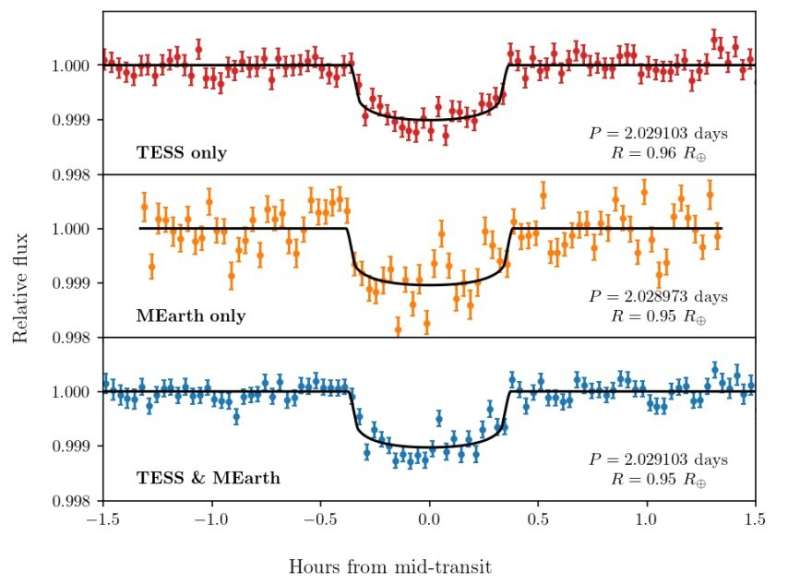
Using NASA's Transiting Exoplanet Survey Satellite (TESS), a team of astronomers from Harvard-Smithsonian Center for Astrophysics (CfA) in Cambridge, Massachusetts, and elsewhere has detected a new exoplanet. The newfound alien world, designated LHS 475 b, is about the size of Venus and orbits a nearby M-dwarf star. The discovery was reported April 4 on the arXiv pre-print repository.
TESS is conducting a survey of about 200,000 of the brightest stars near the sun with the aim of searching for transiting exoplanets. So far, it has identified nearly 6,400 candidate exoplanets (TESS Objects of Interest, or TOI), of which 3,031 have been confirmed so far.
Now, a group of astronomers led by CfA's Kristo Ment reports the discovery of another extrasolar planet with TESS. They reveal that a transit signal was detected in the light curve of LHS 475—a main-sequence red dwarf belonging to the M3 spectral class. The planetary nature of this signal was confirmed by follow-up ground-based photometry using the MEarth-South telescope array at the Cerro Tololo Inter-American Observatory in Chile.
"Here we present the discovery and subsequent ground-based validation observations of LHS 475 b, a Venus-sized planet orbiting a nearby M dwarf," the researchers wrote in the paper.
LHS 475 b has a radius of approximately 0.955 Earth radii and orbits its host every 48.7 hours, at a distance of about 0.02 AU from it. The planet's equilibrium temperature was estimated to be some 587 K, thus LHS 475 b is likely too hot to be habitable.
-
weatheriscool
- Posts: 25811
- Joined: Sun May 16, 2021 6:16 pm
- Contact:
Re: Exoplanets – worlds of other suns
Earth-like exoplanets may be much more common than previously thought
By David Szondy
April 16, 2023
By David Szondy
April 16, 2023
https://newatlas.com/space/earthlike-ex ... re-common/
A new study led by UCLA scientists on how water forms on young exoplanets with hydrogen atmospheres and molten oceans of magma suggests that Earth-like planets may not be as uncommon as once thought and that the presence of water on such planets may be almost inevitable.
One of the historically annoying things about trying to figure out how many planets like Earth that there are in the galaxy is that we only have one real example of an Earth-like planet and we're standing on it.
Since a total sample size of exactly one is statistically meaningless, scientists are very keen to find Earth-like planets outside the Solar System or, at least, ones that can give us insights into the mechanisms that form such planets so meaningful conclusions can be drawn.
One key property that sets Earth apart is the presence of large amounts of liquid water on its surface – a necessary factor for the existence of life. Current hypotheses about how Earth got its water revolve mainly around it being carried to the primordial planet by comets, meteors, or space dust. This is a mechanism that requires very specific circumstances and suggests that watery Earth-like planets may be exceedingly rare.
Re: Exoplanets – worlds of other suns
New exoplanet seen via direct imaging
19th April 2023
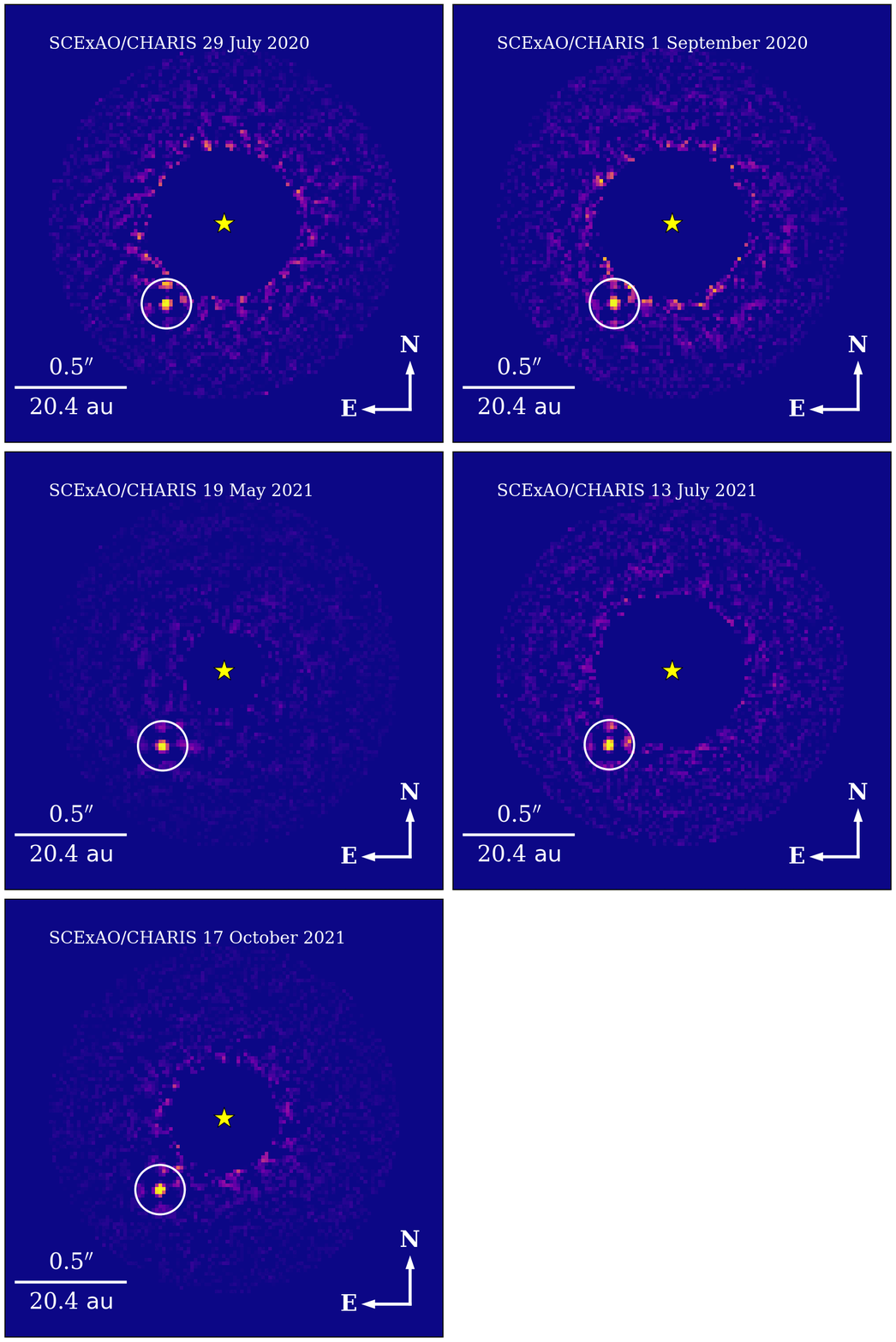
The discovery of HIP 99770 b, a new exoplanet located 133 light years away, is reported in the journal Science. A team of astronomers used a new detection method that combines direct imaging with astrometry.
As of today, there are 5,363 confirmed exoplanets in 3,960 planetary systems. However, only a handful have been seen via direct imaging. Exoplanets are extremely faint compared with their parent stars, making it difficult to spot them in visible light.
A gas giant called HIP 99770 b is the latest of these very few exoplanets confirmed via direct imaging. It has also become the first jointly discovered from both direct imaging and precision astrometry, a new indirect method that identifies a planet by measuring the position of the star it orbits.
Combining these direct and indirect methods can provide a more complete understanding of an exoplanet's characteristics, according to the authors of a study that appears this month in the journal Science.
"Indirect planet detection methods are responsible for most exoplanet discoveries thus far. Using one of these methods – precision astrometry – told us where to look to try to image planets. And, as we found out, we can now see planets a lot easier," said Thayne Currie, Associate Professor of Astrophysics at the University of Texas at San Antonio.
Read more: https://www.futuretimeline.net/blog/202 ... planet.htm
19th April 2023
The discovery of HIP 99770 b, a new exoplanet located 133 light years away, is reported in the journal Science. A team of astronomers used a new detection method that combines direct imaging with astrometry.
As of today, there are 5,363 confirmed exoplanets in 3,960 planetary systems. However, only a handful have been seen via direct imaging. Exoplanets are extremely faint compared with their parent stars, making it difficult to spot them in visible light.
A gas giant called HIP 99770 b is the latest of these very few exoplanets confirmed via direct imaging. It has also become the first jointly discovered from both direct imaging and precision astrometry, a new indirect method that identifies a planet by measuring the position of the star it orbits.
Combining these direct and indirect methods can provide a more complete understanding of an exoplanet's characteristics, according to the authors of a study that appears this month in the journal Science.
"Indirect planet detection methods are responsible for most exoplanet discoveries thus far. Using one of these methods – precision astrometry – told us where to look to try to image planets. And, as we found out, we can now see planets a lot easier," said Thayne Currie, Associate Professor of Astrophysics at the University of Texas at San Antonio.
Read more: https://www.futuretimeline.net/blog/202 ... planet.htm
-
weatheriscool
- Posts: 25811
- Joined: Sun May 16, 2021 6:16 pm
- Contact:
Re: Exoplanets – worlds of other suns
Two super-Earths at the edge of the habitable zone of the nearby M dwarf TOI-2095
https://arxiv.org/abs/2304.09220
https://arxiv.org/abs/2304.09189
https://arxiv.org/abs/2304.09220
Two Warm Super-Earths Transiting the Nearby M Dwarf TOI-2095The planetary system is composed of two transiting planets: TOI-2095b with an orbital period of Pb=17.66484±(7×10⁻⁵) days and TOI-2095c with Pc=28.17232±(14×10−5) days. Both planets have similar sizes with Rb=1.25±0.07R⊕ and Rc=1.33±0.08R⊕ for planet b and c, respectively. We put upper limits on the masses of these objects with Mb<4.1M⊕ for the inner and Mc<7.4M⊕ for the outer planet (95\% confidence level). These two planets present equilibrium temperatures in the range of 300 - 350 K and are close to the inner edge of the habitable zone of their star.
https://arxiv.org/abs/2304.09189
-
weatheriscool
- Posts: 25811
- Joined: Sun May 16, 2021 6:16 pm
- Contact:
Re: Exoplanets – worlds of other suns
Researchers use AI to discover new planet outside solar system
https://phys.org/news/2023-04-ai-planet-solar.html
by Alan Flurry, University of Georgia
https://phys.org/news/2023-04-ai-planet-solar.html
by Alan Flurry, University of Georgia
A University of Georgia research team has confirmed evidence of a previously unknown planet outside of our solar system, and they used machine learning tools to detect it.
A recent study by the team showed that machine learning can correctly determine if an exoplanet is present by looking in protoplanetary disks, the gas around newly formed stars.
The newly published findings in The Astrophysical Journal represent a first step toward using machine learning to identify previously overlooked exoplanets.
"We confirmed the planet using traditional techniques, but our models directed us to run those simulations and showed us exactly where the planet might be," said Jason Terry, doctoral student in the UGA Franklin College of Arts and Sciences department of physics and astronomy and lead author on the study.
"When we applied our models to a set of older observations, they identified a disk that wasn't known to have a planet despite having already been analyzed. Like previous discoveries, we ran simulations of the disk and found that a planet could re-create the observation."
According to Terry, the models suggested a planet's presence, indicated by several images that strongly highlighted a particular region of the disk that turned out to have the characteristic sign of a planet—an unusual deviation in the velocity of the gas near the planet.
"This is an incredibly exciting proof of concept. We knew from our previous work that we could use machine learning to find known forming exoplanets," said Cassandra Hall, assistant professor of computational astrophysics and principal investigator of the Exoplanet and Planet Formation Research Group at UGA. "Now, we know for sure that we can use it to make brand new discoveries."
-
weatheriscool
- Posts: 25811
- Joined: Sun May 16, 2021 6:16 pm
- Contact:
Re: Exoplanets – worlds of other suns
Scientists discover rare element in exoplanet's atmosphere
https://phys.org/news/2023-04-scientist ... phere.html
by Lund University
https://phys.org/news/2023-04-scientist ... phere.html
by Lund University
The rare metal terbium has been found in an exoplanet's atmosphere for the first time. The researchers at Lund University in Sweden have also developed a new method for analyzing exoplanets, making it possible to study them in more detail.
KELT-9 b is the galaxy's hottest exoplanet, orbiting its distant star about 670 light years from Earth. The celestial body, with an average temperature of a staggering 4,000 degrees Celsius, has since its discovery in 2016 excited the world's astronomers. The new study, accepted for publication in Astronomy & Astrophysics, reveals discoveries about the scalding-hot oddball's atmosphere.
"We have developed a new method that makes it possible to obtain more detailed information. Using this, we have discovered seven elements, including the rare substance terbium, which has never before been found in any exoplanet's atmosphere," says Nicholas Borsato, Ph.D. student in astrophysics at Lund University.
-
weatheriscool
- Posts: 25811
- Joined: Sun May 16, 2021 6:16 pm
- Contact:
Re: Exoplanets – worlds of other suns
China to hunt for Earth-like planets with formation-flying telescopes
Andrew Jones April 26, 2023
https://spacenews.com/china-to-hunt-for ... elescopes/
Andrew Jones April 26, 2023
https://spacenews.com/china-to-hunt-for ... elescopes/
HELSINKI — China aims to construct an array of telescopes in deep space to search for habitable planets orbiting other stars.
The Miyin project envisions sending four light-collecting telescopes and a beam combiner to Sun-Earth Lagrange point 2. Flying in formation, the spacecraft will use interferometric techniques to provide high angular resolution mid-infrared observations to directly image and characterize exoplanets around stars up to 65 light-years away.
The main objective would be to detect potentially habitable terrestrial planets orbiting Sun-like stars in our neighborhood within the Milky Way.
The project is still in the development phase, but current plans map out on-orbit technology demonstrations in 2024, followed by interferometry experiments conducted aboard the Tiangong space station a year later.
A prototype of the array would then launch around 2027, before building the five-spacecraft system at L2 in 2030. A further four spacecraft could be added to the array in a second mission phase beyond 2030.
-
weatheriscool
- Posts: 25811
- Joined: Sun May 16, 2021 6:16 pm
- Contact:
Re: Exoplanets – worlds of other suns
Astronomers discover two super-Earths orbiting nearby star
https://phys.org/news/2023-05-astronome ... -star.html
by Tomasz Nowakowski , Phys.org
https://phys.org/news/2023-05-astronome ... -star.html
by Tomasz Nowakowski , Phys.org
Using NASA's Transiting Exoplanet Survey Satellite (TESS), an international team of astronomers has discovered two "super-Earth" exoplanets orbiting a nearby M-dwarf star known as TOI-2095. The newfound alien worlds have short orbital periods and are slightly larger than the Earth. The findings were presented April 18 on the arXiv pre-print server.
TESS is conducting a survey of about 200,000 of the brightest stars near the sun with the aim of searching for transiting exoplanets, ranging from small rocky worlds to gaseous giants. So far, it has identified 6,400 candidate exoplanets (TESS Objects of Interest, or TOI), of which 330 have been confirmed to date.
Now, a team of astronomers led by Felipe Murgas of the University of La Laguna, Spain, reported that two more candidate extrasolar planets monitored with TESS have been confirmed. By conducting photometric observations and radial velocity measurements, they found that transit signals in the light curve of TOI-2095 are of planetary nature.
"We report the validation of two transiting planets around the M dwarf TOI-2095 discovered by TESS. We use ground-based high-resolution imaging, TESS photometric data, and CARMENES radial velocities to discard false positive scenarios, measure the planetary radii, and place stringent upper limits on the masses of the transiting candidates," the researchers explained.
-
weatheriscool
- Posts: 25811
- Joined: Sun May 16, 2021 6:16 pm
- Contact:
Re: Exoplanets – worlds of other suns
Webb finds water vapor, but is it from a rocky planet or its star?
https://phys.org/news/2023-05-webb-vapo ... -star.html
by NASA
https://phys.org/news/2023-05-webb-vapo ... -star.html
by NASA
GJ 486 b is about 30% larger than the Earth and three times as massive, which means it is a rocky world with stronger gravity than Earth. It orbits a red dwarf star in just under 1.5 Earth days. It is too close to its star to be within the habitable zone, with a surface temperature of about 800 degrees Fahrenheit. And yet, Webb observations show hints of water vapor.
The water vapor could be from an atmosphere enveloping the planet, in which case it would need to be continually replenished due to losses from stellar irradiation. But an equally likely possibility is that the water vapor is actually from the outer layer of the planet's cool host star. Additional Webb observations will help answer the question: Can a rocky planet maintain, or reestablish, an atmosphere in the harsh environment near a red dwarf star?
The most common stars in the universe are red dwarf stars, which means that rocky exoplanets are most likely to be found orbiting such a star. Red dwarf stars are cool, so a planet has to hug it in a tight orbit to stay warm enough to potentially host liquid water (meaning it lies in the habitable zone). Such stars are also active, particularly when they are young, releasing ultraviolet and X-ray radiation that could destroy planetary atmospheres. As a result, one important open question in astronomy is whether a rocky planet could maintain, or reestablish, an atmosphere in such a harsh environment.
To help answer that question, astronomers used NASA's James Webb Space Telescope to study a rocky exoplanet known as GJ 486 b. It is too close to its star to be within the habitable zone, with a surface temperature of about 800 degrees Fahrenheit (430 degrees Celsius). And yet, their observations using Webb's Near-Infrared Spectrograph (NIRSpec) show hints of water vapor.
-
Time_Traveller

- Posts: 3025
- Joined: Sun May 16, 2021 4:49 pm
- Location: New York City, USA, November 5th 2032 C.E.
Re: Exoplanets – worlds of other suns
'Hycean' exoplanet may not be able to support life after all
https://www.space.com/hycean-exoplanets ... socialflowabout 23 hours ago
In 2021, astronomers proposed a new class of exoplanets that contain hydrogen-rich atmospheres and support vast liquid-water oceans, making these hypothetical worlds potential candidates in the search for alien life.
However, new research suggests that these "Hycean" planets would suffer from a catastrophic runaway greenhouse effect, thus limiting their potential for habitability.
Hycean worlds get their name from a combination of "hydrogen" and "ocean," because these worlds — which would be larger than Earth but smaller than any of the giant planets in our solar system — are covered in thick, dense layers of a hydrogen atmosphere and could support vast liquid-water oceans.
Although no Hycean worlds have been confirmed to exist, the massive exoplanet survey by NASA's Kepler mission identified several candidate worlds that, based on estimates of their size and density, might be Hycean planets.
Astronomers are very interested in Hycean worlds. Where there's liquid water, there's a potential home for life as we know it. And because of their thick atmospheres, these planets can potentially exist in a much broader range of orbits around their parent stars without sacrificing their habitability, so there's even the chance that life is more common on Hycean worlds than our own.
“In the quantum multiverse, every choice, every decision you've ever and never made exists in an unimaginably vast ensemble of parallel universes.”
-
weatheriscool
- Posts: 25811
- Joined: Sun May 16, 2021 6:16 pm
- Contact:
Re: Exoplanets – worlds of other suns
Astronomers witness star devouring a planet: Possible preview of the ultimate fate of Earth
https://phys.org/news/2023-05-astronome ... lanet.html
by Association of Universities for Research in Astronomy
https://phys.org/news/2023-05-astronome ... lanet.html
by Association of Universities for Research in Astronomy
By studying countless stars at various stages of their evolution, astronomers have been able to piece together an understanding of the life cycle of stars and how they interact with their surrounding planetary systems as they age. This research confirms that when a sun-like star nears the end of its life, it expands anywhere from 100 to 1,000 times its original size, eventually engulfing the system's inner planets. Such events are estimated to occur only a few times each year across the entire Milky Way. Though past observations have confirmed the aftermath of planetary engulfments, astronomers have never caught one in the act, until now.
With the power of the Gemini South Adaptive Optics Imager (GSAOI) on Gemini South, one half of the International Gemini Observatory, operated by NSF's NOIRLab, astronomers have observed the first direct evidence of a dying star expanding to engulf one of its planets. Evidence for this event was found in a telltale "long and low-energy" outburst from a star in the Milky Way about 13,000 light-years from Earth. This event, the devouring of a planet by an engorged star, likely presages the ultimate fate of Mercury, Venus, and Earth when our sun begins its death throes in about five billion years.
-
weatheriscool
- Posts: 25811
- Joined: Sun May 16, 2021 6:16 pm
- Contact:
Re: Exoplanets – worlds of other suns
New Kepler planets up to Kepler-2000 and 2001 Surprised
Multiplicity Boost Of Transit Signal Classifiers: Validation of 69 New Exoplanets Using The Multiplicity Boost of ExoMiner
https://arxiv.org/abs/2305.02470
Multiplicity Boost Of Transit Signal Classifiers: Validation of 69 New Exoplanets Using The Multiplicity Boost of ExoMiner
https://arxiv.org/abs/2305.02470
-
weatheriscool
- Posts: 25811
- Joined: Sun May 16, 2021 6:16 pm
- Contact:
Re: Exoplanets – worlds of other suns
Webb telescope spies evidence of hidden planets around nearby star
https://www.cnn.com/2023/05/08/world/we ... index.html
https://www.cnn.com/2023/05/08/world/we ... index.html
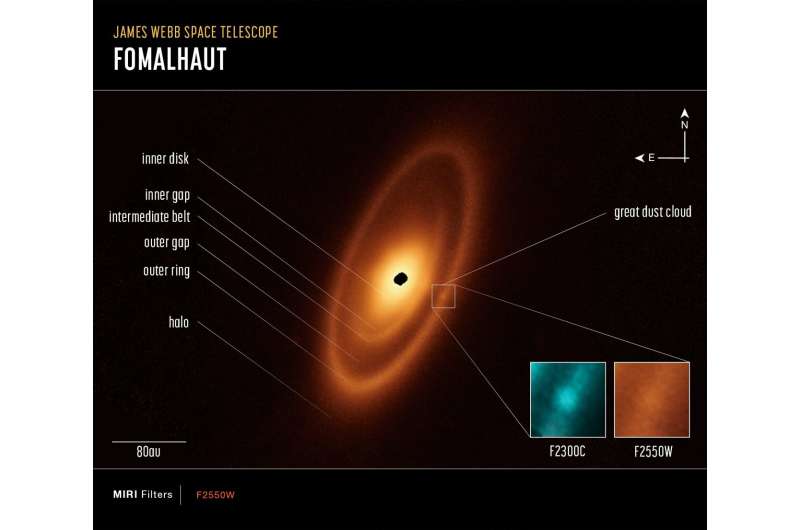
https://phys.org/news/2023-05-webb-foma ... -belt.htmlAstronomers used the James Webb Space Telescope to observe the first asteroid belt seen outside of our solar system and unveiled some cosmic surprises along the way.
The space observatory focused on the warm dust that encircles Fomalhaut, a young, bright star located 25 light-years from Earth in the Piscis Austrinus constellation.
The dusty disk around Fomalhaut was initially discovered in 1983 using NASA’s Infrared Astronomical Satellite. But the Webb researchers weren’t expecting to see three nested rings of dust extending out 14 billion miles (23 billion kilometers) from the star — or 150 times the distance of Earth from the sun.
Webb’s new view revealed Fomalhaut’s two inner belts for the first time, which didn’t appear in previous images taken by the Hubble Space Telescope or other observatories.
-
weatheriscool
- Posts: 25811
- Joined: Sun May 16, 2021 6:16 pm
- Contact:
Re: Exoplanets – worlds of other suns
Researchers measure the light emitted by a sub-Neptune planet's atmosphere for the first time
https://phys.org/news/2023-05-emitted-s ... phere.html
by Emily Nunez, University of Maryland
https://phys.org/news/2023-05-emitted-s ... phere.html
by Emily Nunez, University of Maryland
A team of researchers used JWST to observe GJ 1214b's atmosphere by measuring the heat it emits while orbiting its host star. Their results, published in the journal Nature on May 10, 2023, represent the first time anyone has directly detected the light emitted by a sub-Neptune exoplanet—a category of planets that are larger than Earth but smaller than Neptune.
Though GJ 1214b is far too hot to be habitable, researchers discovered that its atmosphere likely contains water vapor—possibly even significant amounts—and is primarily composed of molecules heavier than hydrogen. University of Maryland Associate Professor of Astronomy Eliza Kempton, lead author of the study, said their findings mark a turning point in the study of sub-Neptune planets like GJ 1214b.
"I've been on a quest to understand GJ 1214b for more than a decade," Kempton said. "When we received the data for this paper, we could see the light from the planet just disappear when it went behind its host star. That had never before been seen for this planet or for any other planet of its class, so JWST is really delivering on its promise."
-
weatheriscool
- Posts: 25811
- Joined: Sun May 16, 2021 6:16 pm
- Contact:
Re: Exoplanets – worlds of other suns
A 1.55 R⊕ habitable-zone planet hosted by TOI-715, an M4 star near the ecliptic South Pole
https://arxiv.org/abs/2305.06206A new generation of observatories is enabling detailed study of exoplanetary atmospheres and the diversity of alien climates, allowing us to seek evidence for extraterrestrial biological and geological processes. Now is therefore the time to identify the most unique planets to be characterised with these instruments. In this context, we report on the discovery and validation of TOI-715 b, a Rb=1.55±0.06R⊕ planet orbiting its nearby (42 pc) M4 host (TOI-715/TIC 271971130) with a period Pb=19.288004+0.000027−0.000024 days. TOI-715 b was first identified by TESS and validated using ground-based photometry, high-resolution imaging and statistical validation. The planet's orbital period combined with the stellar effective temperature Teff=3075±75 K give this planet an instellation Sb=0.67+0.15−0.20 S⊕, placing it within the most conservative definitions of the habitable zone for rocky planets. TOI-715 b's radius falls exactly between two measured locations of the M-dwarf radius valley; characterising its mass and composition will help understand the true nature of the radius valley for low-mass stars. We demonstrate TOI-715 b is amenable for characterisation using precise radial velocities and transmission spectroscopy. Additionally, we reveal a second candidate planet in the system, TIC 271971130.02, with a potential orbital period of P02=25.60712+0.00031−0.00036 days and a radius of R02=1.066±0.092R⊕, just inside the outer boundary of the habitable zone, and near a 4:3 orbital period commensurability. Should this second planet be confirmed, it would represent the smallest habitable zone planet discovered by TESS to date.