Researchers at Keck School of Medicine of USC develop signals that could bring color vision and improved clarity to prosthesis for the blind.
There are millions of people who face the loss of their eyesight from degenerative eye diseases. The genetic disorder retinitis pigmentosa alone affects 1 in 4,000 people worldwide.
Today, there is technology available to offer partial eyesight to people with that syndrome. The Argus II, the world’s first retinal prosthesis, reproduces some functions of a part of the eye essential to vision, to allow users to perceive movement and shapes.
While the field of retinal prostheses is still in its infancy, for hundreds of users around the globe, the “bionic eye” enriches the way they interact with the world on a daily basis. For instance, seeing outlines of objects enables them to move around unfamiliar environments with increased safety.
That is just the start. Researchers are seeking future improvements upon the technology, with an ambitious objective in mind.
Re: Transhumanism & Cybernetics News and Discussions
Posted: Fri May 21, 2021 4:33 am
by Yuli Ban
Re: Transhumanism & Cybernetics News and Discussions
Posted: Fri May 21, 2021 7:39 am
by Yuli Ban
Olfactory enhancement! It's been a while since I've seen anyone touch smell (or taste).
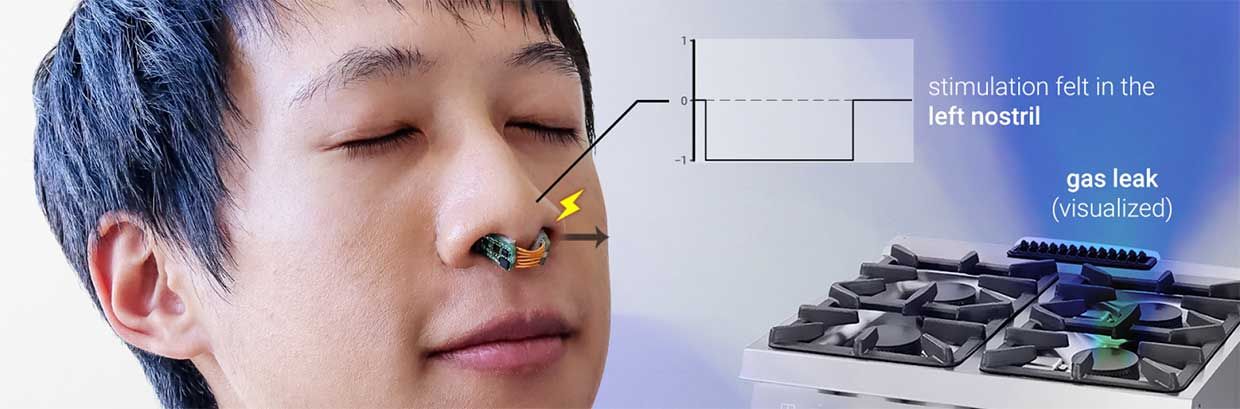
Humans have two nostrils, which you’d think would allow us to determine the direction of smells, in the same way that two ears let us determine the direction of sounds. But that’s not how it works, sadly—humans, in general, are not stereo smellers. We can track down a smell by moving our head and body while sniffing, searching for increasing smell strength, but that’s much different from stereo smelling, which would allow us to localize smells based on different intensities wafting into each nostril.
Branching off from earlier work accessing alternative physiological smelling systems, researchers at the Human Computer Integration lab at the University of Chicago have developed a way to augment our sense of smell with a small piece of nose-worn hardware that uses tiny electrical impulses to give us the power of directional smell.
Image: Human Computer Integration lab/University of Chicago
Re: Transhumanism & Cybernetics News and Discussions
Posted: Sat May 22, 2021 3:13 am
by Yuli Ban
Re: Transhumanism & Cybernetics News and Discussions
Posted: Thu May 27, 2021 5:41 am
by Yuli Ban
Re: Transhumanism & Cybernetics News and Discussions
Chronic pain is like a horror movie monster that sneaks up on you. It’s unpredictable, lingers silently, and when it strikes it’s often too late to tame. More diabolically, our best weapon against it—pain medication—can increase pain intensity over time. And as the opioid epidemic sadly shows, even pain medication is a double-edged sword.
It’s time for something new. This week, a group from the New York University School of Medicine said “no thank you” to medication altogether. Instead, they engineered a “neural bridge” that connects two brain regions: one critical for detecting pain, the other that dampens pain when activated.
For a brain implant, this one’s particularly special. It’s basically a tag-team of spy and sleeper agent. The “spy” listens to electrical chatter in a brain region that processes pain—along with dozens of other tasks—and decodes it in real time. Once it detects an electrical signal that suggests “pain found,” it sends the information to the “sleeper agent,” a computer chip implanted in the front part of the brain. The chip then automatically triggers a light beam to stimulate the region, activating neurons that can override pain signals.
Yeah, it’s pretty wild.
The beauty of this particular brain-machine interface (BMI) is it only activates when there is pain, instead of zapping the brain all the time. That is, it’s specific and efficient.
Re: Transhumanism & Cybernetics News and Discussions
‘ELVIS’ allows doctors to connect a camera to the brain and transfer the picture directly, bypassing the eyes. The technology is set to give or give back vision to 37 million people worldwide by 2027.
Russian specialists at the ‘Sensor-Tekh’ laboratory and the Foundation For the Support of the Deaf and Blind - ‘So-edinenie’ have developed the first Russian neural brain implant that will give sight to those who lost it or were born without it. The device was presented at Moscow’s Skolkovo innovation center in late June 2021.
The device was given the name ‘ELVIS’ (short for “electronic vision”). Visually, it resembles headgear from the videogame ‘Cyberpunk 2077’, or something out of ‘Star Wars: The Old Republic’. It is worn on the head and gives the user increased abilities.
And real life really is catching up to science fiction: doctors surgically implant the device into the cerebral cortex, using electrodes to connect it to the parts responsible for vision. Following several months, the patient is given a headband with a camera, which transmits the picture directly into the brain, circumventing the eye. The implant gives back vision both to those who lost it and those born without it.
Re: Transhumanism & Cybernetics News and Discussions
Surgeons at the Duke University Hospital recently transplanted a total artificial heart (TAH) into a 39-year-old man who experienced sudden heart failure. Unlike conventional artificial hearts, this TAH mimics the human heart and provides the recipient more independence after the surgery, the university said in a press release.
The TAH has been developed by the French company, CARMAT, and consists of two ventricular chambers and four biological valves ensuring that the prosthetic not only resembles the human heart but also functions like one.
The heartbeat is created by an actuator fluid that the patient carries in the bag outside the body and the heart is pumped using micropumps in response to the patient's needs as determined by the sensors and microprocessors on the heart itself. Two outlets connect the artificial heart to the aorta, which is a major artery in the body, as well as the pulmonary artery that carries blood to the lungs to oxygenate it.
The recipient patient, a resident of Shallotte, North Carolina, was diagnosed with sudden heart failure at the Duke Center and had to undergo bypass surgery. However, his condition deteriorated rapidly, making him unfit for a heart transplant either. Luckily, the Center was one of the trial sites where CARMAT is testing its artificial heart after having received primary approvals from the U.S. Food and Drug Administration (FDA).
Re: Transhumanism & Cybernetics News and Discussions
In 2017, Green Bay Packers quarterback Aaron Rodgers broke his right collarbone in a game against the Minnesota Vikings. Typically, it takes about 12 weeks for a collarbone to fully heal, but by mid-December fans and commentators were hoping the three-time MVP might recover early and save a losing season.
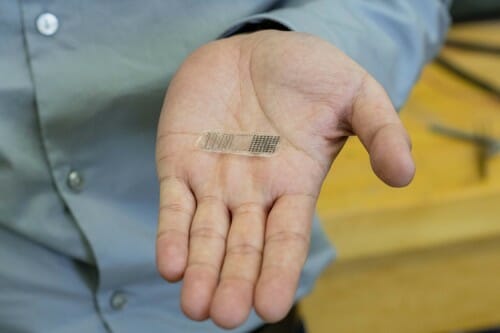
So did Xudong Wang, a professor of materials science and engineering at the University of Wisconsin–Madison and an expert in creating thin, movement-powered medical devices. “I started wondering if we could provide a new solution to bring athletes back to the field quicker than ever,” Wang says.Researchers know that electricity can help speed up bone healing, but “zapping” fractures has never really caught on, since it requires surgically implanting and removing electrodes powered by an external source.
A major update of that same electrostimulation concept, Wang’s latest invention didn’t come in time to help the 2017 Packers — however, it may help many others by making electrostimulation a much more convenient option to speed up bone healing.
Re: Transhumanism & Cybernetics News and Discussions
Posted: Thu Sep 23, 2021 12:31 am
by Yuli Ban
Re: Transhumanism & Cybernetics News and Discussions
Posted: Thu Sep 23, 2021 9:19 am
by Yuli Ban
Re: Transhumanism & Cybernetics News and Discussions
Posted: Wed Oct 27, 2021 7:32 pm
by Yuli Ban
Can I pick "all of the above?"
Re: Transhumanism & Cybernetics News and Discussions
Posted: Sun Oct 31, 2021 8:17 pm
by Yuli Ban
A 'visual prosthesis' implanted directly into the brain has allowed a blind woman to perceive two-dimensional shapes and letters for the first time in 16 years.
The US researchers behind this phenomenal advance in optical prostheses have recently published the results of their experiments, presenting findings that could help revolutionize the way we help those without sight see again.
At age 42, Berna Gomez developed toxic optic neuropathy, a deleterious medical condition that rapidly destroyed the optic nerves connecting her eyes to her brain.
In just a few days, the faces of Gomez' two children and her husband had faded into darkness, and her career as a science teacher had come to an unexpected end.
Then, in 2018, at age 57, Gomez made a brave decision. She volunteered to be the very first person to have a tiny electrode with a hundred microneedles implanted into the visual region of her brain. The prototype would be no larger than a penny, roughly 4 mm by 4 mm, and it would be taken out again after six months.
Unlike retinal implants, which are being explored as means of artificially using light to stimulate the nerves leaving the retina, this particular device, known as the Moran|Cortivis Prosthesis, bypasses the eye and optic nerve completely and goes straight to the source of visual perception.
Re: Transhumanism & Cybernetics News and Discussions
So Cyberpunk genre then. Cyberpunk 2077 showed pretty much this which was nice. The cybernetic tattoo would help against smart bullets in game as a concept so I wonder what else a cybernetic tattoo could do if infused with more exotic technology.
Edited due to typo.
Re: Transhumanism & Cybernetics News and Discussions
Posted: Sat Nov 13, 2021 6:57 am
by Yuli Ban
Re: Transhumanism & Cybernetics News and Discussions
Posted: Mon Dec 06, 2021 10:00 am
by Yuli Ban
Researchers in Australia have made a breakthrough with the Phoenix99 Bionic Eye, allowing for a rudimentary form of vision to blind people.
Scientists from the University of Sydney together with their colleagues from the University of New Wales (UNSW) have developed the Phoenix99 Bionic Eye, which may provide a rudimentary form of vision to certain categories of blind people in the near future. This includes, in particular, patients with retinitis pigmentosa, and those living with severe vision impairment. The three-month study has shown promising results, according to a post by the University of Sydney.
The Phoenix99 consists of a small video camera attached to a pair of glasses and captures the visual scene in front of the user. The video information is converted into a wireless signal, which is transmitted from the camera to the communication module under the skin behind the patient’s ear.
Re: Transhumanism & Cybernetics News and Discussions
Posted: Mon Jan 03, 2022 3:52 pm
by caltrek
Mechanical Engineer Awarded $2.1 Million National Institute of Health Grant to Launch Clinical Trial for Exoskeleton Technology January 3, 2022
(Northern Arizona University via EurekAlert) Mechanical engineer and inventor Zach Lerner, assistant professor in Northern Arizona University’s Department of Mechanical Engineering, has been awarded $2.1 million by the National Institutes of Health’s Eunice Kennedy Shriver National Institute of Child Health & Human Development.
This funding, Lerner’s largest grant as principal investigator to date, will enable him to launch a major, five-year clinical trial to test a treatment strategy for children with cerebral palsy (CP) using his patented and patent-pending inventions comprising a lightweight, wearable robotic device that provides neuromuscular training while making walking easier.
“This is far and away the most significant grant we’ve received to date in terms of duration, budget and scope,” Lerner said. “The project builds directly on the work we’ve been doing at NAU for the past five years—developing an adaptive ankle exoskeleton device that offers a lightweight, portable and effective way to improve mobility in children with CP. We completed technological evaluations and the initial clinical feasibility and pilot studies necessary to collect the preliminary data for this randomized controlled trial (RCT), which is the gold standard for clinical trials looking to establish efficacy of a new intervention relative to standard of care.”
Re: Transhumanism & Cybernetics News and Discussions
Posted: Tue Feb 08, 2022 4:02 am
by Yuli Ban
A paralysed man with a severed spinal cord has been able to walk again, thanks to an implant developed by a team of Swiss researchers.
It is the first time someone who has had a complete cut to their spinal cord has been able to walk freely.
The same technology has improved the health of another paralysed patient to the extent that he has been able to become a father.
The research has been published in the journal Nature Medicine.
Michel Roccati was paralysed after a motorbike accident five years ago. His spinal cord was completely severed - and he has no feeling at all in his legs.
But he can now walk - because of an electrical implant that has been surgically attached to his spine.
Re: Transhumanism & Cybernetics News and Discussions
Posted: Tue Feb 08, 2022 10:36 pm
by Yuli Ban
Re: Transhumanism & Cybernetics News and Discussions
Posted: Mon Feb 14, 2022 9:32 pm
by Yuli Ban
Once upon a time there were some unusual Australian sheep, with exceptionally sharp eyesight.
The small flock spent three months last year with bionic, artificial eyes, surgically implanted behind their retinas.
These sheep were part of a medical trial that aims to ultimately help people with some types of blindness to be able to see.
The specific aim of the sheep test was to see if the device in question, the Phoenix 99, caused any adverse physical reactions - the bionic eye was said to have been well tolerated by the animals. As a result, an application has now been made to start testing in human patients.
The project is being carried out by a team of researchers from the University of Sydney and the University of New South Wales.
The Phoenix 99 is wirelessly linked to a small camera attached to a pair of glasses, it works by stimulating a user's retina. The retina is the layer of light-sensitive cells at the back of the eye that convert light into electrical messages, sent to the brain via the optic nerve, and processed into what we see.