In June 2019, the #500 fastest supercomputer had 1.02 fp64 petaflops, using 1710 Xeon E5-2682v4 16C/32T 2.5 GHz.
In June 2024, the #500 fastest supercomputer had 2.13 fp64 petaflops, using 1162 Xeon Platinum 8360Y 36C/72T 2.4 GHz (total power draw is 395 kilowatts). Efficiency is 5.4 gigaflops per watt (when looking at the whole system).
That's a 2.09x higher High-Performance Linpack flops score after 5 years, which certainly could be regarded as disappointing. Classic theory presumes 2x every 18 months. But still it is exponential, as using 32% less processors they were able to achieve 109% higher performance (in Linpack at least).
One Nvidia B200 costs $6,000 to produce and $40,000 to buy. So it is extremely expensive to build a supercomputer out of even 1 thousand of those, let alone 40 thousand. And one of them might use up to 1200 or even 1300 watts!
For me #1 supercomputer is just like The 1969 Moon Landing <--- it doesn't change much for the vast majority of people. Just a flex - "look at what we can do!". How many people have access to the top 10 supercomputers? Not many. They don't matter as much as some people think.
Supercomputing News and Discussions
-
weatheriscool
- Posts: 24482
- Joined: Sun May 16, 2021 6:16 pm
- Contact:
-
firestar464
- Posts: 7202
- Joined: Wed Oct 12, 2022 7:45 am
-
Tadasuke
November 2024 supercomputers updates
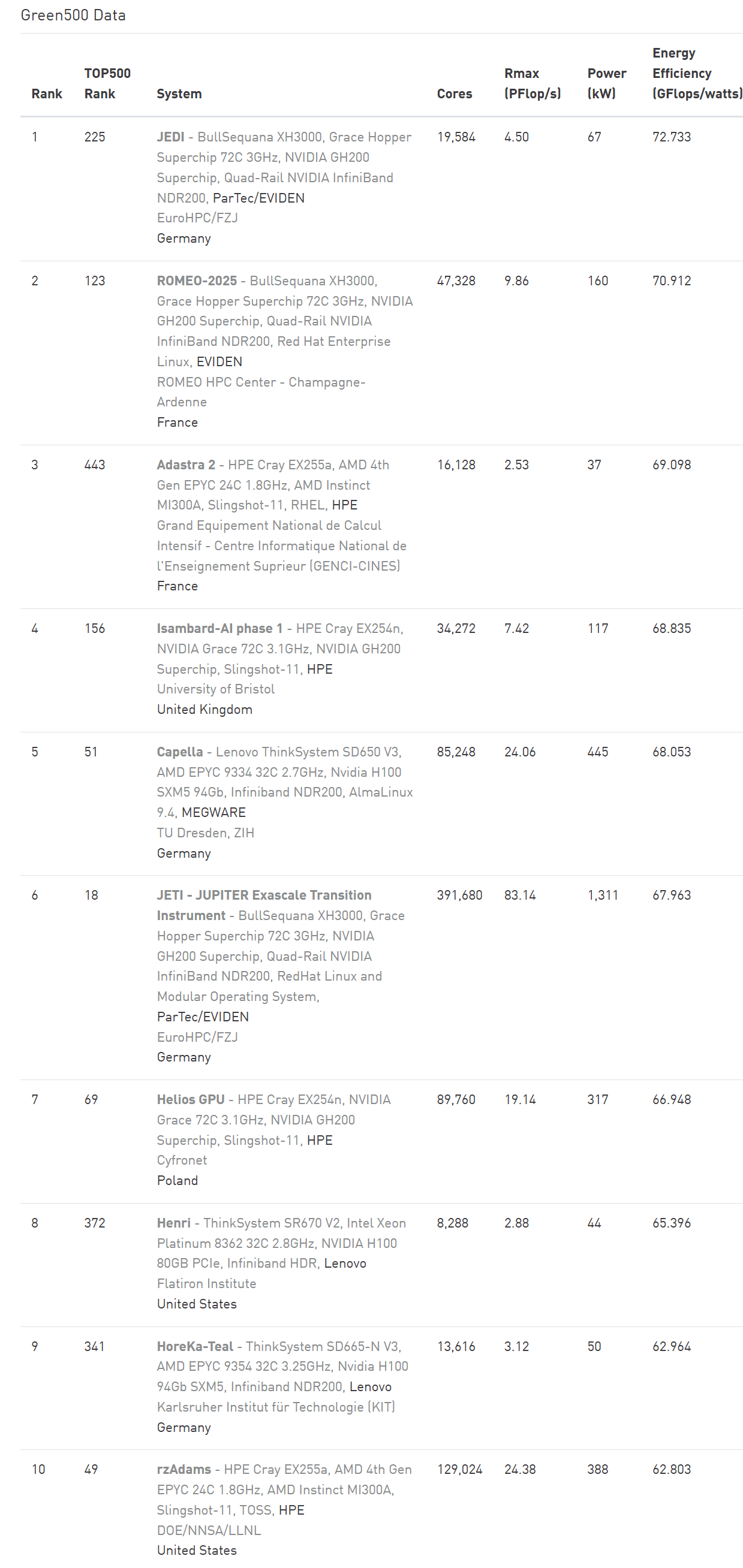
What matters is energy efficiency ("Green500") and useful performance ("HPCG"), therefore the "new" November 2024 lists:
https://top500.org/lists/green500/2024/11/
https://top500.org/lists/hpcg/2024/11/
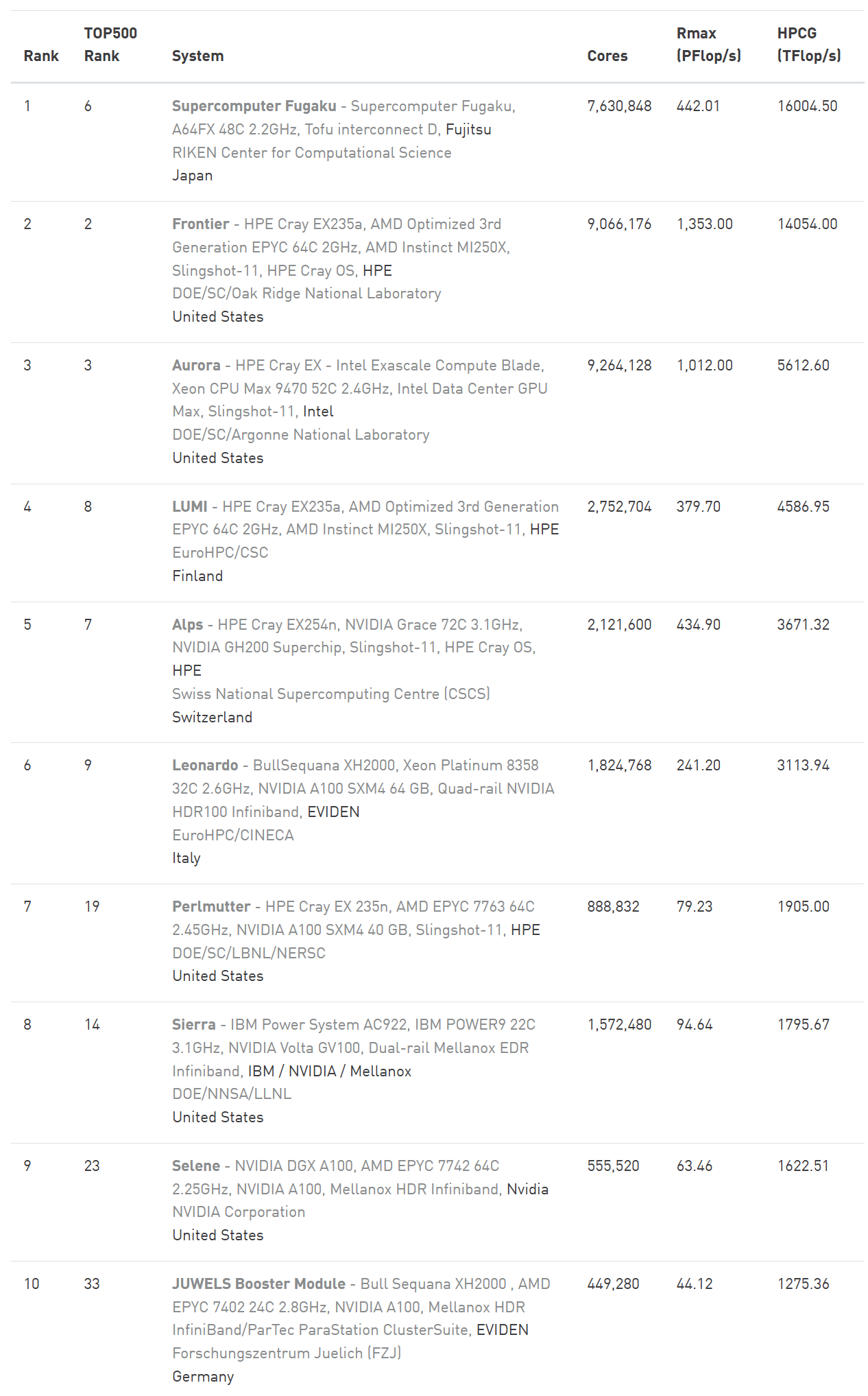
No substantial progress. A bit more of the same.
https://top500.org/lists/green500/2024/11/
https://top500.org/lists/hpcg/2024/11/
No substantial progress. A bit more of the same.

Re: Supercomputing News and Discussions
UK government this morning announced a plan to "increase the public compute capacity by twentyfold" and said "this starts immediately with work starting on a brand new supercomputer."
Re: Supercomputing News and Discussions
Up close with the world's largest supercomputer
Jan 10, 2025
The world's most powerful supercomputer was officially dedicated in California Thursday, with the CEOs of Hewlett-Packard Enterprise and AMD on hand to celebrate their handiwork.
Why it matters: El Capitan — as the $600 million supercomputer is known — will handle an array of classified tasks aimed at securing the U.S. stockpile of nuclear weapons and run a variety of other unspecified simulations.
Zoom in: El Capitan and a smaller sibling designed for nonclassified work sit inside a large data center inside Lawrence Livermore National Labs, roughly 30 miles northeast of Silicon Valley.
[...]
By the numbers: El Capitan is capable of peak performance of 2.79 exaflops, or 2.79 quintillion calculations per second.
https://www.axios.com/2025/01/10/lawren ... ercomputer

Photos: Ina Fried/Axios
Jan 10, 2025
The world's most powerful supercomputer was officially dedicated in California Thursday, with the CEOs of Hewlett-Packard Enterprise and AMD on hand to celebrate their handiwork.
Why it matters: El Capitan — as the $600 million supercomputer is known — will handle an array of classified tasks aimed at securing the U.S. stockpile of nuclear weapons and run a variety of other unspecified simulations.
Zoom in: El Capitan and a smaller sibling designed for nonclassified work sit inside a large data center inside Lawrence Livermore National Labs, roughly 30 miles northeast of Silicon Valley.
[...]
By the numbers: El Capitan is capable of peak performance of 2.79 exaflops, or 2.79 quintillion calculations per second.
https://www.axios.com/2025/01/10/lawren ... ercomputer
Photos: Ina Fried/Axios
Re: Supercomputing News and Discussions
Speculation mounts that Musk will raise tens of billions for AI supercomputer with 1 million GPUs: Report
By Anton Shilov
published 22 April 2025
Elon Musk has held a call with major xAI investors recently in an attempt to raise tens of billions of dollars, according to CNBC's David Faber, a renowned financial journalist and market news analyst. Musk reportedly outlined the raise as a way to place a proper value on the company, although the analyst contends that the money could also be spent on xAI's Colossus 2 supercomputer, which features one million GPUs.
"Musk is quoted as having said, we are going to 'put a proper value on the company' in reference to xAI and people took that to mean and again, this is speculation, that they will have a large raise, the last raise," said Faber. "Remember that I reported on $6 billion. This one would be far in excess of that. Perhaps you get a raise of something like $25 billion for a value that could purport to be between $150 and $200 billion. That's speculation. But that is kind of the conversation that is going on after this call."
xAI's major spendings are on supercomputer clusters to train even more advanced AI models and then used them to earn money. Currently, xAI has its Colossus supercomputer with 200,000 Nvidia's Hopper H100 and H100 GPUs, but Musk is gearing up to build Colossus 2 with a million GPUs, according to Faber. This is apparently why the company needs money. However, it requires considerably more than Faber speculates.
One million Nvidia Blackwell B100 or B200 GPUs will cost from $50 billion to $62.5 billion, depending on the deal Elon Musk manages to strike with Nvidia and its partners. The remaining infrastructure (building, servers, networking gear, cooling, etc.) would roughly cost approximately the same amount of money, so we're looking at a total of $100 billion to $125 billion. Whether Musk can raise them in a reasonable amount of time remains to be seen.
https://www.tomshardware.com/tech-indus ... pus-report
By Anton Shilov
published 22 April 2025
Elon Musk has held a call with major xAI investors recently in an attempt to raise tens of billions of dollars, according to CNBC's David Faber, a renowned financial journalist and market news analyst. Musk reportedly outlined the raise as a way to place a proper value on the company, although the analyst contends that the money could also be spent on xAI's Colossus 2 supercomputer, which features one million GPUs.
"Musk is quoted as having said, we are going to 'put a proper value on the company' in reference to xAI and people took that to mean and again, this is speculation, that they will have a large raise, the last raise," said Faber. "Remember that I reported on $6 billion. This one would be far in excess of that. Perhaps you get a raise of something like $25 billion for a value that could purport to be between $150 and $200 billion. That's speculation. But that is kind of the conversation that is going on after this call."
xAI's major spendings are on supercomputer clusters to train even more advanced AI models and then used them to earn money. Currently, xAI has its Colossus supercomputer with 200,000 Nvidia's Hopper H100 and H100 GPUs, but Musk is gearing up to build Colossus 2 with a million GPUs, according to Faber. This is apparently why the company needs money. However, it requires considerably more than Faber speculates.
One million Nvidia Blackwell B100 or B200 GPUs will cost from $50 billion to $62.5 billion, depending on the deal Elon Musk manages to strike with Nvidia and its partners. The remaining infrastructure (building, servers, networking gear, cooling, etc.) would roughly cost approximately the same amount of money, so we're looking at a total of $100 billion to $125 billion. Whether Musk can raise them in a reasonable amount of time remains to be seen.
https://www.tomshardware.com/tech-indus ... pus-report
Re: Supercomputing News and Discussions
Government recommits to Edinburgh supercomputer
11 Jun 2025
The government has announced up to £750 million for a new national supercomputer in Edinburgh, after controversially axing its funding last year.
The U-turn on investment in the supercomputer project at the University of Edinburgh will be confirmed in chancellor Rachel Reeves’s spending review announcement on 11 June. It comes after prime minister Keir Starmer announced a separate £1 billion investment in the Artificial Intelligence Research Resource to “scale up our compute power by a factor of 20”.
Last year, the government shelved £1.3bn pledged by the Tory government for advanced computers, including £800m for the exascale supercomputer at Edinburgh and £500m for the AI Research Resource, a cluster of advanced computers for AI research.
Following outcry at the decision, science secretary Peter Kyle claimed in October that the previous government had not committed “a single penny” to the supercomputer project, forcing Labour to make the “difficult decision” to shelve future funding.
The recommitment to the Edinburgh supercomputer forms part of the government’s plans to greatly enhance the UK’s AI capabilities and research, some of which were set out in January’s AI Opportunities Action Plan. Last year, critics said cancelling the funding for the exascale supercomputer would be “catastrophic” for UK science.
https://www.researchprofessionalnews.co ... rcomputer/
11 Jun 2025
The government has announced up to £750 million for a new national supercomputer in Edinburgh, after controversially axing its funding last year.
The U-turn on investment in the supercomputer project at the University of Edinburgh will be confirmed in chancellor Rachel Reeves’s spending review announcement on 11 June. It comes after prime minister Keir Starmer announced a separate £1 billion investment in the Artificial Intelligence Research Resource to “scale up our compute power by a factor of 20”.
Last year, the government shelved £1.3bn pledged by the Tory government for advanced computers, including £800m for the exascale supercomputer at Edinburgh and £500m for the AI Research Resource, a cluster of advanced computers for AI research.
Following outcry at the decision, science secretary Peter Kyle claimed in October that the previous government had not committed “a single penny” to the supercomputer project, forcing Labour to make the “difficult decision” to shelve future funding.
The recommitment to the Edinburgh supercomputer forms part of the government’s plans to greatly enhance the UK’s AI capabilities and research, some of which were set out in January’s AI Opportunities Action Plan. Last year, critics said cancelling the funding for the exascale supercomputer would be “catastrophic” for UK science.
https://www.researchprofessionalnews.co ... rcomputer/
Re: Supercomputing News and Discussions
Isambard-AI, the UK’s Most Powerful AI Supercomputer, Goes Live
The University of Bristol’s Isambard-AI, powered by NVIDIA Grace Hopper Superchips, delivers 21 exaflops of AI performance, making it the fastest system in the U.K. and among the most energy-efficient globally.
July 17, 2025 by Brian Caulfield
[...]
The University of Bristol’s Isambard-AI, powered by NVIDIA Grace Hopper Superchips, delivers 21 exaflops of AI performance, making it the fastest system in the U.K. and among the most energy-efficient globally.
July 17, 2025 by Brian Caulfield
[...]
- 21 exaflops of AI performance
- 5,448 NVIDIA GH200 Grace Hopper Superchips
- Set to rank 11th worldwide on the latest TOP500 list of world’s fastest supercomputers
- More than 10x faster than the next-fastest supercomputer in the U.K. More computing power than all other U.K. supercomputers combined
- Ranked fourth globally for energy efficiency
-
weatheriscool
- Posts: 24482
- Joined: Sun May 16, 2021 6:16 pm
- Contact:
Re: Supercomputing News and Discussions
The exaflop era: MIT's new supercomputer is fast, real fast
By Chelsea Haney
October 30, 2025
By Chelsea Haney
October 30, 2025
https://newatlas.com/computers/exaflop- ... rcomputer/
At MIT’s Lincoln Laboratory, a new supercomputer has arrived. TX-GAIN, capable of two AI-exaflops, fuses more than six hundred GPUs into a single, coordinated pulse of processing power. Built not just to calculate but to comprehend, it promises to accelerate breakthroughs in medicine, climate modeling, and beyond.
The new TX-Generative AI Next (TX-GAIN) system has come online: a supercomputer capable of the equivalent of two quintillion operations every second! That’s enough to make yesterday’s loading bar feel like ancient history turtle speed.
To put this into context: Japan’s Fugaku claimed the title of world’s fastest supercomputer in 2020. NVIDIA’s DGX GH200, launched in 2023, then redrew the AI map by linking 256 Grace Hopper chips into a unified architecture. Now, just two years later, TX-GAIN pushes that curve again. It's proof that what once took decades of progress now happens between coffee refills, and it’s the hardware that makes that leap visible.
Re: Supercomputing News and Discussions
Human brain-scale simulations move a step closer
Researchers have developed a new GPU-based method for constructing large neural networks, making the setup phase over ten times faster and paving the way for human brain-scale simulations on future supercomputers.
16th January 2026
Simulating the brain at the level of individual neurons and synapses represents one of the most demanding challenges in computational science. Even a tiny square millimetre of cerebral cortex can generate more than a billion synaptic events per second, as millions of neurons exchange brief electrical spikes with millisecond precision. A new study by an international research team describes a significant advance in tackling this problem, by radically speeding up how such enormous neural networks are built and prepared for simulation on modern supercomputers.
[...]
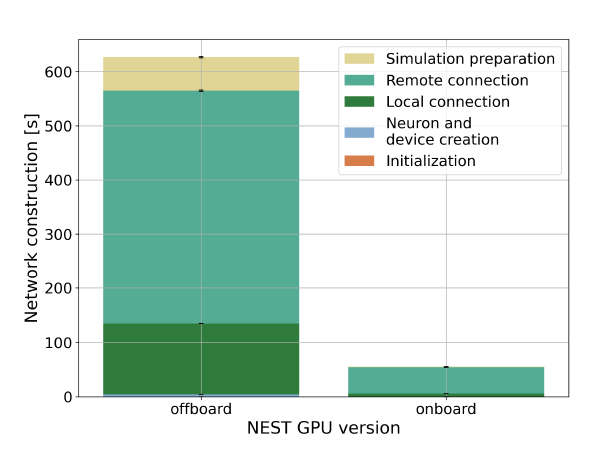
The researchers tested this approach on a realistic model of 32 vision-related areas in the macaque monkey cortex, comprising 4.1 million neurons and 24 billion synapses spread across 32 NVIDIA GPUs. Most of the improvement comes from building local connections 20 times faster and remote connections 9 times faster, while producing identical neural activity to the previous method. The graph below shows how this new "onboard" approach cuts time across every stage of the neural network construction.
Looking ahead, the authors say their method is scalable to far larger and more ambitious models. They point to Europe's first exascale supercomputer, JUPITER, which recently began operations, featuring powerful GH200-class GPU nodes and ultra-fast interconnects that move data between processors with minimal delay. On systems of this scale, the same approach could support simulations of 20 billion neurons and on the order of 10¹⁴ synapses, equivalent to the full human cerebral cortex, while still tracking individual connections and millisecond-level spikes.
Read more: https://www.futuretimeline.net/blog/202 ... meline.htm
Researchers have developed a new GPU-based method for constructing large neural networks, making the setup phase over ten times faster and paving the way for human brain-scale simulations on future supercomputers.
16th January 2026
Simulating the brain at the level of individual neurons and synapses represents one of the most demanding challenges in computational science. Even a tiny square millimetre of cerebral cortex can generate more than a billion synaptic events per second, as millions of neurons exchange brief electrical spikes with millisecond precision. A new study by an international research team describes a significant advance in tackling this problem, by radically speeding up how such enormous neural networks are built and prepared for simulation on modern supercomputers.
[...]
The researchers tested this approach on a realistic model of 32 vision-related areas in the macaque monkey cortex, comprising 4.1 million neurons and 24 billion synapses spread across 32 NVIDIA GPUs. Most of the improvement comes from building local connections 20 times faster and remote connections 9 times faster, while producing identical neural activity to the previous method. The graph below shows how this new "onboard" approach cuts time across every stage of the neural network construction.
Looking ahead, the authors say their method is scalable to far larger and more ambitious models. They point to Europe's first exascale supercomputer, JUPITER, which recently began operations, featuring powerful GH200-class GPU nodes and ultra-fast interconnects that move data between processors with minimal delay. On systems of this scale, the same approach could support simulations of 20 billion neurons and on the order of 10¹⁴ synapses, equivalent to the full human cerebral cortex, while still tracking individual connections and millisecond-level spikes.
Read more: https://www.futuretimeline.net/blog/202 ... meline.htm
Re: Supercomputing News and Discussions
A Shapeshifting Supercomputer May Be More Energy Efficient
Katherine Bourzac
20 minutes ago
Late last year, Sandia National Laboratories started testing an unusual type of supercomputer. Unlike conventional supercomputers, which consist of large interconnected clusters of CPUs and GPUs, this machine incorporates reconfigurable accelerators that optimize their operations for the particular computation that’s being run. This new architecture, which is similar to field-programmable gate arrays (FPGAs), is built by start up NexSilicon. A key benefit of the approach is that it doesn’t require a software re-write: the hardware optimizes itself for the software, not vice versa.
Spectra, which incorporates 128 NextSilicon Maverick-2 accelerators, is still in the investigative phase, says program leader and Sandia senior scientist James Laros. NextSilicon, which has headquarters in Tel Aviv and Minneapolis, claims its accelerators generally use half as much power as NVIDIA’s Blackwell while offering a 4x speed advantage. The power and speed vary depending on the particular application.
NextSilicon CEO Elad Raz says typical architectures predict the next instruction then fetch and cache data. “What if you can remove all that overhead?” he wondered. “A lot of people are trying to build a new CPU or a better GPU. Other companies have a software solution,” says Raz. “I wanted to build something with software and hardware collaborating together.”
The company’s Maverick-2 first runs the application on a CPU and identifies which operations run most frequently. Then, it reconfigures the chip to schedule its work in a way that optimizes data flow. Instead of back and forth fetching of data, he says, “you can generate a pipeline.”
And a key advantage of the company’s design is that users do not have to rewrite their software in order to run it more efficiently on the system. The hardware adapts to the software, not vice versa.
https://spectrum.ieee.org/reconfigurabl ... id=9186317

Credit: Craig Fritz/Sandia National Laboratories
Katherine Bourzac
20 minutes ago
Late last year, Sandia National Laboratories started testing an unusual type of supercomputer. Unlike conventional supercomputers, which consist of large interconnected clusters of CPUs and GPUs, this machine incorporates reconfigurable accelerators that optimize their operations for the particular computation that’s being run. This new architecture, which is similar to field-programmable gate arrays (FPGAs), is built by start up NexSilicon. A key benefit of the approach is that it doesn’t require a software re-write: the hardware optimizes itself for the software, not vice versa.
Spectra, which incorporates 128 NextSilicon Maverick-2 accelerators, is still in the investigative phase, says program leader and Sandia senior scientist James Laros. NextSilicon, which has headquarters in Tel Aviv and Minneapolis, claims its accelerators generally use half as much power as NVIDIA’s Blackwell while offering a 4x speed advantage. The power and speed vary depending on the particular application.
NextSilicon CEO Elad Raz says typical architectures predict the next instruction then fetch and cache data. “What if you can remove all that overhead?” he wondered. “A lot of people are trying to build a new CPU or a better GPU. Other companies have a software solution,” says Raz. “I wanted to build something with software and hardware collaborating together.”
The company’s Maverick-2 first runs the application on a CPU and identifies which operations run most frequently. Then, it reconfigures the chip to schedule its work in a way that optimizes data flow. Instead of back and forth fetching of data, he says, “you can generate a pipeline.”
And a key advantage of the company’s design is that users do not have to rewrite their software in order to run it more efficiently on the system. The hardware adapts to the software, not vice versa.
https://spectrum.ieee.org/reconfigurabl ... id=9186317
Credit: Craig Fritz/Sandia National Laboratories
Re: Supercomputing News and Discussions
£45M for UK’s first AI supercomputer to accelerate fusion energy
1.4MW mission-focused supercomputer named ‘Sunrise’, primed to be the world's most powerful AI supercomputer dedicated to fusion energy.
16 March 2026
The UK government is investing £45 million for a 1.4MW mission-focused supercomputer named ‘Sunrise’, a key first step in establishing the country’s first AI Growth Zone at the UK Atomic Energy Authority’s (UKAEA) Culham Campus in Oxfordshire.
As announced in the Fusion Strategy, Sunrise is targeted for operation in June this year and is primed to be the world’s most powerful AI supercomputer dedicated to fusion energy.
Funded by the Department for Energy Security and Net Zero (DESNZ), Sunrise will tackle key fusion energy challenges in areas such as plasma turbulence, materials development and tritium fuel breeding, while delivering spillover benefits to other clean energy technologies and the UK’s broader net zero ambitions.
It will deliver up to 6.76 Exaflops of AI-accelerated modelling, enabling high-fidelity simulations and the creation of digital twins for complex systems.
https://www.gov.uk/government/news/45m- ... ion-energy
1.4MW mission-focused supercomputer named ‘Sunrise’, primed to be the world's most powerful AI supercomputer dedicated to fusion energy.
16 March 2026
The UK government is investing £45 million for a 1.4MW mission-focused supercomputer named ‘Sunrise’, a key first step in establishing the country’s first AI Growth Zone at the UK Atomic Energy Authority’s (UKAEA) Culham Campus in Oxfordshire.
As announced in the Fusion Strategy, Sunrise is targeted for operation in June this year and is primed to be the world’s most powerful AI supercomputer dedicated to fusion energy.
Funded by the Department for Energy Security and Net Zero (DESNZ), Sunrise will tackle key fusion energy challenges in areas such as plasma turbulence, materials development and tritium fuel breeding, while delivering spillover benefits to other clean energy technologies and the UK’s broader net zero ambitions.
It will deliver up to 6.76 Exaflops of AI-accelerated modelling, enabling high-fidelity simulations and the creation of digital twins for complex systems.
https://www.gov.uk/government/news/45m- ... ion-energy
-
weatheriscool
- Posts: 24482
- Joined: Sun May 16, 2021 6:16 pm
- Contact: