Extreme weather news and discussion
Posted: Fri Jun 11, 2021 6:54 pm
This will be the thread we will talk about historic heat and cold. The nasty stuff. Along with drought! 
A community of futurology enthusiasts
https://www.futuretimeline.net/forum/
https://www.futuretimeline.net/forum/viewtopic.php?f=20&t=549
(Grist) Every year heat kills tens of thousands of people. Their breathing grows shallow, their heart rates flutter, their muscles spasm, and then they die. Heat killed over 100,000 people in 2018, when high temperatures broiled the European Union.
A new study suggests that climate change was responsible for many of those deaths. The paper, published Monday in Nature Climate Change, scrutinized summertime deaths in 43 countries between 1991 and 2018 — the largest collection of heat mortality data ever assembled.
The researchers estimate that higher temperatures driven by greenhouse gas emissions caused more than half the heat-related deaths in several countries, including Thailand, Peru and the Philippines. On average, climate change was at fault for 37 percent of heat-related deaths. The world has only warmed around 2 degrees Fahrenheit so far, but that’s already enough to kill roughly 100,000 people every year, if you apply this paper’s estimate to the entire world.
There are, however, some pretty big holes in the data for anyone trying to do that kind of extrapolation. There’s simply no data on heat-related deaths from huge swaths of the world, including major population centers in equatorial Africa, and India. “The main point of this paper is that the map is mainly empty!” wrote Friedi Otto, a climate scientist at the University of Oxford who was not involved in the study, in an email. And Otto’s own research suggests that that heat is particularly deadly in these places that don’t have sophisticated systems to record the cause of deaths.
In other words, reality could be worse than the estimates. “The countries where we do not have the necessary health data are often among the poorest and most susceptible to climate change, and, concerningly, are also the projected major hotspots of future population growth, ” according to Dann Mitchell, a climate scientist at the University of Bristol, in a piece accompanying the study.
,,,
The drought that has brought Lake Mead low has gripped California, the Pacific Northwest, the Great Basin spanning Nevada, Oregon and Utah, plus the southwestern states of Arizona and New Mexico and even part of the Northern Plains.
Farmers are abandoning crops, Nevada is banning the watering of about one-third of the lawn in the Las Vegas area, and the governor of Utah is literally asking people to pray for rain.
Firefighters are facing worsening conditions this summer – after nearly 10,000 fires in California alone during the last wildfire season burned 4.2 million acres (1.7 million hectares), an area nearly as large as Kuwait.
Droughts are a recurring natural hazard but made worse recently by an accumulation of extremely dry years for most of this century. Scientists say human-influenced climate change has exacerbated the situation.
The record-breaking heat wave roasting the West is expanding its grip on Thursday, with the focus of the triple-digit heat shifting into California — particularly the Central Valley and desert regions.
Why it matters: Across the West, the combination of record heat, preexisting drought conditions, and dry lightning strikes from afternoon thunderstorms threatens to ignite numerous wildfires Thursday.
- Fires have already been burning in Montana, Arizona and other states affected by the heat wave.
- More than 40 million people across the West and Southwest are likely to see temperatures in their area exceed 100°F during the next several days.
- Climate change is making this event more severe than it otherwise would be, based on numerous scientific studies on similar extreme weather events.
Read more: https://www.theguardian.com/us-news/202 ... ought-fireThis week the temperatures hit 106F (41C) in Billings, in northern Montana. In Arizona, animals were scorching their paws on blistering asphalt. In Texas, authorities asked residents to limit cooking and cleaning to preserve a creaking power grid.
These were just some of the scenes emerging from one of the most excruciating heatwaves to ever hit the western United States this early in the year. From California to Montana, a staggering 40 million people are experiencing temperatures of 100F (38C) or hotter this week, and 50 million were under excessive heat warnings and heat advisories.
For many it is merely a hint of things to come as the planet warms amid the global heating crisis and such extreme events become more and more common.
Many cities across the American west have opened cooling stations and hydration stations to keep people safe from the dangerous temperatures – and the hottest months of the year are still expected to come.
CHICAGO (AP) — A tornado swept through communities in heavily populated suburban Chicago, damaging more than 100 homes, toppling trees, knocking out power and causing multiple injuries, officials said.
At least five people, including a woman who was in critical condition, were hospitalized in Naperville, where 16 homes were left “uninhabitable” and dozens of other homes were damaged when a tornado touched down after 11 p.m. Sunday, said city spokeswoman Linda LaCloche.
More than 120 other reports of property damage had been received by 5 a.m. Monday in the suburb of 147,500 people that’s about 25 miles (40 kilometers) west of Chicago. Those were expected to grow as residents surveyed the damage, she said. About 450 power outages were reported.
“We’re lucky that it wasn’t worse,” LaCloche said Monday morning. “We have a lot of utility poles and electrical wires down, and tree damage.”
Pacific Northwest swelters in historic heat wave
Source: AP
By SARA CLINE and REBECCA BOONE
PORTLAND, Ore. (AP) — Government officials, wildlife managers and utility workers across the Pacific Northwest were trying to keep people and animals safe as a historic heat wave scorched the region Saturday.
The heat was expected to break all-time records in cities and towns from eastern Washington state to Portland to southern Oregon, with temperatures in many areas expected to top out up to 30 degrees above normal. It’s a dangerous forecast for a region accustomed to mild weather, and where many people don’t have air conditioning.
The hot weather had berry farmers scrambling to pick crops before they rot on the vine and fisheries managers working to keep endangered sockeye salmon safe from too-warm river water. Stores sold out of portable air conditioners and fans, some hospitals canceled outdoor vaccination clinics, cities opened cooling centers, baseball teams canceled or moved up weekend games, and utilities braced for possible power outages.
In western Washington, morning temperatures felt warmer than they were because of a higher-than-normal dew point, the National Weather Service in Seattle wrote on Twitter. A higher dew point makes the air more muggy or uncomfortable. Seattle was expected to edge above 100 degrees Fahrenheit (38 degrees Celsius) over the weekend and in Portland, Oregon, weather forecasters said the thermometer could soar to 108 F (42 C) by Sunday, breaking an all-time record of 107 F (42 C) set in 1981. Unusually hot weather was expected to extend into next week for much of the region.
Read more: https://apnews.com/article/heat-waves-f ... f0d26638cd

That is hot, i wouldn't like to be there currently.wjfox wrote: ↑Mon Jun 28, 2021 2:51 pm Mental.
-----
Canada weather: Heat hits record 46.6C as US north-west also sizzles
14 minutes ago
Canada has recorded its highest ever temperature as the country's west and the US Pacific north-west frazzle in an unprecedented heatwave.
Lytton in British Columbia soared to 46.6C (116F) on Sunday, breaking an 84-year-old record, officials said.
A "heat dome" - static high pressure acting like a lid on a cooking pot - has set records in many other areas.
The US and Canada have both warned citizens of "dangerous" heat levels that could persist this week.
https://www.bbc.co.uk/news/world-us-canada-57634700
PORTLAND, Ore. (AP) — Oregon’s largest city broke its all-time heat record on Saturday. It could beat the new mark on Sunday.
Forecasters say many Pacific Northwest communities may sweat through the hottest days in their histories as temperatures soar during a heat wave that has sent residents scrambling for relief.
Stores sold out of portable air conditioners and fans, hospitals canceled outdoor vaccination clinics, cities opened cooling centers, baseball teams canceled or moved up weekend games, and utilities braced for possible power outages.
Portland, Oregon, reached 108 degrees Fahrenheit (42.2 degrees Celsius) Saturday afternoon, according to the National Weather Service. The previous heat record for Oregon’s largest city was 107 F (41.7 C), a mark hit in 1965 and 1981.
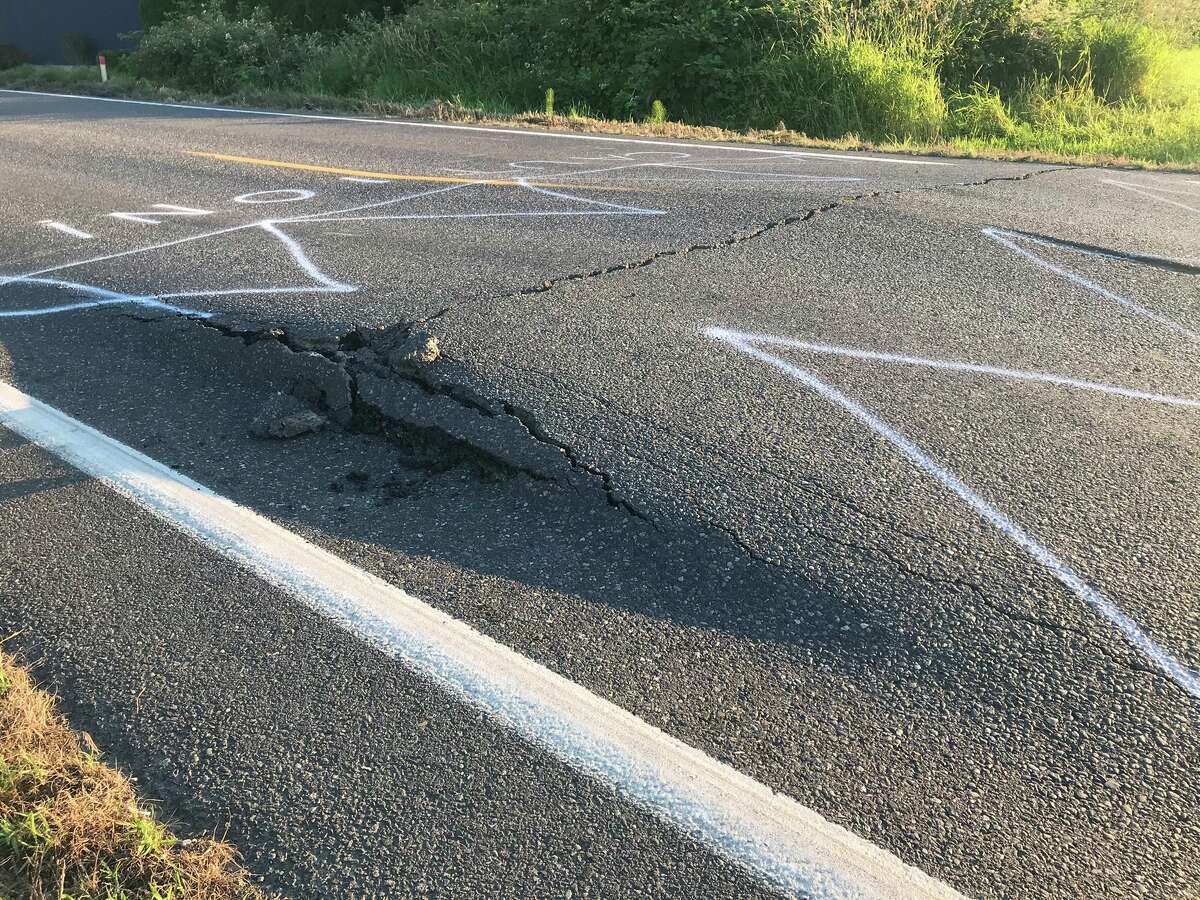
It's so hot in the Pacific Northwest that roads are buckling.
Asphalt and concrete roadways are expanding and cracking and even Interstate 5 has been impacted amid a heat wave that has sent temperatures soaring to dangerous levels.
"There have been several instances of road impacts across Western Washington today, including along I-5 at times," the National Weather Service's Seattle office wrote on Twitter. "Additional impacts likely tomorrow with another day of extreme heat. Remain vigilant on your commutes!"
The most severe heat wave in the history of the Pacific Northwest is near its climax. The National Weather Service had predicted it would be “historic, dangerous, prolonged and unprecedented,” and it is living up to its billing as it rewrites the record books.
On Monday, Portland, Ore., soared to at least 115 degrees, the highest temperature in more than 80 years of record-keeping. It marked the third straight day the city had climbed to an all-time high. On Sunday, it hit 112 Sunday after reaching 108 Saturday, both of which broke the previous all-time record of 107.
Seattle reached 108 degrees Monday evening, surpassing the all-time record of 104 degrees set Sunday (which topped the previous mark of 103).
Medford, Ore., tied its all-time record Monday of 115 degrees. So did Spokane, which soared to 108.
SPOKANE, Wash. (AP) — The unprecedented Northwest U.S. heat wave that slammed Seattle and Portland, Oregon, moved inland Tuesday — prompting a electrical utility in Spokane, Washington, to warn that people will face more rolling blackouts amid heavy power demand.
The intense weather that gave Seattle and Portland consecutive days of record high temperatures far exceeding 100 degrees (37.7 degrees Celcius) was expected to ease in those cities. But inland Spokane was likely to surpass Monday’s high temperature — a record-tying 105 Fahrenheit (40.6 Celsius).
About 8,200 utility customers in parts of Spokane lost power on Monday and Avista Utilities warned that there will be more rolling blackouts on Tuesday in the city of about 220,000 people with the high temperature predicted at 110 F (43.3C), which would be an all-time record.
Avista had planned for much higher than normal demand but hit its limit quicker than anticipated because of the intense heat, said Heather Rosentrater, the company’s senior vice president for energy delivery, said Monday night.