Exoplanets – worlds of other suns

weatheriscool
Posts: 24482
Joined: Sun May 16, 2021 6:16 pm
Contact:

Re: Exoplanets – worlds of other suns

Post by weatheriscool »

weatheriscool
Posts: 24482
Joined: Sun May 16, 2021 6:16 pm
Contact:

Re: Exoplanets – worlds of other suns

Post by weatheriscool »

Newly discovered 'super-Earth' offers prime target in search for alien life
https://phys.org/news/2025-10-newly-sup ... alien.html
by Pennsylvania State University

The discovery of a possible "super-Earth" less than 20 light-years from our own planet is offering scientists new hope in the hunt for other worlds that could harbor life, according to an international team including researchers from Penn State. They dubbed the exoplanet, named GJ 251 c, a "super-Earth" as data suggest it is almost four times as massive as Earth, and likely to be a rocky planet.

"We look for these types of planets because they are our best chance at finding life elsewhere," said Suvrath Mahadevan, the Verne M. Willaman Professor of Astronomy at Penn State and co-author of a paper about the discovery published in The Astronomical Journal.

"The exoplanet is in the habitable or the 'Goldilocks Zone,' the right distance from its star that liquid water could exist on its surface, if it has the right atmosphere."

weatheriscool
Posts: 24482
Joined: Sun May 16, 2021 6:16 pm
Contact:

Re: Exoplanets – worlds of other suns

Post by weatheriscool »

Three Earth-sized planets discovered in a compact binary system
https://phys.org/news/2025-10-earth-siz ... inary.html
by University de Liege

An international team of researchers has just revealed the existence of three Earth-sized planets in the binary stellar system TOI-2267 located about 190 light-years away. This discovery, published in Astronomy & Astrophysics, is remarkable as it sheds new light on the formation and stability of planets in double-star environments, which have long been considered hostile to the development of complex planetary systems.

"Our analysis shows a unique planetary arrangement: two planets are transiting one star, and the third is transiting its companion star," says Sebastián Zúñiga-Fernández, researcher and member of the ExoTIC group at the University of Liège (ULiège) and first author of the study. "This makes TOI-2267 the first binary system known to host transiting planets around both of its stars."
weatheriscool
Posts: 24482
Joined: Sun May 16, 2021 6:16 pm
Contact:

Re: Exoplanets – worlds of other suns

Post by weatheriscool »

User avatar
wjfox
Site Admin
Posts: 13575
Joined: Sat May 15, 2021 6:09 pm
Location: Essex, UK
Contact:

Re: Exoplanets – worlds of other suns

Post by wjfox »

Earth: A Well-Hidden Planet for Extraterrestrial Observers

1 hour ago

Recent discussions in Physics World explore how Earth might appear to extraterrestrial observers and suggest that our world could actually be surprisingly difficult to detect.

Astronomers searching for exoplanets often use the transit method, which detects the tiny dimming of a star as a planet crosses in front of it. However , this method only works if the observer is precisely aligned with the planet’s orbital plane. Because of Earth’s specific orbital geometry, only civilizations located within a very narrow band of space, the Earth Transit Zone (ETZ), could detect our planet this way.

According to research by Kipping and Teachey (2016), this zone makes up only a small fraction of the sky, meaning most potential observers wouldn’t even see Earth pass in front of the Sun. For them, our planet would remain invisible through transit-based searches.

While this limited visibility seems to make Earth “hidden,” it’s worth noting that advanced civilizations could use alternative methods such as direct imaging , gravitational lensing, or atmospheric biosignature detection to identify us. Still, if most rely on techniques similar to ours, Earth could easily blend into the cosmic background.

https://hive.blog/space/@kur8/earth-a-w ... den-planet


Image
Credit: S. R. Kane / arXiv:1511.03779 via Physics world
weatheriscool
Posts: 24482
Joined: Sun May 16, 2021 6:16 pm
Contact:

Re: Exoplanets – worlds of other suns

Post by weatheriscool »

Many mini-Neptunes once thought to be lava worlds may actually have solid surfaces
https://phys.org/news/2025-11-mini-nept ... orlds.html
by Louise Lerner, University of Chicago

As telescopes have become more powerful, it's turned out our solar system is not the only game in town: There are millions of other planets out there in the galaxy. But we're still teasing out clues about what they are actually like.

One of the puzzles is a kind of planet that appears to be one of the most common types in the universe. Known as "mini-Neptunes" because they run a little smaller than Neptune in our solar system, these planets are made of some mix of rock and metal, with thick atmospheres mostly made of hydrogen, helium, and perhaps water. Strangely, despite their abundance elsewhere, they have no analog in our own solar system, making the population something of an enigma.
weatheriscool
Posts: 24482
Joined: Sun May 16, 2021 6:16 pm
Contact:

Re: Exoplanets – worlds of other suns

Post by weatheriscool »

Second exoplanet discovered in the TOI-1422 system
Image
by Tomasz Nowakowski, Phys.org
https://phys.org/news/2025-11-exoplanet-toi.html
European astronomers report the discovery of a second alien world in the TOI-1422 planetary system located some 500 light years away. The newfound exoplanet, which received designation TOI-1422 c, is nearly three times larger and about 14 times more massive than Earth. The discovery was presented in a research paper published Nov. 14 on the arXiv pre-print server.

TOI-1422, also known as TIC 333473672, is a star of spectral type G2V at a distance of approximately 505 light years away from Earth, estimated to be 4.6 billion years old. The star is similar in size and mass to the sun, and has an effective temperature of about 5,811 K.
weatheriscool
Posts: 24482
Joined: Sun May 16, 2021 6:16 pm
Contact:

Re: Exoplanets – worlds of other suns

Post by weatheriscool »

An international team has made a significant breakthrough in understanding the tectonic evolution of terrestrial planets. Using advanced numerical models, the team systematically classified for the first time six distinct planetary tectonic regimes and identified a novel regime: the "episodic-squishy lid."

The study not only provides crucial clues to the origin of Earth's plate tectonics but also offers a robust theoretical framework for deciphering the enigmatic geological features of Venus. The findings have been published in the journal Nature Communications. The team was led by researchers from the Department of Earth and Planetary Sciences at The University of Hong Kong (HKU), including postdoctoral fellow Dr. Tianyang Lyu, Professor Man Hoi Lee (also with the Department of Physics), and Mok Sau-King Professor Guochun Zhao.
weatheriscool
Posts: 24482
Joined: Sun May 16, 2021 6:16 pm
Contact:

Re: Exoplanets – worlds of other suns

Post by weatheriscool »

weatheriscool
Posts: 24482
Joined: Sun May 16, 2021 6:16 pm
Contact:

Re: Exoplanets – worlds of other suns

Post by weatheriscool »


User avatar
wjfox
Site Admin
Posts: 13575
Joined: Sat May 15, 2021 6:09 pm
Location: Essex, UK
Contact:

Re: Exoplanets – worlds of other suns

Post by wjfox »

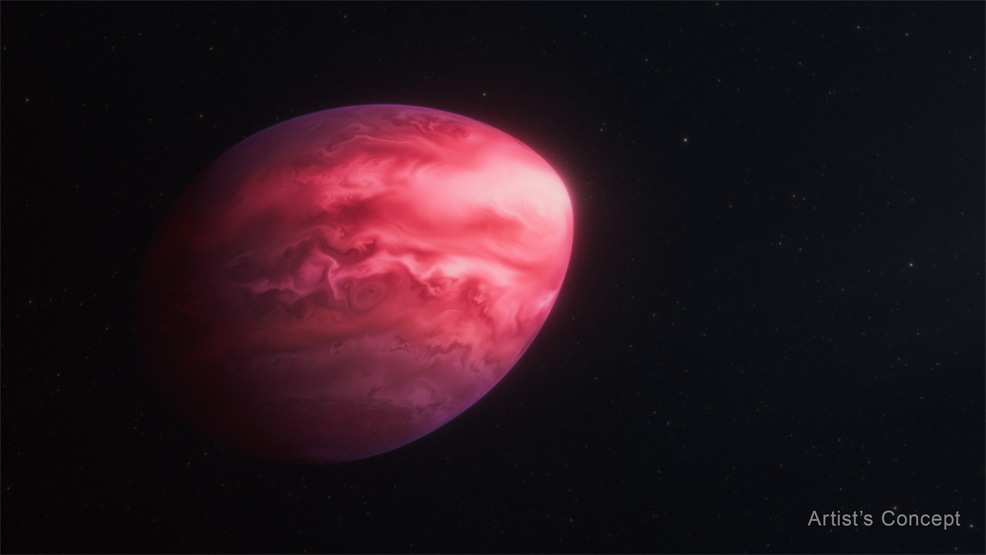
Lemon-shaped planet found by Webb telescope

18th December 2025

Scientists using the James Webb Space Telescope (JWST) have observed an entirely new class of exoplanet whose atmospheric composition challenges our understanding of how it formed.

The Jupiter-mass object, PSR J2322-2650b, is located 750 light-years away. It orbits a pulsar – a type of rapidly rotating neutron star that emits beams of electromagnetic radiation from its magnetic poles – every 7.8 hours. Separated by a distance of just 0.01 astronomical units (1.5 million km), the gravitational distortion from the much heavier pulsar is so huge that the planet is being stretched into a bizarre, lemon-like shape.

While astronomers have previously identified tidally distorted exoplanets, PSR J2322-2650b represents an even more extreme case. In 2024, a team reported the discovery of TOI-6255 b, an egg-shaped rocky planet whose form is warped by intense tidal forces from a nearby red dwarf star. However, PSR J2322-2650b is subject to far stronger gravitational stresses, orbiting not a star but a pulsar – one of the densest objects in the universe – resulting in a level of distortion that surpasses anything seen before.

Furthermore, its exotic helium- and molecular-carbon-dominated atmosphere appears to rule out all known planetary formation mechanisms. Soot clouds likely float through the air, while deep within the planet, carbon may condense to form diamonds.

https://www.futuretimeline.net/blog/202 ... escope.htm


Image
weatheriscool
Posts: 24482
Joined: Sun May 16, 2021 6:16 pm
Contact:

Re: Exoplanets – worlds of other suns

Post by weatheriscool »

Ultra-hot lava world has thick atmosphere, upending expectations

by Carnegie Institution for Science
A Carnegie-led team of astronomers detected the strongest evidence yet of an atmosphere around a rocky planet beyond our solar system. Their work, published in The Astrophysical Journal Letters, used NASA's JWST to reveal an alien atmosphere in an unexpected place—an ancient, ultra-hot super-Earth that likely hosts a magma ocean.

TOI-561 b is a rocky world that's about twice Earth's mass but bears little resemblance to our home planet due to its proximity to its host star. Although the star is slightly less massive and cooler than our sun, the planet orbits at one fortieth the distance of Mercury in our own solar system. On TOI-561 b, a year lasts just 10.56 hours, and one side of the planet is in perpetual daylight.

"Based on what we know about other systems, astronomers would have predicted that a planet like this is too small and hot to retain its own atmosphere for long after formation," explained Carnegie Science Postdoctoral Fellow Nicole Wallack, the paper's second author. "But our observations suggest it is surrounded by a relatively thick blanket of gas, upending conventional wisdom about ultra-short-period planets."
https://phys.org/news/2025-12-ultra-hot ... thick.html
weatheriscool
Posts: 24482
Joined: Sun May 16, 2021 6:16 pm
Contact:

Re: Exoplanets – worlds of other suns

Post by weatheriscool »

Astronomers measure both mass and distance of a rogue planet for the first time
https://phys.org/news/2026-01-astronome ... lanet.html
by Krystal Kasal, Phys.org

While most planets that we are familiar with stick relatively close to their host star in a predictable orbit, some planets seem to have been knocked out of their orbits, floating through space free of any particular gravitational attachments. Astronomers refer to these lonely planets as "free-floating" or "rogue" planets.

Recently, a new rogue planet was identified, and, unlike previously identified rogue planets, astronomers were able to calculate both its mass and distance from Earth. A new study, published in Science, describes how a few lucky observations from both ground-based and space-based telescopes made these calculations possible.
weatheriscool
Posts: 24482
Joined: Sun May 16, 2021 6:16 pm
Contact:

Re: Exoplanets – worlds of other suns

Post by weatheriscool »

User avatar
wjfox
Site Admin
Posts: 13575
Joined: Sat May 15, 2021 6:09 pm
Location: Essex, UK
Contact:

Re: Exoplanets – worlds of other suns

Post by wjfox »

weatheriscool wrote: Wed Jan 07, 2026 3:44 pm

Great news!

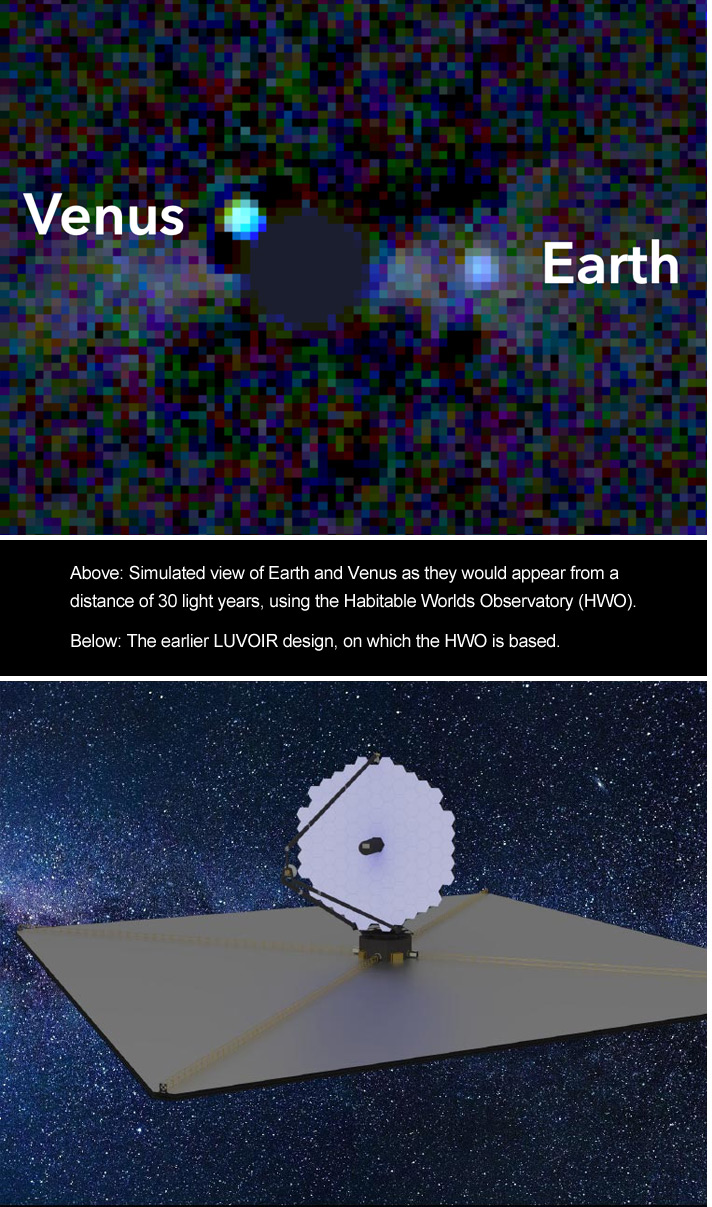
This thing could be phenomenally powerful. Though I suspect it will be downgraded from its earlier proposed size (below).


Image
weatheriscool
Posts: 24482
Joined: Sun May 16, 2021 6:16 pm
Contact:

Re: Exoplanets – worlds of other suns

Post by weatheriscool »

firestar464
Posts: 7202
Joined: Wed Oct 12, 2022 7:45 am

Re: Exoplanets – worlds of other suns

Post by firestar464 »

User avatar
wjfox
Site Admin
Posts: 13575
Joined: Sat May 15, 2021 6:09 pm
Location: Essex, UK
Contact:

Re: Exoplanets – worlds of other suns

Post by wjfox »

weatheriscool
Posts: 24482
Joined: Sun May 16, 2021 6:16 pm
Contact:

Re: Exoplanets – worlds of other suns

Post by weatheriscool »

Earth-size planet spotted with yearlong orbit
Long-overlooked Kepler signal discovered by citizen scientists reveals promising world worth a closer look
https://www.science.org/content/article ... long-orbit
28 Jan 202612:45 PM ETByElise Cutts
GRONINGEN, NETHERLANDS—Astronomers are planning ambitious telescopes to search for signs of life on distant planets. A newly discovered world, announced here last week at the Rocky Worlds conference and published yesterday in The Astrophysical Journal Letters, might just be the perfect target.

The planet, called HD 137010 b, is almost exactly Earth-size. At 355 days, its orbit is almost exactly Earth-like, too. And its star is bright and just 146 light-years away–close enough to be observed in detail with future telescopes.
Image
Although astronomers only got one look at the planet in 2017, with NASA’s Kepler space telescope, they took care to rule out confounding possibilities. “They’ve really done their due diligence,” says Stephen Kane, a planetary astrophysicist at the University of California, Riverside who wasn’t involved in the work. “I’m really looking forward to seeing what we find out next about it.”
firestar464
Posts: 7202
Joined: Wed Oct 12, 2022 7:45 am

Re: Exoplanets – worlds of other suns

Post by firestar464 »

HD 137010 b’s star is a K-dwarf, relatively bright but about 1000°C cooler than the Sun. So despite orbiting at about the same distance as Earth, the planet receives less energy from its star than Mars. That would put it right at the icy edge of the star’s habitable zone, a region around a star within which planets get enough sunshine for water to potentially be liquid on their surfaces. However, there’s a chance the planet could be warmer. The team calculated about a 40% chance that it orbits its star more closely, firmly within the habitable zone.
Ooof
Post Reply