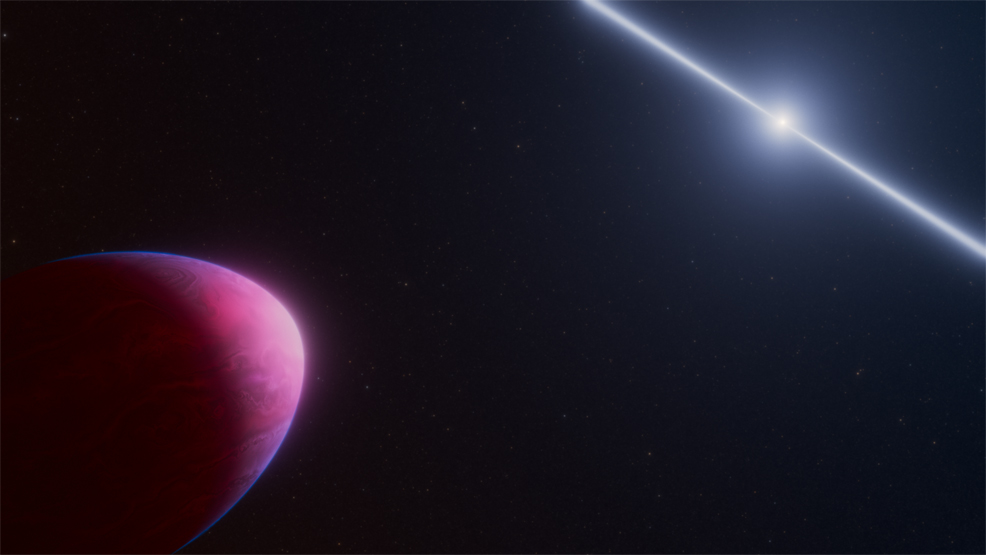
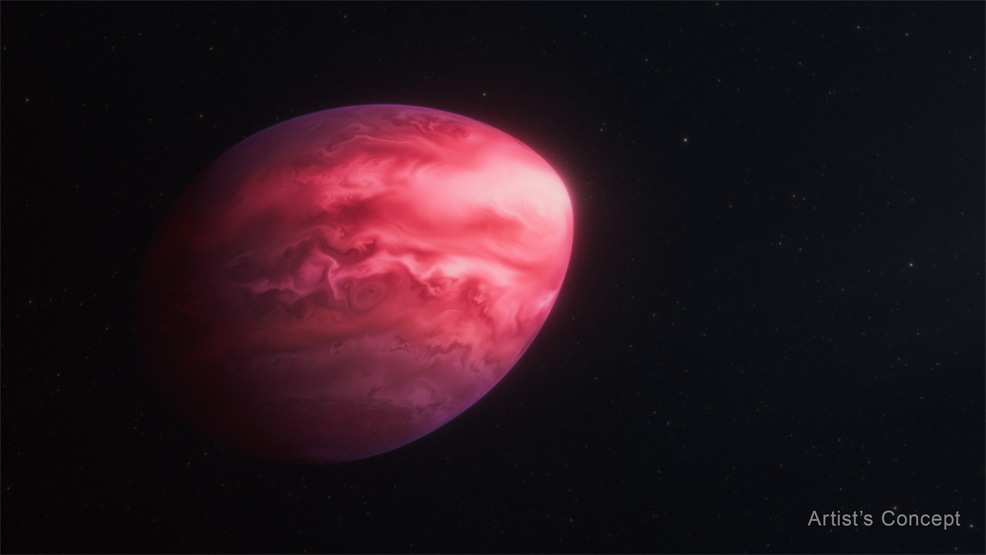
18th December 2025 Lemon-shaped planet found by Webb telescope Astronomers report the discovery of a bizarre, pulsar-orbiting exoplanet with a lemon-like shape and an atmosphere unlike any seen before.
Scientists using the James Webb Space Telescope (JWST) have observed an entirely new class of exoplanet whose atmospheric composition challenges our understanding of how it formed. The Jupiter-mass object, PSR J2322-2650b, is located 750 light-years away. It orbits a pulsar – a type of rapidly rotating neutron star that emits beams of electromagnetic radiation from its magnetic poles – every 7.8 hours. Separated by a distance of just 0.01 astronomical units (1.5 million km), the gravitational distortion from the much heavier pulsar is so huge that the planet is being stretched into a bizarre, lemon-like shape. While astronomers have previously identified tidally distorted exoplanets, PSR J2322-2650b represents an even more extreme case. In 2024, a team reported the discovery of TOI-6255 b, an egg-shaped rocky planet whose form is warped by intense tidal forces from a nearby red dwarf star. However, PSR J2322-2650b is subject to far stronger gravitational stresses, orbiting not a star but a pulsar – one of the densest objects in the universe – resulting in a level of distortion that surpasses anything seen before. Furthermore, its exotic helium- and molecular-carbon-dominated atmosphere appears to rule out all known planetary formation mechanisms. Soot clouds likely float through the air, while deep within the planet, carbon may condense to form diamonds. A study on this unique discovery appears this week in The Astrophysical Journal Letters. "This was an absolute surprise," said study co-author Peter Gao, of the Carnegie Earth and Planets Laboratory in Washington, DC. "I remember after we got the data down, our collective reaction was 'What the heck is this?' It's extremely different from what we expected."
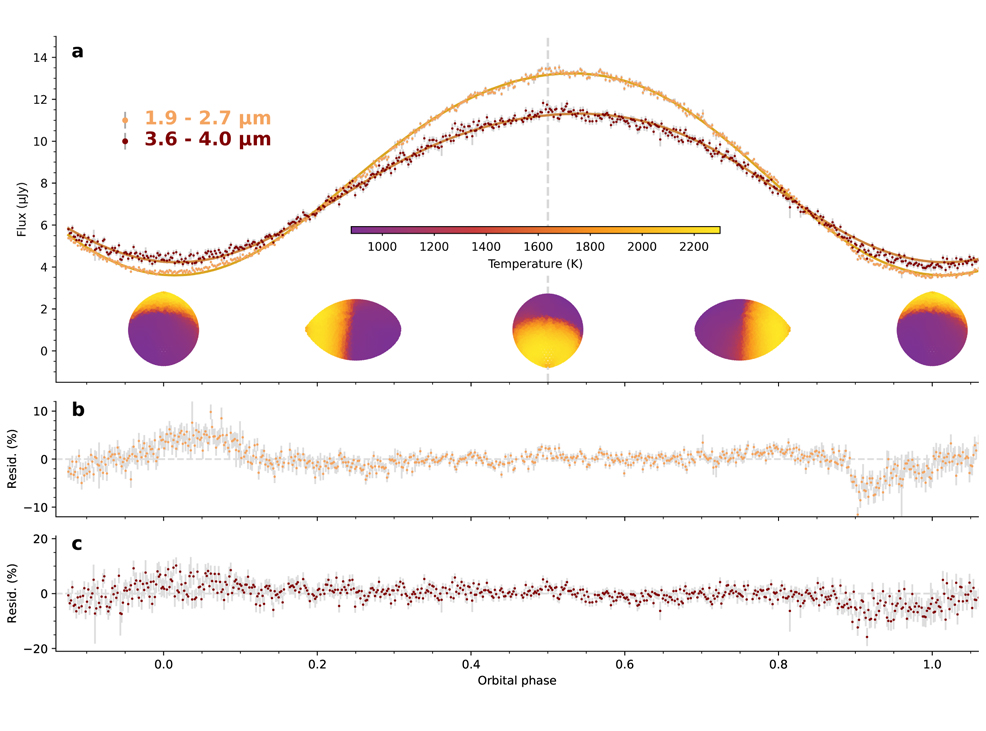
This millisecond pulsar is expected to be emitting mostly gamma rays and other high-energy particles, which are invisible to Webb's infrared vision. Without a bright star in the way, scientists can study the planet in intricate detail across its whole orbit. "This system is unique because we are able to view the planet illuminated by its host star, but not see the host star at all," explains Maya Beleznay, a third-year PhD candidate at Stanford University in California who helped model the shape of the planet and the geometry of its orbit. "So we get a really pristine spectrum. And we can study this system in more detail than normal exoplanets." "This is a new type of planet atmosphere that nobody has ever seen before," said co-author Michael Zhang, from the University of Chicago. "Instead of finding the normal molecules we expect to see on an exoplanet – like water, methane, and carbon dioxide – we saw molecular carbon, specifically C3 and C2." Molecular carbon is highly unusual for a planetary atmosphere. At the extreme temperatures seen on PSR J2322-2650b, carbon would normally bond readily with other elements if they were present. Instead, temperatures ranging from 650 °C on the night side to over 2,000 °C on the day side can support molecular carbon only because the atmosphere contains almost no oxygen or nitrogen. Among the 150 planets whose atmospheres have been studied in detail, both within and beyond the Solar System, no others show any detectable molecular carbon.
Together, the pulsar and its companion may be considered a "black widow" system, though not a typical example. In such rare systems, a rapidly spinning pulsar is paired with a close, low-mass companion that was once more substantial. Over time, intense radiation and a powerful pulsar wind bombard the smaller object, gradually stripping away and evaporating its material. In this case, however, the companion lies far below the mass threshold for a star and is therefore clearly identified as an exoplanet. "Did this thing form like a normal planet? No, because the composition is entirely different," said Zhang. "Did it form by stripping the outside of a star, like typical 'black widow' systems are formed? Probably not, because nuclear physics does not make pure carbon. It's very hard to imagine how you get this extremely carbon-enriched composition. It seems to rule out every known formation mechanism." Future observations of PSR J2322-2650b and similar systems could help astronomers determine whether this planet is a one-off curiosity or the first known example of a previously unrecognised class of worlds. As Webb continues to probe ever more extreme environments, discoveries like this highlight just how much remains to be learned about the diversity of planets in our galaxy.
Comments »
If you enjoyed this article, please consider sharing it:
|