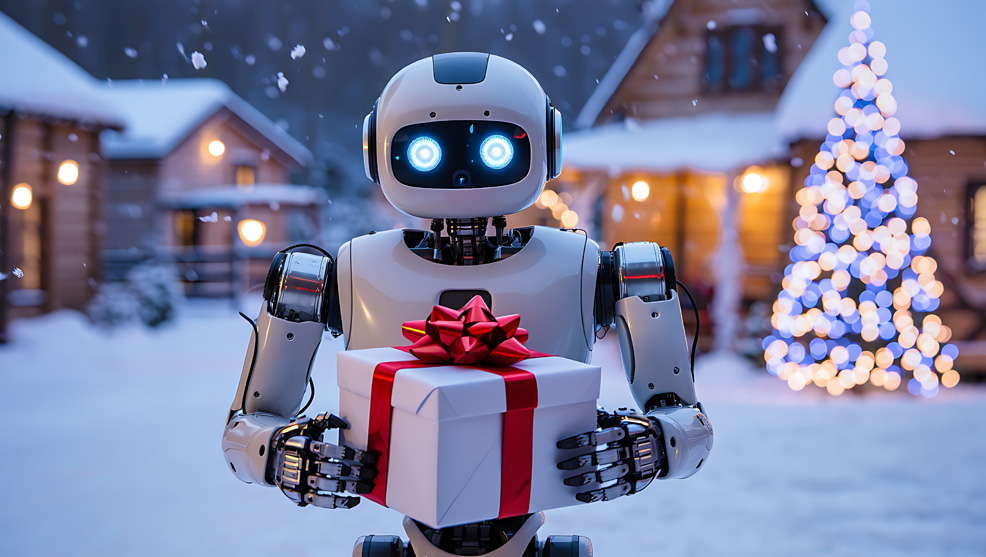
25th December 2025 Merry Christmas and a happy 2026! From the staff and contributors at Future Timeline.
And so, another year comes to an end! It's time to look back on 2025, which provided no shortage of moments that highlighted the accelerating progress of science and technology. AI continued to dominate the headlines, but the conversation shifted from "chatbots that talk" to more agentic systems that can see, listen, plan, and act in a more unified way and over longer time horizons. Video generation in particular took a huge leap forward, with new models capable of producing increasingly coherent clips and, in some cases, matching them with audio in a way that would have seemed unthinkable just two years ago. At the same time, the growing volume of low-quality AI-generated content, often described as "AI slop", alongside rising concerns over misinformation and copyright disputes, underscored the challenges that now accompany these rapidly advancing tools. Robotics also kept gathering momentum. Humanoid machines moved closer to real-world usefulness, with major firms unveiling new hardware and a growing number of startups securing serious funding to trial robots in industrial settings. Both Tesla's Optimus and Figure AI's Figure 03 made waves with demonstrations of smooth, human-like running and fluid movement that indicated significant advances in locomotion and control. At the same time, China's capabilities in humanoid robotics became increasingly visible, with domestic teams showcasing agile, factory-ready machines and signalling ambitions for deployment at far greater scale. In August, Beijing hosted the first World Humanoid Robot Games – a three-day competition that brought together hundreds of humanoid robots from around the world to race, play ball, box, and perform other athletic and skill-based challenges. In biology and medicine, 2025 delivered some genuinely striking moments. One of the year's most hopeful stories came from Huntington's disease, where early clinical data from a gene therapy trial suggested that disease progression could be slowed by a massive 75%, compared with an external control group. It is still not a cure, and longer follow-up studies will matter, but it represents the clearest sign yet that we may be able to meaningfully change the course of this devastating condition. Elsewhere in medicine and biotechnology, 2025 brought a steady stream of advances that hinted at how treatment and prevention could look very different in the years ahead. Gene-editing therapies showed growing clinical promise, with one trial demonstrating large reductions in LDL cholesterol, while researchers used engineered nanoparticles to detect and shrink arterial plaque in a preclinical study. Scientists also reported progress in early disease detection, including a blood test that identified early-stage pancreatic cancer with 85% accuracy. Research into aging and longevity continued to see success, as drug combinations extended mouse lifespans by up to 35% and experimental vaccines appeared to restore youthful metabolism, as well as physical and cognitive abilities, in older animals. Meanwhile, biologists uncovered a previously unknown component of human cells, known as the hemifusome, and de-extinction researchers at Colossal unveiled the "woolly mouse" as a step towards reviving mammoth-like traits. Computing and digital technology saw major advances in scale, efficiency, and the quest for life beyond traditional silicon. The El Capitan supercomputer took the top spot globally with an incredible 1.7 exaFLOPS, beating 2022's Frontier into second place. Researchers explored new routes for future chips – from wafer-scale 2D indium selenide transistors that outperformed silicon's projected performance to optical processors that carried out many calculations in parallel using light. With AI driving ever larger data-centre demands, engineers pursued ways to rein in heat and power use, including a laser-based photonic cooling concept and brain-inspired AI servers designed to deliver high performance with 90% lower energy draw. On the storage front, a consortium reported that DNA could become a practical medium for long-term digital archives within just 3–5 years, offering 500 million times the density of today's best solid-state drives (SSDs). The clean energy transition, meanwhile, began to feel less like a hopeful trend and more like a structural shift. Science highlighted the seemingly unstoppable growth of renewables as its breakthrough of the year, reflecting how rapidly solar, wind, and storage have expanded worldwide. Reports through 2025 also pointed to solar and wind growing fast enough to cover increases in electricity demand over key periods, alongside record-setting annual capacity additions and accelerating storage deployment. In China, multiple analyses suggested that carbon emissions had likely plateaued, or were at least very close to doing so, as its renewable generation continued to surge. India, too, reached a major clean-energy milestone, now surpassing 50% of its power capacity, while across Africa an inflection point in solar adoption became increasingly clear, driven by record imports and exponential growth in dozens of countries. At the cutting edge, researchers pushed the limits of solar technology too, with perovskite–silicon tandem cells reaching new world-record efficiencies in lab conditions. This year saw frustration on the diplomatic front, however, as COP30 failed to deliver the binding commitments many had hoped would match the progress of technology. In the realm of physics, 2025 delivered a mix of record-setting experiments and genuinely mind-bending results. In France, the WEST tokamak achieved a new milestone for nuclear fusion by sustaining plasma for 1,337 seconds, a world-record duration. At CERN, researchers reported an eightfold boost in antimatter production capacity by cooling positrons to near absolute zero, while the Large Hadron Collider also grabbed headlines for producing gold from lead in quantities far beyond earlier attempts. Quantum research continued to scale up too, with Caltech assembling a record-breaking 6,100-qubit array that hinted at what might soon be possible. And on the grandest scales of all, a survey of nearly 15 million galaxies raised fresh questions about whether dark energy could be weakening, nudging cosmologists to reconsider the universe's long-term fate. Astronomy had another exciting year. In June, the Vera C. Rubin Observatory revealed its first imagery, offering a tantalising preview of a decade-long survey designed to turn the night sky into an ultra-high-definition time-lapse record. The year also marked the end of an era for Gaia, as the spacecraft concluded its mission after 11 years of mapping the Milky Way with trillions of observations. Meanwhile, planet-hunters continued to deliver surprises, from a super-Earth in the habitable zone just 18 light-years away to Webb's discovery of a bizarre, pulsar-orbiting exoplanet with a lemon-like shape and an atmosphere unlike anything previously seen. Space exploration brought steady progress on several fronts, from a new generation of lunar missions to ambitious work on heavy-lift launch vehicles. In March, Firefly Aerospace made history when its Blue Ghost Mission 1 became the first commercial mission to land successfully on the Moon without technical issues. NASA's Lucy mission also returned striking new imagery of the asteroid Donaldjohanson, revealing it as an unusual contact binary and offering a glimpse of the discoveries still to come as the probe continues its long tour of ancient worlds. Closer to home, astronomers identified a new "quasi-moon" companion to Earth, while studies modelled how a future lunar impact could throw debris into cislunar space and threaten satellites, highlighting the growing importance of planetary defence in an increasingly crowded near-Earth environment. The year also saw a human milestone, as German engineer Michaela Benthaus became the first wheelchair user to travel into space aboard Blue Origin NS-37. As always, a heartfelt thanks to our readers and contributors for your continued support. Future Timeline simply wouldn't be possible without your engagement and enthusiasm. Here's to 2026, and to another year of progress that makes the future feel a little closer!
Comments »
If you enjoyed this article, please consider sharing it:
|