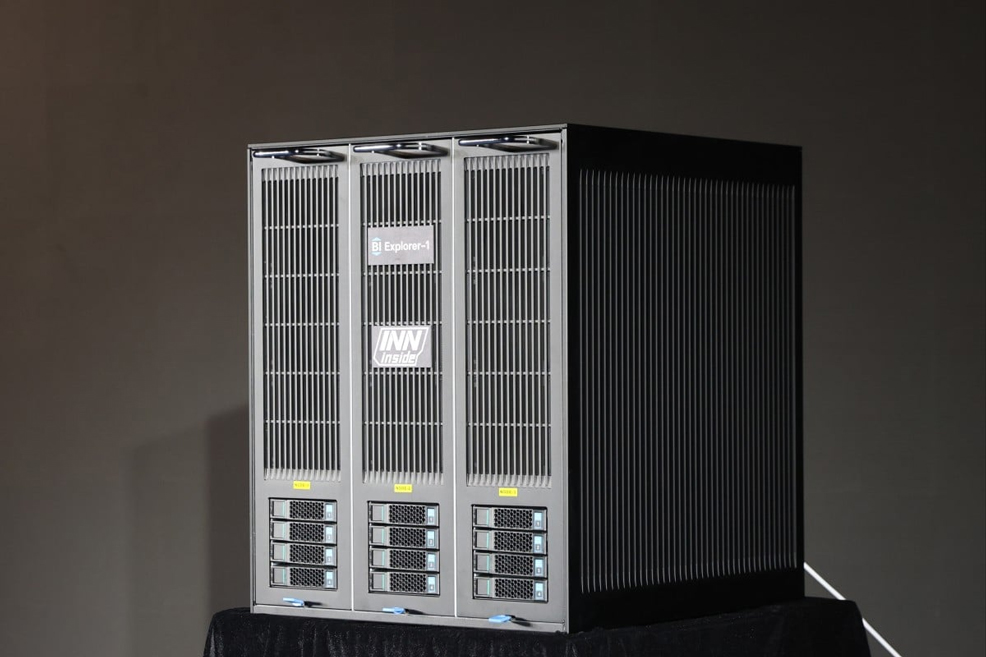
27th October 2025 China unveils brain-like AI server that cuts power use by 90% A refrigerator-sized computer unveiled in southern China could reshape how AI runs, offering supercomputer-level performance on a household power socket.
AI progress comes with a growing problem: energy consumption. Data centres now draw more electricity each year than some countries, and the power demands of large language models keep soaring. As AI becomes central to business and research, scientists face a pressing challenge – how to make it vastly more efficient. In China, one research team claims to have taken a major step toward that goal. At a forum held in the Guangdong–Macao In-Depth Cooperation Zone, the Guangdong Institute of Intelligence Science and Technology (GDIIST) revealed the BI Explorer (BIE-1) – a brain-inspired computer about the size of a mini fridge. The developers say it performs like a room-sized supercomputer while using only one-tenth of the power. The device runs quietly, stays below 70 °C (158 °F) even under load, and plugs into a standard household socket. According to the institute, the BIE-1 contains 1,152 CPU cores, 4.8 terabytes of DDR5 memory, and 204 terabytes of storage. Its performance reportedly reaches around 100,000 tokens per second for training and 500,000 tokens per second for inference – speeds comparable to clusters of high-end GPUs. The system relies on what GDIIST calls an "intuitive neural network"; a brain-like algorithm designed for efficient learning, multimodal reasoning, and interpretability. "It can be easily deployed in homes, small offices, and even mobile environments," according to a statement on the institute's website. "It can be called a miniaturised supercomputer." Potential uses include health monitoring, personal tutoring, and intelligent office assistants. Two start-ups incubated by the institute – Zhuhai Hengqin Neogenint Technology and Suiren (Zhuhai) Medical Technology – are now commercialising the design. If independent tests confirm these claims, the BIE-1 could mark another example of China leaping ahead in advanced computing. Shrinking a supercomputer's power and size to fit a domestic outlet would open new paths for distributed, low-energy AI. Over the next five to ten years, devices like this might shift processing away from giant cloud centres toward compact, edge-based systems – bringing high-level intelligence into homes and workplaces while easing the strain on energy grids.
Comments »
If you enjoyed this article, please consider sharing it:
|