Exoplanets – worlds of other suns
-
weatheriscool
- Posts: 26102
- Joined: Sun May 16, 2021 6:16 pm
- Contact:
Re: Exoplanets – worlds of other suns
Here's a clear rundown of the paper shared in that r/exoplanets post (arXiv:2605.16499, submitted May 15, 2026).
Paper title and authorsTitle: A Revised Mass and Period for the Habitable Zone super-Earth GJ 3378b: A Planet Straddling the Cosmic Shoreline
Lead author: Paul Robertson (with Michael Endl, William D. Cochran, Gudmundur Stefansson, Suvrath Mahadevan, and others)
It's a short, focused radial-velocity (RV) re-analysis paper from the HPF (Hobby-Eberly Telescope Planet Finder) team.Background / original discoveryThe star GJ 3378 is a nearby M4V red dwarf (distance ~7.7 pc / ~25 light-years), fully convective and relatively quiet.
In 2024, Moutou et al. (using SPIRou RV data) announced GJ 3378b: a super-Earth candidate with minimum mass m sin i ≈ 5.26 M⊕ (Earth masses) and orbital period P ≈ 24.73 days.
What the new paper does, The team added their own high-precision near-infrared RVs from HPF (HET) plus extreme-precision visible-light data from NEID (WIYN telescope). They jointly modeled these together with the published CARMENES and SPIRou datasets.Key result: The orbital solution changes significantly. New period: P = 21.45 ± 0.01 days (shorter than previously thought).
New minimum mass: m sin i = 2.3 ± 0.4 M⊕ (more than 2× smaller).
The orbit is consistent with being circular (low eccentricity).
RV semi-amplitude is only K ≈ 1.3 ± 0.2 m/s — a very subtle signal that required the combined precision of multiple instruments to nail down reliably.
Why this matters for habitability, The revised (shorter) period still places GJ 3378b well inside the conservative habitable zone of its M-dwarf host — the region where liquid water could exist on the surface.
The much lower mass now makes a terrestrial (rocky) composition far more plausible (vs. a mini-Neptune with a thick H/He envelope).
It sits very close to the “cosmic shoreline” — the empirical boundary in the mass–insolation plane where M-dwarf habitable-zone planets are thought to either retain or lose their atmospheres due to intense stellar XUV radiation and flares early in the star’s life. Planets just inside this line are at risk of being stripped; just outside, they may keep thick envelopes. GJ 3378b is right on that edge, making it a great test case.
Bottom line / implicationsThis is a nearby (~25 ly) habitable-zone super-Earth that’s now even more Earth-like in mass than originally thought.
Because the host star is so close and the planet is in the HZ, it’s a high-priority target for future atmospheric characterization with JWST or next-gen extremely large telescopes (once they come online).
The paper highlights the power of combining multiple RV instruments (especially near-IR + visible) to resolve subtle signals around quiet M dwarfs.

Re: Exoplanets – worlds of other suns
Smaller Than Earth Habitability Model (STEHM): The Lower Size Limit for Atmosphere Retention in the Habitable Zone
[Submitted on 30 Apr 2026]
With recent advances in exoplanet observational techniques enabling the discovery of increasingly smaller planets, a crucial question emerges in the search for habitable planets: how small can a planet be and still maintain an atmosphere? We present results from the Smaller Than Earth Habitability Model (STEHM) which examines how small a planet can be and still maintain a long-term (multi-gigayear) atmosphere for planets from 1.0R down to 0.5R. The model is based on a stagnant lid planet orbiting within the habitable zone of a sun-like star. Our model demonstrates that planets 0.8R can maintain their atmospheres under our Earth-like default conditions for a solar analog star, while smaller planets lose their atmospheres. Variations from the default Earth-like values cause mostly minor variations to the planet size boundary results, with some changes allowing 0.7R planets to maintain their atmosphere. Initial carbon inventory emerges as the most influential parameter for atmospheric retention, though orders of magnitude difference to Earth values are required to make a significant difference to longevity of atmospheric retention. Planets with substantial initial carbon content, large amounts of heat producing elements, cool initial mantle temperatures and low core radius fractions show the best atmospheric retention capabilities. Our results indicate that atmospheric retention on small planets depends strongly on their formation conditions and early evolution, providing important constraints for future observations of rocky exoplanets and their potential habitability.
https://arxiv.org/abs/2605.00170
[Submitted on 30 Apr 2026]
With recent advances in exoplanet observational techniques enabling the discovery of increasingly smaller planets, a crucial question emerges in the search for habitable planets: how small can a planet be and still maintain an atmosphere? We present results from the Smaller Than Earth Habitability Model (STEHM) which examines how small a planet can be and still maintain a long-term (multi-gigayear) atmosphere for planets from 1.0R down to 0.5R. The model is based on a stagnant lid planet orbiting within the habitable zone of a sun-like star. Our model demonstrates that planets 0.8R can maintain their atmospheres under our Earth-like default conditions for a solar analog star, while smaller planets lose their atmospheres. Variations from the default Earth-like values cause mostly minor variations to the planet size boundary results, with some changes allowing 0.7R planets to maintain their atmosphere. Initial carbon inventory emerges as the most influential parameter for atmospheric retention, though orders of magnitude difference to Earth values are required to make a significant difference to longevity of atmospheric retention. Planets with substantial initial carbon content, large amounts of heat producing elements, cool initial mantle temperatures and low core radius fractions show the best atmospheric retention capabilities. Our results indicate that atmospheric retention on small planets depends strongly on their formation conditions and early evolution, providing important constraints for future observations of rocky exoplanets and their potential habitability.
https://arxiv.org/abs/2605.00170
-
weatheriscool
- Posts: 26102
- Joined: Sun May 16, 2021 6:16 pm
- Contact:
-
weatheriscool
- Posts: 26102
- Joined: Sun May 16, 2021 6:16 pm
- Contact:
Re: Exoplanets – worlds of other suns
Third exoplanet found around Beta Pictoris
1st July 2026
Direct observations have revealed a new reddish gas giant in the youthful Beta Pictoris system, one of the best-studied planetary systems in our stellar neighbourhood.
Read more: https://www.futuretimeline.net/blog/202 ... oris-d.htm
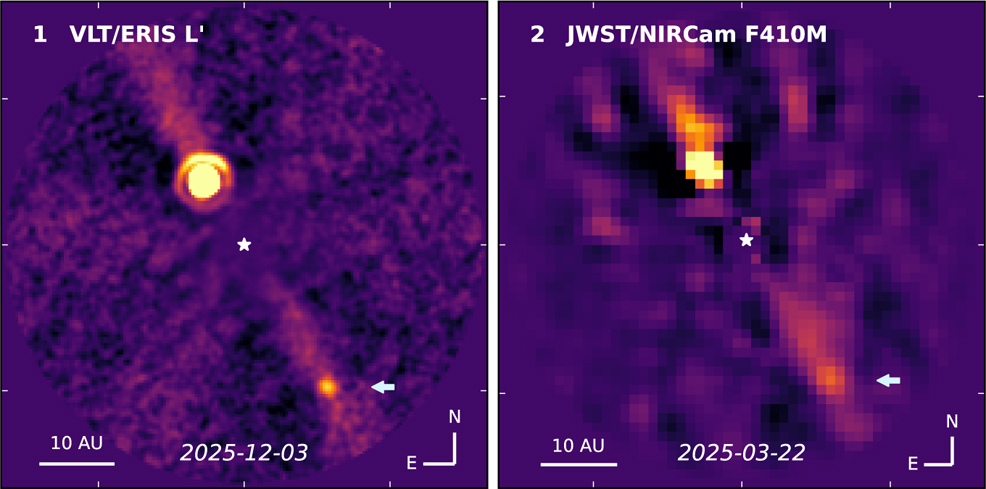
1st July 2026
Direct observations have revealed a new reddish gas giant in the youthful Beta Pictoris system, one of the best-studied planetary systems in our stellar neighbourhood.
Read more: https://www.futuretimeline.net/blog/202 ... oris-d.htm
-
weatheriscool
- Posts: 26102
- Joined: Sun May 16, 2021 6:16 pm
- Contact:
-
weatheriscool
- Posts: 26102
- Joined: Sun May 16, 2021 6:16 pm
- Contact:
-
weatheriscool
- Posts: 26102
- Joined: Sun May 16, 2021 6:16 pm
- Contact:
-
firestar464
- Posts: 8408
- Joined: Wed Oct 12, 2022 7:45 am
Re: Exoplanets – worlds of other suns
Why some lava-covered exoplanets retain atmospheres for billions of years
https://phys.org/news/2026-08-lava-exop ... lions.html
https://phys.org/news/2026-08-lava-exop ... lions.html
-
weatheriscool
- Posts: 26102
- Joined: Sun May 16, 2021 6:16 pm
- Contact:
-
weatheriscool
- Posts: 26102
- Joined: Sun May 16, 2021 6:16 pm
- Contact:
Re: Exoplanets – worlds of other suns
New Space Telescope is 200X Better Than Hubble – Maybe Find 30X Exoplanets From 6000 now to 200,000
September 1, 2026 by Brian Wang
September 1, 2026 by Brian Wang
https://www.nextbigfuture.com/2026/09/n ... 00000.htmlNASA’s Nancy Grace Roman Space Telescope will create enormous cosmic panoramas, which astronomers will use to explore everything from dark energy and dark matter to distant planets and black holes. The first observations will start in early 2027. It is launched and is moving to position.
Roman will collect light from far across the universe using a primary mirror that’s 7.9 feet (2.4 meters) wide — the same size as Hubble’s primary mirror. Roman’s images will have the same crisp resolution as Hubble’s, but each one will capture a patch of the sky at least 100 times larger. Over the first five years of observations, Roman will image more than 50 times as much sky as Hubble covered in 30 years.
-
weatheriscool
- Posts: 26102
- Joined: Sun May 16, 2021 6:16 pm
- Contact: