1st July 2026 Third exoplanet found around Beta Pictoris Direct observations have revealed a new reddish gas giant in the youthful Beta Pictoris system, one of the best-studied planetary systems in our stellar neighbourhood.
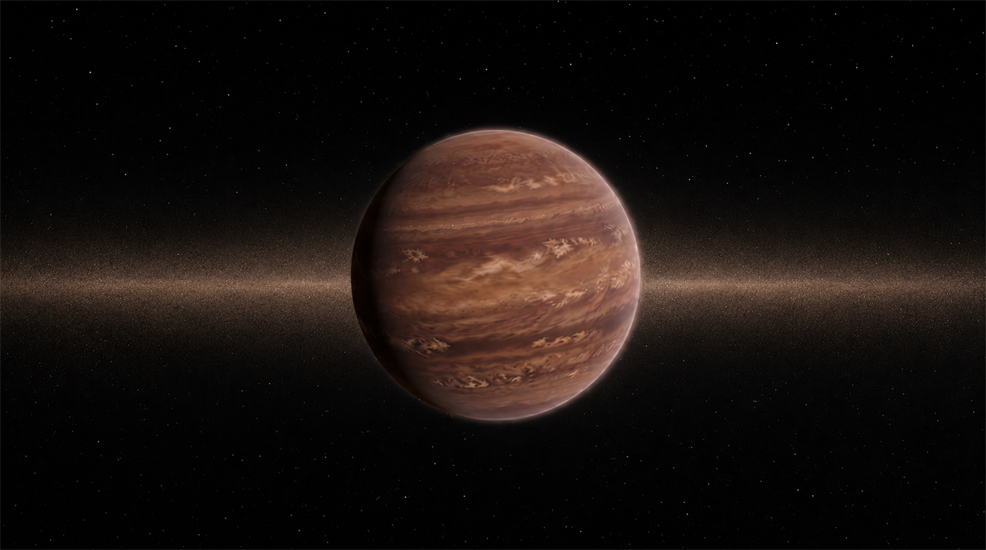
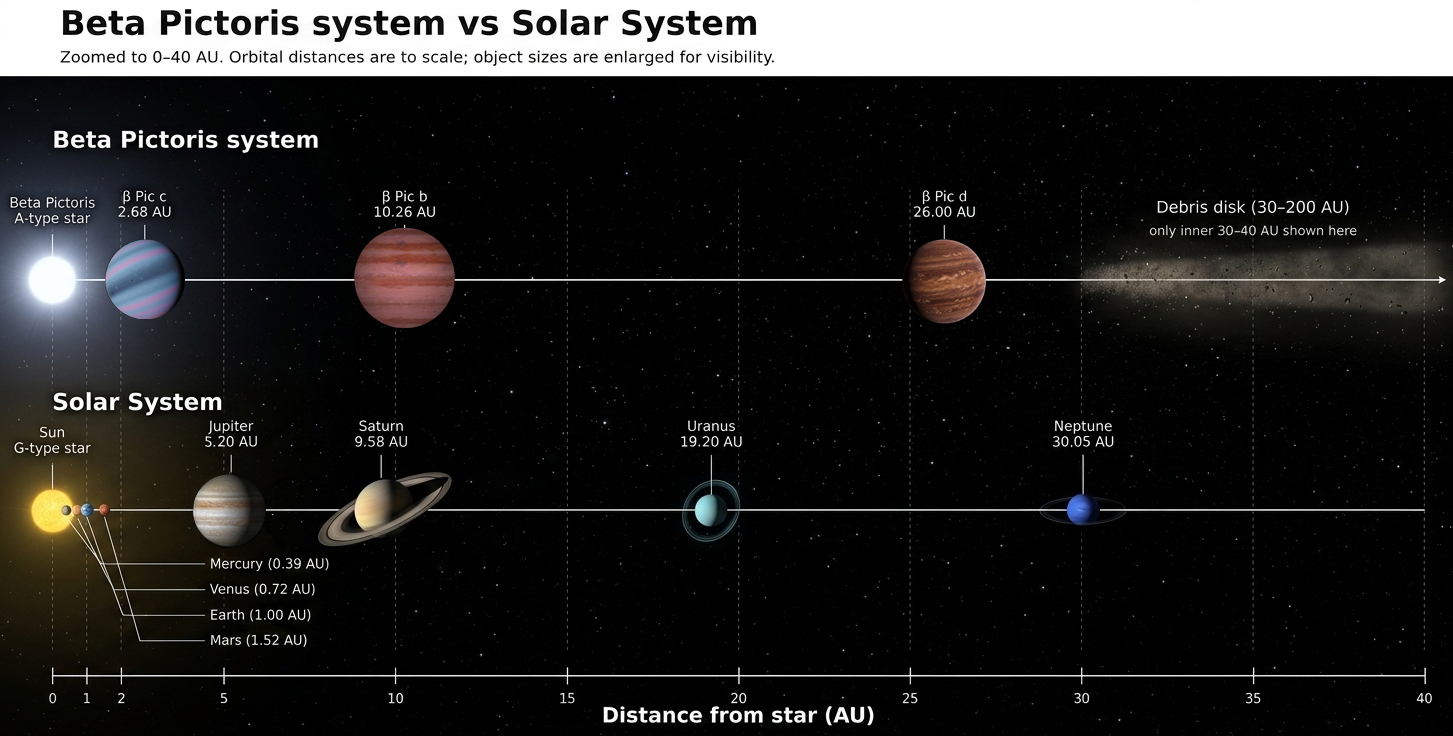
Astronomers have confirmed a third exoplanet orbiting Beta Pictoris, a young star located 64 light-years away. The new world, Beta Pictoris d, adds to a system already famous for its giant planets and spectacular debris disk. The bright A-type star is only 23 million years old and is surrounded by a vast, edge-on ring of dust and planetesimals, offering researchers a rare view of a planetary system still settling into its long-term architecture. Two giant planets were already known in the system. Beta Pictoris b orbits at about 10 AU and has a mass around nine times that of Jupiter, while Beta Pictoris c is similar in mass but much closer in, orbiting at just 2.7 AU. The newly discovered Beta Pictoris d is the outermost and least massive of the three. One study estimates a mass of 2.4 Jupiter masses, a radius of 1.26 Jupiter radii, and an effective temperature of around 600 K (327 °C). Its orbit is still being refined. One team finds a semi-major axis of about 26 AU and a period of roughly 90 years, while another JWST-based analysis suggests stable orbits are more likely beyond 30 AU. This places Beta Pictoris d close to where an additional world had been predicted to help shape the inner edge of the debris disk.
Click to enlarge
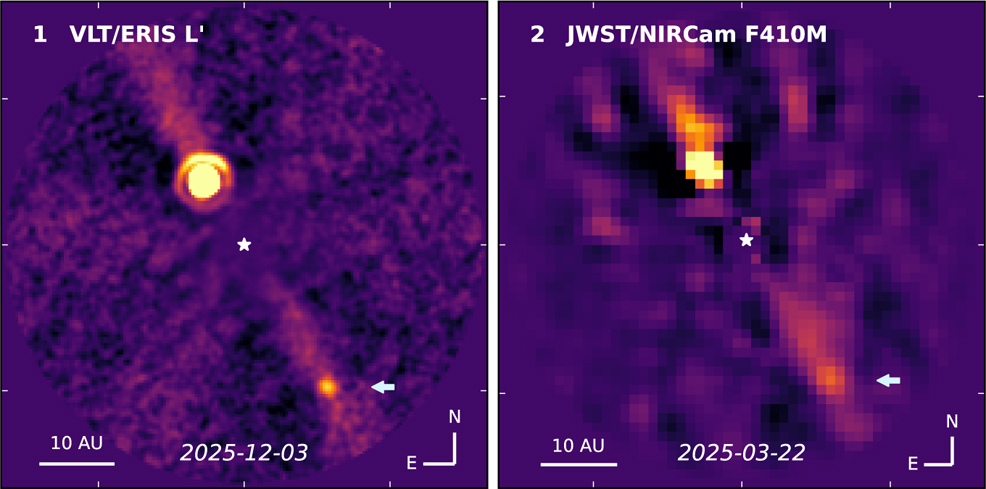
The discovery is also notable because direct imaging remains a rare way to find exoplanets, accounting for only 1.5% of known discoveries. Beta Pictoris now becomes only the second directly imaged planetary system known to contain more than two confirmed planets. Two independent teams report the discovery in papers posted to arXiv. Aidan Gibbs, Jean-Baptiste Ruffio and colleagues detected the planet serendipitously in JWST/NIRSpec observations, later confirming it with JWST/MIRI. Their work marks the first time moderate-resolution spectroscopy has been used to aid the direct-imaging discovery of an exoplanet. Ben Sutlieff, Markus Bonse and colleagues detected Beta Pictoris d with VLT/ERIS direct imaging, supported by archival JWST/NIRCam and VLT/SPHERE images spanning 11 years. Those older observations showed that the planet had been hiding in plain sight, often appearing very close to either the glare of its host star or the brighter planet Beta Pictoris b. Early atmospheric clues point to methane, carbon monoxide and water vapour. Its colour also suggests strong carbon dioxide absorption and enhanced metallicity compared with free-floating planetary-mass objects. Among the lowest-mass exoplanets ever imaged from the ground, Beta Pictoris d is now an important target for future studies of young gas giants.
Comments »
If you enjoyed this article, please consider sharing it:
|