Virtual Reality (VR) and Full-Immersion Virtual Reality (FIVR)
Posted: Tue May 25, 2021 8:23 am
In the next few weeks, I want to re-write this 2039 prediction. It was among the first entries to appear on our timeline, and based largely on a forecast by Ray Kurzweil. Although I admire the guy, he tends to be overly optimistic in terms of timescales. In retrospect, after 12 years of research and writing on futurology, I now think it's highly unlikely we'll have so-called full-immersion virtual reality (FIVR) in just 20 years. I'm creating this thread to gauge people's opinions on the future of virtual reality and the "when" of certain developments.
It's true that technology is advancing exponentially, and will likely continue to do so in the decades ahead. But even with rapid progress, there's still a mountain to climb in terms of reaching the capabilities needed for real-time FIVR.
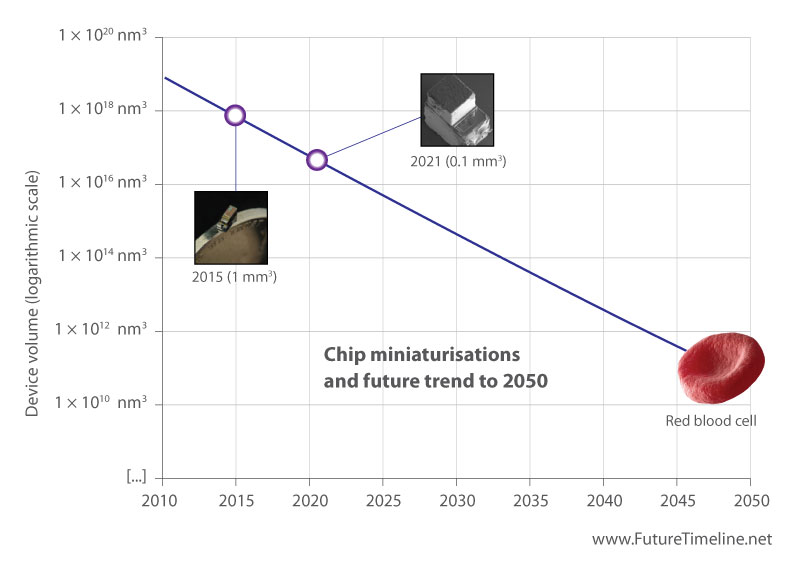
The human brain has nearly 100 billion neurons, and many trillions of synapses. It also has the blood-brain barrier to limit the entry of foreign objects. Computers might reach the scale of blood cells by the late 2040s, going by the current trend in miniaturisation...
https://www.futuretimeline.net/blog/202 ... me-mm3.htm
... but these will need production and deployment in vast numbers, coordinated simultaneously and in real time. Assuming it was even possible by then, why would people choose this highly invasive (and possibly dangerous) method of experiencing VR, when other options would be available that still offer a high-quality experience? The cost of FIVR would likely be much higher than conventional VR too, limiting its market potential.
Surely a more likely scenario is that conventional VR will continue to dominate for at least the next few decades?
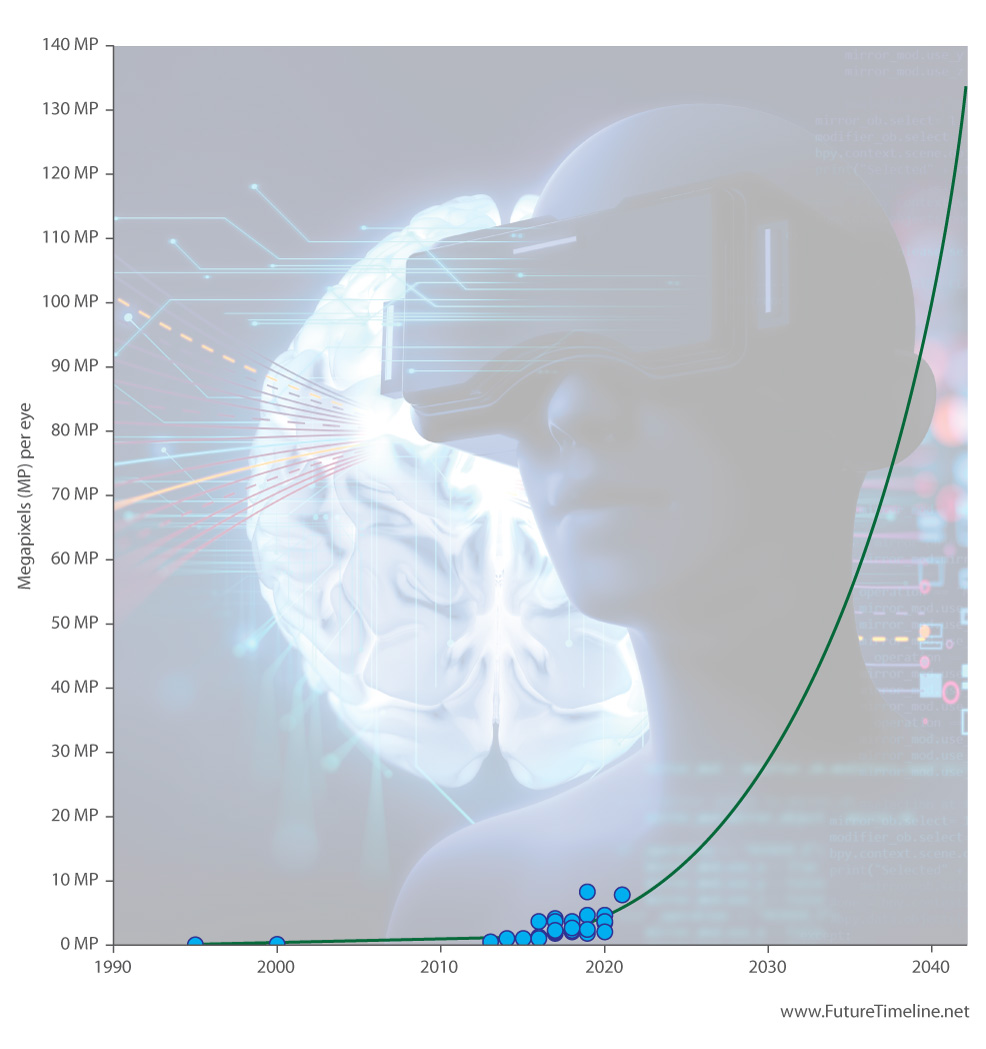
8K displays (33.2 MP per eye) are likely to be standard by 2030 and are covered in detail here. I can then imagine 16K (132.7 MP) following by ~2040, reaching a level of photo-realism that's hard to distinguish from real life.
See my graphs here, for trends in pixel density:
https://www.futuretimeline.net/data-tre ... trends.htm
However, there's a massive difference between "goggles providing photo-realism" and "billions of microscopic machines connected to your brain cells providing photo-realism". The bottom line is that most people will be hesitant about such an invasive procedure.
I think a more likely scenario (at least for the medium term) is new form-factor options – such as contact lenses that beam graphics into your retina, alongside ear implants, and other wearables such as gloves, haptic suits/chairs, etc. For the more adventurous/hardcore gamers, these might be combined with some form of brain-computer interface, but in a limited way.
Laboratory research into FIVR might be happening by 2040-50, using mice or primates, but its usage in humans is something I view as a more distant technological prospect. And remember, we aren't just talking about the visual experience. FIVR would need to encompass the other four senses and include real-time input/output based on a vast ecosystem of thoughts/memories/emotions. It would also need human NPCs with perfect animation and facial models, full interactivity, etc.
All of the above seems very optimistic for 2039. So I'm interested to know what people think is the likely future evolution of VR, and when FIVR might become a reality, if it happens at all.
It's true that technology is advancing exponentially, and will likely continue to do so in the decades ahead. But even with rapid progress, there's still a mountain to climb in terms of reaching the capabilities needed for real-time FIVR.
The human brain has nearly 100 billion neurons, and many trillions of synapses. It also has the blood-brain barrier to limit the entry of foreign objects. Computers might reach the scale of blood cells by the late 2040s, going by the current trend in miniaturisation...
https://www.futuretimeline.net/blog/202 ... me-mm3.htm
... but these will need production and deployment in vast numbers, coordinated simultaneously and in real time. Assuming it was even possible by then, why would people choose this highly invasive (and possibly dangerous) method of experiencing VR, when other options would be available that still offer a high-quality experience? The cost of FIVR would likely be much higher than conventional VR too, limiting its market potential.
Surely a more likely scenario is that conventional VR will continue to dominate for at least the next few decades?
8K displays (33.2 MP per eye) are likely to be standard by 2030 and are covered in detail here. I can then imagine 16K (132.7 MP) following by ~2040, reaching a level of photo-realism that's hard to distinguish from real life.
See my graphs here, for trends in pixel density:
https://www.futuretimeline.net/data-tre ... trends.htm
However, there's a massive difference between "goggles providing photo-realism" and "billions of microscopic machines connected to your brain cells providing photo-realism". The bottom line is that most people will be hesitant about such an invasive procedure.
I think a more likely scenario (at least for the medium term) is new form-factor options – such as contact lenses that beam graphics into your retina, alongside ear implants, and other wearables such as gloves, haptic suits/chairs, etc. For the more adventurous/hardcore gamers, these might be combined with some form of brain-computer interface, but in a limited way.
Laboratory research into FIVR might be happening by 2040-50, using mice or primates, but its usage in humans is something I view as a more distant technological prospect. And remember, we aren't just talking about the visual experience. FIVR would need to encompass the other four senses and include real-time input/output based on a vast ecosystem of thoughts/memories/emotions. It would also need human NPCs with perfect animation and facial models, full interactivity, etc.
All of the above seems very optimistic for 2039. So I'm interested to know what people think is the likely future evolution of VR, and when FIVR might become a reality, if it happens at all.

 Second sounds like it makes the mistake of making mind uploading out to be a sureshot way to immortality for the individual being "uploaded" - I'm still of the believe most forms of so-called mind uploading only creates a clone and the first person actually dies while leaving a new person who just happens to be a duplicate behind. Of course, I do believe there are ways around this where a person's mind can be digitized while the original individual actually gets to live to enjoy their new uploaded existence instead of just dying with a clone behind, but that's a different discussion (you're probably already aware of the concept though - just think ship of Theseus).