Foundations of the Fourth Industrial Revolution
Posted: Sun May 01, 2022 11:36 pm
A short thread, made just for my own personal fun, to explore the Fourth Industrial Revolution.
First of all, a recap of the previous three industrial revolutions and the inter-revolutionary periods. At least according to my own interpretation.
Quasi/Proto-Industrial Revolutions: Southern Song China, Mughal India. The Southern Song came closer to an industrial revolution than anyone else in world history, even closer than Ancient Rome and Mughal India. So close that some might even argue they temporarily crossed over and were actively industrializing at one point in the 12th century. However it's controversial. The Mughal Empire didn't come quite as close, but it was more due to material conditions. They had the culture and even some of the technology necessary, but never had the drive to go as far. Perhaps if they had Chinese steel manufacturing and oil drilling, they could have done it and we'd all be speaking an Indo-Arabian language right now.
First Industrial Revolution: 1760–1840, defined by steam power and textile industry. This was a truly revolutionary period in the history of life on Earth, the point at which human technological development achieved truly exponential growth. Except not quite. Life in 1840 was not much different from life in 1760. Outside the general background technological progress being known, your daily life and the general human condition had not meaningfully changed since the days of Ancient Greece other than the increased number of machines and better nutrition. This industrial revolution largely benefited only the capitalist owners, undermining the aristocracy and causing a drop off in the quality of life for the working class. The Napoleonic Wars had a big effect in causing the revolution to continue past the point it would have otherwise ended by delaying the industrialization of Europe until it all started happening at once.
First Inter-Revolutionary Period: 1840-1870, which started because technology got about as good as it possibly could at the time. This was the era of an economic recession as a result of the end of the industrial revolution, of technological refinements to what came before, the maturation of the telegraph, and the birth of the technologies that would later define the Second Industrial Revolution, such as the telephone, recorded sound, automobiles, atomic physics, modern medicine and germ theory, and more. Otherwise, little changed in the daily life of the average person.
Second Industrial Revolution: 1870-1914, defined by the maturation of electricity, electric light, advanced steam power, nuclear physics, early quantum physics, the telephone, automobiles, the birth of modern medicine, modern agriculture, advanced mechanics, radio, and so much more that it boggles the mind. For the first time, technological change had a direct effect on the human condition, changing the quality of life for even the poor. The Industrialization of life itself wrought great optimism, but it also directly led to the bloodshed of the first World War.
Second Inter-Revolutionary Period: 1915-1945. Capped by the First and Second World Wars, this was an era where the fruits of the Second Industrial Revolution really ripened and matured, but the rate of world changing innovations slowed in the meantime. The foundations for the Third, Digital Revolution were established, but technological limitations prevented a flourishing. The average futurist of this era would have been flummoxed at where the great innovations of the previous generation had gone, and why it had all been replaced by countries and reloading for another pointless world war. Of course, these innovative discoveries and inventions still happened, such as jet propulsion, digital computing, penicillin, nuclear power, space exploration, and the Chemical Revolution. However, the innovations of the Second Industrial Revolution wrought great horrors upon the world due to society developing slower than technology. Most notably through the rise of totalitarianism, fascism, communism, and industrial genocide.
Third Industrial Revolution: 1945-1995, which was defined by nuclear power and advanced energy production, digital computing, the birth of the internet, genetic modification, jet flight, space flight, early robotics, television, mass media, mass electrification, home automation, personal computers, and much more. The human condition changed at a rate so extreme that the future was no longer easily predictable based on past performance. In fact, even the poorest could now live better than kings of olde.
Third Inter-Revolutionary Period: 1995-Present (?), marked by the maturation of digital technology and the overwhelming sense of technological stagnation. Also known as the Smartphone Era, the Social Media Era, and Y-2-Lame, the expectations of the new millennium being an era of science fiction dreams come true initially seemed to be dashed by the arrival of Y2K in a society that seemed otherwise unchanged since the 1970s sans advanced computing. However, in the background, the paradigms of the next industrial revolution were being established, such as machine learning, artificial general intelligence, genetic engineering, metamaterials, fusion power, advanced solar and wind power, automation, room temperature superconductors, transhumanism, mixed reality, the metaverse, passenger drones, commercial space exploration, advanced space industry, graphene, advanced robotics, brain computer interfaces, and more.
Fourth Industrial Revolution: Present (?) What's going to happen next?
First, I have to stress "my own interpretation" because some of these are speculative. A lot of people claim the Third Industrial Revolution didn't start until 1970 and is still ongoing, while others claim there's only one industrial revolution and everything since has just been sub-periods within it. And a good number include the inter-revolutionary periods in their accompanying revolutions.
I personally see the Third Industrial Revolution as having started around the end of WW2, with the advent of digital Turing-complete computers, applied atomic physics, and modern medicine.
The Fourth Industrial Revolution is the upcoming/current one. And this goes into my second point: we won't know when the Fourth Industrial Revolution started until WELL after it's underway.
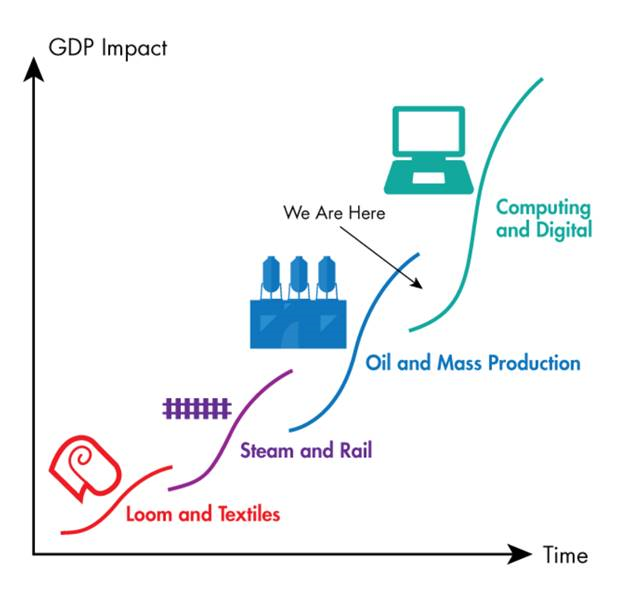
Next, "inter-revolutionary period" refers to the fact that technology generally progresses in inter-twining S-curves and right as one paradigm peaks, another troughs before rising. This is why people between 1920-1940 and between 2000 and 2020 felt like all the great technologies of their preceding industrial revolutions had given way to incremental iterative improvements and great laboratory advancements that never seemed capable of actually leaving the laboratory. If you ever wondered why the 2000s and 2010s felt indistinguishable and slow, as if nothing changed from 1999 to the present, it was because you were living in that intermediate period between technological revolutions. During that time, all the necessary components for the Fourth Industrial Revolution were being set up as the foundations for what we're seeing now while simultaneously all the fruits of the Third Industrial Revolution were fully maturing and perhaps even starting to spoil, with nothing particularly overwhelming pushing things forward. You might remember this as "foundational futurism."
As it stands, a lot of foundational stuff tends to be pretty boring on its own. Science fiction talks of the future being things like flying cars, autonomous cars, humanoid servant robots, synthetic media, space colonies, neurotechnology, and so on. Sci-fi media sometimes set years for these things to happen, like the 1990s or 2000s. Past futurists often set similar dates. Dates like, say, 2020 AD. According to Blade Runner, we're supposed to have off-world colonies and 100% realistic humanoid robots (e.g. with human-level artificial general intelligence) by now. According to Ray Kurzweil, we were supposed to have widespread human-AI relationships (ala Her) and PCs with the same power as the human brain by 2019. When these dates passed and the most we had was, say, the Web 2.0 and smartphones, we felt depressed about the future.
But here's the thing: we're basically asking why we don't have a completed 2-story house when we're still setting down the foundation, a foundation using tools that were created in the preceding years.
We couldn't get to the modern internet without P2P, VoIP, enterprise instant messaging, e-payments, business rules management, wireless LANs, enterprise portals, chatbots, and so on. Things that are so fundamental to how the internet circa 2020 works that we can scarcely even consider them individually. No increased bandwidth for computer connections? No audio or video streaming. No automated trading or increased use of chatbots? No fully automated businesses. No P2P? No blockchain. No smartphones or data sharing? No large data sets that can be used to power machine learning, and thus no advanced AI.
Finally and a bit more lightheartedly, I'd strongly recommend against using this to predict future industrial revolutions unless you're writing a pulp sci-fi story and need to figure out roughly when the 37th industrial revolution will be underway. If the Fourth Industrial Revolution pans out the way I feel it will, there won't be a Fifth. Or perhaps more accurately, we won't be able to predict the Fifth, specifically when it'll take place and what it will involve.
Onto the meat of this post: what will define the Fourth Industrial Revolution? What are its foundational technologies?
To summarize, the Fourth Industrial Revolution will be THE biggest and MOST sweeping of them all. It will have more quality-of-life impacts on the human condition than even the Second Industrial Revolution, which saw humans going from horse-and-buggies and prayer-and-gin to automobiles, airplanes, and penicillin in just a generation. Indeed, the whole reason I'm making this thread (besides just having something to do) is because I had an epiphany last night about just how obscenely overwhelming the Fourth Industrial Revolution is going to be. Nothing we've experienced thus far has adequately prepared us.
In no particular order of importance, the technologies that will have the most impact over the next 30 to 40 years:
• Artificial Intelligence. Advanced artificial narrow intelligence and artificial general intelligence will be the steam and electricity of the Fourth Industrial Revolution, allowing for a lot of what we're soon to be capable of. Indeed, my honest opinion is that without digital computing and narrow artificial intelligence, we as a technological civilization would have stagnated around 1970 much the same way we could have stagnated in the 1800s without steam power. On its own, AGI almost certainly means the Singularity, a revolution so far beyond anything we've ever seen in the history of life on this planet that it'd essentially begin a new epoch of the universe itself. Of course, that's IF the Kurzweilian Singularity proves true. The sheer range of changes that will come from artificial general intelligence is so absolute that I'd undermine this whole post if I listed them here. This— is— the Fourth Industrial Revolution.
• Advanced metamaterials. Materials that have unnatural properties are going to unlock a world of massive technologies for us, such as nearly perfect solar panels, invisibility cloaks, ultra-fast computing, earthquake protection, totally silent transportation, and much much more. On their own, metamaterials could trigger a small industrial revolution.
• Room-temperature superconductors. On their own, RTSCs could trigger an industrial revolution the likes of which will extend far beyond Earth. The sheer range of applications is mind-boggling and would very easily lead to a classically sci-fi lifestyle of flying cars, space colonies, advanced fusion power, long-performing robots, and much more.
• Graphene. The wondermaterial is just now starting to be mass produced and it will still be a while before it takes off, but once it does, we'll have yet another "minor industrial revolution-tier technology" to add to the list. Graphene is superior to carbon nanotubes and rivals metamaterials in terms of potential applications.
• Genetic engineering. With the human genome now completely decoded and technologies like CRISPR starting to mature, we're rapidly approaching an inflection point where modifying genetic material can be done on an industrial, ultra-precise scale. The very nature of what it means to be human is going to change— and that's without getting into other lifeforms. We could engineer more nutritious food, domesticate wild animals in a single generation, resurrect extinct species, create entirely new species that have never existed before, and so much more. The question isn't "can we?" but "should we" and "will we?" You know my opinion on these matters: yes, yes, yes, yes, yes, we should.
• 3D Printing and Micro-Manufacturing. There was a time around 2013-2015 when 3D printing was overhyped and seen as the next big thing. That hype faded as the limitations of 3D printers became obvious, but that doesn't mean the technology is dead. Rather, it's just maturing in the background. Once atomically-precise printing becomes feasible, all bets are off, and we could see an industrial explosion. 3D printing also ought to make space exploration much, much easier since it would only require us bring raw materials off world (and that's when we couldn't fabricate materials out of extraterrestrial resources, such as for things that require biological matter). The laws of thermodynamics prevent us from creating full-fledged Santa Claus machines, but there's still a wide range of possibilities even with current technology.
• Robotics and automation. Once we have even proto-AGI, let alone the full thing, we'll be living in neo-Antiquity. Robots are the final true stepping stone to a "sci-fi world," because once we have robots, we will have The Future™. Robots mean industry wherever. Robots mean abundance. The lines between capitalism and the idealized version of socialism will blur with the introduction of a technological helot class, and in more entertaining fashion, robots mean almost any fictional creation can be realized in our real world. Barring thermodynamics, robots resolve many of the crises of labor such as the need to eat and rest or the inefficiencies of human labor. But this will only be realized through AI.
• Autonomous vehicles and personal aero-transport. Another technology enabled by AI, autonomous vehicles will be realized once we have commonsense-understanding perfect vision systems, which all but heralds AGI itself (hence my opinion that we need AGI for autonomous vehicle technology to truly take off as promised). As a side effect, autonomous vehicle technology will make the dream of flying cars feasible by cutting out what has always been the biggest obstacle to personal air transport: the need for a human pilot.
• Transhumanism and neurotechnology. Brain-computer interfaces alone are going to upend everything, with techno-telepathy possibly becoming the next big medium of communication. As I posited in the Man of 2022 thread, we're only about a decade out from having a more unified non-invasive regime of changes, and probably two or three from more invasive methods becoming dominant. By the end of the Fourth Industrial Revolution, there WILL be a sizable number of humans who are extensively techno-augmented. Where I disagree with the likes of Kurzweil is in the idea that this will be a majority or even a sizable minority of humans; I think even by the 2060s you could still measure the number of transhumans with "tens of millions" rather than anything larger unless you're being particularly liberal with your definition of transhuman (to the point you include all humans with glasses and a smartphone "transhuman") As for posthumans? Trickier to say...
• Metaverse and augmented reality. I view the Metaverse as being a 3D internet more than whatever buzzword neoliberal rags are using, and mixed reality will overlay that next generation internet over our actuality. As a result, I see the metaverse as also being a place plenty of people will choose to escape into as an alternative form of proto-transhumanism, and plenty of those aforementioned transhumans will be defined by the fact they use technology to sustain themselves IRL so they can live out other lives in the metaverse.
• A resolution to the energy crisis. Solar, wind, nuclear fission, nuclear fusion, tidal, geothermal, and space-based solar power will converge to push humanity to realms of energy production so outrageous in such short order that we'll laugh and cringe at the fact we were so dependent upon burning dinosaur-era plants just to keep our civilization functioning. Solar in particular has already passed the terawatt mark, and is almost certainly going to double in about four to five years presuming current growth sustains itself, and that growth will similarly double, to the point solar alone could supply 30% of our global energy needs by 2035 (I think 2030 is too soon, and 2050 far too late). Of course, the more power, the merrier our civilization, and even as solar dominates, we'll still be developing fusion power. Presuming our civilization is still intact by then, we ought to have an extreme energy surplus by 2050, with most of that surplus being stored and/or used for scientific experiments and computational resources. This because if RTSCs, graphene, and metamaterials take off as they ought to, our civilization will simultaneously become extraordinarily more energy efficient and won't require even half the amount of power we use now for far more advanced technology. We as a civilization will probably never become a "Type 1 Civilization" on the Kardashev Scale in terms of energy consumption save for said experiments and computations, hence why I agree with funkervogt's claim that we should instead measure our civilization category through other means. Or perhaps we could become a Type 1 civilization through energy production, generating energy we might never actually use but will still have. Solar is going to dominate the Fourth Industrial Revolution, with fusion coming online in the middle of it. So in an indirect way, fusion will still dominate the Fourth Industrial Revolution.
• Blockchains. This is almost certainly going to be more of a banking and economic thing than anything impacting wider society like those behind NFTs like to claim, but I still do think that blockchain technology will be an important aspect of this era. They may allow for more decentralized economic activity to take root, which would certainly upset world governments but could, in theory, be useful in our upcoming automated society.
• Quantum computing. The most discrete tech of the Fourth Industrial Revolution but still an important one, quantum computers are fantastic for crunching extraordinary amounts of data, making them perfect for artificial intelligence and genetic engineering applications. Even with RTSCs and more advanced material science, I strongly doubt these will ever be in your home. But coupled with cloud computing and more advanced data transmission, it may not matter.
• Space colonization: Space exploration will advance, but it's going to be driven heavily by robots and 3D printers, almost completely ruining old pulp visions of rugged lunar and Martian pioneers braving extraterrestrial lands to carve out their own way. We're going to send up the machines to construct colonies first. Indeed, robotics and additive manufacturing are going to prove to be that "secret ingredient" for advanced space exploration. Once we have capable artificial intelligence and fully omni-purpose machines, the heavens will open up to us in ways that truly seem like science fiction. We'll see far more advanced space stations and space colonies be constructed in very short order, as well as those aforementioned extraterrestrial bases and colonies. Proto-transhumanism will undoubtedly exploit this, as VR already allows people to telepresence to other worlds today— those who live in the metaverse could essentially already "live" in space if they so choose.
• In vitro food production and next-generation agriculture. As a byproduct of advanced biotechnology, we're going to see the next big food and consumer materials revolution through lab-grown foodstuffs and other lab-grown materials, like lab-grown leather. Couple this with indoor farming and you could see a much more sustainable agricultural economy. Indeed, once you have such agricultural technology, you actually no longer need full-fledged globalism as individual regions could create just about anything they desire. You could have Canadian chocolate, Caribbean whale blubber, Mongolian bananas, and more. Thus it's possible that next-gen agriculture could actually trigger a wave of "benevolent nationalism" as megaregions no longer have a reason to be interconnected economically besides some larger resources that can't be made in a lab without nucleosynthesis.
• Next-generation medicine. With artificial intelligence and genomics, we're going to see the formal "end" of diseases as we know them between now and 2060. We already see this today with the advent of mRNA and T-cell treatment, but it's going to become much more advanced as we solve things like protein folding and gene modification. Diseases like all known cancers, diabetes, heart disease, even prion diseases might be resolved in less than a generation, and again, you can thank artificial intelligence for enabling such progress. We've made such predictions before, predicated on that classic "Well, we'll solve them somehow through sheer human ingenuity and black-swan breakthroughs," but it's since become clear that we're only going to accomplish such things with AI. Quantum computers may be needed for the most complex of diseases. The holy grail of this is undoubtedly life extension. Once medicine can reliably allow people to live to 120 and beyond, we'll know that the human condition has truly and irrevocably been changed forever in ways beyond anything we've ever known.
These are the major trends I feel will define the next 40 years of technological progress, the ones I feel are absolutely certain to come to pass.
Remember when I said this was going to be a short thread? I lied.
Remember when I said that it was in no particular order of importance? That was mostly the truth, but I started with artificial intelligence precisely because it IS going to be the single most important technology of the Fourth Industrial Revolution. We could still have a Fourth Industrial Revolution without it, because just look at the sheer number of technologies that are going to mature at roughly the same time, but it's going to be the driving factor. Indeed some technologies will only reach their maximum potential BECAUSE of it. Like medicine and robotics— without AI, medicine would progress slowly and unevenly for the rest of the century, with life extension and cures for deep diseases like cancer, diabetes, and prion diseases being forever just-round-the-corner, while robots flat out would never progress beyond where they are now without AI (barring something unusual like VR remote control of robots becoming a major industry). In fact, the impacts of AGI alone are so great that when I set out to revise my bullet point for it, I accidentally wrote about 400 words REDESCRIBING THE ENTIRE FOURTH INDUSTRIAL REVOLUTION. I mean AGI is going to be freaking extreme.
I also didn't include synthetic media as its own unique bullet point because that's ultimately a direct impact of AI. Indeed, I view synthetic media— the Age of Imaginative Machines— as the direct precursor to artificial general intelligence. There are good reasons why generalized AI only started becoming a thing through synthetic media.
Finally, I know my point about blockchain was pretty small. Unlike the points about metamaterials and RTSCs, which were small because I wrote them early on, I don't care much about blockchain and need to be convinced it's going to be a major technology. I don't doubt it could be, but everything I've seen of it thus far has been more or less crypto-bros meming about how much it's going to change the world rather than it actually changing the world.
First of all, a recap of the previous three industrial revolutions and the inter-revolutionary periods. At least according to my own interpretation.
Quasi/Proto-Industrial Revolutions: Southern Song China, Mughal India. The Southern Song came closer to an industrial revolution than anyone else in world history, even closer than Ancient Rome and Mughal India. So close that some might even argue they temporarily crossed over and were actively industrializing at one point in the 12th century. However it's controversial. The Mughal Empire didn't come quite as close, but it was more due to material conditions. They had the culture and even some of the technology necessary, but never had the drive to go as far. Perhaps if they had Chinese steel manufacturing and oil drilling, they could have done it and we'd all be speaking an Indo-Arabian language right now.
First Industrial Revolution: 1760–1840, defined by steam power and textile industry. This was a truly revolutionary period in the history of life on Earth, the point at which human technological development achieved truly exponential growth. Except not quite. Life in 1840 was not much different from life in 1760. Outside the general background technological progress being known, your daily life and the general human condition had not meaningfully changed since the days of Ancient Greece other than the increased number of machines and better nutrition. This industrial revolution largely benefited only the capitalist owners, undermining the aristocracy and causing a drop off in the quality of life for the working class. The Napoleonic Wars had a big effect in causing the revolution to continue past the point it would have otherwise ended by delaying the industrialization of Europe until it all started happening at once.
First Inter-Revolutionary Period: 1840-1870, which started because technology got about as good as it possibly could at the time. This was the era of an economic recession as a result of the end of the industrial revolution, of technological refinements to what came before, the maturation of the telegraph, and the birth of the technologies that would later define the Second Industrial Revolution, such as the telephone, recorded sound, automobiles, atomic physics, modern medicine and germ theory, and more. Otherwise, little changed in the daily life of the average person.
Second Industrial Revolution: 1870-1914, defined by the maturation of electricity, electric light, advanced steam power, nuclear physics, early quantum physics, the telephone, automobiles, the birth of modern medicine, modern agriculture, advanced mechanics, radio, and so much more that it boggles the mind. For the first time, technological change had a direct effect on the human condition, changing the quality of life for even the poor. The Industrialization of life itself wrought great optimism, but it also directly led to the bloodshed of the first World War.
Second Inter-Revolutionary Period: 1915-1945. Capped by the First and Second World Wars, this was an era where the fruits of the Second Industrial Revolution really ripened and matured, but the rate of world changing innovations slowed in the meantime. The foundations for the Third, Digital Revolution were established, but technological limitations prevented a flourishing. The average futurist of this era would have been flummoxed at where the great innovations of the previous generation had gone, and why it had all been replaced by countries and reloading for another pointless world war. Of course, these innovative discoveries and inventions still happened, such as jet propulsion, digital computing, penicillin, nuclear power, space exploration, and the Chemical Revolution. However, the innovations of the Second Industrial Revolution wrought great horrors upon the world due to society developing slower than technology. Most notably through the rise of totalitarianism, fascism, communism, and industrial genocide.
Third Industrial Revolution: 1945-1995, which was defined by nuclear power and advanced energy production, digital computing, the birth of the internet, genetic modification, jet flight, space flight, early robotics, television, mass media, mass electrification, home automation, personal computers, and much more. The human condition changed at a rate so extreme that the future was no longer easily predictable based on past performance. In fact, even the poorest could now live better than kings of olde.
Third Inter-Revolutionary Period: 1995-Present (?), marked by the maturation of digital technology and the overwhelming sense of technological stagnation. Also known as the Smartphone Era, the Social Media Era, and Y-2-Lame, the expectations of the new millennium being an era of science fiction dreams come true initially seemed to be dashed by the arrival of Y2K in a society that seemed otherwise unchanged since the 1970s sans advanced computing. However, in the background, the paradigms of the next industrial revolution were being established, such as machine learning, artificial general intelligence, genetic engineering, metamaterials, fusion power, advanced solar and wind power, automation, room temperature superconductors, transhumanism, mixed reality, the metaverse, passenger drones, commercial space exploration, advanced space industry, graphene, advanced robotics, brain computer interfaces, and more.
Fourth Industrial Revolution: Present (?) What's going to happen next?
First, I have to stress "my own interpretation" because some of these are speculative. A lot of people claim the Third Industrial Revolution didn't start until 1970 and is still ongoing, while others claim there's only one industrial revolution and everything since has just been sub-periods within it. And a good number include the inter-revolutionary periods in their accompanying revolutions.
I personally see the Third Industrial Revolution as having started around the end of WW2, with the advent of digital Turing-complete computers, applied atomic physics, and modern medicine.
The Fourth Industrial Revolution is the upcoming/current one. And this goes into my second point: we won't know when the Fourth Industrial Revolution started until WELL after it's underway.
Next, "inter-revolutionary period" refers to the fact that technology generally progresses in inter-twining S-curves and right as one paradigm peaks, another troughs before rising. This is why people between 1920-1940 and between 2000 and 2020 felt like all the great technologies of their preceding industrial revolutions had given way to incremental iterative improvements and great laboratory advancements that never seemed capable of actually leaving the laboratory. If you ever wondered why the 2000s and 2010s felt indistinguishable and slow, as if nothing changed from 1999 to the present, it was because you were living in that intermediate period between technological revolutions. During that time, all the necessary components for the Fourth Industrial Revolution were being set up as the foundations for what we're seeing now while simultaneously all the fruits of the Third Industrial Revolution were fully maturing and perhaps even starting to spoil, with nothing particularly overwhelming pushing things forward. You might remember this as "foundational futurism."
As it stands, a lot of foundational stuff tends to be pretty boring on its own. Science fiction talks of the future being things like flying cars, autonomous cars, humanoid servant robots, synthetic media, space colonies, neurotechnology, and so on. Sci-fi media sometimes set years for these things to happen, like the 1990s or 2000s. Past futurists often set similar dates. Dates like, say, 2020 AD. According to Blade Runner, we're supposed to have off-world colonies and 100% realistic humanoid robots (e.g. with human-level artificial general intelligence) by now. According to Ray Kurzweil, we were supposed to have widespread human-AI relationships (ala Her) and PCs with the same power as the human brain by 2019. When these dates passed and the most we had was, say, the Web 2.0 and smartphones, we felt depressed about the future.
But here's the thing: we're basically asking why we don't have a completed 2-story house when we're still setting down the foundation, a foundation using tools that were created in the preceding years.
We couldn't get to the modern internet without P2P, VoIP, enterprise instant messaging, e-payments, business rules management, wireless LANs, enterprise portals, chatbots, and so on. Things that are so fundamental to how the internet circa 2020 works that we can scarcely even consider them individually. No increased bandwidth for computer connections? No audio or video streaming. No automated trading or increased use of chatbots? No fully automated businesses. No P2P? No blockchain. No smartphones or data sharing? No large data sets that can be used to power machine learning, and thus no advanced AI.
Finally and a bit more lightheartedly, I'd strongly recommend against using this to predict future industrial revolutions unless you're writing a pulp sci-fi story and need to figure out roughly when the 37th industrial revolution will be underway. If the Fourth Industrial Revolution pans out the way I feel it will, there won't be a Fifth. Or perhaps more accurately, we won't be able to predict the Fifth, specifically when it'll take place and what it will involve.
Onto the meat of this post: what will define the Fourth Industrial Revolution? What are its foundational technologies?
To summarize, the Fourth Industrial Revolution will be THE biggest and MOST sweeping of them all. It will have more quality-of-life impacts on the human condition than even the Second Industrial Revolution, which saw humans going from horse-and-buggies and prayer-and-gin to automobiles, airplanes, and penicillin in just a generation. Indeed, the whole reason I'm making this thread (besides just having something to do) is because I had an epiphany last night about just how obscenely overwhelming the Fourth Industrial Revolution is going to be. Nothing we've experienced thus far has adequately prepared us.
In no particular order of importance, the technologies that will have the most impact over the next 30 to 40 years:
• Artificial Intelligence. Advanced artificial narrow intelligence and artificial general intelligence will be the steam and electricity of the Fourth Industrial Revolution, allowing for a lot of what we're soon to be capable of. Indeed, my honest opinion is that without digital computing and narrow artificial intelligence, we as a technological civilization would have stagnated around 1970 much the same way we could have stagnated in the 1800s without steam power. On its own, AGI almost certainly means the Singularity, a revolution so far beyond anything we've ever seen in the history of life on this planet that it'd essentially begin a new epoch of the universe itself. Of course, that's IF the Kurzweilian Singularity proves true. The sheer range of changes that will come from artificial general intelligence is so absolute that I'd undermine this whole post if I listed them here. This— is— the Fourth Industrial Revolution.
• Advanced metamaterials. Materials that have unnatural properties are going to unlock a world of massive technologies for us, such as nearly perfect solar panels, invisibility cloaks, ultra-fast computing, earthquake protection, totally silent transportation, and much much more. On their own, metamaterials could trigger a small industrial revolution.
• Room-temperature superconductors. On their own, RTSCs could trigger an industrial revolution the likes of which will extend far beyond Earth. The sheer range of applications is mind-boggling and would very easily lead to a classically sci-fi lifestyle of flying cars, space colonies, advanced fusion power, long-performing robots, and much more.
• Graphene. The wondermaterial is just now starting to be mass produced and it will still be a while before it takes off, but once it does, we'll have yet another "minor industrial revolution-tier technology" to add to the list. Graphene is superior to carbon nanotubes and rivals metamaterials in terms of potential applications.
• Genetic engineering. With the human genome now completely decoded and technologies like CRISPR starting to mature, we're rapidly approaching an inflection point where modifying genetic material can be done on an industrial, ultra-precise scale. The very nature of what it means to be human is going to change— and that's without getting into other lifeforms. We could engineer more nutritious food, domesticate wild animals in a single generation, resurrect extinct species, create entirely new species that have never existed before, and so much more. The question isn't "can we?" but "should we" and "will we?" You know my opinion on these matters: yes, yes, yes, yes, yes, we should.
• 3D Printing and Micro-Manufacturing. There was a time around 2013-2015 when 3D printing was overhyped and seen as the next big thing. That hype faded as the limitations of 3D printers became obvious, but that doesn't mean the technology is dead. Rather, it's just maturing in the background. Once atomically-precise printing becomes feasible, all bets are off, and we could see an industrial explosion. 3D printing also ought to make space exploration much, much easier since it would only require us bring raw materials off world (and that's when we couldn't fabricate materials out of extraterrestrial resources, such as for things that require biological matter). The laws of thermodynamics prevent us from creating full-fledged Santa Claus machines, but there's still a wide range of possibilities even with current technology.
• Robotics and automation. Once we have even proto-AGI, let alone the full thing, we'll be living in neo-Antiquity. Robots are the final true stepping stone to a "sci-fi world," because once we have robots, we will have The Future™. Robots mean industry wherever. Robots mean abundance. The lines between capitalism and the idealized version of socialism will blur with the introduction of a technological helot class, and in more entertaining fashion, robots mean almost any fictional creation can be realized in our real world. Barring thermodynamics, robots resolve many of the crises of labor such as the need to eat and rest or the inefficiencies of human labor. But this will only be realized through AI.
• Autonomous vehicles and personal aero-transport. Another technology enabled by AI, autonomous vehicles will be realized once we have commonsense-understanding perfect vision systems, which all but heralds AGI itself (hence my opinion that we need AGI for autonomous vehicle technology to truly take off as promised). As a side effect, autonomous vehicle technology will make the dream of flying cars feasible by cutting out what has always been the biggest obstacle to personal air transport: the need for a human pilot.
• Transhumanism and neurotechnology. Brain-computer interfaces alone are going to upend everything, with techno-telepathy possibly becoming the next big medium of communication. As I posited in the Man of 2022 thread, we're only about a decade out from having a more unified non-invasive regime of changes, and probably two or three from more invasive methods becoming dominant. By the end of the Fourth Industrial Revolution, there WILL be a sizable number of humans who are extensively techno-augmented. Where I disagree with the likes of Kurzweil is in the idea that this will be a majority or even a sizable minority of humans; I think even by the 2060s you could still measure the number of transhumans with "tens of millions" rather than anything larger unless you're being particularly liberal with your definition of transhuman (to the point you include all humans with glasses and a smartphone "transhuman") As for posthumans? Trickier to say...
• Metaverse and augmented reality. I view the Metaverse as being a 3D internet more than whatever buzzword neoliberal rags are using, and mixed reality will overlay that next generation internet over our actuality. As a result, I see the metaverse as also being a place plenty of people will choose to escape into as an alternative form of proto-transhumanism, and plenty of those aforementioned transhumans will be defined by the fact they use technology to sustain themselves IRL so they can live out other lives in the metaverse.
• A resolution to the energy crisis. Solar, wind, nuclear fission, nuclear fusion, tidal, geothermal, and space-based solar power will converge to push humanity to realms of energy production so outrageous in such short order that we'll laugh and cringe at the fact we were so dependent upon burning dinosaur-era plants just to keep our civilization functioning. Solar in particular has already passed the terawatt mark, and is almost certainly going to double in about four to five years presuming current growth sustains itself, and that growth will similarly double, to the point solar alone could supply 30% of our global energy needs by 2035 (I think 2030 is too soon, and 2050 far too late). Of course, the more power, the merrier our civilization, and even as solar dominates, we'll still be developing fusion power. Presuming our civilization is still intact by then, we ought to have an extreme energy surplus by 2050, with most of that surplus being stored and/or used for scientific experiments and computational resources. This because if RTSCs, graphene, and metamaterials take off as they ought to, our civilization will simultaneously become extraordinarily more energy efficient and won't require even half the amount of power we use now for far more advanced technology. We as a civilization will probably never become a "Type 1 Civilization" on the Kardashev Scale in terms of energy consumption save for said experiments and computations, hence why I agree with funkervogt's claim that we should instead measure our civilization category through other means. Or perhaps we could become a Type 1 civilization through energy production, generating energy we might never actually use but will still have. Solar is going to dominate the Fourth Industrial Revolution, with fusion coming online in the middle of it. So in an indirect way, fusion will still dominate the Fourth Industrial Revolution.
• Blockchains. This is almost certainly going to be more of a banking and economic thing than anything impacting wider society like those behind NFTs like to claim, but I still do think that blockchain technology will be an important aspect of this era. They may allow for more decentralized economic activity to take root, which would certainly upset world governments but could, in theory, be useful in our upcoming automated society.
• Quantum computing. The most discrete tech of the Fourth Industrial Revolution but still an important one, quantum computers are fantastic for crunching extraordinary amounts of data, making them perfect for artificial intelligence and genetic engineering applications. Even with RTSCs and more advanced material science, I strongly doubt these will ever be in your home. But coupled with cloud computing and more advanced data transmission, it may not matter.
• Space colonization: Space exploration will advance, but it's going to be driven heavily by robots and 3D printers, almost completely ruining old pulp visions of rugged lunar and Martian pioneers braving extraterrestrial lands to carve out their own way. We're going to send up the machines to construct colonies first. Indeed, robotics and additive manufacturing are going to prove to be that "secret ingredient" for advanced space exploration. Once we have capable artificial intelligence and fully omni-purpose machines, the heavens will open up to us in ways that truly seem like science fiction. We'll see far more advanced space stations and space colonies be constructed in very short order, as well as those aforementioned extraterrestrial bases and colonies. Proto-transhumanism will undoubtedly exploit this, as VR already allows people to telepresence to other worlds today— those who live in the metaverse could essentially already "live" in space if they so choose.
• In vitro food production and next-generation agriculture. As a byproduct of advanced biotechnology, we're going to see the next big food and consumer materials revolution through lab-grown foodstuffs and other lab-grown materials, like lab-grown leather. Couple this with indoor farming and you could see a much more sustainable agricultural economy. Indeed, once you have such agricultural technology, you actually no longer need full-fledged globalism as individual regions could create just about anything they desire. You could have Canadian chocolate, Caribbean whale blubber, Mongolian bananas, and more. Thus it's possible that next-gen agriculture could actually trigger a wave of "benevolent nationalism" as megaregions no longer have a reason to be interconnected economically besides some larger resources that can't be made in a lab without nucleosynthesis.
• Next-generation medicine. With artificial intelligence and genomics, we're going to see the formal "end" of diseases as we know them between now and 2060. We already see this today with the advent of mRNA and T-cell treatment, but it's going to become much more advanced as we solve things like protein folding and gene modification. Diseases like all known cancers, diabetes, heart disease, even prion diseases might be resolved in less than a generation, and again, you can thank artificial intelligence for enabling such progress. We've made such predictions before, predicated on that classic "Well, we'll solve them somehow through sheer human ingenuity and black-swan breakthroughs," but it's since become clear that we're only going to accomplish such things with AI. Quantum computers may be needed for the most complex of diseases. The holy grail of this is undoubtedly life extension. Once medicine can reliably allow people to live to 120 and beyond, we'll know that the human condition has truly and irrevocably been changed forever in ways beyond anything we've ever known.
These are the major trends I feel will define the next 40 years of technological progress, the ones I feel are absolutely certain to come to pass.
Remember when I said this was going to be a short thread? I lied.
Remember when I said that it was in no particular order of importance? That was mostly the truth, but I started with artificial intelligence precisely because it IS going to be the single most important technology of the Fourth Industrial Revolution. We could still have a Fourth Industrial Revolution without it, because just look at the sheer number of technologies that are going to mature at roughly the same time, but it's going to be the driving factor. Indeed some technologies will only reach their maximum potential BECAUSE of it. Like medicine and robotics— without AI, medicine would progress slowly and unevenly for the rest of the century, with life extension and cures for deep diseases like cancer, diabetes, and prion diseases being forever just-round-the-corner, while robots flat out would never progress beyond where they are now without AI (barring something unusual like VR remote control of robots becoming a major industry). In fact, the impacts of AGI alone are so great that when I set out to revise my bullet point for it, I accidentally wrote about 400 words REDESCRIBING THE ENTIRE FOURTH INDUSTRIAL REVOLUTION. I mean AGI is going to be freaking extreme.
I also didn't include synthetic media as its own unique bullet point because that's ultimately a direct impact of AI. Indeed, I view synthetic media— the Age of Imaginative Machines— as the direct precursor to artificial general intelligence. There are good reasons why generalized AI only started becoming a thing through synthetic media.
Finally, I know my point about blockchain was pretty small. Unlike the points about metamaterials and RTSCs, which were small because I wrote them early on, I don't care much about blockchain and need to be convinced it's going to be a major technology. I don't doubt it could be, but everything I've seen of it thus far has been more or less crypto-bros meming about how much it's going to change the world rather than it actually changing the world.