The largest-ever fossil of a giant millipede—as big as a car—has been found on a beach in the north of England.
The fossil—the remains of a creature called Arthropleura—dates from the Carboniferous Period, about 326 million years ago, over 100 million years before the Age of Dinosaurs. The fossil reveals that Arthropleura was the largest-known invertebrate animal of all time, larger than the ancient sea scorpions that were the previous record holders.
The specimen, found on a Northumberland beach about 40 miles north of Newcastle, is made up of multiple articulated exoskeleton segments, broadly similar in form to modern millipedes. It is just the third such fossil ever found. It is also the oldest and largest: the segment is about 75 centimeters long, while the original creature is estimated to have measured around 2.7 meters long and weighed around 50 kilograms. The results are reported in the Journal of the Geological Society.
The fossil was discovered in January 2018 in a large block of sandstone that had fallen from a cliff to the beach at Howick Bay in Northumberland. "It was a complete fluke of a discovery," said Dr. Neil Davies from Cambridge's Department of Earth Sciences, the paper's lead author. "The way the boulder had fallen, it had cracked open and perfectly exposed the fossil, which one of our former Ph.D. students happened to spot when walking by."
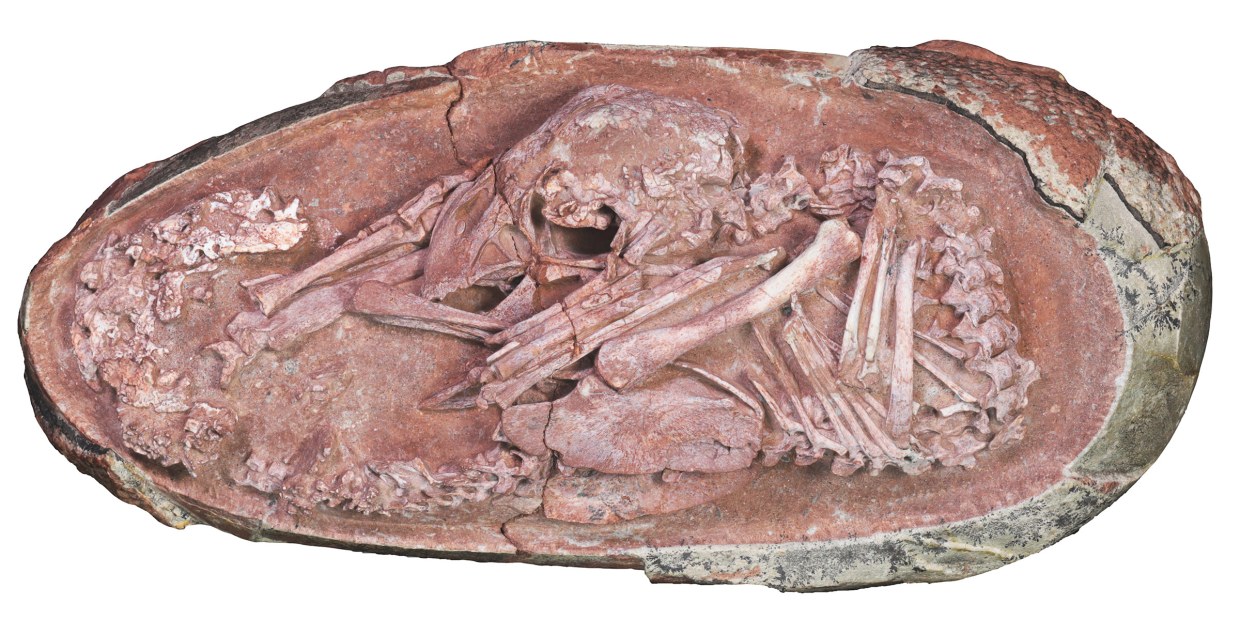
A 66-million-year-old fossil of a complete baby dinosaur in its egg, apparently just a few days before it would hatch, shows the remarkable similarities between theropod dinosaurs and the birds they would evolve into, according to a study published Tuesday.
The fossilized bones of the embryo, named “Baby Yingliang” after the museum in southern China where it was discovered, can be seen curled-up inside its 6-inch elongated eggshell and looking almost exactly like a modern bird at that stage, although it has tiny arms and claws rather than wings.
Fion Waisum Ma, a paleontologist at the University of Birmingham in the United Kingdom, said the head is particularly striking in its similarity to the head of a newly hatched bird — a resemblance heightened by a beak that was a feature of this dinosaur species, called an oviraptorosaur. Ma is one of the lead authors of the fossil study published in the journal iScience. Scientists from China, Canada and elsewhere in the U.K. were also involved.
Photo of the oviraptorosaur embryo ‘Baby Yingliang’. It is one of the best-preserved dinosaur embryos ever reported. Courtesy Xing et al., 2021
And remember my friend, future events such as these will affect you in the future
(Inverse) SCIENTISTS UNEARTHED A skull from a fossil-rich area of northern Nevada that reveals striking answers about ocean life — both past and present.
WHAT’S NEW — In a study published Thursday in the journal Science, researchers identified a new species of ichthyosaur — an enormous fish-shaped marine reptile that emerged 250 million years ago not long after the Permian mass extinction wiped out most of life on Earth.
The new species is dubbed Cymbospondylus youngorum — a massive creature comparable in size to the largest animal on Earth today: the blue whale.
The researchers’ findings tease a fascinating insight into the rapid evolution of ichthyosaurs’ enormous bodies compared to similarly large cetaceans — a class of marine animals that includes whales.
“We have discovered that ichthyosaurs and whales, two iconic groups of giant ocean predators that both evolved from land-living ancestors, evolved gigantism in very different ways,” Lars Schmitz, a co-author on the study and an associate professor of biology at Claremont McKenna, tells Inverse.
(EurekAlert) A team of Australian and international scientists led by Australian Museum (AM) and University of New South Wales (UNSW) palaeontologist Dr Matthew McCurry and Dr Michael Frese of the University of Canberra have discovered and investigated an important new fossil site in New South Wales, Australia, containing superb examples of fossilised animals and plants from the Miocene epoch. The team’s findings were published today in Science Advances.
The new fossil site (named McGraths Flat), located in the Central Tablelands, NSW near the town of Gulgong, represents one of only a handful of fossil sites in Australia that can be classified as a ‘Lagerstätte’– a site that contains fossils of exceptional quality.
Over the last three years a team of researchers has been secretly excavating the site, discovering thousands of specimens including rainforest plants, insects, spiders, fish and a bird feather.
Dr McCurry said the fossils formed between 11 and 16 million years ago and are important for understanding the history of the Australian continent.
“The fossils we have found prove that the area was once a temperate, mesic rainforest and that life was rich and abundant here in the Central Tablelands, NSW,” McCurry said.
(Science Alert) Scientists in China say they have found the oldest flower bud in the fossil record, finally aligning the fossil evidence with the genetic data suggesting flowering plants, or angiosperms, evolved tens of millions of years earlier than we initially thought.
The team hopes their discovery will help "ease the pain" around a nagging, centuries-old mystery that Charles Darwin once called "abominable".
If the oldest unambiguous fossil flower is no older than 130 million years old, then how come angiosperms began to dominate ecosystems just 20 to 30 million years later? How had they evolved such great diversity that quickly?
Further Extract:
In 2018, another fossilized flower was found in China, and this one, called Nanjinganthus, was about 174 million years old. Like a modern flowering plant, its seeds were completely enclosed in an ovary.
Not all botanists, however, are convinced these are true angiosperms. Some argue these plants are too primitive to be considered flowers, while others think their structures are too complex for a gymnosperm, an older type of plant with unenclosed seeds and lacking a flower, like a conifer.
(Science Alert) Reanalyzing fossils can often lead to new discoveries, as has been the case with a study of an 80 million-year-old Late Cretaceous Struthiosaurus austriacus skull. A new analysis reveals the dinosaur was likely sluggish in its movements and was probably largely deaf as well.
Researchers used a high-resolution 3D scan of a partial braincase section – just 50 millimeters (nearly 2 inches) in diameter – of the creature's skull, holding the brain and other brain and neurosensory tissues. Researchers used micro-computed tomography (micro-CT), where X-rays build up a detailed cross-section of an object, to create the scan.
They found signs that the dinosaur probably didn't have the brain capacity to focus on potential predators due to the small flocculus part of the brain that does this job. That suggests that the plates and spikes on the body of the S. austriacus were enough to discourage any other animals looking for a meal.
"In contrast to its North American relative Euoplocephalus, which had a tail club and a clear flocculus on the brain cast, Struthiosaurus austriacus may rather relied on its body armor for protection," says paleontologist Marco Schade, from the University of Greifswald in Germany.
Further digging into the braincase scans revealed the semicircular canals in the inner ear were formed in such a way that suggests the dinosaur wasn't the most agile of its kind: These parts of the ear help control balance movement, and various conclusions can be drawn from them.
About 2.4 billion years ago, Earth's atmosphere underwent what is called the Great Oxidation Event (GOE). Prior to the GOE, early Earth had far less molecular oxygen than we have today. After the GOE, molecular oxygen began to increase in abundance, eventually making life like ours possible.
For decades, researchers have tried to understand why and how the GOE occurred.
A team of scientists, led by James Andrew Leong with Tucker Ely, both of whom earned their doctoral degrees from Arizona State University (ASU)'s School of Earth and Space Exploration in 2020, and ASU Professor Everett Shock, has determined that weathering rocks might have contributed to the GOE. Their results were recently published in Nature Communications.
Molecular oxygen is produced by plants and photosynthetic microbes, but molecular oxygen is also consumed by organisms and by the oxidation of iron, sulfur, carbon and other elements in rocks. Molecular oxygen can also be consumed through reaction with reduced gases like hydrogen, which can form during rock weathering.
Scientists studying the early Earth hypothesize that the consumption of oxygen was perhaps more rapid than the production of oxygen by photosynthesis, so oxygen was not able to accumulate in the atmosphere.
"It's like when your bills exceed your income, money can't accumulate in a savings account. This appears to have been the situation on the early Earth," said co-author Shock, of ASU's School of Earth and Space Exploration and the School of Molecular Sciences.
A trio of researchers at the University of Bristol has found evidence of an early ancestor of the giant sauropodomorph dinosaurs that walked upright and was also likely quick and agile. In their paper published in the journal Royal Society Open Science, the group describes their study of Thecodontosaurus antiquus—a much smaller member of sauropodomorphs—found at a site in southwest England.
Sauropodomorphs have made the headlines in recent years due to their massive size. Fossils unearthed over the past several years have shown that they were very large herbivorous sauropods. In this new effort, the researchers found a fossil of one of their ancestors that lived approximately 20 million years earlier that was much smaller—just 30 centimeters tall when standing.
(Science Alert) Peering back hundreds of millions of years into the past can turn up some astonishing findings – as it has with the discovery of a second species of opabiniid, a soft-bodied arthropod with a segmented exoskeleton that lived on the seafloor during the Miaolingian (509-497 million years ago).
The original opadiniid, Opabinia regalis, was first described over a century ago in 1912, and has several notable physical characteristics – not least the five eyes protruding on stalks from its head, a backwards-facing mouth, and its hollow, tubular proboscis.
Now there's another: Opabinia regalis is not as unique a species as first thought, because it's been joined by Utaurora comosa. This creature was previously thought to belong to a different group of animals known as radiodonts, but has now been reclassified as an opabiniid after some extensive research.
"The initial phylogenetic analysis showed it was most closely related to Opabinia," says paleontologist Jo Wolfe from Harvard University.
"We followed up with more tests to interrogate that result using different models of evolution and data sets to visualize the different kinds of relationships this fossil may have had."
(EurekaAlert) Scientists analysing one of the largest genomic datasets of plants have discovered how the first plants on Earth evolved the mechanisms used to control water and ‘breathe’ on land hundreds of millions of years ago. The study by the University of Bristol and University of Essex, published in New Phytologist,* has important implications in understanding how plant water transport systems have evolved and how these might adapt in future in response to climate change.
Over the last 500-million years, the evolution of land plants has supported the diversity of life on an increasingly green planet. Throughout their evolution, plants have acquired adaptations such as leaves and roots, allowing them to control water and colonise land. Some of these ‘tools’ evolved in early land plants and today are found in both tiny mosses and giant trees which form complex forest ecosystems.
Researchers from Essex’s School of Life Sciences, and Bristol’s Schools of Biological Sciences and Geographical Sciences first compared the genes of 532 plant species to investigate the role of new and old genes in the genesis of these adaptations. Of these, the team focused on 218 genes which were genes related to major innovations in land plant evolution such as roots and vascular tissues.
They discovered that some early traits essential for land plants, like stomata (pores that plants use to ‘breathe’), are related to the origin of new genes. In contrast, later innovations (e.g. roots, the vascular system) recycle old genes that emerged in the ancestors of land plants and showed that different parts of plant anatomies (stomata, vascular tissue, roots) involved in the transport of water were linked to different methods of gene evolution.
Dr Jordi Paps, joint lead author and Senior Lecturer from Bristol's School of Biological Sciences, explained: “Our analyses shed new light on the genetic basis of the greening of the planet, highlighting the different methods of gene evolution in the diversification of the plant kingdom. Historically it has not been clear if evolutionary innovations are driven by the emergence of new genes or by the repurposing of old ones. Our findings tell us how plants have evolved at distinct moments in their history and how different modes of evolution, the origin of new genes and the recycling of older ones, contributed to the emergence of major innovations key to the greening of the planet.
Approximately 80 miles from the westernmost reach of China's Great Wall, paleontologists found relics of an even more ancient world. Over the last two decades, teams of researchers unearthed more than 100 specimens of fossil birds that lived approximately 120 million years ago, during the time of the dinosaurs. However, many of these fossils have proved difficult to identify: they're incomplete and sometimes badly crushed. In a new paper published in the Journal of Systematics and Evolution, researchers examined six of these fossils and identified two new species. And as a fun side note, one of those new species had a movable bony appendage at the tip of its lower jaw that may have helped the bird root for food.
"It was a long, painstaking process teasing out what these things were," says Jingmai O'Connor, the study's lead author and the associate curator of vertebrate paleontology at Chicago's Field Museum. "But these new specimens include two new species that increase our knowledge of Cretaceous bird faunas, and we found combinations of dental features that we've never seen in any other dinosaurs."
A new dinosaur which formed part of an array of 'unusual' creatures has been discovered in Argentina.
The new species, Guemesia ochoai, could be the close relative of the ancestors of an armless group of dinosaurs, which roamed the southern hemisphere over 70 million years ago.
A partially complete skull uncovered in Argentina provides new evidence of a unique ecosystem during the Late Cretaceous.
Guemesia ochoai was a species of abelisaurid, a clade of carnivores which roamed what is now Africa, South America and India. Dating back around 70 million years, the dinosaur may have been a close relative of the entire group's ancestors.
The discovery of Guemesia ochoai's skull offers a valuable insight into an area which has very few abelisaurid fossils, and may go some way to explain why the area gave rise to such unusual animals.
Professor Anjali Goswami, Research Leader at the Museum and co-author, says, "This new dinosaur is quite unusual for its kind. It has several key characteristics that suggest that is a new species, providing important new information about an area of the world which we don't know a lot about.
A pair of researchers affiliated with both the NOVA School of Science and Technology and Museu da Lourinhã, has found evidence that suggests a group of fossils found 23 years ago in Portugal are the remains of a new species of Spinosaurus—the type of dinosaur featured prominently in the movie Jurassic Park III. They have named it Iberospinus natarioi. In their paper posted on the open-access site PLOS ONE, Octa´vio Mateus and Darı´o Estraviz-Lo´pez, describe the fossils they studied and explain why they believe they belonged to a separate species of Spinosaurus.
Spinosaurids are believed to be one of the largest living carnivores to have ever walked the earth. They were long with large back legs and small front legs, as well as long tails and large heads that somewhat resembled those of a crocodile. They lived during the Mesozoic in Africa and parts of Britain and Europe, most notably on the Iberian Peninsula. Prior research has suggested that they likely lived most of their lives in the water but were quite capable of chasing down prey on land as well. Estimates of their characteristics are generalized as only a small number of fossils that have been found.
In this new effort, Mateus and Estraviz-Lo´pez suspected that the fossil remains discovered in 1999 close to Cabo Espichel, Portugal had been mistakenly identified. For many years, it was believed that the remains were from a single Spinosaurus known as Baryonyx walkeri—so they were given the label ML1190. The fossils included dorsal vertebra, rib fragments, a pubis shaft, dentary fragments, a partial right scapula, a phalanx bone, a public peduncle, and dorsal neural arches.
(Science Alert) A low-lying continent that existed some 40 million years ago and was home to exotic fauna may have "paved the way" for Asian mammals to colonize southern Europe, new research suggests.
Wedged between Europe, Africa and Asia, this forgotten continent – which researchers have dubbed "Balkanatolia" – became a gateway between Asia and Europe when sea levels dropped and a land bridge formed, around 34 million years ago.
"When and how the first wave of Asian mammals made it to south-eastern Europe remains poorly understood," palaeogeologist Alexis Licht and colleagues write in their new study.
But the result was nothing short of dramatic. Around 34 million years ago, at the end of the Eocene epoch, huge numbers of native mammals disappeared from Western Europe as new Asian mammals emerged, in a sudden extinction event now known as the Grande Coupure.
Recent fossil findings in the Balkans, however, have upended that timeline, pointing towards a 'peculiar' bioregion that appears to have enabled Asian mammals to colonize southeastern Europe as much as 5 to 10 million years before the Grande Coupure occurred.
(EurekAlert) Danish and Swedish researchers have dated the enormous Hiawatha impact crater, a 31 km-wide meteorite crater buried under a kilometer of Greenlandic ice. The dating ends speculation that the meteorite impacted after the appearance of humans and opens up a new understanding of Earth’s evolution in the post-dinosaur era.
Ever since 2015, when researchers at the University of Copenhagen’s GLOBE Institute discovered the Hiawatha impact crater in northwestern Greenland, uncertainty about the crater’s age has been the subject of considerable speculation. Could the asteroid have slammed into Earth as recently as 13,000 years ago, when humans had long populated the planet? Could its impact have catalyzed a nearly 1,000-year period of global cooling known as the Younger Dryas?
New analyses performed on grains of sand and rocks from the Hiawatha impact crater by the Natural History Museum of Denmark and the GLOBE Institute at the University of Copenhagen, as well as the Swedish Museum of Natural History in Stockholm, demonstrate that the answer is no. The Hiawatha impact crater is far older. In fact, a new study published in the journal Science Advances today reports its age to be 58 million years old.
"Dating the crater has been a particularly tough nut to crack, so it’s very satisfying that two laboratories in Denmark and Sweden, using different dating methods arrived at the same conclusion. As such, I’m convinced that we’ve determined the crater’s actual age, which is much older than many people once thought," says Michael Storey of the Natural History Museum of Denmark.
"Determining the new age of the crater surprised us all. In the future, it will help us investigate the impact’s possible effect on climate during an important epoch of Earth's history" says Dr. Gavin Kenny of the Swedish Museum of Natural History
Spinosaurus is the biggest carnivorous dinosaur ever discovered—even bigger than T. rex—but the way it hunted has been a subject of debate for decades. It's hard to guess the behavior of an animal that we only know from fossils; based on its skeleton, some scientists have proposed that Spinosaurus could swim, but others believe that it just waded in the water like a heron. Since looking at the anatomy of spinosaurid dinosaurs wasn't enough to solve the mystery, a group of paleontologists are publishing a new study in Nature that takes a different approach: examining the density of their bones. By analyzing the density of spinosaurid bones and comparing them to other animals like penguins, hippos, and alligators, the team found that Spinosaurus and its close relative Baryonyx had dense bones that likely would have allowed them to submerge themselves underwater to hunt. Meanwhile, another related dinosaur called Suchomimus had lighter bones that would have made swimming more difficult, so it likely waded instead or spent more time on land like other dinosaurs.
"The fossil record is tricky—among spinosaurids, there are only a handful of partial skeletons, and we don't have any complete skeletons for these dinosaurs," says Matteo Fabbri, a postdoctoral researcher at the Field Museum and the lead author of the study in Nature. "Other studies have focused on interpretation of anatomy, but clearly if there are such opposite interpretations regarding the same bones, this is already a clear signal that maybe those are not the best proxies for us to infer the ecology of extinct animals."
A trio of researchers with the National Museum of Natural History, Smithsonian Institution, the University of Calgary and Carleton University, respectively, has found a snake-like fossil that may represent a creature in transition from four legs to none. In their paper published in the journal Nature Ecology & Evolution, Arjan Mann, Jason Pardo and Hillary Maddin describe the fossil they found and why they believe it helps to explain how animals such as snakes lost their limbs.
Prior research has shown that after animals evolved to walk on land, some of the four-legged creatures evolved in ways that resulted in loss of their limbs—modern snakes are a prime example. In this new effort, the researchers found a fossilized creature that may represent a step in that process.
Dubbed Nagini mazonense, the fossil is believed to represent both a new genus and species belonging to a group known as molgophids. It was approximately 10 centimeters in length and had no forelimbs or even a pectoral girdle. It did have hind legs, feet and four toes, however, which is why the researchers believe it represents a transitional creature.