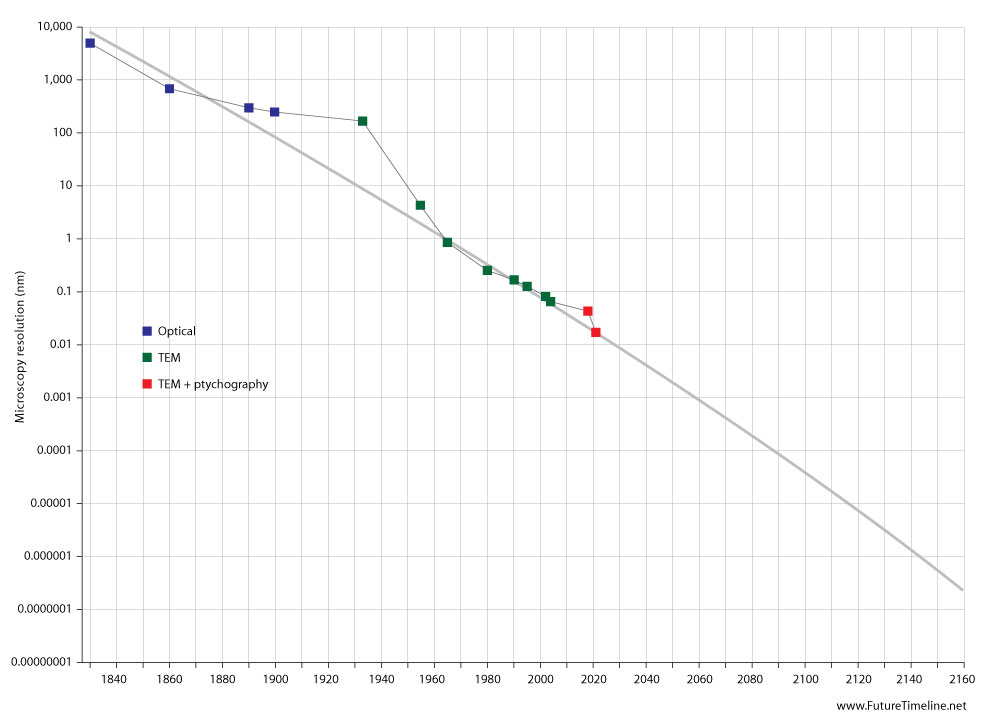
The best possible resolution we have today is approaching 0.01 nanometres (10 picometres), which is fine enough to view individual atoms. We can see them in a recent blog post here.
Presumably new innovations will allow even smaller details to be resolved in the future. During the 22nd century, it should even be possible to view individual protons, which have a radius of 0.831 femtometres (fm), or 1.662 fm if we're going with diameter.
1.662 fm = 0.000001662 nm, achievable by around 2140, based on the graph below.
So my question is: what might that mean in terms of practical applications? Let's say we're able to view subatomic structures and physical phenomena on that scale. What would we do with such technology? What might we learn about protons? This could make an interesting entry on our timeline.
Quarks and electrons, which are three orders of magnitude smaller than protons, might be viewable around 2200.