Natural History (13.8 billion years BC – 3.3 million BC)

Got something to say about the past? Say it here!
Post Reply
weatheriscool
Posts: 24495
Joined: Sun May 16, 2021 6:16 pm
Contact:

Re: Natural History (13.8 billion years BC – 3.3 million BC)

Post by weatheriscool »

Newly identified softshell turtle lived alongside T. rex and Triceratops
https://phys.org/news/2022-03-newly-sof ... atops.html
by Katherine Unger Baillie, University of Pennsylvania
Anewly described softshell turtle that lived in North Dakota 66.5 million years ago at the end of the Cretaceous Period, just before the end-Cretaceous mass extinction, is one of the earliest known species of the genus, according to new research shared in the journal Cretaceous Research.
User avatar
wjfox
Site Admin
Posts: 13587
Joined: Sat May 15, 2021 6:09 pm
Location: Essex, UK
Contact:

Re: Natural History (13.8 billion years BC – 3.3 million BC)

Post by wjfox »

User avatar
raklian
Posts: 1981
Joined: Sun May 16, 2021 4:46 pm
Location: North Carolina

Re: Natural History (13.8 billion years BC – 3.3 million BC)

Post by raklian »

The description about the asteroid impact that wiped out the dinosaurs is... frankly accurate in a way it blows away any delusions Hollywood movies had about this event. The impact was so violent that it probably left pieces of dinosaur bone on the Moon. :shock:

To know is essentially the same as not knowing. The only thing that occurs is the rearrangement of atoms in your brain.
User avatar
caltrek
Posts: 9280
Joined: Mon May 17, 2021 1:17 pm

Re: Natural History (13.8 billion years BC – 3.3 million BC)

Post by caltrek »

Diverse Life Forms May Have Evolved Earlier Than Previously Thought
April 13, 2022

https://www.eurekalert.org/news-releases/949513

Introduction:
(University College of London via EurekAlert) Diverse microbial life existed on Earth at least 3.75 billion years ago, suggests a new study led by UCL researchers that challenges the conventional view of when life began.

For the study, published in Science Advances, the research team analysed a fist-sized rock from Quebec, Canada, estimated to be between 3.75 and 4.28 billion years old. In an earlier Nature paper*, the team found tiny filaments, knobs and tubes in the rock which appeared to have been made by bacteria.

However, not all scientists agreed that these structures – dating about 300 million years earlier than what is more commonly accepted as the first sign of ancient life – were of biological origin.

Now, after extensive further analysis of the rock, the team have discovered a much larger and more complex structure – a stem with parallel branches on one side that is nearly a centimetre long – as well as hundreds of distorted spheres, or ellipsoids, alongside the tubes and filaments.

The researchers say that, while some of the structures could conceivably have been created through chance chemical reactions, the “tree-like” stem with parallel branches was most likely biological in origin, as no structure created via chemistry alone has been found like it
Don't mourn, organize.

-Joe Hill
weatheriscool
Posts: 24495
Joined: Sun May 16, 2021 6:16 pm
Contact:

Re: Natural History (13.8 billion years BC – 3.3 million BC)

Post by weatheriscool »

The question is why did it take ~2.5 billion years for life to explode and into the multi-cell creatures that we see the past 500 million years.
User avatar
caltrek
Posts: 9280
Joined: Mon May 17, 2021 1:17 pm

Re: Natural History (13.8 billion years BC – 3.3 million BC)

Post by caltrek »

weatheriscool wrote: Wed Apr 13, 2022 8:34 pm The question is why did it take ~2.5 billion years for life to explode and into the multi-cell creatures that we see the past 500 million years.
Complexity takes time to develop. Once it is achieved, it is relatively easy to spread and become even more complex. At least that is my oversimplified way of viewing it.

What I came here to post:

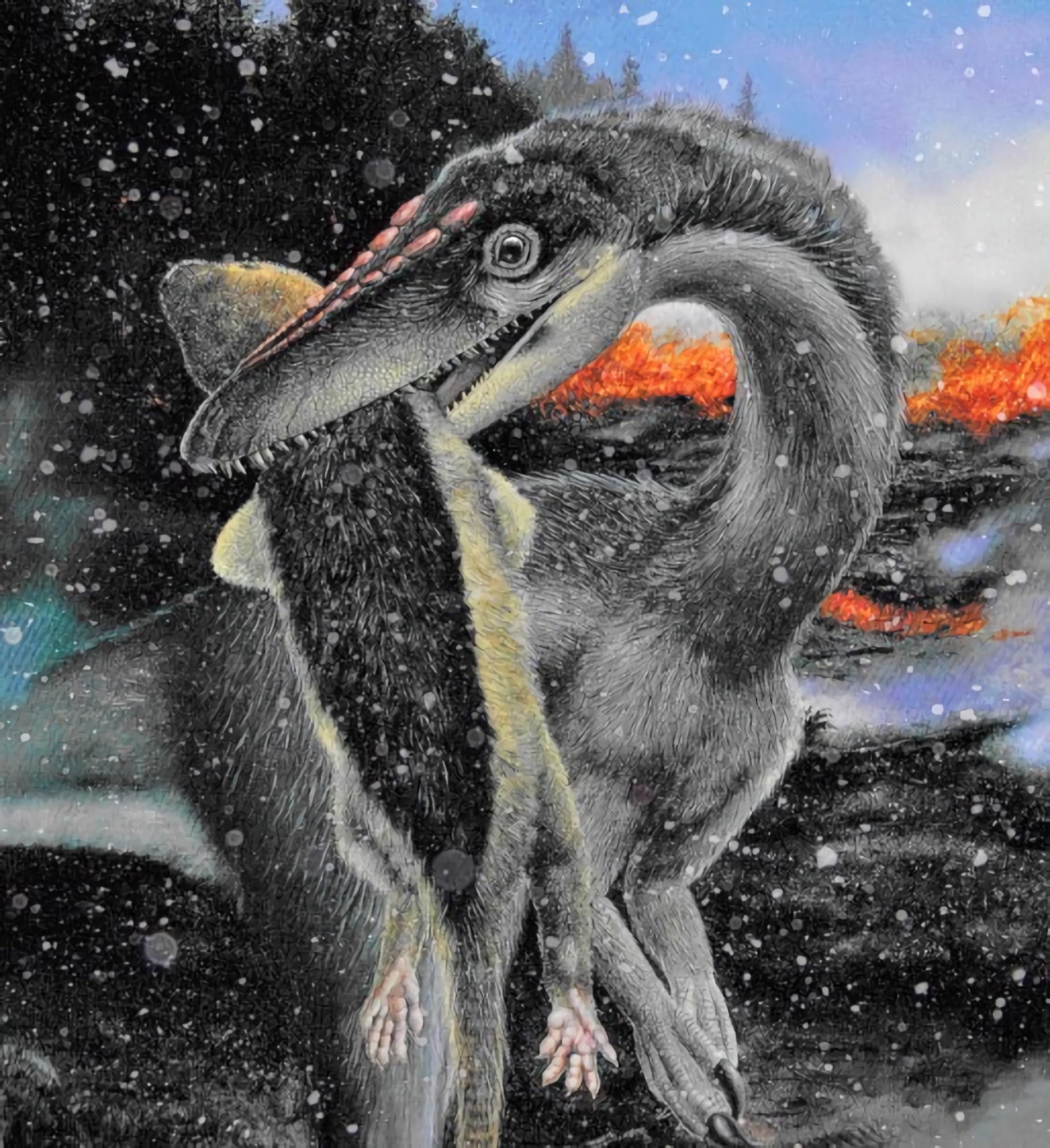
Groundbreaking Study Confirms Pterosaurs Really Did Have Feathers – And That's Not All
Peter Dockrill
April 20, 2022


https://www.sciencealert.com/groundbrea ... ful-secret

Introduction:
(Science Alert) For much of the history of paleontology, scientists thought all dinosaurs were covered in scales, like the lizards of today.

That was until a spate of discoveries in recent decades revealed many of these marvelous extinct animals sported ancient feathers – just like their later descendants, birds.

As for pterosaurs – the flying reptiles that reigned in the sky when the dinosaurs roamed – the issue has never been settled. Were they bald? Did they have feathers too? Scant evidence in the fossil record has never been definitive – until now, scientists say.

Preserved on slabs of ancient limestone in north-eastern Brazil, a newly discovered fossil of Tupandactylus imperator reveals the existence of pterosaur feathers about 113 million years ago.

"We didn't expect to see this at all," says paleontologist Aude Cincotta from University College Cork in Ireland.
The article also goes on to further discuss evidence of feathers as well as of the pigmentation of these ancient creatures.
Don't mourn, organize.

-Joe Hill
User avatar
wjfox
Site Admin
Posts: 13587
Joined: Sat May 15, 2021 6:09 pm
Location: Essex, UK
Contact:

Re: Natural History (13.8 billion years BC – 3.3 million BC)

Post by wjfox »

User avatar
wjfox
Site Admin
Posts: 13587
Joined: Sat May 15, 2021 6:09 pm
Location: Essex, UK
Contact:

Re: Natural History (13.8 billion years BC – 3.3 million BC)

Post by wjfox »

Edit: I see Caltrek has already posted about this earlier.

Oh well, I'll leave it up anyway.

-----

Pterosaurs had brightly colored feathers like toucans, according to a new study

PUBLISHED APRIL 26, 2022 7:29PM (EDT)

Pterosaurs, flying reptiles that coexisted with dinosaurs, have been on a roll lately — or, rather, their fossils have, as a plethora of recent discoveries has helped flesh out the evolutionary timeline with new insights into prehistoric life.

Last year paleontologists discovered a miniature pterosaur that had opposable thumbs, similar to humans and other primates. Also in 2021, scientists cracked the mystery of how pterodactyls were able to swoop down and scoop up large prey without breaking their necks. (The answer: They had bones in their necks with structures similar to the spokes in bicycle wheels.)

Now a new study reveals something surprising about pterosaurs: They may have possessed colored feathers like a toucan or a parrot. If true, it would help fit together the evolutionary puzzle pieces that tie together reptiles, dinosaurs and modern birds.

According to a recent study published in the scientific journal Nature, a Brazilian fossil of a pterosaur called Tupandactylus imperator included extensive amounts of soft tissue.

https://www.salon.com/2022/04/26/pteros ... new-study/
weatheriscool
Posts: 24495
Joined: Sun May 16, 2021 6:16 pm
Contact:

Re: Natural History (13.8 billion years BC – 3.3 million BC)

Post by weatheriscool »

A new 225-million-year-old reptile from Brazil
https://phys.org/news/2022-05-million-y ... razil.html
by PeerJ
Maehary bonapartei represents a small reptile that is considered to be the most basal of the evolutionary lineage that gave rise to pterosaurs. A study in PeerJ focuses on this latest find while also demonstrating that Faxinalipterus minimus is not a winged reptile, contrary to what was previously supposed.

Researchers from the National Museum/UFRJ, the Federal University of Santa Maria, the Catalan Institute of Paleontology, the Regional University of Cariri, the Federal University of Pampa, the Federal University of Rio Grande do Sul and COPPE/UFRJ presented a review of a small reptile named Faxinalipterus minimus, from Triassic rocks (about 225 million years ago) in Rio Grande do Sul.

Faxinalipterus was described more than a decade ago (2010), being assigned to the Pterosauria, a group that includes the first vertebrates to develop active flight. The original fossil of Faxinalipterus was composed of bones from the postcranial skeleton and a part of the skull (an upper jaw with several teeth), found separately in two field expeditions, carried out in 2002 and 2005 at the Linha São Luiz fossil site located in the municipality of Faxinal do Soturno. Thus, it was not possible to say with certainty whether all parts belonged to the same type of animal and species. Despite this, it was assumed at the time that all the bones belonged to a single species, named Faxinalipterus minimus.

The new study of Faxinalipterus established that there were two distinct species, with the isolated jaw representing another animal. This was possible based on the comparison with a new fossil recently found at the same site (Linha São Luiz). The new material is composed of an incomplete skull, whose maxilla exhibits the same features of the maxilla attributed to Faxinalipterus. In addition, there are parts of the mandible, scapula and some vertebrae. The maxilla of Faxinalipterus can therefore be incorporated into the description of the new fossil, which was named Maehary bonapartei. The study was featured in the journal PeerJ.

"There was always a great doubt whether the two specimens attributed to Faxinalipterus represented the same species, and whether this was a flying reptile," commented Alexander Kellner, a specialist in pterosaurs who currently directs the Museu Nacional/UFRJ. Having examined the specimen shortly after publication in 2010, he saw that several bones could be misidentified and the lack of diagnostic features of pterosaurs, including the absence of specific features on the humerus (forelimb bone), such as a large and projected deltopectoral crest, which is typical of pterosaurs.

Borja Holgado, also a specialist in pterosaurs from the Catalan Institute of Paleontology and currently a researcher at the Regional University of Cariri (Ceará), analyzed the material and agreed with the initial conclusions. "It was clear to me that this is a primitive reptile that did not belong to pterosaurs, as it did not present any unequivocal features of this lineage," explained Holgado. "But the present knowledge of the faunas at the end of the Triassic indicates that the disparity of animals at that time was so great that animals that might resemble pterosaurs at first glance, but really they are not flying reptiles. This is what happened to Faxinalipterus and Maehary."

"The material on which Faxinalipterus is based is very fragile and very incomplete. In addition, parts of the bones were covered by rock matrix, which required a more detailed preparation," commented Cesar Schultz, from UFRGS and one of the authors of the 2010 work and of the new research that has just been published.

The preparation of the original material required a lot of experience and was carried out at the National Museum. "Fortunately, we were able to photograph the entire specimen in detail," said Orlando Grillo, who took care to reproduce in the form of drawings each anatomical detail of the bones of Faxinalipterus.
A: map with the location where the fossils were found (Linha São Luiz, Faxinal do Soturno, Rio Grande do Sul); B: photo of the outcrop where the fossils were collected; C: Skeletal reconstruction of Faxinalipterus minimus; D: Maehary bonapartei skull reconstruction. Image of the published article. Credit: Alexander W.A. Kellner

It was with the help of a CT scanner that the enigma was revealed. "Computed tomography has been an increasingly used tool in paleontological studies," says Ricardo Lopes from COPPE/UFRJ. "It is a non-destructive analysis that allows the visualization of anatomical details still covered by the sedimentary rock where the fossil is preserved," adds Olga Araújo, also from COPPE.

"In the original work from 2010, we found that the teeth present in the maxilla of Faxinalipterus were very closely spaced, which is a characteristic of early Triassic pterosaurs. However, tomography of the maxilla showed that the teeth were not as separated as initially thought, since many teeth had been lost during the fossilization process. As a result, the dentition pattern and the close-spacing between the alveoli (cavities where the teeth are inserted) were not consistent with pterosaurs," says Marina Soares.

After these studies, there was still a doubt about who, after all, Faxinalipterus was. The solution came from the finding of a new specimen that had been collected in the same region where the specimens of Faxinalipterus came from. "Systematic collections have been carried out by CAPPA (Support Center for Paleontological Research of the Fourth Colony), from UFSM, revealing a series of new fossil species for the Triassic of Rio Grande do Sul," said Flávio Pretto. At the Linha de São Luiz fossil site, in the municipality of Faxinal do Soturno, several fossils have already been found, such as close relatives of mammals, dinosaurs and other reptiles. The region where the excavations were carried out is located in the territory of the Quatro Colônia, which is seeking to become an UNESCO Geopar
k.

User avatar
wjfox
Site Admin
Posts: 13587
Joined: Sat May 15, 2021 6:09 pm
Location: Essex, UK
Contact:

Re: Natural History (13.8 billion years BC – 3.3 million BC)

Post by wjfox »

User avatar
caltrek
Posts: 9280
Joined: Mon May 17, 2021 1:17 pm

Re: Natural History (13.8 billion years BC – 3.3 million BC)

Post by caltrek »

How Plants Colonized the Land
May 20, 2022

Introduction:
(EurekAlert) University of Copenhagen researchers have shed new light on how plant life became established on the surface of our planet. Specifically, they demonstrated that two genes are indispensable for allowing terrestrial plants to defend themselves against fungal attack – a defense mechanism that they traced back 470 million years. It is likely that these defenses paved the way for all terrestrial plant life.

When plants evolved from aquatic algae to being able to survive on land nearly half a billion years ago, the foundation for life on land was established. One of the challenges that made this dramatic transition particularly difficult were fungi:

"It is estimated that 100 million years prior, fungi crept across Earth’s surface in search of nourishment and most likely found it in dead algae washed up from the sea. So, if you, as a new plant, were going to establish yourself on land, and the first thing you encountered is a fungus that would eat you, you needed some sort of defense mechanism," says Mads Eggert Nielsen, a biologist at the University of Copenhagen’s Department of Plant and Environmental Sciences.

According to Mads Eggert Nielsen and his research colleagues from the Department of Plant and Environmental Sciences and the University of Paris-Saclay, the essence of this defense mechanism can be narrowed down to two genes, PEN1 and SYP122. Together, they help form a kind of plug in plants that blocks the invasion of fungi and fungus-like organisms.

"We found out that if we destroy these two genes in our model plant thale cress (Arabidopsis), we open the door for pathogenic fungi to penetrate. We found that they are essential to form this cell wall-like plug that defends against fungi. Interestingly, it appears to be a universal defense mechanism that is found in all terrestrial plants," says Mads Eggert Nielsen, senior author of the study, which is published in the journal eLife.
Read more here: https://www.eurekalert.org/news-releases/953425

For a more technical presentation: https://elifesciences.org/articles/73487#s3
Don't mourn, organize.

-Joe Hill
User avatar
caltrek
Posts: 9280
Joined: Mon May 17, 2021 1:17 pm

Re: Natural History (13.8 billion years BC – 3.3 million BC)

Post by caltrek »

Dinosaur at Top of Food Chain Discovered in Argentina
by Tatsuyuki Kobori
May 23, 2022

Introduction:
(Asahi Shimbun) An international research team has identified a new dinosaur species in Argentina, an apex predator so ferocious that it was named after an evil spirit from a local myth.

Maip macrothorax, the largest relative of Megaraptora found so far, was discovered through bones from its spinal column and ribs unearthed from a stratum formed 70 million years ago in what is now Santa Cruz province, southern Argentina, in March 2020.

“Based on the discovery of Maip macrothorax, combined with other finds, it appears that Megaraptora came to hold one of the top spots among carnivores in South America by the end of the Cretaceous Period,” said Makoto Manabe, deputy director of the National Museum of Nature and Science in Tokyo.

Manabe and Takanobu Tsuihiji, a chief researcher at the museum, were involved in the dinosaur study.

Maip macrothorax, a theropod, was an estimated 9 meters long and weighed 5 tons. Like other Megaraptora, the new species probably had many teeth in its elongated head as well as sharp claws on its forearms.
Read more here: https://www.asahi.com/ajw/articles/14614286

For a more technical discussion: https://www.nature.com/articles/s41598-022-09272-z
Don't mourn, organize.

-Joe Hill
User avatar
caltrek
Posts: 9280
Joined: Mon May 17, 2021 1:17 pm

Re: Natural History (13.8 billion years BC – 3.3 million BC)

Post by caltrek »

In New Science Study, Researchers Might Have Found a Missing Link Between the Primordial World and Modern Life
by Charles Q. Choi
May 25, 2022

Extract:
(Inverse) In the new study, researchers examined molecules other than the A, U, C, and G used in RNA. These so-called "non-canonical RNA bases" find use in transfer and ribosomal RNA.

In RNA, bases are combined with sugar molecules to form compounds known as nucleosides. Nucleosides can be combined with phosphorus-loaded chemicals to produce molecules known as nucleotides. RNAs are made up of strings of nucleotides.

Non-canonical nucleosides — ones that use different bases or sugars normally found in RNA — nowadays "are needed for RNA to fold into the right three-dimensional structure," study senior author Thomas Carell, a biochemist at Ludwig Maximilians University in Munich, tells Inverse. "They also give RNA the stability that is required for its function."

Moreover, non-canonical RNA nucleosides help increase the accuracy of the system used to decode genetic information. "Without these nucleotides decoding genetic information, the whole process is far too error-prone," Carell notes.

Non-canonical nucleosides can have amino acids linked with them. Carell and his colleagues reasoned that such compounds might have provided a way for ancient RNA molecules to help synthesize proteins. They synthesized RNA strands incorporating such non-canonical nucleosides to see what chemical reactions might happen.
Read more here: https://www.inverse.com/science/origin ... ry-rna-dna
.
Don't mourn, organize.

-Joe Hill
weatheriscool
Posts: 24495
Joined: Sun May 16, 2021 6:16 pm
Contact:

Re: Natural History (13.8 billion years BC – 3.3 million BC)

Post by weatheriscool »

Europe's largest land predator unearthed on the Isle of Wight
https://phys.org/news/2022-06-europe-la ... -isle.html
by University of Southampton
Research led by paleontologists at the University of Southampton has identified the remains of one of Europe's largest ever land-based hunters: a dinosaur that measured over 10m long and lived around 125 million years ago.

Several prehistoric bones, uncovered on the Isle of Wight, on the south coast of England, and housed at Dinosaur Isle Museum in Sandown, belonged to a type of two-legged, crocodile-faced predatory dinosaur known as spinosaurids. Dubbed the 'White Rock spinosaurid'—after the geological layer in which it was found—it was a predator of impressive proportions.

"This was a huge animal, exceeding 10 m in length and probably several tons in weight. Judging from some of the dimensions, it appears to represent one of the largest predatory dinosaur ever found in Europe—maybe even the biggest yet known," said Ph.D. student Chris Barker, who led the study. "It's a shame it's only known from a small amount of material, but these are enough to show it was an immense creature."
User avatar
wjfox
Site Admin
Posts: 13587
Joined: Sat May 15, 2021 6:09 pm
Location: Essex, UK
Contact:

Re: Natural History (13.8 billion years BC – 3.3 million BC)

Post by wjfox »

User avatar
caltrek
Posts: 9280
Joined: Mon May 17, 2021 1:17 pm

Re: Natural History (13.8 billion years BC – 3.3 million BC)

Post by caltrek »

The Greening of the Land
June 20, 2022

Introduction:
(EurekAlert) A team led by evolutionary biologist Prof. Dr. Sven Gould of Heinrich Heine University Düsseldorf (HHU) has been studying the current state of research on the plant colonisation of land that occurred some 500 million years ago. The findings from this illustrated overview study published by Dr. Mona Schreiber as lead author have now appeared in the latest issue of the journal Trends in Plant Science.

It took several hundred million years after the formation of Earth some 4½ billion years ago for the initially fiery globe to cool down, allowing the first oceans and land masses to form. The land was barren rock for the next three billion years.

The blue planet with green continents that we know today did not exist as such in that era. For conditions on the continents were largely hostile to life, with a much higher volcanic activity releasing toxic gases into the atmosphere, a weaker magnetic field than exists today exposing the land more to cosmic rays, and a thinner ozone layer to filter out UV light.

This started changing approximately 500 million years ago when plants began colonizing land. The invasion catalysed a metamorphosis of the hostile environment, accelerating the transformation of the atmosphere, to lay the foundations for the development of life on land as we know it today. All this could only occur once plants, which had only lived in the oceans and inland freshwater, had conquered the continents.

Now Prof. Dr. Sven Gould of the Institute of Molecular Evolution at HHU, Prof. Dr. Stefan Rensing and Dr. Mona Schreiber, a bioinformatics specialist and artist from the University of Marburg, are providing an overview of the current state of research on the plant colonization of land in the journal Trends in Plant Science. Their paper was written in connection with priority programme 2237 “MAdLand” (Molecular Adaptation to Land), funded by the German Research Foundation. The purpose of the MAdLand programme is to explore the beginnings of the evolutionary adaptation of plant organisms to life on land.
Read more here: https://www.eurekalert.org/news-releases/956080
Don't mourn, organize.

-Joe Hill
User avatar
Time_Traveller
Posts: 3025
Joined: Sun May 16, 2021 4:49 pm
Location: New York City, USA, November 5th 2032 C.E.

Re: Natural History (13.8 billion years BC – 3.3 million BC)

Post by Time_Traveller »

Study of Ancient Mass Extinction Reveals Dinosaurs Took Over Earth Amid Ice, Not Warmth
JULY 1, 2022

Image

Many of us are familiar with the popular theory of how the dinosaurs died 66 million years ago: in Earth’s violent collision with a meteorite, followed by a global winter caused by dust and debris choking the atmosphere. But there was a far more mysterious and less discussed previous extinction: the one 202 million years ago, which wiped out the big reptiles who up until then ruled the planet, and apparently cleared the way for dinosaurs to take over. What caused the so-called Triassic-Jurassic Extinction, and why did dinosaurs thrive when other creatures perished?

We know that the world was generally hot and steamy during the Triassic Period, which preceded the extinction, and there were similar conditions during the following Jurassic, which kicked off the age of dinosaurs. However, new research turns the idea of heat-loving dinosaurs on its head: It presents the first physical evidence that Triassic dinosaur species, which were a minor group largely relegated to the polar regions at the time, regularly endured freezing conditions there.

The telltale indicators are dinosaur footprints along with odd rock fragments that only could have been deposited by ice. The authors of the study explain that during the extinction, cold snaps already happening at the poles spread to lower latitudes, killing off the cold-blooded reptiles. Dinosaurs, which had already adapted, survived the evolutionary bottleneck and spread out. The rest is ancient history.

“Dinosaurs were there during the Triassic under the radar all the time,” said Paul Olsen, a geologist at Columbia University’s Lamont-Doherty Earth Observatory, and lead author of the study. “The key to their eventual dominance was very simple. They were fundamentally cold-adapted animals. When it got cold everywhere, they were ready, and other animals weren’t.”

The study, based on recent excavations in the remote desert of northwest China’s Junggar Basin, was published today (July 1, 2022) in the journal Science Advances.
https://scitechdaily.com/study-of-ancie ... ot-warmth/
“In the quantum multiverse, every choice, every decision you've ever and never made exists in an unimaginably vast ensemble of parallel universes.”
weatheriscool
Posts: 24495
Joined: Sun May 16, 2021 6:16 pm
Contact:

Re: Natural History (13.8 billion years BC – 3.3 million BC)

Post by weatheriscool »

Dinosaurs took over amid ice, not warmth, says a new study of ancient mass extinction
https://phys.org/news/2022-07-dinosaurs ... -mass.html
by Columbia University
Many of us know the conventional theory of how the dinosaurs died 66 million years ago: in Earth's fiery collision with a meteorite, and a following global winter as dust and debris choked the atmosphere. But there was a previous extinction, far more mysterious and less discussed: the one 202 million years ago, which killed off the big reptiles who up until then ruled the planet, and apparently cleared the way for dinosaurs to take over. What caused the so-called Triassic-Jurassic Extinction, and why did dinosaurs thrive when other creatures died?

We know that the world was generally hot and steamy during the Triassic Period, which preceded the extinction, and during the following Jurassic, which kicked off the age of dinosaurs. However, a new study turns the idea of heat-loving dinosaurs on its head: It presents the first physical evidence that Triassic dinosaur species—then a minor group largely relegated to the polar regions—regularly endured freezing conditions there. The telltale indicators: dinosaur footprints along with odd rock fragments that only could have been deposited by ice. The study's authors say that during the extinction, cold snaps already happening at the poles spread to lower latitudes, killing off the coldblooded reptiles. Dinosaurs, already adapted, survived the evolutionary bottleneck and spread out. The rest is ancient history.
User avatar
Time_Traveller
Posts: 3025
Joined: Sun May 16, 2021 4:49 pm
Location: New York City, USA, November 5th 2032 C.E.

Re: Natural History (13.8 billion years BC – 3.3 million BC)

Post by Time_Traveller »

Explosion of life on Earth linked to heavy metal act at planet’s centre
Sun 3 Jul 2022

Image

At the centre of the Earth, a giant sphere of solid iron is slowly swelling. This is the inner core and scientists have recently uncovered intriguing evidence that suggests its birth half a billion years ago may have played a key role in the evolution of life on Earth.

At that time, our planet’s magnetic field was faltering – and that would have had critical consequences, they argue. Normally this field protects life on the surface by repelling cosmic radiation and charged particles emitted by our sun.

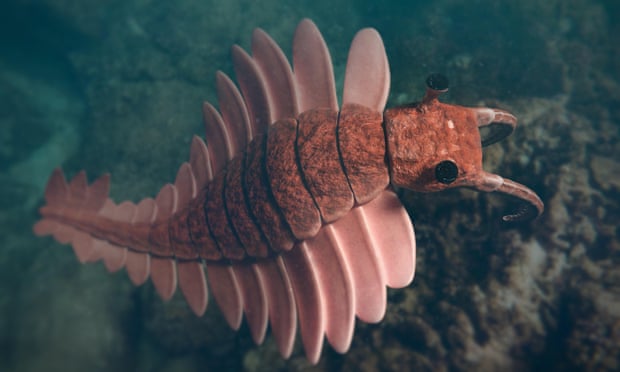
But 550m years ago, it had dropped to a fraction of its current strength – before it abruptly regained its power. And in the wake of this planetary reboot, Earth witnessed the sudden proliferation of complex multicellular life on its surface. This was the Cambrian explosion, when most major animal groups first appeared in the fossil record. Now scientists have linked it to events at the very centre of the Earth.

Our planet consists of spheres. There is a 5-70km-thick layer of rock that covers Earth like an eggshell. This is called the crust and below it lies the mantle, made up of a 3,000km layer of silicates. Further down, there is the outer core, made of molten iron, and inside it there is another sphere – of solid iron. It is more than 2,000km in diameter and is growing by about a millimetre a year.

“Earth’s magnetic field is generated by swirling iron in the outer core,” said John Tarduno, professor of geophysics at the University of Rochester, New York. “Before the Cambrian explosion the core was entirely molten and its ability to generate a magnetic field was collapsing.”
https://www.theguardian.com/science/202 ... ets-centre
“In the quantum multiverse, every choice, every decision you've ever and never made exists in an unimaginably vast ensemble of parallel universes.”
weatheriscool
Posts: 24495
Joined: Sun May 16, 2021 6:16 pm
Contact:

Re: Natural History (13.8 billion years BC – 3.3 million BC)

Post by weatheriscool »

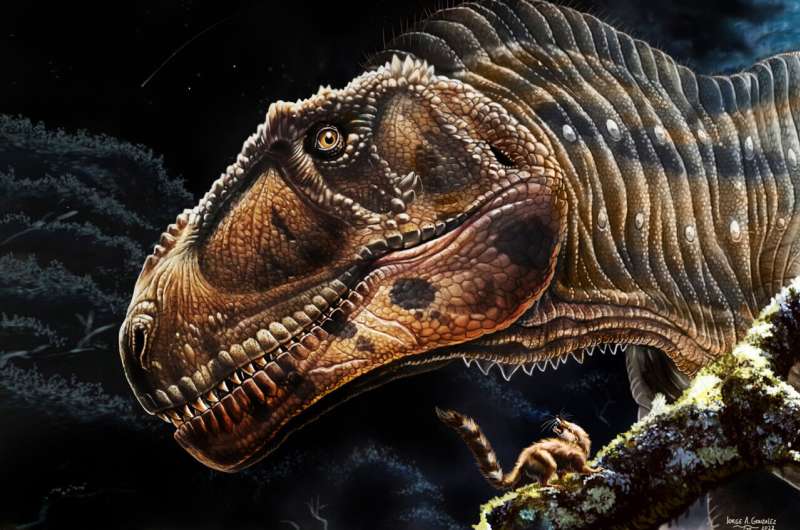
New giant carnivorous dinosaur discovered with tiny arms like T. rex

Image

https://phys.org/news/2022-07-giant-car ... -arms.html
by Cell Press
Tyrannosaurs (like the famous T. rex) is not the only group of giant carnivorous dinosaur with tiny arms. Researchers discovered a new species of dinosaur with disproportionally short arms just like T. rex called the Meraxes gigas. The findings, published in the journal Current Biology on July 7, argued that T. rex and M. gigas evolved to have tiny arms independently, and proposed some potential functions for the short arms like mating or movement support.

"The fossil of M. gigas shows never seen before, complete regions of the skeleton, like the arms and legs that helped us to understand some evolutionary trends and the anatomy of Carcharodontosaurids—the group that M. gigas belongs to," says Juan Canale, the project lead at Ernesto Bachmann Paleontological Museum in Neuquén, Argentina.

The authors first set the record straight; T. rex did not get their short arms from M. gigas or vice versa. Not only did M. gigas become extinct almost 20 million years before T. rex became a species, but they are also very far apart on the evolutionary tree. "There is no direct relationship between both," says Canale. Rather, Canale believes that having tiny arms somehow gave the two dinosaurs some kind of survival advantage.

"I'm convinced that those proportionally tiny arms had some sort of function. The skeleton shows large muscle insertions and fully developed pectoral girdles, so the arm had strong muscles," says Canale. This means that the arms did not shrink because they were useless to the dinosaurs. The harder question is what exactly the functions were.
Last edited by weatheriscool on Fri Jul 15, 2022 7:07 am, edited 1 time in total.
Post Reply