James Webb Space Telescope (JWST)

-
weatheriscool
- Posts: 26094
- Joined: Sun May 16, 2021 6:16 pm
- Contact:
-
weatheriscool
- Posts: 26094
- Joined: Sun May 16, 2021 6:16 pm
- Contact:
Re: James Webb Space Telescope (JWST)
James Webb Space Telescope Might Be Able to Detect Alien Agriculture
By Ryan Whitwam on April 25, 2022 at 7:30 am
https://www.extremetech.com/extreme/334 ... griculture
By Ryan Whitwam on April 25, 2022 at 7:30 am
https://www.extremetech.com/extreme/334 ... griculture
If you were an alien looking at Earth from a great distance, it would have looked mostly the same right up until 10,000 years ago. That’s when humans invented agriculture, and the planet has never been the same since. Farming allowed humans to proliferate, and the scale at which we now produce food has changed the way Earth would appear to an outside observer. The same could be true of an inhabited exoplanet, and it just so happens we finally have a tool that could detect these conditions: the James Webb Space Telescope. A team of astronomers recently explained how the new observatory might be able to spot “exofarms” when it begins scanning the heavens later this year.
A study exploring this possibility is available on the preprint arXiv server. It comes courtesy of the Blue Marble Space Institute of Science in collaboration with NASA’s Goddard Space Flight Center and the University of California. The analysis assumes a few things about agriculture on exoplanets, including that the biosphere would take advantage of the free energy raining down from their suns. If there’s something like photosynthesis, then the large-scale farming of plants would produce recognizable signatures as it does on Earth.
Re: James Webb Space Telescope (JWST)

To know is essentially the same as not knowing. The only thing that occurs is the rearrangement of atoms in your brain.
-
weatheriscool
- Posts: 26094
- Joined: Sun May 16, 2021 6:16 pm
- Contact:
Re: James Webb Space Telescope (JWST)
Examining the heart of Webb: The final phase of commissioning
https://phys.org/news/2022-05-heart-web ... oning.html
by Scott Friedman, NASA
https://phys.org/news/2022-05-heart-web ... oning.html
by Scott Friedman, NASA
NASA's James Webb Space Telescope is now experiencing all seasons—from hot to cold—as it undergoes the thermal stability test. Meanwhile, activities are underway for the final phase of commissioning: digging into the details of the science instruments, the heart of Webb. To complete commissioning, we will measure the detailed performance of the science instruments before we start routine science operations in the summer.
Today, the lead commissioning scientist for Webb, Scott Friedman of the Space Telescope Science Institute (STScI), gives us all the details on this final phase of commissioning.
"With the telescope beautifully aligned and the observatory near its final cryogenic temperature, we are ready to begin the last group of activities before the science observations start: science instrument commissioning. Here I describe just a few of those activities.
"The instruments, the Near-Infrared Camera (NIRCam), Near-Infrared Spectrometer (NIRSpec), Near-Infrared Imager and Slitless Spectrometer (NIRISS), Mid-Infrared Instrument (MIRI), and the Fine Guidance Sensor (FGS) have been powered up and safely cooled. We have operated their mechanisms and detectors, including filter wheels, grating wheels, and the NIRSpec microshutter assembly. The Webb optics team used images of isolated stars taken with each of the instruments to align the primary and secondary mirrors of the observatory. But we have more work to do before Webb is fully ready to embark on the ambitious science observations that will reveal the secrets of the universe.
Re: James Webb Space Telescope (JWST)
How the James Webb Space Telescope Beat all Expectations
by Ethan Siegel
May 2, 2022
https://bigthink.com/starts-with-a-bang ... 1651475855
Introduction:
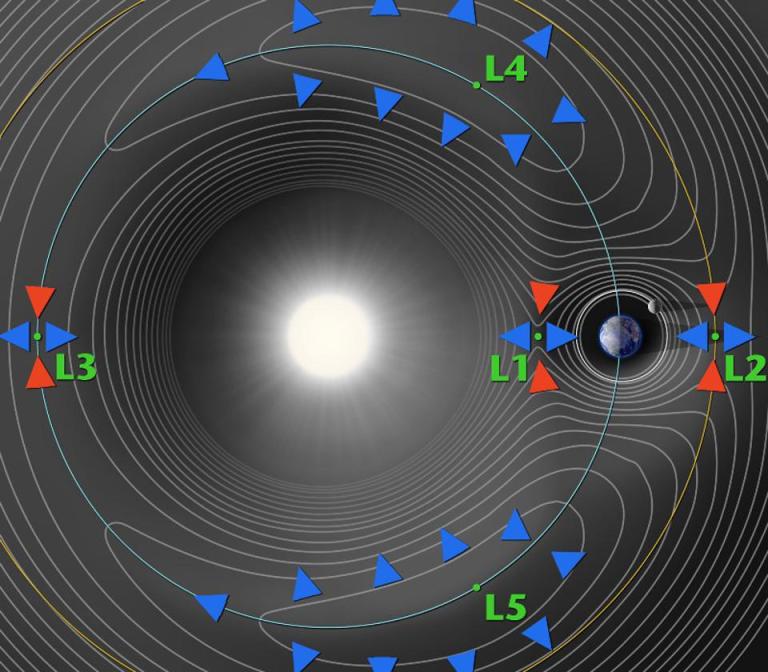
Every planet orbiting a star has five location around it, Lagrange points, that co-orbit. An object precisely located at L1, L2, L3, L4, or L5 will continue to orbit the Sun with precisely the same period as Earth does, meaning that the Earth-spacecraft distance will be constant. L1, L2, and L3 are unstable points of equilibrium, requiring periodic course corrections to maintain a spacecraft’s position there, while L4 and L5 are stable. Webb successfully inserted itself in orbit around L2, and must always face away from the Sun for cooling purposes.
Credit: NASA
by Ethan Siegel
May 2, 2022
https://bigthink.com/starts-with-a-bang ... 1651475855
Introduction:
(Big Think) On Christmas Day of 2021, the James Webb Space Telescope was launched from Earth into space. With an expected 6-month deployment, the mission's plan was to begin science operations afterward and to have a 5-to-10 year science lifetime. At every turn, however, the Webb Telescope team has beaten expectations. After barely 4 months, it's practically ready, with perhaps 20 years of science ahead of it.
On December 25, 2021, the James Webb Space Telescope rocketed into space.
The plan envisioned six months of deployment, cooling, and calibration.
Afterwards, science operations would commence, yielding a 5-to-10 year anticipated lifetime.
Yet on April 28, 2022, each instrument’s alignment was completed, with a ~20 year lifetime expected.
Every planet orbiting a star has five location around it, Lagrange points, that co-orbit. An object precisely located at L1, L2, L3, L4, or L5 will continue to orbit the Sun with precisely the same period as Earth does, meaning that the Earth-spacecraft distance will be constant. L1, L2, and L3 are unstable points of equilibrium, requiring periodic course corrections to maintain a spacecraft’s position there, while L4 and L5 are stable. Webb successfully inserted itself in orbit around L2, and must always face away from the Sun for cooling purposes.
Credit: NASA
Don't mourn, organize.
-Joe Hill
-Joe Hill
-
weatheriscool
- Posts: 26094
- Joined: Sun May 16, 2021 6:16 pm
- Contact:
Re: James Webb Space Telescope (JWST)
Webb telescope nearly set to explore the solar system
https://phys.org/news/2022-05-webb-tele ... solar.html
by Thaddeus Cesari, NASA's Goddard Space Flight Center
https://phys.org/news/2022-05-webb-tele ... solar.html
by Thaddeus Cesari, NASA's Goddard Space Flight Center
As NASA's James Webb Space Telescope moves through the final phases of commissioning its science instruments, we have also begun working on technical operations of the observatory. While the telescope moves through space, it will constantly find distant stars and galaxies and point at them with extreme precision to acquire images and spectra. However, we also plan to observe planets and their satellites, asteroids, and comets in our solar system, which move across the background stars of our galaxy.
Webb needs to be able to lock on to these objects and track them with sufficient precision to obtain images and spectra. The Webb team recently completed the first test to track a moving object. The test verified that Webb could conduct moving target science. As we move forward through commissioning, we will test other objects moving at various speeds to verify we can study objects with Webb that move throughout the solar system.
Today, we asked Heidi Hammel, Webb interdisciplinary scientist for solar system observations, to tell us about her plans for studying Earth's nearest neighbors:
-
weatheriscool
- Posts: 26094
- Joined: Sun May 16, 2021 6:16 pm
- Contact:
Re: James Webb Space Telescope (JWST)
Geology from 50 Light-Years: Webb Gets Ready to Study Rocky Worlds
https://www.nasa.gov/feature/goddard/20 ... cky-worlds
https://www.nasa.gov/feature/goddard/20 ... cky-worlds
Imagine if Earth were much, much closer to the Sun. So close that an entire year lasts only a few hours. So close that gravity has locked one hemisphere in permanent searing daylight and the other in endless darkness. So close that the oceans boil away, rocks begin to melt, and the clouds rain lava.
While nothing of the sort exists in our own solar system, planets like this—rocky, roughly Earth-sized, extremely hot and close to their stars—are not uncommon in the Milky Way galaxy.
What are the surfaces and atmospheres of these planets really like? NASA’s James Webb Space Telescope is about to provide some answers.
With its mirror segments beautifully aligned and its scientific instruments undergoing calibration, NASA’s James Webb Space Telescope is just weeks away from full operation. Soon after the first observations are revealed this summer, Webb’s in-depth science will begin.
Among the investigations planned for the first year are studies of two hot exoplanets classified as “super-Earths” for their size and rocky composition: the lava-covered 55 Cancri e and the airless LHS 3844 b. Researchers will train Webb’s high-precision spectrographs on these planets with a view to understanding the geologic diversity of planets across the galaxy, and the evolution of rocky planets like Earth.
Super-Hot Super-Earth 55 Cancri e
55 Cancri e orbits less than 1.5 million miles from its Sun-like star (one twenty-fifth of the distance between Mercury and the Sun), completing one circuit in less than 18 hours. With surface temperatures far above the melting point of typical rock-forming minerals, the day side of the planet is thought to be covered in oceans of lava.
Planets that orbit this close to their star are assumed to be tidally locked, with one side facing the star at all times. As a result, the hottest spot on the planet should be the one that faces the star most directly, and the amount of heat coming from the day side should not change much over time.
But this doesn’t seem to be the case. Observations of 55 Cancri e from NASA’s Spitzer Space Telescope suggest that the hottest region is offset from the part that faces the star most directly, while the total amount of heat detected from the day side does vary.
Does 55 Cancri e Have a Thick Atmosphere?
One explanation for these observations is that the planet has a dynamic atmosphere that moves heat around. “55 Cancri e could have a thick atmosphere dominated by oxygen or nitrogen,” explained Renyu Hu of NASA’s Jet Propulsion Laboratory in Southern California, who leads a team that will use Webb’s Near-Infrared Camera (NIRCam) and Mid-Infrared Instrument (MIRI) to capture the thermal emission spectrum of the day side of the planet. “If it has an atmosphere, [Webb] has the sensitivity and wavelength range to detect it and determine what it is made of,” Hu added.
Or Is It Raining Lava in the Evening on 55 Cancri e?
Another intriguing possibility, however, is that 55 Cancri e is not tidally locked. Instead, it may be like Mercury, rotating three times for every two orbits (what’s known as a 3:2 resonance). As a result, the planet would have a day-night cycle.
“That could explain why the hottest part of the planet is shifted,” explained Alexis Brandeker, a researcher from Stockholm University who leads another team studying the planet. “Just like on Earth, it would take time for the surface to heat up. The hottest time of the day would be in the afternoon, not right at noon.”
Brandeker’s team plans to test this hypothesis using NIRCam to measure the heat emitted from the lit side of 55 Cancri e during four different orbits. If the planet has a 3:2 resonance, they will observe each hemisphere twice and should be able to detect any difference between the hemispheres.

Re: James Webb Space Telescope (JWST)
James Webb Space Telescope hit by tiny meteoroid
By Jonathan Amos
BBC Science Correspondent
1 hour ago
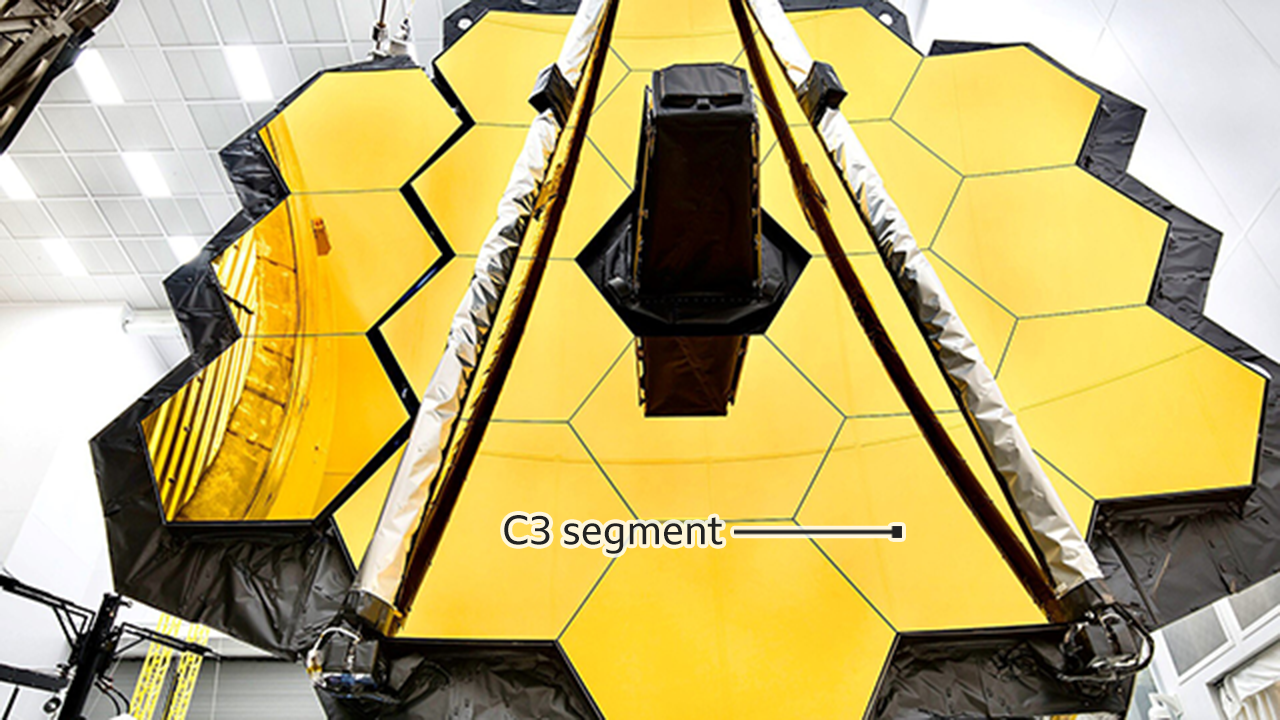
A tiny rock fragment has hit the new James Webb Space Telescope's main mirror.
The damage inflicted by the dust-sized micrometeoroid is producing a noticeable effect in the observatory's data but is not expected to limit the mission's overall performance.
James Webb was launched in December to succeed the revolutionary - but now ageing - Hubble Space Telescope.
Astronomers are due to release its first views of the cosmos on 12 July.
The US space agency Nasa said these images would be no less stunning because of what's just happened.
https://www.bbc.co.uk/news/science-environment-61744257
By Jonathan Amos
BBC Science Correspondent
1 hour ago
A tiny rock fragment has hit the new James Webb Space Telescope's main mirror.
The damage inflicted by the dust-sized micrometeoroid is producing a noticeable effect in the observatory's data but is not expected to limit the mission's overall performance.
James Webb was launched in December to succeed the revolutionary - but now ageing - Hubble Space Telescope.
Astronomers are due to release its first views of the cosmos on 12 July.
The US space agency Nasa said these images would be no less stunning because of what's just happened.
https://www.bbc.co.uk/news/science-environment-61744257
Re: James Webb Space Telescope (JWST)
NASA scientists say images from the Webb telescope nearly brought them to tears
Deep field images of the universe, exoplanet atmospheres, and more to be unveiled.
https://arstechnica.com/science/2022/06 ... telescope/
Deep field images of the universe, exoplanet atmospheres, and more to be unveiled.
https://arstechnica.com/science/2022/06 ... telescope/
Six months have passed since a European rocket lofted the James Webb Space Telescope into orbit. Since that time, the ultra-complex telescope has successfully unfolded its expansive sunshield, commissioned its science instruments, and reached an observation point more than 1 million km from Earth.
This white-knuckle period in space followed nearly two decades of effort to design, build, and test the telescope on Earth prior to its launch on Christmas Day, 2021. But now, all of that effort is in the rearview mirror, and Webb's massive 6.5-meter diameter mirror is gazing outward and collecting scientific data and images. It is the largest and most powerful telescope that humans have ever put into space, and it's already revealing new insights about our cosmos.
"The images are being taken right now," said Thomas Zurbuchen, who leads NASA's scientific programs, during a news conference on Wednesday. "There is already some amazing science in the can, and some others are yet to be taken as we go forward. We are in the middle of getting the history-making data down."
NASA said it plans to release several images beginning at 10:30 am ET (14:30 UTC) on July 12, the result of Webb's "first light" observations. On Wednesday, space agency officials said the images and other data would include the deepest-field image of the universe ever taken—looking further into the cosmos than humans ever have before—as well as the spectrum of an atmosphere around an exoplanet. By looking in the infrared, Webb will be able to identify the fingerprints of small molecules, such as carbon dioxide and ozone, that will offer meaningful clues about the habitability of worlds around other stars.
NASA's deputy administrator, Pam Melroy, said she was blown away by the images Webb has produced so far. "What I have seen moved me, as a scientist, as an engineer, and as a human being," she said.
The telescope is healthy. Thanks to a precise launch by the European Space Agency's Ariane 5 rocket, Webb should have enough maneuvering propellant on board for 20 years of life. And although there have already been five micrometeoroid impacts, the telescope was designed to account for these small dings with a lot of margin.
Recounting his first encounter with data from Webb, Zurbuchen said he, too, was in awe of what the telescope had proven capable of. He said he almost cried when looking at the first photos taken by the new instrument.
"It's really hard to not look at the universe in a new light and not just have a moment that is deeply personal," he said. "It's an emotional moment when you see nature suddenly releasing some of its secrets. and I would like you to imagine and look forward to that."
What a tease!
Unfortunately, we will have to wait nearly two full weeks to see the final products from Webb's first observations. NASA said it will not be releasing any images early, even on an embargoed basis. But we've waited 20 years for Webb to come online and offer a truly worthy successor to the Hubble Space Telescope. I suppose we can wait a little while longer.
If we must.
Re: James Webb Space Telescope (JWST)
Please limit quotations to ~5 paragraphs, unless the article is taken from a press release or other "free" source, e.g. government website. Thanks.

Re: James Webb Space Telescope (JWST)
And remember my friend, future events such as these will affect you in the future
Re: James Webb Space Telescope (JWST)
The Webb Telescope to Examine Jupiter and Two of Its Moons
by Kiona Smith
July 1, 2022
Introduction:
by Kiona Smith
July 1, 2022
Introduction:
Read more here: https://www.inverse.com/science/will-j ... e-jupiter(Inverse) SOME OF the James Webb Space Telescope’s first real science won’t be all far-off galaxies and distant stars. In fact, some of the first heavy-hitting science will come from our cosmic backyard.
As part of the Director’s Discretionary Early Release Science Program — an initial round of studies carefully chosen to help scientists test Webb’s capabilities — University of California, Berkeley planetary scientist Imke de Pater and her team will use Webb to study Jupiter.
Our Solar System’s largest planet and its complex menagerie of moons and rings present some fascinating scientific targets for Webb. Along the way, the team will explore the limits of Webb’s abilities and find the best ways to use the telescope to study our own Solar System, which comes with a unique set of challenges for a telescope built to look 13 billion years into the past.
Webb will spend about 33 hours this summer observing Jupiter, its rings, and two of its most interesting moons: icy Ganymede and volcanic hellscape Io.
Don't mourn, organize.
-Joe Hill
-Joe Hill
-
weatheriscool
- Posts: 26094
- Joined: Sun May 16, 2021 6:16 pm
- Contact:
Re: James Webb Space Telescope (JWST)
caltrek wrote: ↑Sat Jul 02, 2022 1:32 pm The Webb Telescope to Examine Jupiter and Two of Its Moons
by Kiona Smith
July 1, 2022
Introduction:Read more here: https://www.inverse.com/science/will-j ... e-jupiter(Inverse) SOME OF the James Webb Space Telescope’s first real science won’t be all far-off galaxies and distant stars. In fact, some of the first heavy-hitting science will come from our cosmic backyard.
As part of the Director’s Discretionary Early Release Science Program — an initial round of studies carefully chosen to help scientists test Webb’s capabilities — University of California, Berkeley planetary scientist Imke de Pater and her team will use Webb to study Jupiter.
Our Solar System’s largest planet and its complex menagerie of moons and rings present some fascinating scientific targets for Webb. Along the way, the team will explore the limits of Webb’s abilities and find the best ways to use the telescope to study our own Solar System, which comes with a unique set of challenges for a telescope built to look 13 billion years into the past.
Webb will spend about 33 hours this summer observing Jupiter, its rings, and two of its most interesting moons: icy Ganymede and volcanic hellscape Io.
Sounds like a good idea. Why not aim it at earth to test its abilities to find life and as a test to go down the list?
-
Time_Traveller

- Posts: 3025
- Joined: Sun May 16, 2021 4:49 pm
- Location: New York City, USA, November 5th 2032 C.E.
Re: James Webb Space Telescope (JWST)
James Webb Space Telescope will watch smashing worlds in high definition
https://www.space.com/james-webb-space- ... socialflowpublished about 10 hours ago
Researchers are looking forward to a glimpse of colliding worlds in action from NASA's cutting-edge space observatory.
After the James Webb Space Telescope finishes its commissioning period and releases its first operational images on July 12, the observatory will dive into science in earnest. And one of the telescope's first-year investigations will include a close-up view of the strange neighborhood of Beta Pictoris.
The young star, just 63 light years away from us, is surrounded by a dusty disc full of debris left over from its formation. It's a crowded space, hosting "at least two planets [and] a jumble of smaller, rocky bodies," researchers said in a 2021 press release(opens in new tab) about the investigation.
While the research has numerous directions, one key aspect is watching a young planetary system evolving as planetesimals (the predecessors to planets) collide. Because Beta Pictoris is wreathed in dust, researchers will be using Webb's infrared light to peer through the debris and see what is happening in high definition.
Webb will have decades of past work to draw upon, including ground-based observatories and space observations from the Hubble Space Telescope. We know from such studies that Beta Pictoris hosts at least two gigantic planets, both much more massive than Jupiter. Researchers also glimpsed the first known exocomets, or comets beyond our solar system, whirling in the debris cloud.
“In the quantum multiverse, every choice, every decision you've ever and never made exists in an unimaginably vast ensemble of parallel universes.”
-
weatheriscool
- Posts: 26094
- Joined: Sun May 16, 2021 6:16 pm
- Contact:
Re: James Webb Space Telescope (JWST)
NASA reveals Webb telescope's first cosmic targets
https://phys.org/news/2022-07-nasa-reve ... osmic.html
An image of the Carina Nebula shot by the Hubble Space Telescope.
https://phys.org/news/2022-07-nasa-reve ... osmic.html
An image of the Carina Nebula shot by the Hubble Space Telescope.
NASA said Friday the first cosmic images from the James Webb Space Telescope will include unprecedented views of distant galaxies, bright nebulae, and a faraway giant gas planet.
The US, European and Canadian space agencies are gearing up for a big reveal on July 12 of early observations by the $10 billion observatory, the successor to Hubble that is set to reveal new insights into the origins of the universe.
"I'm looking very much forward to not having to keep these secrets anymore, that will be a great relief," Klaus Pontoppidan, an astronomer at the Space Telescope Science Institute (STSI) that oversees Webb, told AFP last week.
An international committee decided the first wave of full-color scientific images would include the Carina Nebula, an enormous cloud of dust and gas 7,600 light years away, as well as the Southern Ring Nebula, which surrounds a dying star 2,000 light years away.
-
weatheriscool
- Posts: 26094
- Joined: Sun May 16, 2021 6:16 pm
- Contact:
Re: James Webb Space Telescope (JWST)
NASA releases James Webb telescope 'teaser' picture
https://phys.org/news/2022-07-nasa-jame ... easer.html
A test image from the James Webb Telescope -- among the deepest images of the universe ever taken.
https://phys.org/news/2022-07-nasa-jame ... easer.html
A test image from the James Webb Telescope -- among the deepest images of the universe ever taken.
NASA has a provided a tantalizing teaser photo ahead of the highly-anticipated release next week of the first deep-space images from the James Webb Telescope—an instrument so powerful it can peer back into the origins of the universe.
The $10 billion observatory—launched in December last year and now orbiting the Sun a million miles (1.5 million kilometers) away from Earth—can look where no telescope has looked before thanks to its enormous primary mirror and instruments that focus on infrared, allowing it to peer through dust and gas.
The first fully formed pictures are set for release on July 12, but NASA provided an engineering test photo on Wednesday—the result of 72 exposures over 32 hours that shows a set of distant stars and galaxies.
The image has some "rough-around-the-edges" qualities, NASA said in a statement, but is still "among the deepest images of the universe ever taken" and offers a "tantalizing glimpse" at what will be revealed in the coming weeks, months, and years.
"When this image was taken, I was thrilled to clearly see all the detailed structure in these faint galaxies," said Neil Rowlands, program scientist for Webb's Fine Guidance Sensor at Honeywell Aerospace.
Jane Rigby, Webb's operations scientist at NASA's Goddard Space Flight Center, said the "faintest blobs in this image are exactly the types of faint galaxies that Webb will study in its first year of science operations."
-
weatheriscool
- Posts: 26094
- Joined: Sun May 16, 2021 6:16 pm
- Contact:
Re: James Webb Space Telescope (JWST)
President Biden will share the Webb Telescope's first image today (at 5 PM, Monday July 11th)
https://edition.cnn.com/2022/07/11/worl ... index.htmlThe first glimpse of how the James Webb Space Telescope will change the way people see the universe is arriving a little earlier than expected.
President Joe Biden will release one of Webb's first images Monday at the White House at 5 p.m. ET. The preview event, during which NASA Administrator Bill Nelson will also share remarks, will stream live on NASA's website (link here ... https://www.nasa.gov/nasalive ).