Thankfully because of Elon musk reusable rockets we won't need russia anymore. Russia will be screwing themselves.Time_Traveller wrote: ↑Mon Jun 07, 2021 6:04 pm Russia to U.S.: Lift sanctions on space sector or we'll exit space station
https://www.msn.com/en-us/news/world/ru ... NjUV?pfr=12 hrs ago
MOSCOW (Reuters) - The head of Russia's space agency on Monday suggested Moscow would withdraw from the International Space Station in 2025 unless Washington lifted sanctions on the space sector that were hampering Russian satellite launches.
Dmitry Rogozin, the head of Roscosmos, was addressing parliamentarians ahead of a summit in Geneva later this month between Russian President Vladimir Putin and his U.S. counterpart Joe Biden.
Rogozin said Moscow was struggling to launch some of its satellites because of U.S. sanctions which meant Russia could not import certain microchip sets needed for its space programme.
"We have more than enough rockets but nothing to launch them with," Rogozin said, in a rare admission by a senior Russian official that Western sanctions are seriously impeding the development of a given industry.
Space News and Discussions
-
weatheriscool
- Posts: 25206
- Joined: Sun May 16, 2021 6:16 pm
- Contact:
Re: Space News and Discussions
-
weatheriscool
- Posts: 25206
- Joined: Sun May 16, 2021 6:16 pm
- Contact:
Re: Space News and Discussions
Scientists identify a rare magnetic propeller in a binary star system
https://phys.org/news/2021-06-scientist ... inary.html
by Jessica Sieff, University of Notre Dame
https://phys.org/news/2021-06-scientist ... inary.html
by Jessica Sieff, University of Notre Dame
Researchers at the University of Notre Dame have identified the first eclipsing magnetic propeller in a cataclysmic variable star system, according to research forthcoming in the Astrophysical Journal.
The star system, referred to as J0240, is only the second of its kind on record. It was identified in 2020 as an unusual cataclysmic variable—a binary system consisting of a white dwarf star and a mass-donating red star. Normally, the compact white dwarf star collects the donated gas and grows in mass. In J0240, however, the fast-spinning, magnetic white dwarf rejects the donor's gas and propels it out of the binary system.
-
weatheriscool
- Posts: 25206
- Joined: Sun May 16, 2021 6:16 pm
- Contact:
Re: Space News and Discussions
Jeff Bezos and His Brother Will Fly on First Blue Origin Flight
June 7, 2021 by Brian Wang
This takes balls I'll say that much.
June 7, 2021 by Brian Wang
https://www.nextbigfuture.com/2021/06/j ... light.htmlJeff Bezos and his brother Mark will join the auction winner on New Shepard’s first human flight on July 20th, 2021.
Ever since Jeff Bezos was five years old, he has dreamed of traveling to space. On July 20th, he will take that journey with his brother. The greatest adventure, with his best friend.
It is a gutsy move. Nextbigfuture salutes Jeff Bezos and his brother Mark for taking the risk associated with a Blue Origin rocket flight.
I wish the Bezos brothers good luck and a safe flight.
This flight will be made weeks after Bezos steps down from his role as CEO of Amazon. Bezos likely had to step down as CEO of Amazon in order to take the risk for this flight.
This takes balls I'll say that much.
-
weatheriscool
- Posts: 25206
- Joined: Sun May 16, 2021 6:16 pm
- Contact:
Re: Space News and Discussions
See the First Images NASA’s Juno Took As It Sailed by Ganymede
Jun 08, 2021
JunoCam Ganymede - adjusted
https://www.jpl.nasa.gov/news/see-the-f ... y-ganymede
Jun 08, 2021
JunoCam Ganymede - adjusted
https://www.jpl.nasa.gov/news/see-the-f ... y-ganymede
The spacecraft flew closer to Jupiter’s largest moon than any other in more than two decades, offering dramatic glimpses of the icy orb.
The first two images from NASA Juno’s June 7, 2021, flyby of Jupiter’s giant moon Ganymede have been received on Earth. The photos – one from the Jupiter orbiter’s JunoCam imager and the other from its Stellar Reference Unit star camera – show the surface in remarkable detail, including craters, clearly distinct dark and bright terrain, and long structural features possibly linked to tectonic faults.

-
weatheriscool
- Posts: 25206
- Joined: Sun May 16, 2021 6:16 pm
- Contact:
Re: Space News and Discussions
CHIME telescope detects more than 500 mysterious fast radio bursts in its first year of operation
by Abby Abazorius, Massachusetts Institute of Technology
https://phys.org/news/2021-06-chime-tel ... radio.html
by Abby Abazorius, Massachusetts Institute of Technology
https://phys.org/news/2021-06-chime-tel ... radio.html
To catch sight of a fast radio burst is to be extremely lucky in where and when you point your radio dish. Fast radio bursts, or FRBs, are oddly bright flashes of light, registering in the radio band of the electromagnetic spectrum, that blaze for a few milliseconds before vanishing without a trace.
These brief and mysterious beacons have been spotted in various and distant parts of the universe, as well as in our own galaxy. Their origins are unknown, and their appearance is unpredictable. Since the first was discovered in 2007, radio astronomers have only caught sight of around 140 bursts in their scopes.
Now, a large stationary radio telescope in British Columbia has nearly quadrupled the number of fast radio bursts discovered to date. The telescope, known as CHIME, for the Canadian Hydrogen Intensity Mapping Experiment, has detected 535 new fast radio bursts during its first year of operation, between 2018 and 2019.
-
Time_Traveller

- Posts: 3025
- Joined: Sun May 16, 2021 4:49 pm
- Location: New York City, USA, November 5th 2032 C.E.
Re: Space News and Discussions
Spaceport Cornwall signs agreement with US company
https://www.bbc.co.uk/news/uk-england-cornwall-5741759022 hours ago
Spaceport Cornwall has signed a memorandum of understanding with a US company to explore future opportunities.
The Sierra Nevada Corporation wants to make spaceflight "globally accessible".
Its spaceplane Dream Chaser, run by subsidiary Sierra Space, is designed to launch vertically to low-Earth obit and land on a spaceport or runway.
Melissa Thorpe, head of Spaceport near Newquay, said she was "delighted" to welcome Sierra Space ahead of the G7.
Spaceport Cornwall is working towards launching the first satellites into space in spring 2022.
“In the quantum multiverse, every choice, every decision you've ever and never made exists in an unimaginably vast ensemble of parallel universes.”
-
weatheriscool
- Posts: 25206
- Joined: Sun May 16, 2021 6:16 pm
- Contact:
Re: Space News and Discussions
Europe will join the space party at Planet Venus
Jonathan Amos
https://www.bbc.com/news/science-environment-57416589
Jonathan Amos
https://www.bbc.com/news/science-environment-57416589
You wait ages for a mission to Venus and then three come along at once.
The European Space Agency has just selected a probe called Envision to go study the second planet from the Sun.
Esa made the announcement one week after its American counterpart, Nasa, chose two Venus projects of its own, known as Veritas and Davinci+
The destination isn't the only overlap; Europe and the US will both be contributing to each other's efforts in the form of hosted instrumentation.
"All three of the missions are highly complementary," Dr Philippa Mason, an Envision science team-member from Imperial College London, UK, told BBC News.
-
weatheriscool
- Posts: 25206
- Joined: Sun May 16, 2021 6:16 pm
- Contact:
Re: Space News and Discussions
ALMA discovers earliest gigantic black hole storm
by National Astronomical Observatory of Japan
https://phys.org/news/2021-06-alma-earl ... -hole.html
by National Astronomical Observatory of Japan
https://phys.org/news/2021-06-alma-earl ... -hole.html
Researchers using the Atacama Large Millimeter/submillimeter Array (ALMA) discovered a titanic galactic wind driven by a supermassive black hole 13.1 billion years ago. This is the earliest example yet observed of such a wind to date and is a telltale sign that huge black holes have a profound effect on the growth of galaxies from the very early history of the universe.
At the center of many large galaxies hides a supermassive black hole that is millions to billions of times more massive than the Sun. Interestingly, the mass of the black hole is roughly proportional to the mass of the central region (bulge) of the galaxy in the nearby universe. At first glance, this may seem obvious, but it is actually very strange. The reason is that the sizes of galaxies and black holes differ by about 10 orders of magnitude. Based on this proportional relationship between the masses of two objects that are so different in size, astronomers believe that galaxies and black holes grew and evolved together (coevolution) through some kind of physical interaction.

Re: Space News and Discussions
Europe Picks Categories for Three Flagship Space Missions
June 11, 2021
https://www.sciencemag.org/news/2021/06 ... e-missions
Introduction:
June 11, 2021
https://www.sciencemag.org/news/2021/06 ... e-missions
Introduction:
(Science) The biggest space missions gestate for the longest time. Today, the European Space Agency (ESA) revealed the three broad science themes it wants to pursue for large-scale missions of €1 billion or more that would launch between 2035 and 2050. They include a close look at icy moons around Jupiter and Saturn, dissecting the atmospheres of nearby exoplanets, and new ways to study the formation of the universe’s first stars, galaxies, and black holes. “We must start planning the science and the technology we’ll need for the missions we want to launch decades from now,” Günther Hasinger, ESA’s director of science, said in a statement.
Don't mourn, organize.
-Joe Hill
-Joe Hill
Re: Space News and Discussions
NASA Seeking Proposals for Private Astronaut Missions
June 11, 2021
https://techcrunch.com/2021/06/11/nasa- ... ns-to-iss/
Introduction:
Image Credit: NASA
June 11, 2021
https://techcrunch.com/2021/06/11/nasa- ... ns-to-iss/
Introduction:
(TechCrunch) NASA said Friday it was seeking proposals from commercial companies for two new private crewed missions to the International Space Station. The first mission would likely take place between fall of 2022 and mid-2023. The second one would follow sometime between mid-2023 and the end of 2023.
Private astronaut missions are a relatively recent initiative from NASA, part of its Commercial low Earth Orbit (LEO) Development program. For most of humanity’s history in space, trips to the ISS were reserved for astronauts from countries’ respective space agencies.
Houston-based startup Axiom Space was awarded the first private astronaut mission, to take place in January 2022. That mission will carry four private astronauts for an eight-day mission from the Kennedy Space Center in Florida. NASA will pay Axiom $1.69 million for services associated with the mission.
Each of the new missions can be up to 14 days and proposals are due by July 9. The agency specified that the missions must be brokered by a U.S. company and use approved U.S. transportation spacecraft. (Axiom’s private mission will use a SpaceX Crew Dragon.)
NASA said that enabling private manned missions such as this one may help “develop a robust low-Earth orbit economy where NASA is one of many customers, and the private sector leads the way.” Thanks to the significantly decreased launch costs — due in large part to innovations in rocket reusability, led by SpaceX — as well as a whole new ecosystem of “new space” companies that have sprung up over the last five years, space has become busier than ever.
Image Credit: NASA
Don't mourn, organize.
-Joe Hill
-Joe Hill
-
Time_Traveller
- Posts: 3025
- Joined: Sun May 16, 2021 4:49 pm
- Location: New York City, USA, November 5th 2032 C.E.
Re: Space News and Discussions
Governments ally for federated quantum encryption satellite network
https://spacenews.com/governments-ally- ... e-network/June 11, 2021
TAMPA, Fla. — The United States and five other countries are banding together with the United Kingdom to develop a satellite-based quantum technology encryption network.
The Federated Quantum System (FQS) will be based on the one British startup Arqit is developing for commercial customers, using quantum technology breakthroughs to guard against increasingly sophisticated cyberattacks.
But while that network is on a managed services platform run by Arqit, FQS will be closed off in a way that enables interoperability between allied countries.
Fighter jets and other military units and command and control centers would be able to share communications more securely across a sovereign-controlled network.
The governments of Japan, Canada, Italy, Belgium and Austria are also partnering on the initiative, which includes companies from each country to design and test the system.
“In the quantum multiverse, every choice, every decision you've ever and never made exists in an unimaginably vast ensemble of parallel universes.”
-
Time_Traveller
- Posts: 3025
- Joined: Sun May 16, 2021 4:49 pm
- Location: New York City, USA, November 5th 2032 C.E.
Re: Space News and Discussions
First seat to space on Blue Origin's New Shepard sells for $28 million
14 hours ago
With a high bid of $28 million, an unnamed individual has won the chance to join the richest person on Earth on a flight into space.
Blue Origin, Jeff Bezos' commercial spaceflight company, concluded its two-week-long competition for the first seat on board its New Shepard launch vehicle with a live auction on Saturday (June 12). The bidding, which the company streamed live online, soared from the opening $4.8 million to the hammer of $28 million in just under seven minutes.
"How exciting was that! $28 million!" exclaimed Ariane Cornell, Blue Origin's director of astronaut and orbital sales, just after the auction concluded. "The whole Blue Origin team cannot wait to meet our first customer."
The total payment for the seat, including the six-percent buyer's premium, will be $29,680,000. The winning bid amount will be donated to Blue Origin's non-profit foundation, Club for the Future, which has the goal of inspiring future generations to pursue careers in STEM (science, technology, engineering and mathematics) and "to help invent the future of life in space."
The high bidder, who Blue Origin said they will identify at a later time, has won the opportunity to join Bezos, his brother Mark and one still-to-be-named passenger on the New Shepard launch scheduled for July 20. Timed to coincide with the 52nd anniversary of the Apollo 11 moon landing, the bidder stands to make history of his or her own by being one of the first space tourists to fly to just above the 62-mile-high (100 kilometers) Kármán line, the internationally-recognized boundary separating Earth's atmosphere from outer space.
https://www.space.com/blue-origin-new-s ... at-auction
14 hours ago
With a high bid of $28 million, an unnamed individual has won the chance to join the richest person on Earth on a flight into space.
Blue Origin, Jeff Bezos' commercial spaceflight company, concluded its two-week-long competition for the first seat on board its New Shepard launch vehicle with a live auction on Saturday (June 12). The bidding, which the company streamed live online, soared from the opening $4.8 million to the hammer of $28 million in just under seven minutes.
"How exciting was that! $28 million!" exclaimed Ariane Cornell, Blue Origin's director of astronaut and orbital sales, just after the auction concluded. "The whole Blue Origin team cannot wait to meet our first customer."
The total payment for the seat, including the six-percent buyer's premium, will be $29,680,000. The winning bid amount will be donated to Blue Origin's non-profit foundation, Club for the Future, which has the goal of inspiring future generations to pursue careers in STEM (science, technology, engineering and mathematics) and "to help invent the future of life in space."
The high bidder, who Blue Origin said they will identify at a later time, has won the opportunity to join Bezos, his brother Mark and one still-to-be-named passenger on the New Shepard launch scheduled for July 20. Timed to coincide with the 52nd anniversary of the Apollo 11 moon landing, the bidder stands to make history of his or her own by being one of the first space tourists to fly to just above the 62-mile-high (100 kilometers) Kármán line, the internationally-recognized boundary separating Earth's atmosphere from outer space.
https://www.space.com/blue-origin-new-s ... at-auction
“In the quantum multiverse, every choice, every decision you've ever and never made exists in an unimaginably vast ensemble of parallel universes.”
-
Time_Traveller
- Posts: 3025
- Joined: Sun May 16, 2021 4:49 pm
- Location: New York City, USA, November 5th 2032 C.E.
Re: Space News and Discussions
Astronomers spot a 'blinking giant' near the center of the galaxy
https://phys.org/news/2021-06-astronome ... alaxy.htmlJune 11, 2021
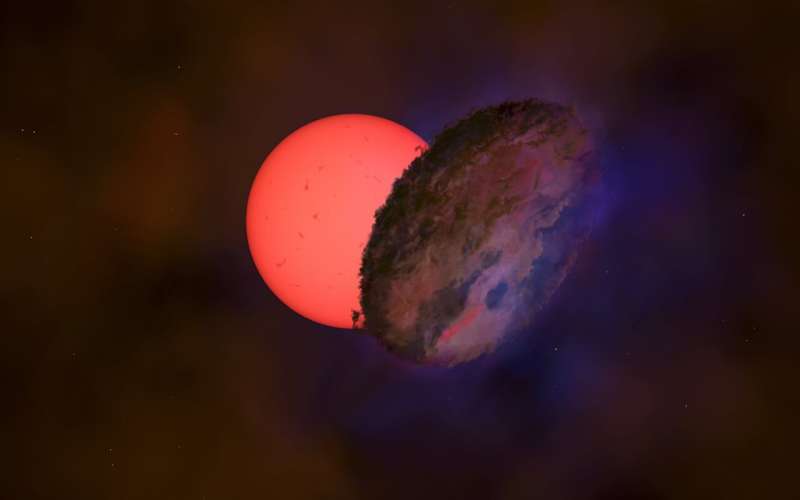
Astronomers have spotted a giant 'blinking' star towards the center of the Milky Way, more than 25,000 light years away.
An international team of astronomers observed the star, VVV-WIT-08, decreasing in brightness by a factor of 30, so that it nearly disappeared from the sky. While many stars change in brightness because they pulsate or are eclipsed by another star in a binary system, it's exceptionally rare for a star to become fainter over a period of several months and then brighten again.
The researchers believe that VVV-WIT-08 may belong to a new class of "blinking giant" binary star system, where a giant star 100 times larger than the Sun is eclipsed once every few decades by an as-yet unseen orbital companion. The companion, which may be another star or a planet, is surrounded by an opaque disc, which covers the giant star, causing it to disappear and reappear in the sky. The study is published in Monthly Notices of the Royal Astronomical Society.
The discovery was led by Dr. Leigh Smith from Cambridge's Institute of Astronomy, working with scientists at the University of Edinburgh, the University of Hertfordshire, the University of Warsaw in Poland and Universidad Andres Bello in Chile.
"It's amazing that we just observed a dark, large and elongated object pass between us and the distant star and we can only speculate what its origin is," said co-author Dr. Sergey Koposov from the University of Edinburgh.
“In the quantum multiverse, every choice, every decision you've ever and never made exists in an unimaginably vast ensemble of parallel universes.”
Re: Space News and Discussions
Number of Mysterious Radio Flashes Detected Quadruples
June 12, 2021
https://skyandtelescope.org/astronomy-n ... uadruples/
Introduction:
June 12, 2021
https://skyandtelescope.org/astronomy-n ... uadruples/
Introduction:
(Sky & Telescope) Fast radio bursts are powerful but fleeting flashes of radio waves. Their brevity makes them hard to find; since 2007, astronomers have detected only about 140 of them.
Now, at the recent virtual meeting of the American Astronomical Society, a first data release from the Canadian Hydrogen Intensity Mapping Experiment (CHIME) nearly quadruples that number with 535 new fast radio bursts (FRBs), including 61 bursts from 18 repeating sources. The data come from the detector’s first year of operations, from mid-2018 to mid-2019.
CHIME is uniquely suited to finding FRBs because, unlike most radio telescopes with postage-stamp fields of view, it scans the whole sky visible from its location in British Columbia every night. Astronomers then use digital signal-processing to work through huge amounts of data — about 7 terabits per second, equivalent to a few percent of the world’s internet traffic — to “focus” on FRB signals.
Nevertheless, CHIME only sees the tip of the iceberg. The CHIME/FRB Collaboration calculates that some 800 bright bursts occur every day, and the telescope only sees a small fraction of that.
The radio flashes CHIME does see are spread out on the sky, which means that, as astronomers had already suspected, the sources of these mysterious flashes aren’t concentrated in the Milky Way. But that spread isn’t completely uniform. The team finds that FRBs correlate with galaxies out to 5 billion light-years away.
Don't mourn, organize.
-Joe Hill
-Joe Hill
-
Time_Traveller
- Posts: 3025
- Joined: Sun May 16, 2021 4:49 pm
- Location: New York City, USA, November 5th 2032 C.E.
Re: Space News and Discussions
Queqiao: The bridge between Earth and the far side of the moon
https://www.moondaily.com/reports/Queqi ... n_999.htmlJun 11, 2021
Because of a phenomenon called gravitational locking, the Moon always faces the Earth from the same side. This proved useful in the early lunar landing missions in the 20th century, as there was always a direct line of sight for uninterrupted radiocommunications between Earth ground stations and equipment on the Moon. However, gravitational locking makes exploring the hidden face of the moon - the far side - much more challenging, because signals cannot be sent directly across the Moon towards Earth.
Still, in January 2019, China's lunar probe Chang'e-4 marked the first time a spacecraft landed on the far side of the Moon. Both the lander and the lunar rover it carried have been gathering and sending back images and data from previously unexplored areas. But how does Chang'e-4 probe communicate with the Earth? The answer is Queqiao, a relay communications satellite, explains Dr. Lihua Zhang from DFH Satellite Co., Ltd., China.
As explained by Dr. Zhang in a review paper recently published in Space: Science and Technology, Queqiao is an unprecedented satellite designed specifically for one purpose: to act as a bridge between Chang'e-4 probe and the Earth. Queqiao was launched in 2018 and put into orbit around a point 'behind' the Moon.
This point is known as the Earth-Moon Libration point 2, where a special case of gravitational balance allows Queqiao to maintain an orbit such that it has almost constant direct line of sight with both the far side of the Moon and the Earth. Getting the satellite into this peculiar orbit required careful planning and maintenance management, and the success of this operation set a precedent for future attempts at putting satellites in orbit around other Earth-Moon libration points.
From its stable place in space, Queqiao helped guide the soft-landing and surface operations of Chang'e-4 probe and has been our intermediary with it ever since. The satellite is equipped with two different kinds of antennas: a parabolic antenna and several spiral antennas. The former, which has a large diameter of 4.2 m, was designed to send and receive signals on the X band (7-8GHz) to and from the rover and lander on the surface of the Moon. Its large size is related the expected noise levels and the low intensity of the transmissions that are sent by surface equipment.
“In the quantum multiverse, every choice, every decision you've ever and never made exists in an unimaginably vast ensemble of parallel universes.”
-
weatheriscool
- Posts: 25206
- Joined: Sun May 16, 2021 6:16 pm
- Contact:
Re: Space News and Discussions
Trip to space with Jeff Bezos sells for $28 mn
https://phys.org/news/2021-06-space-jeff-bezos-mn.html
by Cyril Julien
https://phys.org/news/2021-06-space-jeff-bezos-mn.html
by Cyril Julien
Blue Origin's New Shepard rocket has successfully carried out more than a dozen uncrewed test runs launching from its facility in the Guadalupe Mountains of West Texas.
A mystery bidder paid $28 million at auction Saturday for a seat alongside Jeff Bezos on board the first crewed spaceflight of the billionaire's company Blue Origin next month.
The Amazon founder revealed this week that both he and his brother Mark would take seats on board the company's New Shepard launch vehicle on July 20, to fly to the edge of space and back.
The Bezos brothers will be joined by the winner of Saturday's charity auction, whose identity remains unknown, and by a fourth, as yet unnamed space tourist.
"The name of the auction winner will be released in the weeks following the auction's conclusion," tweeted Blue Origin following the sale.
"Then, the fourth and final crew member will be announced—stay tuned."
-
weatheriscool
- Posts: 25206
- Joined: Sun May 16, 2021 6:16 pm
- Contact:
Re: Space News and Discussions
Boundary of heliosphere mapped for the first time
https://phys.org/news/2021-06-boundary-heliosphere.html
by Los Alamos National Laboratory
https://phys.org/news/2021-06-boundary-heliosphere.html
by Los Alamos National Laboratory
For the first time, the boundary of the heliosphere has been mapped, giving scientists a better understanding of how solar and interstellar winds interact.
"Physics models have theorized this boundary for years," said Dan Reisenfeld, a scientist at Los Alamos National Laboratory and lead author on the paper, which was published in the Astrophysical Journal today. "But this is the first time we've actually been able to measure it and make a three-dimensional map of it."
The heliosphere is a bubble created by the solar wind, a stream of mostly protons, electrons, and alpha particles that extends from the Sun into interstellar space and protects the Earth from harmful interstellar radiation.
-
weatheriscool
- Posts: 25206
- Joined: Sun May 16, 2021 6:16 pm
- Contact:
Re: Space News and Discussions
Relativity Space Will Make 3D Printed Reusable Rocket at Near Falcon 9 Scale
June 14, 2021 by Brian Wang
https://www.nextbigfuture.com/2021/06/r ... scale.html
June 14, 2021 by Brian Wang
https://www.nextbigfuture.com/2021/06/r ... scale.html
Relativity Space has raised a $650 million Series E. They have raised over $1.2 billion. Relativity’s post-money valuation now stands at $4.2 billion.
They will make the heavy-lift, fully reusable two-stage rocket called the Terran R. Their first rocket is the Terran 1 and it is scheduled for a first orbital flight at the end of 2021.
The new rocket, Terran R, will be just a bit smaller than the SpaceX Falcon 9. Terran R is 216 feet tall while the Falcon 9 is 230 feet tall. Terran R will have a 20000 pound max payload while Falcon 9 has 22500 pounds of max payload.
Terran R will be 3D printed and built in 60 days.
-
weatheriscool
- Posts: 25206
- Joined: Sun May 16, 2021 6:16 pm
- Contact:
Re: Space News and Discussions
World's first wooden satellite to launch later this year
By Nick Lavars
June 14, 2021
By Nick Lavars
June 14, 2021
https://newatlas.com/space/world-first- ... e-woodsat/A first-of-a-kind spacecraft is set to make history later this year, but will do so using materials you could find at your local hardware store. The world's first wooden satellite will enter orbit as a box made largely of birch plywood, which will be packed with sensors from the European Space Agency (ESA) to study the potential of the material in space.
The Woodsat is a CubeSat measuring around 10 cm (4 in) along each side, but what's unique about this box-shaped miniature satellite is that the surface panels will be made from plywood. In fact, the only non-wooden parts featured on the outside are the corner aluminum railings that will help with its deployment once in space, along with a metal selfie stick.
The Woodsat is the brainchild of Finnish science journalist Jari Makinen, who also heads up a company called Arctic Astronauts that sells replica CubeSats for educational use and space hobbyists.