A completely paralysed man, who was left unable to communicate for months after losing the ability to even move his eyes, has used a brain implant to ask his caregivers for a beer.
Composing sentences at a rate of just one character per minute, the man also asked to listen to the band Tool “loud”, requested a head massage from his mother, and ordered a curry – all through the power of thought.
The man, who is now 36, had two square electrode arrays surgically implanted into his brain to facilitate communication in March 2019 after being left in a locked-in state as a result of amyotrophic lateral sclerosis (ALS).
BCIs & Neurotechnology News and Discussions
Re: BCIs & Neurotechnology News and Discussions
And remember my friend, future events such as these will affect you in the future
-
weatheriscool
- Posts: 26097
- Joined: Sun May 16, 2021 6:16 pm
- Contact:
Re: BCIs & Neurotechnology News and Discussions
Decoding movement and speech from the brain of a tetraplegic person
https://medicalxpress.com/news/2022-04- ... legic.html
by Lori Dajose, California Institute of Technology
https://medicalxpress.com/news/2022-04- ... legic.html
by Lori Dajose, California Institute of Technology
New research identifies a brain region where both imagined hand grasps and spoken words can be decoded, indicating a promising candidate region for brain implants for neuroprosthetic applications.
Every year, the lives of hundreds of thousands of people are severely disrupted when they lose the ability to move or speak as a result of spinal injury, stroke, or neurological diseases. At Caltech, neuroscientists in the laboratory of Richard Andersen, James G. Boswell Professor of Neuroscience, and Leadership Chair and Director of the Tianqiao & Chrissy Chen Brain-Machine Interface Center, are studying how the brain encodes movements and speech, in order to potentially restore these functions to those individuals who have lost them.
Re: BCIs & Neurotechnology News and Discussions
Kernel: Light speed towards accessible brain imaging
Flow® images the brain activity through variations in blood oxygenation in the cortical areas of the brain, a paradigm of brain activity measurement similar to fMRI. The time-domain functional near-infrared spectroscopy (TD-fNIRS) method selected by Kernel provides the benefits of higher signal-to-noise ratio and allows faster data rate than a current continuous imaging approach. This technology was a great fit to Ryan’s skillset.
“I took everything I learned: from my PhD, my work with LIDAR, how to build chips, electronic systems and applying signal processing. We took this learning and built an ASIC (Application Specific Integrated Circuit), it’s the 3rd iteration of this chip that you see in Kernel Flow today”
With Ryan at the helm of Flow, the team quickly achieved some exciting firsts: the first time the custom chip was fired up on the bench, the first human signals being read by their sensor, the first full helmet multi sensor array and the first commercial launch of the headset device this January. Getting this general purpose and high-quality platform into the hands of users is one of the key steps to achieving Kernel’s mission.
And remember my friend, future events such as these will affect you in the future

-
weatheriscool
- Posts: 26097
- Joined: Sun May 16, 2021 6:16 pm
- Contact:
Re: BCIs & Neurotechnology News and Discussions
Wireless neurostimulator to revolutionize patient care
https://medicalxpress.com/news/2022-04- ... tient.html
by University of Queensland
https://medicalxpress.com/news/2022-04- ... tient.html
by University of Queensland
Many neurological disorders like Parkinson's, chronic depression and other psychiatric conditions could be managed at home, thanks to a collaborative project involving researchers at the University of Queensland (UQ).
Queensland Brain Institute (QBI) Professor Peter Silburn AM said his team, together with Neurosciences Queensland and Abbott Neuromodulation have developed a remote care platform that allows patients to access treatment from anywhere in the world. More details about this development are published in Scientific Reports.
"By creating the world's first integrated and completely wireless remote care platform, we have removed the need for patients to see their doctor in person to have their device adjusted," Professor Silburn said.
Electrodes are surgically inserted into the brain and electrical stimulation is delivered by a pacemaker which alters brain function—providing therapeutic relief and improving quality of life. This digital platform allows clinicians to monitor patients remotely, as well as adjust the device to treat and alleviate symptoms in real time.
"We have shown that it is possible to minimize disruption to patients' and caregivers' lifestyles by increasing accessibility to the service, saving time and money," Professor Silburn said.
Re: BCIs & Neurotechnology News and Discussions
And remember my friend, future events such as these will affect you in the future
-
Nanotechandmorefuture
- Posts: 478
- Joined: Fri Sep 17, 2021 6:15 pm
- Location: At the moment Miami, FL
Re: BCIs & Neurotechnology News and Discussions
I'm far more interested in the applications for texting by thinking. Machine learning-enhanced EEG isn't quite as good as MEG, fNIRS, or direct brain stimulation, but it's certainly superior to traditional EEG products. This could feasibly establish texting-by-thinking as doable in an early form. Probably not very fast, but I can imagine it's something someone will try.
And remember my friend, future events such as these will affect you in the future
Re: BCIs & Neurotechnology News and Discussions
And remember my friend, future events such as these will affect you in the future
Re: BCIs & Neurotechnology News and Discussions
I don't really care about full immersion vr much myself. My interest in it is more in the real world rather than virtual. Controlling my smart tv with a thought, turning on a lamp just by thinking about it, adjusting the volume on a speaker with my mind, this technology would basically transform the smart home into something near godly - technokinesis (albeit very limited). Truly next level.Nanotechandmorefuture wrote: ↑Fri Apr 22, 2022 5:17 pmThis is a step towards Full Immersion Virtual Reality headsets as predicted on the Future Timeline. The external option is nice and of course if anyone wants to there is always the internal actual brain chip. Gaming will never be the same!
Although the company was recently bought by Snap.
https://techcrunch.com/2022/03/23/snap- ... -nextmind/
I don't know if this development is ultimately good news or bad news for our VR and/or smart home controlled by thought dreams, but I do know that it means there's not going to be a commercial version of this in our near future. So close and yet so far. Well, I finally bought some Amazon Alexas recently, so I guess controlling my limited domain by voice will have to suffice for now. But here's hoping that Snap's next Spectacles still allow for some of what NextMind was promising.
Re: BCIs & Neurotechnology News and Discussions
Pitch-side brain scans aim to make sports safer
By Hugh Pym
Health editor
4 hours ago
Three rugby union clubs in England are to begin trialling scanning technology to monitor players' brain health.
Researchers hope a device which measures brain patterns could help medical personnel spot and manage concussion, and make sports safer.
The work is still in its infancy, but the idea is to get a baseline scan to use for comparison if an injury occurs.
It is one of a number of projects aimed at improving how contact sports deal with concussion risk.
The WAVi device involves a series of sensors being placed on the scalp to measure electrical activity, which produces a set of readings.
https://www.bbc.co.uk/news/health-61269585

By Hugh Pym
Health editor
4 hours ago
Three rugby union clubs in England are to begin trialling scanning technology to monitor players' brain health.
Researchers hope a device which measures brain patterns could help medical personnel spot and manage concussion, and make sports safer.
The work is still in its infancy, but the idea is to get a baseline scan to use for comparison if an injury occurs.
It is one of a number of projects aimed at improving how contact sports deal with concussion risk.
The WAVi device involves a series of sensors being placed on the scalp to measure electrical activity, which produces a set of readings.
https://www.bbc.co.uk/news/health-61269585
Re: BCIs & Neurotechnology News and Discussions
Saw this a while back (like...two weeks ago?) and thought it was interesting. In ear BCI, which seems clever.
https://www.wired.com/story/nextsense-w ... our-brain/
https://www.wired.com/story/nextsense-w ... our-brain/
-
Nanotechandmorefuture
- Posts: 478
- Joined: Fri Sep 17, 2021 6:15 pm
- Location: At the moment Miami, FL
Re: BCIs & Neurotechnology News and Discussions
Hopefully its secure because so far the long standing threat is still hackers with these BCIs. Other than that they seem normally to be an ok thing.Vakanai wrote: ↑Mon May 02, 2022 4:24 pm Saw this a while back (like...two weeks ago?) and thought it was interesting. In ear BCI, which seems clever.
https://www.wired.com/story/nextsense-w ... our-brain/
Re: BCIs & Neurotechnology News and Discussions
Hopefully, but I'm not worried about it right now. It's just read not write capabilities, and we're still not at the "can read thoughts" level of read, so it's not like anyone can cause anyone harm or steal particularly useful data by hacking these things just yet. Not saying we should be lax on this or that the danger isn't real, just pointing out we have time to address the issue before it can cause harm. Especially for these in ear type BCIs, which I don't see ever having write capabilities. I think that's more something that will need invasive BCIs to do, and I don't see anyone getting those for anything other than medical reasons in the next 20 to 30 years probably.Nanotechandmorefuture wrote: ↑Tue May 03, 2022 5:59 pmHopefully its secure because so far the long standing threat is still hackers with these BCIs. Other than that they seem normally to be an ok thing.Vakanai wrote: ↑Mon May 02, 2022 4:24 pm Saw this a while back (like...two weeks ago?) and thought it was interesting. In ear BCI, which seems clever.
https://www.wired.com/story/nextsense-w ... our-brain/
Hopefully it's at least going to be secure as other medical devices, but then I'm not even sure how secure those are. I've never heard of anyone hacking a pacemaker to kill someone, but that doesn't mean a pacemaker has good firewalls, could just mean no one's tried.
Re: BCIs & Neurotechnology News and Discussions
And remember my friend, future events such as these will affect you in the future

Re: BCIs & Neurotechnology News and Discussions
Directly Wireless Communication of Human Minds Via Non-invasive Brain-Computer-Metasurface Platform
June 11, 2022
Introduction:
Also from Eurekalert and of related interest: https://www.eurekalert.org/news-releases/955602
caltrek's comment: It is too bad Starspawn no longer frequents this forum as I would have enjoyed reading his comments on these articles.
June 11, 2022
Introduction:
Read more here: https://www.eurekalert.org/news-releases/955604(EurekAlert) Recently, coding metasurfaces, incorporating active components, have enabled real-time and programmable controls over EM functionalities, which used to be static or quite limited in conventional passive counterparts. However, these kinds of metasurface still require the manual operations. To directly inspect and distinguish the human's will, the brain-computer interface (BCI) is presented to establish the communication between brain and devices, offering a new control perspective for programmable metasurfaces. By collecting brain signals from the “special hat”, a BCI can decode operator’s intentions and send commands to the controlled objects, without any requirement for the operator’s muscle activity.
In a new paper published in eLight, a team of scientists, led by Professor Tie Jun Cui from State Key Laboratory of Millimeter Waves, Southeast University, China, and co-workers have developed an electromagnetic brain-computer-metasurface (EBCM) to flexibly and non-invasively control the information syntheses and wireless transmissions. The presented EBCM can not only translate the operator’s brain messages to EEG signals, and further into various EM commands, but also perform the wireless “mind-communication” between two operators.
Also from Eurekalert and of related interest: https://www.eurekalert.org/news-releases/955602
caltrek's comment: It is too bad Starspawn no longer frequents this forum as I would have enjoyed reading his comments on these articles.
Don't mourn, organize.
-Joe Hill
-Joe Hill
Re: BCIs & Neurotechnology News and Discussions
Robotic Arms Connected Directly to Brain of Partially Paralyzed Man Allows Him to Feed Himself
June 28, 2022
Introduction:
June 28, 2022
Introduction:
Read more here: https://www.eurekalert.org/news-releases/957122(EurekAlert) Two robotic arms – a fork in one hand, a knife in the other – flank a seated man, who sits in front of a table, with a piece of cake on a plate. A computerized voice announces each action: “moving fork to food” and “retracting knife.” Partially paralyzed, the man makes subtle motions with his right and left fists at certain prompts, such as “select cut location”, so that the machine slices off a bite-sized piece. Now: “moving food to mouth” and another subtle gesture to align the fork with his mouth.
In less than 90 seconds, a person with very limited upper body mobility who hasn’t been able to use his fingers in about 30 years, just fed himself dessert using his mind and some smart robotic hands.
A team led by researchers at the Johns Hopkins Applied Physics Laboratory (APL), in Laurel, Maryland, and the Department of Physical Medicine and Rehabilitation (PMR) in the Johns Hopkins School of Medicine, published a paper in the journal Frontiers in Neurorobotics that described this latest feat using a brain-machine interface (BMI) and a pair of modular prosthetic limbs.
Also sometimes referred to as a brain-computer interface, BMI systems provide a direct communication link between the brain and a computer, which decodes neural signals and ‘translates’ them to perform various external functions, from moving a cursor on a screen to now enjoying a bite of cake. In this particular experiment, muscle movement signals from the brain helped control the robotic prosthetics.
A new approach
The study built on more than 15 years of research in neural science, robotics, and software, led by APL in collaboration with the Department of PMR, as part of the Revolutionizing Prosthetics program, which was originally sponsored by the US Defense Advanced Research Project Agency (DARPA). The new paper outlines an innovative model for shared control that enables a human to maneuver a pair of robotic prostheses with minimal mental input.
Don't mourn, organize.
-Joe Hill
-Joe Hill
-
weatheriscool
- Posts: 26097
- Joined: Sun May 16, 2021 6:16 pm
- Contact:
Re: BCIs & Neurotechnology News and Discussions
Wireless activation of targeted brain circuits in less than one second
https://medicalxpress.com/news/2022-07- ... cuits.html
by Jade Boyd, Rice University
https://medicalxpress.com/news/2022-07- ... cuits.html
by Jade Boyd, Rice University
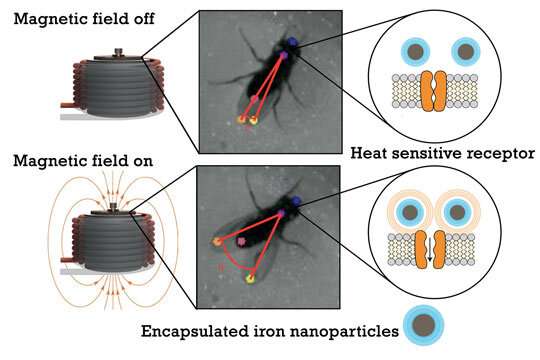
A research team led by Rice University neuroengineers has created wireless technology to remotely activate specific brain circuits in fruit flies in under one second.
In a published demonstration in Nature Materials, researchers from Rice, Duke University, Brown University and Baylor College of Medicine used magnetic signals to activate targeted neurons that controlled the body position of freely moving fruit flies in an enclosure.
"To study the brain or to treat neurological disorders the scientific community is searching for tools that are both incredibly precise, but also minimally invasive," said study author Jacob Robinson, an associate professor in electrical and computer engineering at Rice and a member of Rice's Neuroengineering Initiative. "Remote control of select neural circuits with magnetic fields is somewhat of a holy grail for neurotechnologies. Our work takes an important step toward that goal because it increases the speed of remote magnetic control, making it closer to the natural speed of the brain."
-
weatheriscool
- Posts: 26097
- Joined: Sun May 16, 2021 6:16 pm
- Contact:
Re: BCIs & Neurotechnology News and Discussions
Researchers observe memory formation in real time
https://medicalxpress.com/news/2022-07- ... -real.html
by Alan Toth, Stanford University
https://medicalxpress.com/news/2022-07- ... -real.html
by Alan Toth, Stanford University
Why is it that someone who hasn't ridden a bicycle in decades can likely jump on and ride away without a wobble, but could probably not recall more than a name or two from their 3rd grade class?
This may be because physical skills—dubbed motor memories by neuroscientists—are encoded differently in our brains than our memories for names or facts.
Now, a new study by scientists with the Wu Tsai Neurosciences Institute is revealing exactly how motor memories are formed and why they are so persistent. It may even help illuminate the root causes of movement disorders like Parkinson's disease.
"We think motor memory is unique," said Jun Ding, an associate professor of neurosurgery and of neurology. "Some studies on Alzheimer's disease included participants who were previously musicians and couldn't remember their own families, but they could still play beautiful music. Clearly, there's a huge difference in the way that motor memories are formed."
Memories are thought to be encoded in the brain in the pattern of activity in networks of hundreds or thousands of neurons, sometimes distributed across distant brain regions. The concept of such a memory trace—sometimes called a memory engram—has been around for more than a century, but identifying exactly what an engram is and how it is encoded has proven extremely challenging. Previous studies have shown that some forms of learning activate specific neurons, which reactivate when the learned memory is recalled. However, whether memory engram neurons exist for motor skill learning remains unknown.
-
weatheriscool
- Posts: 26097
- Joined: Sun May 16, 2021 6:16 pm
- Contact:
Re: BCIs & Neurotechnology News and Discussions
Researchers identify a new mechanism responsible for controlling auditory sensitivity
https://medicalxpress.com/news/2022-07- ... ivity.html
by Kelsea Pieters, CU Anschutz Medical Campus
https://medicalxpress.com/news/2022-07- ... ivity.html
by Kelsea Pieters, CU Anschutz Medical Campus
A new study published in PNAS highlights a newly identified mechanism of how auditory sensitivity is regulated that could temporarily reduce sensitivity of the auditory system to protect itself from loud sounds that can cause irreversible damage.
The study, led by CU Anschutz researchers Andrew Mecca and Giusy Caprara in the laboratory of Anthony Peng, tested a decades-old hypothesis which proposed that the gating spring, a tiny, nanometer-scale protein structure which mechanically opens and closes an ion channel in sensory hair cell cells in response to sound vibrations, can act directly as a controller of the channel's activity.
Previous work in the auditory field has focused mostly on understanding mechanisms which target the ion channel. This study provides the first evidence that the gating spring itself has the capacity to modulate the sensitivity of the channel.
"This study documents the first time we understand a mechanism that regulates auditory sensitivity on both the molecular and mechanical levels," says Peng, Ph.D., associate professor at the University of Colorado School of Medicine and senior author of the study. "We uncovered a new mechanism of modulating sensitivity, which opens the door to discovering more about how the auditory system functions generally and uses this to both maximize the range of sounds that we can detect and protect the vital sensory cells from potential damage."