The Moon

User avatar
wjfox
Site Admin
Posts: 13579
Joined: Sat May 15, 2021 6:09 pm
Location: Essex, UK
Contact:

The Moon

Post by wjfox »

A general thread for news and discussions regarding Earth's nearest neighbour.

----------

New report argues for ownership of the Moon

16th February 2022

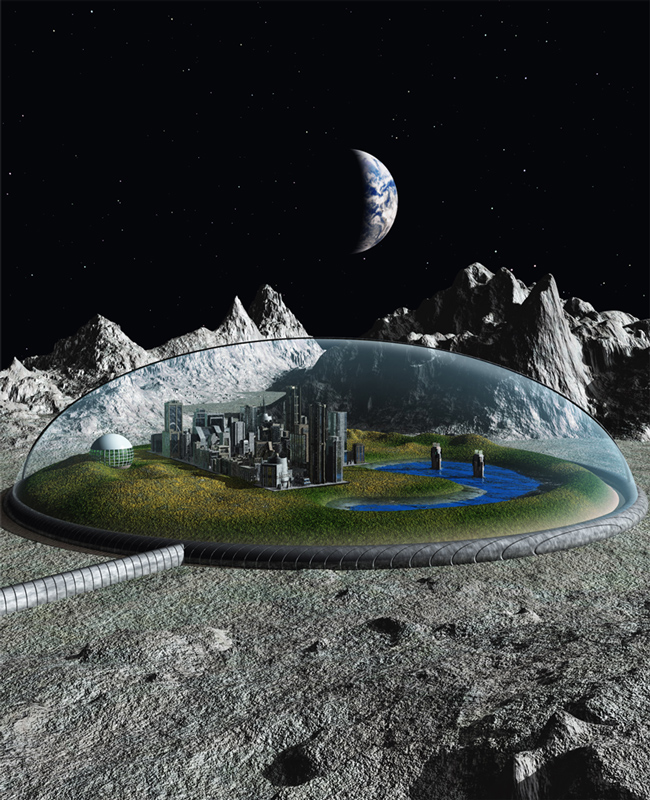
The Adam Smith Institute (ASI), a neoliberal think tank based in London, UK, has published a new report on property rights in space. It suggests dividing the Moon into regions and privatising it, which the institute believes could help end global poverty.

Space Invaders: Property Rights on the Moon, by economic consultant Rebecca Lowe, argues that creating a clear system of property rights in space could empower all of humanity with a greater stake in space exploration, as well as accelerating scientific discovery.

The Outer Space Treaty of 1967 – of which 111 countries are party to, including all major spacefaring powers – states that space is the "province of all mankind" and shall be freely explored and used by all nations. It precludes any country from claiming sovereignty over outer space or any celestial body, regardless of what national flags are planted on its surface.

However, the ASI believes this way of thinking has become outdated and is holding back humanity's potential. Recent advances in space travel and commercialisation from the likes of SpaceX, Blue Origin, and other companies have opened up the possibility of Moon settlement in the relatively near future and the time has therefore come for a fresh approach to space resource utilisation, the institute says.

Lowe's paper sets out a framework for individuals to gain morally-justified property rights in space, with a particular focus on plots of Moon land. Under the proposed system, individuals would compete against each other for plots of land on the Moon (that have most likely been initially acquired by, or assigned to, particular nations). This competition would involve paying 'rent' for such plots – the area and cost of which would be determined by supply and demand. A rebate could be given for improving the condition of land or providing for urgent human needs. Governance would currently depend on international agreement.

Read more: https://www.futuretimeline.net/blog/202 ... e-moon.htm

Image
User avatar
caltrek
Posts: 9280
Joined: Mon May 17, 2021 1:17 pm

Re: The Moon

Post by caltrek »

Chinese Rover Finds Translucent Glass Globules on the Moon
by Nancy Atkinson
February 24, 2022

https://www.universetoday.com/154669/ch ... ore-154669

Introduction:
(Universe Today) Scientists say China’s Yutu-2 rover, part of the Chang’E-4 mission, has found several small glass globules on the Moon’s far side. While tiny glass beads have been found previously in lunar samples brought back by the Apollo astronauts, the ones found by Yutu-2 are much bigger and translucent.

The discovery was made by Dr. Zhiyong Xiao, one of the lead scientific team members of the Chang’E-4 mission. The beads were found by looking at panoramic images taken by the rover. Since the rover doesn’t have sampling capabilities and is not a sample return mission like it’s older sibling, the Chang-E-5 mission, there is no compositional data on the glass beads, only observational evidence.

In the paper published in the Science Bulletin, Xiao said taking into account the location where the glass was found – in the South Pole Atkien basin at the lunar farside – and the local context of what is known about that region, they believe the beads are...most likely the result of large impacts to the Moon.

The paper details the discovery of several translucent spherical and dumbbell-shaped glassy globules that range in size, but are as large as 4 centimeters (1.5 inches). They were found on the surface of the Moon, and are transparent to translucent, with some exhibiting a light brownish color.
Image
Two confirmed (upper row) and two possible (bottom row) glass globules found along the route of Yutu-2 (Image taken by the Yutu-2 rover)
Courtesy of China National Space Administration
Don't mourn, organize.

-Joe Hill
weatheriscool
Posts: 24486
Joined: Sun May 16, 2021 6:16 pm
Contact:

Re: The Moon

Post by weatheriscool »

Scientists help recover gases from moon rock time capsule
https://phys.org/news/2022-03-scientist ... psule.html
by Talia Ogliore, Washington University in St. Louis
Scientists from Washington University in St. Louis are helping to recover gases from a container of lunar soil that astronauts collected and sealed under vacuum on the surface of the moon in 1972. The effort is part of NASA's Apollo Next Generation Sample Analysis (ANGSA) initiative.

Apollo 17 astronauts Harrison Schmitt and Eugene Cernan collected the sample from the site of an ancient landslide in the moon's Taurus-Littrow Valley. The astronauts used a coring device to dig out a column of lunar regolith—a rough mixture of dust, soil and broken rock from the surface of the moon—and sealed it in a container. Back on Earth, NASA carefully placed the container in the lunar vault at NASA's Johnson Space Center, where it has remained in pristine condition, virtually untouched until now.

"For the last 50 years, the lunar core was enclosed in a core sample vacuum container, which was then enclosed in an outer vacuum container," said Alex Meshik, a research professor of physics in Arts & Sciences and faculty fellow of the university's McDonnell Center for the Space Sciences. "They were nested together, almost like Russian dolls."

The containers were placed in two sealed Teflon bags and stored in a nitrogen glove box in a vault.

Cracking the containers open, as Meshik and collaborators did last month, was tricky. The scientists needed to be able to identify the original chemical signature of every bit of gas that could be in the containers. That includes lunar gas that might have been captured at the time the lunar regolith was collected on the surface of the moon, as well as any other gases that could have seeped from the rocks during the subsequent decades in storage.
User avatar
caltrek
Posts: 9280
Joined: Mon May 17, 2021 1:17 pm

Re: The Moon

Post by caltrek »

China’s Lunar Lander Finds Water Under its Feet
by Nancy Atkinson
June 15, 2022

Introduction:
(Universe Today) Earlier this year, scientists from China’s Chang’E-5 lunar lander revealed they had found evidence of water in the form of hydroxyl from in-situ measurements taken while lander was on the Moon. Now, they have confirmed the finding with laboratory analysis of the lunar samples from Chang’E-5 that were returned to Earth. The amount of water detected varied across the randomly chosen samples taken from around the base of the lander, from 0 to 180 parts per million (ppm), mean value of 28.5?ppm, which is on the weak end of lunar hydration.

“For the first time in the world, the results of laboratory analysis of lunar return samples and spectral data from in-situ lunar surface surveys were used jointly to examine the presence, form and amount of ‘water’ in lunar samples,” said co-author Li Chunlai from the National Astronomical Observatories of the Chinese Academy of Sciences (NAOC), in a press release. “The results accurately answer the question of the distribution characteristics and source of water in the Chang’E-5 landing zone and provide a ground truth for the interpretation and estimation of water signals in remote sensing survey data.”

The researchers, who published a paper in Nature Communications, said the laboratory analysis of the also provide critical clues to the possible sources of these hydroxyl. Hydroxyl is a close chemical cousin of water (H2O). Hydroxyl is HO, with one atom of oxygen and one of hydrogen.
The article goes on to explain that there seems to be two basic sources of the hydroxyl. One, from “solar wind implantation (that) can bring water to the lunar surface. Charged particles from the Sun drive hydrogen atoms to the lunar surface where they later bonded with oxygen to form water and hydroxyl.” The other is so-called indigenous hydroxyl which is embedded in the rock of the Moon’s surface.

Read more here: https://www.universetoday.com/156307/c ... re-156307
Don't mourn, organize.

-Joe Hill
User avatar
Time_Traveller
Posts: 3025
Joined: Sun May 16, 2021 4:49 pm
Location: New York City, USA, November 5th 2032 C.E.

Re: The Moon

Post by Time_Traveller »

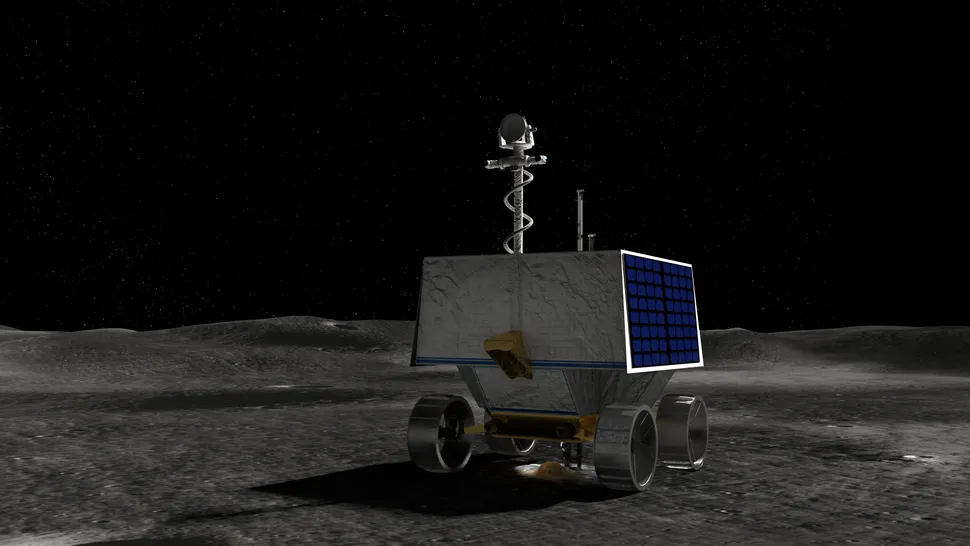
NASA delays ice-hunting VIPER moon rover launch to 2024, a one-year slip
published about 6 hours ago

Image

NASA's new VIPER lunar rover must wait at least an extra year to search for ice on the surface of the moon.

The VIPER moon rover will now launch no earlier than 2024 following a NASA request for more ground testing of the Griffin lunar lander. Both Griffin and VIPER are made by the company Astrobotic.

The ice-hunting VIPER rover, the name is short for Volatiles Investigating Polar Exploration Rover, was supposed to touch down in November 2023 in the lunar south polar region to assess how much water might be available for human missions. NASA, however, asked for more time to assess Griffin's readiness for its debut mission, pushing the landing to November 2024.

"The additional tests aim to reduce the overall risk to VIPER's delivery to the moon," NASA said of the decision in a release(opens in new tab) Monday (July 18), but provided no other details. Astrobotic made no comment on social media or in a news release.

The Commercial Lunar Payload Services (CLPS) contract for Astrobotic will be allocated an additional $67.8 million to fulfill the extra work, bringing the total cost to $320.4 million, NASA stated.
https://www.space.com/nasa-viper-moon-r ... socialflow
“In the quantum multiverse, every choice, every decision you've ever and never made exists in an unimaginably vast ensemble of parallel universes.”
User avatar
caltrek
Posts: 9280
Joined: Mon May 17, 2021 1:17 pm

Re: The Moon

Post by caltrek »

Johns Hopkins Applied Physics Laboratory Assembles First Global Map of Lunar Hydrogen
July 20, 2022

Introduction:
(EurekAlert) Using data collected over two decades ago, scientists from the Johns Hopkins Applied Physics Laboratory (APL) in Laurel, Maryland, have compiled the first complete map of hydrogen abundances on the Moon’s surface. The map identifies two types of lunar materials containing enhanced hydrogen and corroborates previous ideas about lunar hydrogen and water, including findings that water likely played a role in the Moon’s original magma-ocean formation and solidification.

APL’s David Lawrence, Patrick Peplowski and Jack Wilson, along with Rick Elphic from NASA Ames Research Center, used orbital neutron data from the Lunar Prospector mission to build their map. The probe, which was deployed by NASA in 1998, orbited the Moon for a year and a half and sent back the first direct evidence of enhanced hydrogen at the lunar poles, before impacting the lunar surface.

When a star explodes, it releases cosmic rays, or high-energy protons and neutrons that move through space at nearly the speed of light. When those cosmic rays come into contact with the surface of a planet, or a moon, they break apart atoms located on those bodies, sending protons and neutrons flying. Scientists are able to identify an element and determine where and how much of it exists by studying the motion of those protons and neutrons.
Read more here: https://www.eurekalert.org/news-releases/959403
Don't mourn, organize.

-Joe Hill
User avatar
caltrek
Posts: 9280
Joined: Mon May 17, 2021 1:17 pm

Re: The Moon

Post by caltrek »

Korea’s Lunar Orbiter Heads for the Moon
by David Dickinson
August 5, 2022

Extract::
(Sky & Telescope) A SpaceX Falcon 9 rocket lit up the skies over Cape Canaveral in Florida yesterday evening, taking with it South Korea’s first Moon mission: the Korea Pathfinder Lunar Orbiter, now officially called Danuri. The $180 million mission is a pathfinder for an eventual mission with an orbiter, lander, and rover.

WHAT DANURI WILL DELIVER

The mission's name, Danuri, is a portmanteau of the Korean words dal and nurida, collectively meaning “enjoy the Moon.” The mission will scout the lunar surface for minerals and elements, including aluminum, helium-3, and surface water ice.

To accomplish this, the solar-powered spacecraft carries six instruments, one from NASA and five from the Korea Aerospace Research Institute (KARI):
  • The Wide-Angle Polarimetric Camera (PolCam) will image and analyze the lunar regolith in polarized light. Though Earth-observing satellites have long used this technique, this is the first time a polarized-light imager has flown to the Moon. Bill Farrand (Space Science Institute) says that he will use PolCam to explore the nature of pyroclastic deposits, which formed early in the Moon's history during explosive volcanic activity.
  • The KPLO Magnetometer contains three sensors that will characterize the magnetic field lines frozen into lunar rocks.
  • The Lunar Terrain Imager will take sharp images of future landing sites, resolving features down to just 16.5 feet (5 meters) across.
  • The Delay-Tolerant Networking experiment will test a sort of “interplanetary internet” by addressing the technical issues that arise in a communications network that lacks continuous connectivity.
  • The Gamma Ray Spectrometer is a gamma-ray spectrometer that works in the 10 kilo-electron volt (keV) to 10 mega-electron volt (MeV) range to probe the surface of the Moon in search of key chemicals and elementsKPLO in the clean room on Earth.
Read more here: https://skyandtelescope.org/astronomy- ... ter-moon/
Don't mourn, organize.

-Joe Hill
User avatar
caltrek
Posts: 9280
Joined: Mon May 17, 2021 1:17 pm

Re: The Moon

Post by caltrek »

NASA's Artemis 1 Moon Mission Will Carry Two Water-seeking Cubesats
by Stefanie Waldek
August 15, 2022

Introduction:
(Space.com) When Artemis 1 launches, hopefully on Aug. 29, its primary mission is simple: test the brand new Space Launch System (SLS) rocket, the Orion spacecraft, and the ground systems at Kennedy Space Center in Florida. NASA hopes that this combination of technology will see humans return to the moon in a few years.

But that means Artemis 1 will be headed for the moon, an opportunity not to be missed, so it will be taking with it 10 secondary payloads. Two of those are cubesats designed to search the moon for water: Lunar IceCube and Lunar Polar Hydrogen Mapper (LunaH-Map). As humans return to the moon — and travel beyond — the discovery of water is crucial for long-duration missions, since would-be explorers hope to harvest breathable air and rocket fuel from the ice.

Lunar IceCube is being developed by Morehead State University in Kentucky. The 31-pound (14 kilograms) cubesat will carry a NASA instrument called the Broadband Infrared Compact High-Resolution Exploration Spectrometer (BIRCHES), which will map water on the lunar surface as well as in the exosphere, the thin layer of gas surrounding the moon like a very weak imitation of Earth's atmosphere.

"Lunar IceCube will help pave the way for human missions through significantly less expensive robotic missions and by addressing water dynamics on the moon," Mark Lupisella, a NASA exploration research and development manager, said in a statement. "This is not only important for science, but it could also be important for reducing the cost of human missions over the long-term."

The mission will also test a new ion propulsion thruster, which "operates electrically using small amounts of propellant to give a small push and drive the spacecraft along its path, similar to that of butterfly wings," according to NASA.
Read more here: https://www.space.com/artemis-1-moon-w ... -cubesats
Don't mourn, organize.

-Joe Hill
User avatar
wjfox
Site Admin
Posts: 13579
Joined: Sat May 15, 2021 6:09 pm
Location: Essex, UK
Contact:

Re: The Moon

Post by wjfox »

User avatar
raklian
Posts: 1981
Joined: Sun May 16, 2021 4:46 pm
Location: North Carolina

Re: The Moon

Post by raklian »

To know is essentially the same as not knowing. The only thing that occurs is the rearrangement of atoms in your brain.
User avatar
caltrek
Posts: 9280
Joined: Mon May 17, 2021 1:17 pm

Re: The Moon

Post by caltrek »

The Moon's Darkest Places Are Permanent Shadows, But Now We Can Peer Into Them
by Michele Starr
August 30, 2022

Introduction:
(Science Alert) It's a common misconception that the Moon has a "dark" side. Like a rotisserie chicken, the Moon's rotation ensures a nice, even sunbathe around its equator.

But there are pockets that never receive any rays: deep craters and pocks at high latitudes, in the Moon's polar regions, with high walls that protect the crater floor from harsh solar radiation.

In these mysterious Moon holes, which maintain freezing temperatures around -163 degrees Celsius (-260 degrees Fahrenheit), scientists believe there may be all sorts of interesting things.

Well, mainly one: water ice, in patches up to several meters thick.

We likely won't know for sure until at least 2024, the year NASA plans to send astronauts up to our li'l lunar buddy to check it out… but in the meantime, scientists have found a way to illuminate those shadowed regions for a sneak peek.


Read more here: https://www.sciencealert.com/the-moons ... into-them
Don't mourn, organize.

-Joe Hill
User avatar
raklian
Posts: 1981
Joined: Sun May 16, 2021 4:46 pm
Location: North Carolina

Re: The Moon

Post by raklian »

To know is essentially the same as not knowing. The only thing that occurs is the rearrangement of atoms in your brain.
weatheriscool
Posts: 24486
Joined: Sun May 16, 2021 6:16 pm
Contact:

Re: The Moon

Post by weatheriscool »

SpaceX’s Starship will carry an SUV-sized rover to the Moon in 2026

While its next-generation rocket has yet to fly, that’s not stopping SpaceX from booking Starship flights. On Friday, a startup named Astrolab revealed that it had recently signed an agreement with Elon Musk’s private space firm to reserve a spot on an uncrewed Starship cargo mission that could launch as early as mid-2026. “This is SpaceX’s first commercial cargo contract to the lunar surface,” Jaret Matthews, CEO of Astrolab, told The New York Times, adding his company was one of a few customers involved in the flight.
https://www.engadget.com/spacexs-starsh ... 26510.html
weatheriscool
Posts: 24486
Joined: Sun May 16, 2021 6:16 pm
Contact:

Re: The Moon

Post by weatheriscool »

Collision May Have Formed the Moon in Mere Hours, Simulations Reveal
https://www.nasa.gov/feature/ames/lunar ... imulations
Billions of years ago, a version of our Earth that looks very different than the one we live on today was hit by an object about the size of Mars, called Theia – and out of that collision the Moon was formed. How exactly that formation occurred is a scientific puzzle researchers have studied for decades, without a conclusive answer.

Most theories claim the Moon formed out of the debris of this collision, coalescing in orbit over months or years. A new simulation puts forth a different theory – the Moon may have formed immediately, in a matter of hours, when material from the Earth and Theia was launched directly into orbit after the impact.

“This opens up a whole new range of possible starting places for the Moon’s evolution,” said Jacob Kegerreis, a postdoctoral researcher at NASA’s Ames Research Center in California’s Silicon Valley, and lead author of the paper on these results published in The Astrophysical Journal Letters. “We went into this project not knowing exactly what the outcomes of these high-resolution simulations would be. So, on top of the big eye-opener that standard resolutions can give you misleading answers, it was extra exciting that the new results could include a tantalisingly Moon-like satellite in orbit."

The simulations used in this research are some of the most detailed of their kind, operating at the highest resolution of any simulation run to study the Moon’s origins or other giant impacts. This extra computational power showed that lower-resolution simulations can miss out on important aspects of these kinds of collisions, allowing researchers to see new behaviors emerge in a way previous studies just couldn’t see.
weatheriscool
Posts: 24486
Joined: Sun May 16, 2021 6:16 pm
Contact:

Re: The Moon

Post by weatheriscool »

Building Telescopes on the Moon Could Transform Astronomy—And It’s Becoming an Achievable Goal
The Moon still has much to tell us about the early solar system. Encouragingly, it also has scientific value as a platform for observational astronomy.
https://gizmodo.com/telescopes-moon-ach ... 1850352064
By
Ian Crawford, The Conversation
Lunar exploration is undergoing a renaissance. Dozens of missions, organised by multiple space agencies—and increasingly by commercial companies—are set to visit the Moon by the end of this decade. Most of these will involve small robotic spacecraft, but NASA’s ambitious Artemis program, aims to return humans to the lunar surface by the middle of the decade.

There are various reasons for all this activity, including geopolitical posturing and the search for lunar resources, such as water-ice at the lunar poles, which can be extracted and turned into hydrogen and oxygen propellant for rockets. However, science is also sure to be a major beneficiary.

The Moon still has much to tell us about the origin and evolution of the solar system. It also has scientific value as a platform for observational astronomy.

The potential role for astronomy of Earth’s natural satellite was discussed at a Royal Society meeting earlier this year. The meeting itself had, in part, been sparked by the enhanced access to the lunar surface now in prospect.
weatheriscool
Posts: 24486
Joined: Sun May 16, 2021 6:16 pm
Contact:

Re: The Moon

Post by weatheriscool »

User avatar
wjfox
Site Admin
Posts: 13579
Joined: Sat May 15, 2021 6:09 pm
Location: Essex, UK
Contact:

Re: The Moon

Post by wjfox »

Please keep exploration of the Moon in the relevant thread, thanks.
weatheriscool
Posts: 24486
Joined: Sun May 16, 2021 6:16 pm
Contact:

Re: The Moon

Post by weatheriscool »

More evidence found showing the moon's inner core is solid, like Earth's
https://phys.org/news/2023-05-evidence- ... earth.html
by Bob Yirka , Phys.org
A small team of astronomers at Université Côte d'Azur, Observatoire de la Côte d'Azur, working with a colleague from MCCE, Observatoire de Paris, Sorbonne Université, has found more evidence that the moon has an inner core similar to Earth's. In their study, reported in the journal Nature, the group analyzed data from a wide variety of sources and used it to create models depicting the inner parts of the moon

In 2011, planetary scientists at NASA used seismic data recorded by Apollo astronauts to predict what might lie at the center of the moon. They suggested it was likely that there was a solid inner core with a radius of approximately 240 kilometers. In this new effort, the researchers used a variety of sources to make similar estimates and found evidence that matches closely with the NASA results.

To learn more about the moon's core, the research team collected data from several space missions and from several lunar-based ranging experiments. They used that data to create a likely profile for the interior of the moon, including characteristics such as deformations created due to gravitational interactions with the Earth, the moon's distance from Earth and also the moon's density. They then input all of their data into a modeling application. Next, they ran multiple modeling scenarios to see which corresponded most closely with real-world data.

The model that fit most closely to observations revealed evidence of active overturn, where denser material is pulled closer to the core over time, forcing lighter material upward. This finding helps explain how many of the elements found in volcanic regions of the moon got there.
User avatar
Time_Traveller
Posts: 3025
Joined: Sun May 16, 2021 4:49 pm
Location: New York City, USA, November 5th 2032 C.E.

Re: The Moon

Post by Time_Traveller »

Israeli startup WeSpace aims to launch robotic 'moon hopper' by 2026
about 22 hours ago

Israeli startup WeSpace Technologies wants to put its robotic footprint on the moon.

The company aims to provide autonomous lunar hopper drones, which will deliver customer payloads to hard-to-reach regions of the moon.

WeSpace was founded in 2019 by CEO Yifat Feffer and chief technology officer Yigal Harel, the latter of whom previously helmed the pioneering Beresheet lunar lander program for the Israeli organization SpaceIL. Beresheet, a four-legged stationary probe, crashed into the moon's surface during its landing attempt in April 2019. Harel and Feffer established WeSpace that same year, with aspirations for a much more complex lunar vehicle.

WeSpace is touting the hopper as a highly capable autonomous spacecraft with the ability to zip around the moon using thrusters to fly from location to location, hover above specific areas or deliver payloads somewhere on the surface — and possibly even beneath it.

The company views the current means of exploring the lunar surface — mainly via rovers — as inadequate to help develop an emerging lunar economy. The company's website lists the spacecraft's advantages over other vehicles, including the ability to explore the moon's underground lava tubes and operate autonomously in permanently shadowed regions, areas thought to be rich in water ice that are, unfortunately, also essentially communication "dark" zones.
https://www.space.com/israeli-startup-w ... =space.com
“In the quantum multiverse, every choice, every decision you've ever and never made exists in an unimaginably vast ensemble of parallel universes.”
weatheriscool
Posts: 24486
Joined: Sun May 16, 2021 6:16 pm
Contact:

Re: The Moon

Post by weatheriscool »

Post Reply