Grab their prey?weatheriscool wrote: ↑Thu Jul 07, 2022 4:33 pm New giant carnivorous dinosaur discovered with tiny arms like T. rex
https://phys.org/news/2022-07-giant-car ... -arms.html
by Cell Press[...]
The harder question is what exactly the functions were.
Natural History (13.8 billion years BC – 3.3 million BC)
-
Lorem Ipsum

- Posts: 117
- Joined: Tue May 24, 2022 4:51 pm
Re: Natural History (13.8 billion years BC – 3.3 million BC)

Re: Natural History (13.8 billion years BC – 3.3 million BC)
Study Reveals Yunnanozoans as the Oldest Known Stem Vertebrates
July 7, 2022
Introduction:
July 7, 2022
Introduction:
Read more here: https://www.eurekalert.org/news-releases/957799(EurekAlert) Scientists have long puzzled over the gap in the fossil record that would explain the evolution of invertebrates to vertebrates. Vertebrates, including fishes, amphibians, reptiles, birds, mammals, and humans, share unique features, such as a backbone and a skull. Invertebrates are animals without backbones.
The process that moved invertebrates toward becoming vertebrates — and what those earliest vertebrates looked like — has been a mystery to scientists for centuries.
A research team has now conducted a study of yunnanozoans, extinct creatures from the early Cambrian period (518 million years ago), and discovered evidence that they are the oldest known stem vertebrates. The term stem vertebrate refers to those vertebrates that are extinct, but very closely related to living vertebrates.
Don't mourn, organize.
-Joe Hill
-Joe Hill
Re: Natural History (13.8 billion years BC – 3.3 million BC)
500-Million-Year-Old Fossilized Brains of Stanleycaris Prompt a Rethink of the Evolution of Insects and Spiders
July 8 , 2022
Introduction:
July 8 , 2022
Introduction:
Read more here: https://www.eurekalert.org/news-releases/957715(EurekAlert) TORONTO, ON, July 8, 2022 – ROM (Royal Ontario Museum) revealed new research based on a cache of fossils that contains the brain and nervous system of a half-billion-year-old marine predator from the Burgess Shale called Stanleycaris. Stanleycaris belonged to an ancient, extinct offshoot of the arthropod evolutionary tree called Radiodonta, distantly related to modern insects and spiders. These findings shed light on the evolution of the arthropod brain, vision, and head structure. The results were announced in the paper, “A three-eyed radiodont with fossilized neuroanatomy informs the origin of the arthropod head and segmentation”, published in the journal Current Biology.
It’s what’s inside Stanleycaris’ head that has the researchers most excited. In 84 of the fossils, the remains of the brain and nerves are still preserved after 506 million years. “While fossilized brains from the Cambrian Period aren’t new, this discovery stands out for the astonishing quality of preservation and the large number of specimens,” said Joseph Moysiuk, lead author of the research and a University of Toronto (U of T) PhD Candidate in Ecology and Evolutionary Biology, based at the Royal Ontario Museum. “We can even make out fine details such as visual processing centers serving the large eyes and traces of nerves entering the appendages. The details are so clear it’s as if we were looking at an animal that died yesterday”.
The new fossils show that the brain of Stanleycaris was composed of two segments, the protocerebrum and deutocerebrum, connected with the eyes and frontal claws, respectively. “We conclude that a two-segmented head and brain has deep roots in the arthropod lineage and that its evolution likely preceded the three-segmented brain that characterizes all living members of this diverse animal phylum,” added Moysiuk.
Don't mourn, organize.
-Joe Hill
-Joe Hill
-
weatheriscool
- Posts: 26094
- Joined: Sun May 16, 2021 6:16 pm
- Contact:
Re: Natural History (13.8 billion years BC – 3.3 million BC)
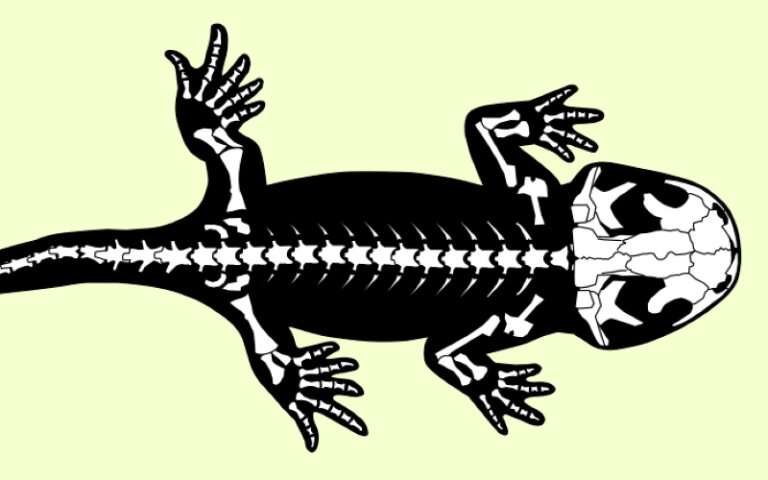
Oldest European salamander fossil, discovered in Scotland, informs amphibian origins
https://phys.org/news/2022-07-oldest-eu ... tland.html
by University College London
https://phys.org/news/2022-07-oldest-eu ... tland.html
by University College London
Fossils discovered in Scotland represent some of the world's oldest salamanders, according to a new study led by UCL researchers.
The research team analyzed 166-million-year-old fossils of a type of animal called Marmorerpeton, found in Middle Jurassic rocks on the Isle of Skye.
They found that it has several key salamander traits, but is not part of the modern group of salamanders. Their results are reported in Proceedings of the National Academy of Sciences (PNAS). The specimen is believed to be the oldest salamander fossil found in Europe.
Marmorerpeton was first described over 30 years ago, but only a few isolated fossil vertebrae and partial jaw bones were found, making it somewhat enigmatic. The new Scottish material adds a wealth of new data, and it also represents a new species: Marmorerpeton wakei, named after the late Professor David Wake, a leading American authority on salamander evolution.
Last edited by weatheriscool on Fri Jul 15, 2022 7:06 am, edited 1 time in total.
-
weatheriscool
- Posts: 26094
- Joined: Sun May 16, 2021 6:16 pm
- Contact:
Re: Natural History (13.8 billion years BC – 3.3 million BC)
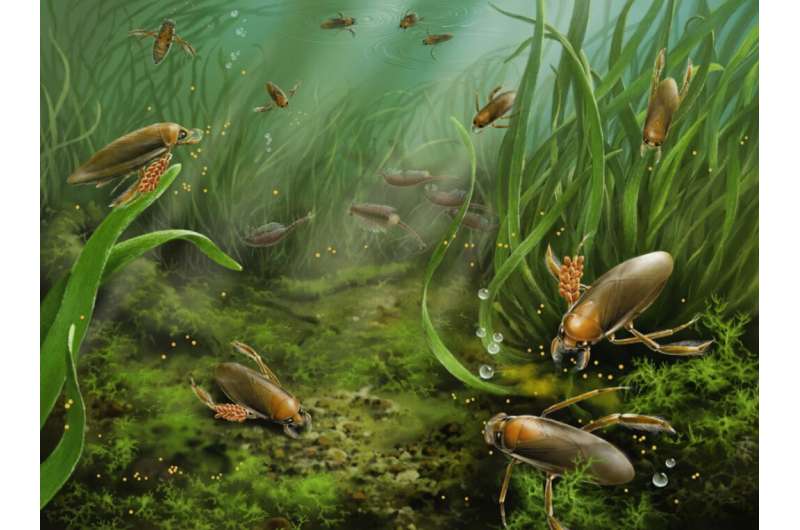
Earliest known example of brood care found in extinct insects from China
https://phys.org/news/2022-07-earliest- ... china.html
by Bob Yirka , Phys.org
https://phys.org/news/2022-07-earliest- ... china.html
by Bob Yirka , Phys.org
At a dig site in China, a team of researchers at the Chinese Academy of Sciences working with a colleague from the Netherlands has uncovered the earliest known example of brood care in an insect. In their paper published in Proceedings of The Royal Society B: Biological Sciences, the group describes the extinct water bugs and the results of close inspection of their legs.
Prior to this find, the earliest known example of brood care in insects was from samples dated back approximately 122 million years. The water bugs found by the team in China were dated back 160 million years and have been named Karataviella popovi. The researchers found them while digging in rock deposits at a site near Daohugou in a northeastern part of China. In all, they found 30 fossilized specimens, all female, and all with a unique leg characteristic. Each of them had a stalk extending from their mesotibia (middle) left leg for the purpose of holding eggs, likely until they hatched.
Last edited by weatheriscool on Fri Jul 15, 2022 7:00 am, edited 1 time in total.
-
weatheriscool
- Posts: 26094
- Joined: Sun May 16, 2021 6:16 pm
- Contact:
Re: Natural History (13.8 billion years BC – 3.3 million BC)
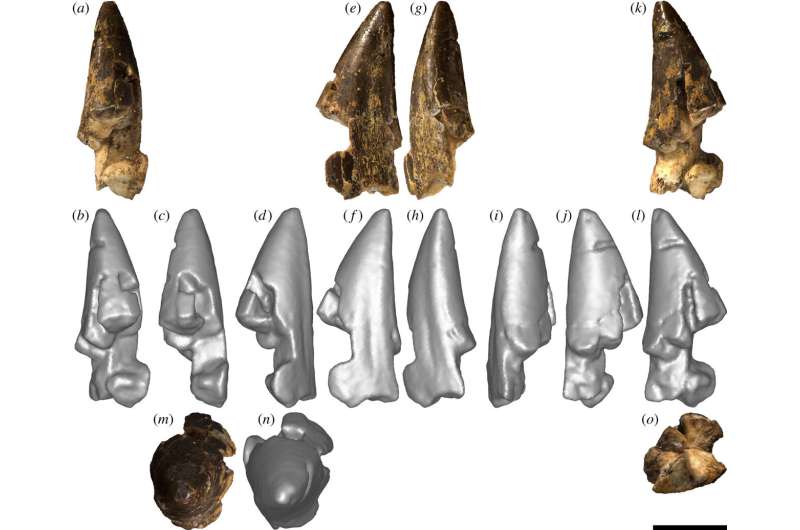
Rare sauropod dinosaur teeth uncovered in Australia
https://phys.org/news/2022-07-rare-saur ... vered.html
by Bob Yirka , Phys.org
https://phys.org/news/2022-07-rare-saur ... vered.html
by Bob Yirka , Phys.org
A team of researchers at the Australian Age of Dinosaurs Natural History Museum The Jump-Up, working with colleagues from the University of New England and University College London, has uncovered sauropod teeth fossils at the Upper Cretaceous Winter Formation of Queensland in Australia. In their paper published in the journal Royal Society Open Science, the group describes their find and its importance to understanding the history of the creatures in Australia.
Sauropods were big, plant-eating dinosaurs with long necks that lived in many parts of the world. Fossils have been found in many countries, but have been rare in Australia due to its unique geography. The country has very few places where rocks from the Cretaceous or Jurassic are exposed at the surface. The dig site for this new effort, called Mitchell, is little more than a small mound sticking up out of a vast, flat landscape used to graze sheep. The site has thus far yielded 17 sauropod teeth.
The researchers note that sauropods did not chew their food and thus, they had no molars. All of their teeth were semi-conical and curved with a pointed end and were slightly offset. The dinosaurs would have used them in conjunction with their tongue and jaw to grab leaves and snip them into their mouths, which they would consume as is—no pre-processing occurred in the mouth. Thus, the gut would have had to do all the work, a process that could take as long as two weeks.
-
weatheriscool
- Posts: 26094
- Joined: Sun May 16, 2021 6:16 pm
- Contact:
Re: Natural History (13.8 billion years BC – 3.3 million BC)
Newly discovered Liexi fauna reveals early stage of great Ordovician biodiversification event
https://phys.org/news/2022-07-newly-lie ... early.html
by Li Yuan, Chinese Academy of Sciences
https://phys.org/news/2022-07-newly-lie ... early.html
by Li Yuan, Chinese Academy of Sciences
From the beginning of the Ordovician, marine life began its great radiation outward, which was characterized by the rapid appearance of new orders, families, and genera, together with the replacement of existing groups.
The Great Ordovician Biodiversification Event (GOBE) constructed the essential framework for Paleozoic evolutionary faunas. During the GOBE, Cambrian faunas dominated by arthropods were replaced by Paleozoic faunas represented by filter feeders and reef-forming organisms.
Recently, a joint research team from the Nanjing Institute of Geology and Paleontology of the Chinese Academy of Sciences (NIGPAS), Hunan Museum, and Central South University has reported a new Lagerstätte, Liexi fauna, from the Lower Ordovician of Yongshun County, Hunan Province. This discovery helps advance our understanding of the early GOBE.
This study was published in Proceedings of the Royal Society B on July 13.
The GOBE was originally studied and defined using skeletonized taxa rather than non-mineralized taxa. Exceptionally preserved Lagerstätte accurately reflects the living community, providing new evidence for understanding the Ordovician marine world. However, only a few Ordovician Lagerstätten have been discovered, especially from the Lower Ordovician.
Re: Natural History (13.8 billion years BC – 3.3 million BC)
Mammals Were Not the First to be Warm-blooded
July 20, 2022
Introduction:
July 20, 2022
Introduction:
Read more here: https://www.eurekalert.org/news-releases/959231(EurekAlert) Endothermy, or warm-bloodedness, is the ability of mammals and birds to produce their own body heat and control their body temperature.
This major difference with the cold-blooded reptiles underpins the ecological dominance of mammals in almost every ecosystem globally. Until now, it was not known exactly when endothermy originated in mammalian ancestry. A team of international scientists, including researchers from the University of the Witwatersrand (Wits University) in Johannesburg, South Africa, has found the smoking gun of this key evolutionary event in the inner ears of fossils from South Africa and around the globe.
A new study suggests that endothermy appeared in mammalian ancestors about 233 million years ago, well before the origin of mammals, which occurred about 200 million years ago. This study, titled Inner ear biomechanics reveals Late Triassic origin of mammalian endothermy is published in Nature.
“For the first time, we are able to trace through evolution the direct consequence of the origin of endothermy on the skeletal anatomy of our pre-mammalian ancestors,” says Dr Julien Benoit, Senior Researcher in Palaeontology at the Evolutionary Studies Institute at Wits University. “This is an exciting time for our field of study.”
Don't mourn, organize.
-Joe Hill
-Joe Hill
Re: Natural History (13.8 billion years BC – 3.3 million BC)
Idea of Ice Age 'Species Pump' in the Philippines Boosted by New Way of Drawing Evolutionary Trees
July 20, 2022
Introduction:
July 20, 2022
Introduction:
Read more here: https://www.eurekalert.org/news-releases/959411 and here: https://www.pnas.org/doi/10.1073/pnas.2121036119(EurekAlert) LAWRENCE — Does the Philippines’ astonishing biodiversity result in part from rising and falling seas during the ice ages?
Scientists have long thought the unique geography of the Philippines — coupled with seesawing ocean levels — could have created a “species pump” that triggered massive diversification by isolating, then reconnecting, groups of species again and again on islands. They call the idea the “Pleistocene aggregate island complex (PAIC) model” of diversification.
But hard evidence, connecting bursts of speciation to the precise times that global sea levels rose and fell, has been scant until now.
A groundbreaking Bayesian method and new statistical analyses of genomic data from geckos in the Philippines shows that during the ice ages, the timing of gecko diversification gives strong statistical support for the first time to the PAIC model, or “species pump.” The investigation, with roots at the University of Kansas, was just published in the Proceedings of the National Academy of Sciences.
“The Philippines is an isolated archipelago, currently including more than 7,100 islands, but this number was dramatically reduced, possibly to as few as six or seven giant islands, during the Pleistocene,” said co-author Rafe Brown, curator-in-charge of the herpetology division of the Biodiversity Institute and Natural History Museum at KU. “The aggregate landmasses were composed of many of today’s smaller islands, which became connected together by dry land as sea levels fell, and all that water was tied up in glaciers. It’s been hypothesized that this kind of fragmentation and fusion of land, which happened as sea levels repeatedly fluctuated over the last 4 million years, sets the stage for a special evolutionary process, which may have triggered simultaneous clusters or bursts of speciation in unrelated organisms present at the time. In this case, we tested this prediction in two different genera of lizards, each with species found only in the Philippines.”
Don't mourn, organize.
-Joe Hill
-Joe Hill

Re: Natural History (13.8 billion years BC – 3.3 million BC)
New Discovery of Panda Species Which May Have Been Europe’s Last
August 1, 2022
Introduction:
Edit: CNN also has an article on this: https://www.cnn.com/2022/08/01/europe/e ... index.html
August 1, 2022
Introduction:
Read more here: https://www.eurekalert.org/news-releases/959877(EurekAlert) Lumbering through the forested wetlands of Bulgaria around six million years ago, a new species of panda has been uncovered by scientists who state it is currently the last known and “most evolved” European giant panda.
Unearthed from the bowels of the Bulgarian National Museum of Natural History, two fossils of teeth originally found in the eastern European nation in the late 1970s, provide new evidence of a sizable relative of the modern giant panda. Unlike today’s iconic black and white bear however, it was not reliant on purely bamboo.
“Although not a direct ancestor of the modern genus of the giant panda, it is its close relative,” explains the Museum’s Professor Nikolai Spassov, whose findings are today published in the peer-reviewed Journal of Vertebrate Paleontology https://www.tandfonline.com/doi/full/1 ... 21.2054718.
“This discovery shows how little we still know about ancient nature and demonstrates also that historic discoveries in paleontology can lead to unexpected results, even today.”
The upper carnassial tooth, and an upper canine, were originally cataloged by paleontologist Ivan Nikolov, who added them to the museum’s trove of fossilized treasures when they were unearthed in northwestern Bulgaria. This new species is named Agriarctos nikolovi in his honor.
Edit: CNN also has an article on this: https://www.cnn.com/2022/08/01/europe/e ... index.html
Don't mourn, organize.
-Joe Hill
-Joe Hill
-
weatheriscool
- Posts: 26094
- Joined: Sun May 16, 2021 6:16 pm
- Contact:
Re: Natural History (13.8 billion years BC – 3.3 million BC)
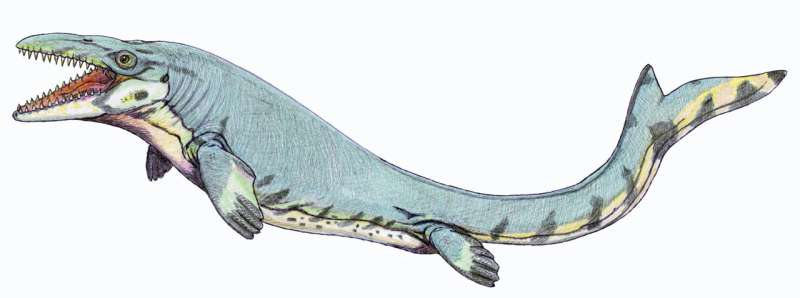
Fossils of 30-foot prehistoric marine lizard unearthed in Texas
https://phys.org/news/2022-08-fossils-f ... izard.html
by Adithi Ramakrishnan
https://phys.org/news/2022-08-fossils-f ... izard.html
by Adithi Ramakrishnan
One sweltering afternoon this spring, Stephen Kruse trekked along a dry creek bed with a backpack full of fossils.
An amateur enthusiast, Kruse has been interested in dinosaurs and prehistoric creatures since he hunted for rocks with his brother as a kid. That afternoon, he was hiking by himself near the North Sulphur River, about 80 miles northeast of Dallas. It's an area he'd combed several times.
He was getting tired. As the day got longer, Kruse searched for a way back to his white Chevy Suburban. He decided to look for a shortcut a quarter mile farther out. "Best decision I ever made," he said.
Just 100 yards down the rocky stream bed, he saw it: a 5- to 6-inch black vertebra, a piece of a prehistoric creature's spine.
Re: Natural History (13.8 billion years BC – 3.3 million BC)
Continents on Ancient Earth Were Created by Giant Meteorite Impacts, Scientists Find
by Michele Starr
August 10, 2022
Introduction:
My new vocabulary word for the day:
by Michele Starr
August 10, 2022
Introduction:
Read more here: https://www.sciencealert.com/the-conti ... e-impacts(Science Alert) To date, Earth is the only planet we know of that has continents.
Exactly how they formed and evolved is unclear, but we do know – because the edges of continents thousands of miles apart match up – that, at one time long ago, Earth's landmass was concentrated in one big supercontinent.
Since that's not what the planet looks like today, something must have triggered that supercontinent to break apart. Now, we have new evidence to suggest that giant meteorite impacts played a significant role.
The smoking gun consists of crystals of the mineral zircon, excavated from a craton in Western Australia, a piece of Earth's crust that has remained stable for over a billion years.
Known as the Pilbara Craton, it is the best-preserved chunk of crust on the planet… and the zircon crystals within it contain evidence of ancient meteorite impacts before the continents broke apart.
My new vocabulary word for the day:
cra·ton
/ˈkrātän/
noun
GEOLOGY
1. a large stable block of the earth's crust forming the nucleus of a continent.
"Although continents were small, they consisted of stable cratons."
Don't mourn, organize.
-Joe Hill
-Joe Hill
Re: Natural History (13.8 billion years BC – 3.3 million BC)
Scientists discover a 5-mile wide undersea crater created as the dinosaurs disappeared
Updated 0248 GMT (1048 HKT) August 18, 2022
An asteroid from space slammed into the Earth's surface 66 million years ago, leaving a massive crater underneath the sea and wreaking havoc with the planet.
No, it's not that asteroid, the one that doomed the dinosaurs to extinction, but a previously unknown crater 248 miles off the coast of West Africa that was created right around the same time. Further study of the Nadir crater, as it's called, could shake up what we know about that cataclysmic moment in natural history.
Uisdean Nicholson, an assistant professor at Heriot-Watt University in Edinburgh, happened on the crater by accident -- he was reviewing seismic survey data for another project on the tectonic split between South America and Africa and found evidence of the crater beneath 400 meters of seabed sediment.
"While interpreting the data, I (came) across this very unusual crater-like feature, unlike anything I had ever seen before," he said.
https://edition.cnn.com/2022/08/17/afri ... index.html

Updated 0248 GMT (1048 HKT) August 18, 2022
An asteroid from space slammed into the Earth's surface 66 million years ago, leaving a massive crater underneath the sea and wreaking havoc with the planet.
No, it's not that asteroid, the one that doomed the dinosaurs to extinction, but a previously unknown crater 248 miles off the coast of West Africa that was created right around the same time. Further study of the Nadir crater, as it's called, could shake up what we know about that cataclysmic moment in natural history.
Uisdean Nicholson, an assistant professor at Heriot-Watt University in Edinburgh, happened on the crater by accident -- he was reviewing seismic survey data for another project on the tectonic split between South America and Africa and found evidence of the crater beneath 400 meters of seabed sediment.
"While interpreting the data, I (came) across this very unusual crater-like feature, unlike anything I had ever seen before," he said.
https://edition.cnn.com/2022/08/17/afri ... index.html
Re: Natural History (13.8 billion years BC – 3.3 million BC)
Global Warming Spawned the Age of Reptiles
August 19, 2022
Introduction:
For the lengthier and more technical Science Advances article: https://www.science.org/doi/10.1126/sciadv.abq1898
August 19, 2022
Introduction:
Read more of the EurekAlert article here: https://www.eurekalert.org/news-releases/961704(EurekAlert) Studying climate change-induced mass extinctions in the deep geological past allows researchers to explore the impact of environmental crises on organismal evolution. One principal example is the Permian-Triassic climatic crises, a series of climatic shifts driven by global warming that occurred between the Middle Permian (265 million years ago) and Middle Triassic (230 million years ago). These climatic shifts caused two of the largest mass extinctions in the history of life at the end of the Permian, the first at 261myo and the other at 252myo, the latter eliminating 86% of all animal species worldwide.
The end-Permian extinctions are important not only because of their magnitude, but also because they mark the onset of a new era in the history of the planet when reptiles became the dominant group of vertebrate animals living on land. During the Permian, vertebrate faunas on land were dominated by synapsids, the ancestors of mammals. After the Permian extinctions, in the Triassic Period (252-200 million years ago), reptiles evolved at rapid rates, creating an explosion of reptile diversity. This expansion was key to the construction of modern ecosystems and many extinct ecosystems. These rapid rates of evolution and diversification were believed by most paleontologists to be due to the extinction of competitors allowing reptiles to take over new habitats and food resources that several synapsid groups had dominated before their extinction.
However, in a new study in Science Advances researchers in the Department of Organismic and Evolutionary Biology and the Museum of Comparative Zoology at Harvard University and collaborators reveal the rapid evolution and radiation of reptiles began much earlier, before the end of the Permian, in connection to the steadily increasing global temperatures through a long series of climatic changes that spanned almost 60 million years in the geological record.
For the lengthier and more technical Science Advances article: https://www.science.org/doi/10.1126/sciadv.abq1898
Don't mourn, organize.
-Joe Hill
-Joe Hill
-
weatheriscool
- Posts: 26094
- Joined: Sun May 16, 2021 6:16 pm
- Contact:
Re: Natural History (13.8 billion years BC – 3.3 million BC)
Scientists discover a 5-mile wide undersea crater created as the dinosaurs disappeared
Source: CNN
Updated 8:30 AM ET, Thu August 18, 2022
Source: CNN
Updated 8:30 AM ET, Thu August 18, 2022
Read more: https://www.cnn.com/2022/08/17/africa/a ... index.html
(CNN) An asteroid from space slammed into the Earth's surface 66 million years ago, leaving a massive crater underneath the sea and wreaking havoc with the planet. No, it's not that asteroid, the one that doomed the dinosaurs to extinction, but a previously unknown crater 248 miles off the coast of West Africa that was created right around the same time. Further study of the Nadir crater, as it's called, could shake up what we know about that cataclysmic moment in natural history.
Uisdean Nicholson, an assistant professor at Heriot-Watt University in Edinburgh, happened on the crater by accident -- he was reviewing seismic survey data for another project on the tectonic split between South America and Africa and found evidence of the crater beneath 400 meters of seabed sediment. "While interpreting the data, I (came) across this very unusual crater-like feature, unlike anything I had ever seen before," he said. "It had all the characteristics of an impact crater."
To be absolutely certain the crater was caused by an asteroid strike, he said that it would be necessary to drill into the the crater and test minerals from the crater floor. But it has all the hallmarks scientists would expect: the right ratio of crater width to depth, the height of the rims, and the height of the central uplift -- a mound in the center created by rock and sediment forced up by the shock pressure. The journal [link:http://www.science.org/doi/10.1126/scia ... 096Science Advances published the study] on Thursday.
"The discovery of a terrestrial impact crater is always significant, because they are very rare in the geologic record. There are fewer than 200 confirmed impact structures on Earth and quite a few likely candidates that haven't yet been unequivocally confirmed," said Mark Boslough, a research professor in Earth and Planetary Sciences at the University of New Mexico. He was not involved in this research but agreed that it was probably caused by an asteroid.
-
Time_Traveller

- Posts: 3025
- Joined: Sun May 16, 2021 4:49 pm
- Location: New York City, USA, November 5th 2032 C.E.
Re: Natural History (13.8 billion years BC – 3.3 million BC)
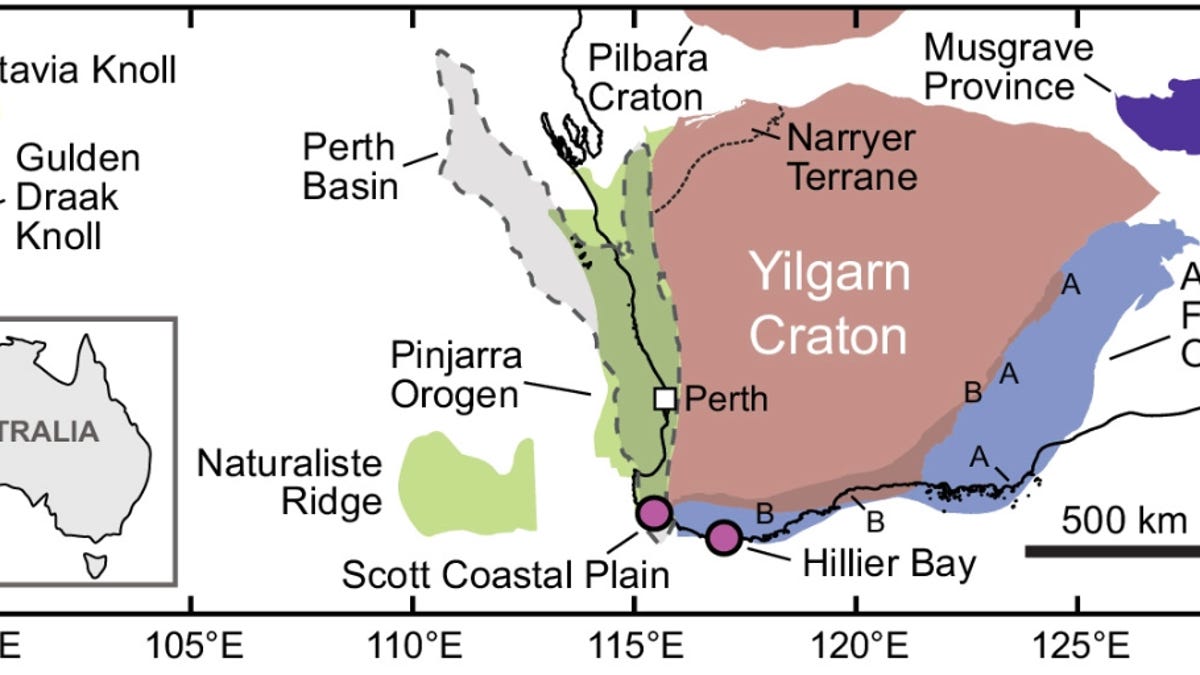
4 Billion-Year-Old Piece of Earth's Crust Found Under Australia
https://www.cnet.com/science/4-billion- ... australia/Aug. 22, 2022 4:13 p.m. PT
Researchers at Australia's Curtin University have discovered a piece of the Earth's crust that dates back 4 billion years.
The chunk, found underneath the South-West of Western Australia and about the size of Ireland, was discovered by researchers using "lasers smaller than a human hair."
The lasers targeted grains of a mineral extracted from beach sand, Curtin University said in a press release Monday. The announcement details a study published in June in Terra Nova. The lasers showed where the grains were originally eroded and their geological history.
“In the quantum multiverse, every choice, every decision you've ever and never made exists in an unimaginably vast ensemble of parallel universes.”
Re: Natural History (13.8 billion years BC – 3.3 million BC)
Plants that Pull Nitrogen from Thin Air Thrive in Arid Environments
August 22, 2022
Introduction:
August 22, 2022
Introduction:
Conclusion:(EurekAlert) After a comprehensive study of plants across the United States, researchers have arrived at the unexpected conclusion that plants able to fix atmospheric nitrogen are most diverse in arid regions of the country. This finding runs counter to the prevailing assumption that nitrogen-fixers should be comparatively most diverse in environments where nitrogen in the soil is in limited supply.
The results were particularly surprising given that nitrogen-fixers lack the traits often associated with dry soils, such as the thick water-storing stems of cacti. “At first glance, nitrogen-fixers don’t necessarily appear to be adapted for arid ecosystems,” said lead author Joshua Doby, a doctoral student in the department of biology at the University of Florida.
The reason for this unexpected pattern wasn’t immediately clear, but Doby suspects it’s related to the way nitrogen-fixers and non-fixers use the element.
Read more here: https://www.eurekalert.org/news-releases/962599Most nitrogen-fixing plant lineages got their start in the Cretaceous, when dinosaurs were still around and temperatures were higher than they are today. Over the last 50 million years, Earth’s climate has gradually cooled and dried, sparking the formation of sprawling grasslands and vast deserts. Plants that couldn’t cut it in these new environments were gradually weeded out, Doby explains, while many nitrogen-fixers that were well-suited to this new world diversified in the vacated landscapes.
“This study gives us a really good idea of why plant communities are the way they are today,” Doby said, adding that he worries conditions that support diverse floras in arid regions may not last much longer. “As things become wetter and warmer due to climate change, the traits that made these plants well-adapted and diverse aren’t going to be very beneficial anymore. Many of the unique plant communities we have around today are going to be at risk in the long term.”
Don't mourn, organize.
-Joe Hill
-Joe Hill
Re: Natural History (13.8 billion years BC – 3.3 million BC)
Study Finds that Ocean Cooling Over Millennia Led to Larger Fish
August 22, 2022
Introduction:
August 22, 2022
Introduction:
Read more here: https://www.eurekalert.org/news-releases/962597(EurekAlert) Earth’s geological history is characterized by many dynamic climate shifts that are often associated with large changes in temperature. These environmental shifts can lead to trait changes, such as body size, that can be directly observed using the fossil record.
To investigate whether temperature shifts that occurred before direct measurements were recorded, called paleoclimatology, are correlated with body size changes, several members of the University of Oklahoma’s Fish Evolution Lab decided to test their hypothesis using tetraodontiform fishes as a model group. Tetradontiform fishes are primarily tropical marine fishes, and include pufferfish, boxfishes and filefish, among others.
The study was led by Dahiana Arcila, assistant professor of biology and assistant curator at the Sam Noble Museum of Natural History, with Ricardo Betancur, assistant professor of biology, along with biology graduate student Emily Troyer, and involved collaborators from the Smithsonian Institution, University of Chicago, and George Washington University in the United States, as well as University of Turin in Italy, University of Lyon in France, and CSIRO Australia.
The researchers discovered that the body sizes of these fishes have grown larger over the past hundred million years in conjunction with the gradual cooling of ocean temperatures.
Their finding adheres to two well-known rules of evolutionary trends, Cope’s rule which states that organismal body sizes tend to increase over evolutionary time, and Bergmann’s rule which states that species reach larger sizes in cooler environments and smaller sizes in warmer environments. What was less understood, however, was how these rules relate to ectotherms, organisms that can’t regulate their internal body temperatures and are dependent on their external or environmental climates.
Don't mourn, organize.
-Joe Hill
-Joe Hill
Re: Natural History (13.8 billion years BC – 3.3 million BC)
Dinosaur tracks from 113 million years ago uncovered due to severe drought conditions at Dinosaur Valley State Park
Updated 0242 GMT (1042 HKT) August 24, 2022
Dinosaur tracks from around 113 million years ago have been revealed at Dinosaur Valley State Park in Texas due to severe drought conditions that dried up a river, the park said Monday in a statement.
"Most tracks that have recently been uncovered and discovered at different parts of the river in the park belong to Acrocanthosaurus. This was a dinosaur that would stand, as an adult, about 15 feet tall and (weigh) close to seven tons," park spokesperson Stephanie Salinas Garcia told CNN in an email.
The other species that left tracks behind at the park in Glen Rose, Texas, was Sauroposeidon, which would be about 60 feet tall and weigh about 44 tons as an adult, Garcia added.
This summer's excessive drought has caused a river in the park to dry out completely in most spots, revealing the tracks -- the latest long-hidden secret recently exposed as bodies of water have dried up due to drought conditions across the globe.
https://edition.cnn.com/2022/08/23/us/d ... index.html

Updated 0242 GMT (1042 HKT) August 24, 2022
Dinosaur tracks from around 113 million years ago have been revealed at Dinosaur Valley State Park in Texas due to severe drought conditions that dried up a river, the park said Monday in a statement.
"Most tracks that have recently been uncovered and discovered at different parts of the river in the park belong to Acrocanthosaurus. This was a dinosaur that would stand, as an adult, about 15 feet tall and (weigh) close to seven tons," park spokesperson Stephanie Salinas Garcia told CNN in an email.
The other species that left tracks behind at the park in Glen Rose, Texas, was Sauroposeidon, which would be about 60 feet tall and weigh about 44 tons as an adult, Garcia added.
This summer's excessive drought has caused a river in the park to dry out completely in most spots, revealing the tracks -- the latest long-hidden secret recently exposed as bodies of water have dried up due to drought conditions across the globe.
https://edition.cnn.com/2022/08/23/us/d ... index.html