
China launches second module for its space station Heavenly Palace
China has launched the second of three modules for its space station.
It sent the first in April 2021 and hopeS the station will be operational by the end of this year.
Tiangong or "Heavenly Palace" will have its own power, propulsion, life support systems and living quarters.
https://www.bbc.co.uk/news/av/world-asia-china-62282862
Space News and Discussions
-
weatheriscool
- Posts: 25824
- Joined: Sun May 16, 2021 6:16 pm
- Contact:
Re: Space News and Discussions
Russia to opt out of International Space Station after 2024
Source: AP
Source: AP
Read more: https://apnews.com/article/russia-ukrai ... 9acbdbc140MOSCOW (AP) — Russia will opt out of the International Space Station after 2024 and focus on building its own orbiting outpost, the country’s newly appointed space chief said Tuesday.
Yuri Borisov, who was appointed earlier this month to lead the state-controlled space corporation Roscosmos, said during a meeting with Russian President Vladimir Putin that Russia will fulfill its obligations to other partners at the International Space Station before it leaves the project.
“The decision to leave the station after 2024 has been made,” Borisov said.Borisov’s statement reaffirmed previous declarations by Russian space officials about Moscow’s intention to leave the space outpost after 2024.It comes amid soaring tensions between Russia and the West over the Kremlin’s military action in Ukraine.
Despite the rift, NASA and Roscosmos made a deal earlier this month for astronauts to continue riding Russian rockets and for Russian cosmonauts to catch lifts to the International Space Station with SpaceX beginning this fall.
-
weatheriscool
- Posts: 25824
- Joined: Sun May 16, 2021 6:16 pm
- Contact:
Re: Space News and Discussions
Chinese booster rocket makes uncontrolled return to Earth
https://phys.org/news/2022-07-chinese-b ... earth.html
The launch of the second module for China's Tiangong space station on July 24.
https://phys.org/news/2022-07-chinese-b ... earth.html
The launch of the second module for China's Tiangong space station on July 24.
A Chinese booster rocket made an uncontrolled return to Earth on Saturday, leading US officials to chide Beijing for not sharing information about the potentially hazardous object's descent.
US Space Command "can confirm the People's Republic of China (PRC) Long March 5B (CZ-5B) re-entered over the Indian Ocean at approx 10:45 am MDT on 7/30," the US military unit said on Twitter.
"We refer you to the #PRC for further details on the reentry's technical aspects such as potential debris dispersal+ impact location," it said.
In a statement posted to its official WeChat profile, the China Manned Space Agency later gave coordinates for an impact area in the Sulu Sea, about 35 miles (57 kilometers) off the east coast of the Philippines' Palawan Island.
"Most of its devices were ablated and destroyed during re-entry," the agency said of the booster rocket, which was used last Sunday to launch the second of three modules China needed to complete its new Tiangong space station.
Malaysia's space agency said it detected rocket debris burning up on re-entry before falling in the Sulu Sea northeast of the island of Borneo.
"The debris of the rocket caught fire while entering the Earth's airspace and the movement of the burning debris also crossed Malaysian airspace and could be detected in several areas including crossing the airspace around the state of Sarawak," it said.
-
weatheriscool
- Posts: 25824
- Joined: Sun May 16, 2021 6:16 pm
- Contact:
Re: Space News and Discussions
Formation of dwarf galaxy observed using India's AstroSat
https://phys.org/news/2022-08-formation ... rosat.html
by Bob Yirka , Phys.org
https://phys.org/news/2022-08-formation ... rosat.html
by Bob Yirka , Phys.org
An international team of researchers has observed part of the formation of a dwarf galaxy, helping to explain how they evolve from a dwarf state to maturity. In their paper published in the journal Nature, the group describes finding evidence of maturation in such galaxies.
Prior research has shown that there are dwarf galaxies in the universe. Such galaxies are typically made up of just a few billion stars, as compared to mature galaxies such as the Milky Way, which have 200 to 400 billion stars. Prior research has also suggested that some dwarf galaxies might evolve to become more mature galaxies, but how that might happen has not been clear. In this new effort, the researchers focused the AstroSat space-based telescope on several blue compact dwarf galaxies, which are calculated to be approximately 1.5 to 3.9 billion light-years from Earth. The team then used the ultraviolet imaging telescope aboard AstroSat, which is India's first multi-wavelength space telescope, to look for evidence of star formation activity.

Re: Space News and Discussions
Unexpected Solar Wind Stream Hits Earth at 372 Miles Per Second
by Fiona MacDonald
August 9, 2022
Introduction:
by Fiona MacDonald
August 9, 2022
Introduction:
Read more here: https://www.sciencealert.com/an-unfore ... er-second(Science Alert) On Sunday, Earth's magnetic field was pelted by a solar wind stream reaching velocities of more than 600 kilometers (372 miles) per second.
While that's nothing too alarming – solar storms often pummel our planet triggering spectacular auroras – what is weird is that this storm was totally unexpected.
"This event was not in the forecast, so the resulting auroras came as a surprise," SpaceWeather reported.
Solar wind occurs when a stream of highly energized particles and plasma can no longer be held back by the Sun's gravity and burst out towards Earth.
Don't mourn, organize.
-Joe Hill
-Joe Hill
-
weatheriscool
- Posts: 25824
- Joined: Sun May 16, 2021 6:16 pm
- Contact:
Re: Space News and Discussions
Making oxygen with magnets could help astronauts breathe easy
https://phys.org/news/2022-08-oxygen-ma ... -easy.html
by University of Warwick
https://phys.org/news/2022-08-oxygen-ma ... -easy.html
by University of Warwick
A potentially better way to make oxygen for astronauts in space using magnetism has been proposed by an international team of scientists, including a University of Warwick chemist.
The conclusion is from new research on magnetic phase separation in microgravity published in npj Microgravity by researchers from the University of Warwick in the United Kingdom, University of Colorado Boulder and Freie Universität Berlin in Germany.
Keeping astronauts breathing aboard the International Space Station and other space vehicles is a complicated and costly process. As humans plan future missions to the Moon or Mars better technology will be needed.
-
weatheriscool
- Posts: 25824
- Joined: Sun May 16, 2021 6:16 pm
- Contact:
Re: Space News and Discussions
Underwater snow gives clues about Europa's icy shell
https://phys.org/news/2022-08-underwate ... shell.html
by University of Texas at Austin
https://phys.org/news/2022-08-underwate ... shell.html
by University of Texas at Austin
Below Europa's thick icy crust is a massive, global ocean where the snow floats upwards onto inverted ice peaks and submerged ravines. The bizarre underwater snow is known to occur below ice shelves on Earth, but a new study shows that the same is likely true for Jupiter's moon, where it may play a role in building its ice shell.
The underwater snow is much purer than other kinds of ice, which means Europa's ice shell could be much less salty than previously thought. That's important for mission scientists preparing NASA's Europa Clipper spacecraft, which will use radar to peek beneath the ice shell to see if Europa's ocean could be hospitable to life. The new information will be critical because salt trapped in the ice can affect what and how deep the radar will see into the ice shell, so being able to predict what the ice is made of will help scientists make sense of the data.
The study, published in the August edition of the journal Astrobiology, was led by The University of Texas at Austin, which is also leading the development of Europa Clipper's ice penetrating radar instrument. Knowing what kind of ice Europa's shell is made of will also help decipher the salinity and habitability of its ocean.
Re: Space News and Discussions
Interesting how the Moon rates its own thread in this forum, while the sun enjoys no such honor. At any rate:
Astrophotographer Captures a Glimpse of the International Space Station Crossing the Sun from His Backyard
by Jessica Stewart
August 21, 2022
Introduction:
Astrophotographer Captures a Glimpse of the International Space Station Crossing the Sun from His Backyard
by Jessica Stewart
August 21, 2022
Introduction:
View photos here: https://mymodernmet.com/jamie-cooper-iss-transit/(My Modern Met) Astrophotographer Jamie Cooper has traveled the world looking for exceptional views of the stars. But he didn't have to travel far to capture something rare. From his backyard in Northamptonshire, England, he was able to photograph the International Space Station (ISS) transiting the Sun. Considering that the event lasted for less than a second, the image he produced is incredible.
The ISS moves at a speed of five miles per second, which means that it circles Earth every 90 minutes. In fact, it passes in front of the Sun 16 times during a 24-hour period. Though it's a frequent occurrence, actually seeing it is another matter. Cooper just happened to be in the right place at the right time to capture multiple frames that he composited into one image.
“There's a very narrow band where you, the space station and Sun are all in a straight line and it's about three miles wide,” shared Cooper. “I'd checked the data three days before and it was going to miss my house, I checked the day before and it was going to be over my house, so I was lucky.”
To capture the event, Cooper used a high-speed camera that shoots at 80 frames per second. He also used a special telescope with a filter that allowed him to photograph the event safely.
If you are interested in seeing when a transit might happen in your area, NASA has a helpful website that provides detailed information. But, it's important to note that just because a transit may occur, there's no guarantee that it will be visible. Weather is a critical factor in whether or not one can view this blink-and miss it event. And, if you do attempt to view an ISS transit, it's vital to take a cue from Cooper and use proper safety equipment to avoid damaging your eyes.
Don't mourn, organize.
-Joe Hill
-Joe Hill
Re: Space News and Discussions
Speaking of the sun..
China is Building a Huge Ring of Telescopes to Study Eruptions on the Sun
by Andrew Jones
August 22, 2022
Introduction:
China is Building a Huge Ring of Telescopes to Study Eruptions on the Sun
by Andrew Jones
August 22, 2022
Introduction:
Read more here: https://www.space.com/china-world-larg ... rch-array(Space.com) China is building the world's largest array of telescopes dedicated to studying the sun with the aim to improve the understanding of coronal mass ejections which can cause chaos on and above Earth.
The Daocheng Solar Radio Telescope (DSRT) is under construction on a plateau in Sichuan province, southwest China. When completed, it will consist of 313 dishes, each with a diameter of 19.7 feet (6 meters), forming a circle with a circumference of 1.95 miles (3.14 kilometers).
The telescope array will image the sun in radio waves to study coronal mass ejections (CMEs), large eruptions of charged particles from the sun's upper atmosphere, the corona.
CMEs are triggered by realignments in the star's magnetic field that occur in sunspots. When directed at Earth, these eruptions can wreak havoc on power grids, telecommunications, orbiting satellites and even put the safety of astronauts at risk. On the other hand, CMEs are also responsible for the colorful aurora displays that can be observed in the night sky in polar regions.
Don't mourn, organize.
-Joe Hill
-Joe Hill
-
weatheriscool
- Posts: 25824
- Joined: Sun May 16, 2021 6:16 pm
- Contact:
Re: Space News and Discussions
Surprising details leap out in sharp new James Webb Space Telescope images of Jupiter
https://phys.org/news/2022-08-sharp-jam ... scope.html
by Robert Sanders, University of California - Berkeley
https://phys.org/news/2022-08-sharp-jam ... scope.html
by Robert Sanders, University of California - Berkeley
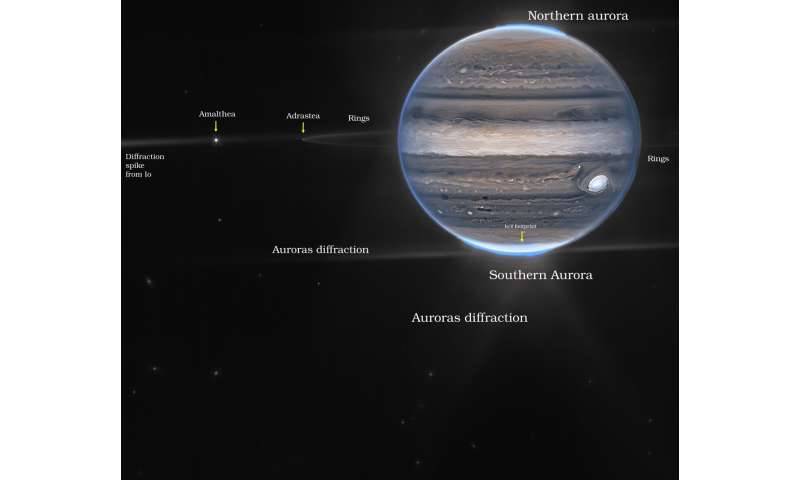
The latest images of Jupiter from the James Webb Space Telescope (JWST) are stunners.
Captured on July 27, the infrared images—artificially colored to make specific features stand out—show fine filigree along the edges of the colored bands and around the Great Red Spot and also provide an unprecedented view of the auroras over the north and south poles.
One wide-field image presents a unique lineup of the planet, its faint rings and two of Jupiter's smaller satellites—Amalthea and Adrastea—against a background of galaxies.
"We've never seen Jupiter like this. It's all quite incredible," said planetary astronomer Imke de Pater, professor emerita of the University of California, Berkeley, who led the scientific observations of the planet with Thierry Fouchet, a professor at the Paris Observatory. "We hadn't really expected it to be this good, to be honest. It's really remarkable that we can see details on Jupiter together with its rings, tiny satellites and even galaxies in one image."
De Pater, Fouchet and their team released the images today (Aug. 22) as part of the telescope's Early Release Science program.
-
weatheriscool
- Posts: 25824
- Joined: Sun May 16, 2021 6:16 pm
- Contact:
Re: Space News and Discussions
Scientists have traced Earth's path through the galaxy via tiny crystals found in its crust
by Chris Kirkland and Phil Sutton, The Conversation
https://phys.org/news/2022-08-scientist ... -tiny.html
by Chris Kirkland and Phil Sutton, The Conversation
https://phys.org/news/2022-08-scientist ... -tiny.html
"To see a world in a grain of sand," the opening sentence of the poem by William Blake, is an oft-used phrase that also captures some of what geologists do.
We observe the composition of mineral grains, smaller than the width of a human hair. Then, we extrapolate the chemical processes they suggest to ponder the construction of our planet itself.
Now, we've taken that minute attention to new heights, connecting tiny grains to Earth's place in the galactic environment.
Looking out to the universe
At an even larger scale, astrophysicists seek to understand the universe and our place in it. They use laws of physics to develop models that describe the orbits of astronomical objects.
Although we may think of the planet's surface as something shaped by processes entirely within Earth itself, our planet has undoubtedly felt the effects of its cosmic environment. This includes periodic changes in Earth's orbit, variations in the sun's output, gamma ray bursts, and of course meteorite impacts.
-
weatheriscool
- Posts: 25824
- Joined: Sun May 16, 2021 6:16 pm
- Contact:
Re: Space News and Discussions
DART sets sights on asteroid target
https://phys.org/news/2022-09-dart-sights-asteroid.html
by NASA
https://phys.org/news/2022-09-dart-sights-asteroid.html
by NASA
NASA's Double Asteroid Redirection Test (DART) spacecraft recently got its first look at Didymos, the double-asteroid system that includes its target, Dimorphos. On Sept. 26, DART will intentionally crash into Dimorphos, the asteroid moonlet of Didymos. While the asteroid poses no threat to Earth, this is the world's first test of the kinetic impact technique, using a spacecraft to deflect an asteroid for planetary defense.
This image of the light from asteroid Didymos and its orbiting moonlet Dimorphos is a composite of 243 images taken by the Didymos Reconnaissance and Asteroid Camera for Optical navigation (DRACO) on July 27, 2022.
From this distance—about 20 million miles away from DART—the Didymos system is still very faint, and navigation camera experts were uncertain whether DRACO would be able to spot the asteroid yet. But once the 243 images DRACO took during this observation sequence were combined, the team was able to enhance it to reveal Didymos and pinpoint its location.
"This first set of images is being used as a test to prove our imaging techniques," said Elena Adams, the DART mission systems engineer at the Johns Hopkins Applied Physics Laboratory (APL) in Laurel, Maryland. "The quality of the image is similar to what we could obtain from ground-based telescopes, but it is important to show that DRACO is working properly and can see its target to make any adjustments needed before we begin using the images to guide the spacecraft into the asteroid autonomously."
Although the team has already conducted a number of navigation simulations using non-DRACO images of Didymos, DART will ultimately depend on its ability to see and process images of Didymos and Dimorphos, once it too can be seen, to guide the spacecraft toward the asteroid, especially in the final four hours before impact. At that point, DART will need to self-navigate to impact successfully with Dimorphos without any human intervention.

Re: Space News and Discussions
And remember my friend, future events such as these will affect you in the future
Re: Space News and Discussions
And remember my friend, future events such as these will affect you in the future
Re: Space News and Discussions
Where Do High-energy Particles that Endanger Satellites, Astronauts and Airplanes Come From?
September 13, 2022
Introduction:
September 13, 2022
Introduction:
Read more here: https://www.eurekalert.org/news-releases/964273(EurekAlert) For decades, scientists have been trying to solve a vexing problem about the weather in outer space: At unpredictable times, high-energy particles bombard the earth and objects outside the earth’s atmosphere with radiation that can endanger the lives of astronauts and destroy satellites’ electronic equipment. These flare-ups can even trigger showers of radiation strong enough to reach passengers in airplanes flying over the North Pole. Despite scientists’ best efforts, a clear pattern of how and when flare-ups will occur has remained enduringly difficult to identify.
This week, in a paper in The Astrophysical Journal Letters, authors Luca Comisso and Lorenzo Sironi of Columbia’s Department of Astronomy and the Astrophysics Laboratory, have for the first time used supercomputers to simulate when and how high-energy particles are born in turbulent environments like that on the atmosphere of the sun. This new research paves the way for more accurate predictions of when dangerous bursts of these particles will occur.
“This exciting new research will allow us to better predict the origin of solar energetic particles and improve forecasting models of space weather events, a key goal of NASA and other space agencies and governments around the globe,” Comisso said. Within the next couple of years, he added, NASA's Parker Solar Probe, the closest spacecraft to the sun, may be able to validate the paper’s findings by directly observing the predicted distribution of high-energy particles that are generated in the sun's outer atmosphere.
In their paper, “Ion and Electron Acceleration in Fully Kinetic Plasma Turbulence,” Comisso and Sironi demonstrate that magnetic fields in the outer atmosphere of the sun can accelerate ions and electrons up to velocities close to the speed of light. The sun and other stars’ outer atmosphere consist of particles in a plasma state, a highly turbulent state distinct from liquid, gas, and solid states. Scientists have long believed that the sun’s plasma generates high-energy particles. But particles in plasma move so erratically and unpredictably that they have until now not been able to fully demonstrate how and when this occurs.
Using supercomputers at Columbia, NASA, and the National Energy Research Scientific Computing Center, Comisso and Sironi created computer simulations that show the exact movements of electrons and ions in the sun’s plasma. These simulations mimic the atmospheric conditions on the sun, and provide the most extensive data gathered to-date on how and when high-energy particles will form.
Don't mourn, organize.
-Joe Hill
-Joe Hill
Re: Space News and Discussions
A Core Principle of General Relativity Just Passed Its Strictest Test Yet
by Michele Starr
September 15, 2022
Introduction:
by Michele Starr
September 15, 2022
Introduction:
Read more here: https://www.sciencealert.com/a-core-pr ... -test-yet(Science Alert) A core principle of Einstein's general theory of relativity has just passed its most stringent test yet.
Using a specially designed satellite, an international team of scientists measured the accelerations of pairs of free-falling objects in Earth's orbit. Results based on five months' worth of data indicated the accelerations didn't differ by more than one part in 1015, ruling out any violations to the weak equivalence principle down to that scale.
The weak equivalence principle is relatively simple to observe, stating all objects accelerate identically in the same gravitational field when no other influences act upon them, regardless of their mass or composition.
It was perhaps most famously demonstrated to dramatic effect in 1971 when astronaut Dave Scott dropped a hammer and a feather simultaneously from the same height while standing on the Moon. Without air resistance to slow the feather, the two objects dropped to the Moon's surface at the same speed.
The new experiment, called MICROSCOPE and headed by the late physicist Pierre Touboul, was somewhat more rigorous than Scott's demonstration. It involved a satellite circling over Earth in orbit from April 25, 2016 until deactivation on October 18, 2018.
Don't mourn, organize.
-Joe Hill
-Joe Hill
-
weatheriscool
- Posts: 25824
- Joined: Sun May 16, 2021 6:16 pm
- Contact:
Re: Space News and Discussions
United Arab Emirates to launch first lunar rover in November
https://phys.org/news/2022-09-arab-emir ... ember.html
https://phys.org/news/2022-09-arab-emir ... ember.html
The United Arab Emirates will launch its first lunar rover in November, the mission manager said Monday.
Hamad Al Marzooqi told The National, a state-linked newspaper, that the "Rashid" rover, named for Dubai's ruling family, would be launched from the Kennedy Space Center in Florida sometime between Nov. 9 and Nov. 15. The exact date will be announced next month, he said.
The rover is to be launched aboard a Falcon 9 SpaceX rocket and deposited on the moon by a Japanese ispace lander sometime in March.
"We've finished with the testing of the rover and we are happy with the results," Al Marzooqi was quoted as saying. "The rover has been integrated with the lander and it is ready for launch."
The lunar mission is part of the UAE's broader strategy to become a major player in the field of space exploration. If the moon mission succeeds, the UAE and Japan would join the ranks of only the U.S., Russia and China as nations that have put a spacecraft on the lunar surface.
Re: Space News and Discussions
Undergrad Publishes Theory on Immune Dysfunction in Space
September 19, 2022
Introduction:
September 19, 2022
Introduction:
Read more here: https://www.eurekalert.org/news-releases/965152(EurekAlert) ITHACA, N.Y. -- It’s been known for decades that astronauts’ immune systems become suppressed in space, leaving them vulnerable to disease, but the exact mechanisms of immune dysfunction have remained a mystery – now a Cornell undergraduate has found a potential solution.
A biological and mechanical engineering double major in the College of Engineering, Rocky An ’23 published his theory, “MRTF May be the Missing Link in a Multiscale Mechanobiology Approach toward Macrophage Dysfunction in Space,” Sept. 12 in Frontiers in Cell and Developmental Biology.
An reviewed the last 20 years of literature on the behavior of macrophages – key cells in the body’s immune response – in space and recent research about how macrophages respond to forces in normal gravity, identifying a transcription factor that could prove to be the missing piece of the puzzle.
“I just kept asking questions about how the data is presented,” An said. “There are these two really important papers, in particular, one a review of how macrophages are suppressed in microgravity, and another about the mechanobiology of macrophages. I was able to connect these two papers, and that's when the idea came to me. I was really excited, as it was kind of a eureka moment for me.”
In space, the lack of gravity changes the shape of the immune cell, and scientists have suspected that changes to the cytoskeleton, the filamented infrastructure of the cell, were involved in immune dysfunction. Recent studies in normal gravity have shown that disturbing the cytoskeleton of macrophages reduces the transport of a particular protein, a transcription factor important for immune response, to the nucleus.
Don't mourn, organize.
-Joe Hill
-Joe Hill